
Civil Discourse with Joyce Vance
I spent the better part of today reading judges’ opinions so you don’t have to — and tonight’s piece includes the key excerpts so you can see the language for yourself. It’s longer than I’d usually publish on a Sunday evening, but these are the times we live in, and the details matter. What I’m doing here — connecting dots between rulings in different districts and putting them in context — is experience-based analysis you won’t find anywhere else.
If Civil Discourse helps you make sense of this moment, I hope you’ll become a paid subscriber. Be part of a community of people committed to saving democracy — and help to keep this work accessible to readers who otherwise wouldn’t have it.
This week: All the tails, wagging all the dogs, as Trump tries to avoid what is steadily coming for him with the Epstein Files. Yes, he bombed Iran overnight, as we learned Saturday morning. But it’s hard to avoid the lingering feeling that at least in part, it’s all about the missing documentation about complaints he sexually assaulted young girls.
Last Thursday, there was reporting that Republican Senators—Republicans—are pressuring Pam Bondi to release files that DOJ has withheld. “Republicans are on the defensive as Senate Democratic Leader Chuck Schumer (N.Y.) is vowing that Democrats will use every tactic at their disposal to force the release of the missing records.” Louisiana Senator John Kennedy is quoted as saying, “Release the documents. Redact the names of the victims. Don’t release photographs, naked or otherwise, of minors. Release the documents. This is not going to go away until there is full disclosure.” When you’ve lost the good Senator from Louisiana, you’re in trouble if you’re the man in the White House.

So what better than to bomb a deeply hated, and rightly so, cruel regime in the Middle East? All of the distractions that surface this week, and you’d be correct to anticipate weighty and important ones ranging from Iran to Trump’s long-desired takeover of federal elections, and more, should be viewed in this context. What is Donald Trump trying to hide from you?
Now that Hillary and Bill Clinton have testified under oath about Epstein, there is no reason Donald Trump and his third wife, Melania, shouldn’t as well. So while the media headlines Iran around the clock, make sure you tell your elected officials that you expect the Trumps to testify, and that you’ll be waiting with your ballot in hand come November to make sure that they do.
Beyond that, I want to flag a serious development that won’t get the coverage it should this week. Trump may have bombed Iran, but the Federal Judiciary is Declaring War on ICE.
Minnesota
Minnesota is leading the way, because of the occupation of Minneapolis. Chief Judge Patrick Shiltz, who longtime lawyers in that District characterize as extremely smart, and not someone a lawyer should pick a fight with, entered an order in a case called Juan T.R. v. Noem, that concludes with this sentence, “This Court will continue to do whatever is required to protect the rule of law, including, if necessary, the use of criminal contempt. One way or another, ICE will comply with this Court’s orders.” That happened on February 26.
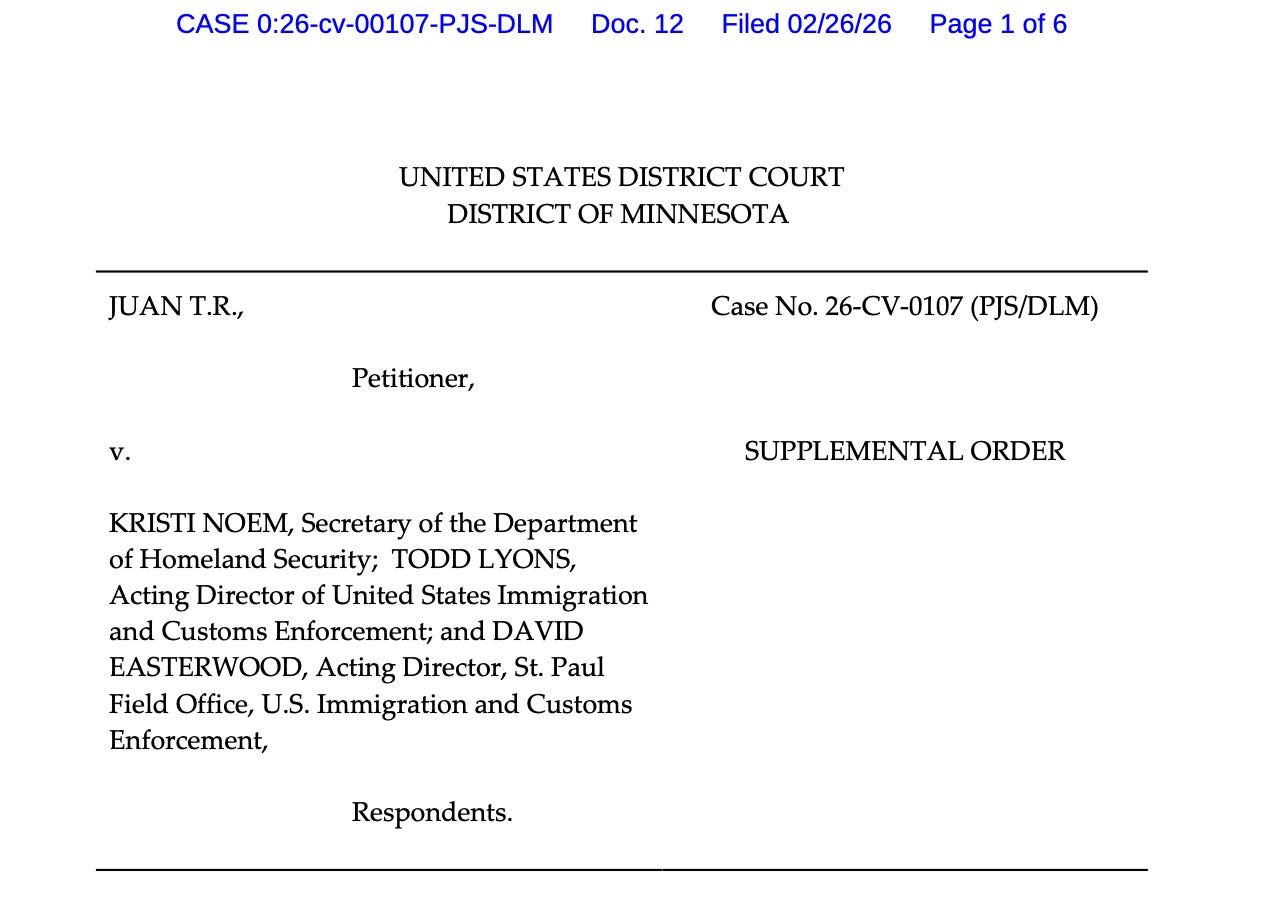
Here is what led to that rather remarkable statement. On January 8, Juan T.R. filed a petition for a writ of habeas corpus. That’s Latin for "you have the body." The writ is frequently used by convicted inmates to challenge their conviction or confinement, and I’ve handled many of them in the course of 25 years at DOJ. The writ ensures that a judge will make a determination about the legality of the petitioner’s detention, providing essential protection from arbitrary or unlawful confinement. People in immigration detention can use the writ too, which is what happened here, and is happening in many cases where people who are wrongfully held in immigration detention have access to a lawyer.
The Court issued an order that required the government to respond by January 12. They didn’t.
That may not seem remarkable, but let me assure you that it is. The government does not miss filing deadlines. You can always ask a judge for an extension if necessary. Failing to file on time? Never acceptable. Any Assistant U.S. Attorney who did this would be facing discipline from their own chain of command, to say nothing of the court.
Because the government failed to respond, Judge Schiltz granted the writ in part and ordered the government to either give Juan a bond hearing within seven days or, if they didn’t, to release him from detention.
It gets worse. The government neither held a bond hearing nor released Juan.
So, the Judge, apparently bending over backwards to be patient, issued what’s called a “show‐cause order” and scheduled a hearing. Not just any hearing. He ordered the personal appearance of Todd Lyons, Acting Director of ICE. Show cause orders require a party—here, that’s Mr. Lyons—to appear and explain (“show cause”) why the court shouldn’t take action it’s contemplating. This type of order can be used to address violations of court orders, in which case the party the judge enters it against has to justify its actions to avoid an adverse decision, or even some form of penalty or sanction.
The Judge advised Lyon that if it advised the court Juan had been released, he would cancel the hearing and Lyons would not have to appear. The government filed a joint stipulation with Juan’s lawyer, advising the court it had met those conditions, and the Judge canceled the hearing. But the Judge expressed what he called “grave concerns about ICE’s noncompliance with court orders.” He identified 96 court orders that ICE had violated in 74 cases and listed them in an appendix, noting that “the list was hurriedly compiled by extraordinarily busy judges” and that, “[u]ndoubtedly, mistakes were made.”
Judge Schiltz explained what happened next in his order. “Unfortunately, the government’s response to the Court’s order was not to do a better job complying with court orders, but instead to attack the Court. In an email to the undersigned dated February 9, 2026, Daniel N. Rosen, the United States Attorney for the District of Minnesota, accused the Court of wildly overstating the extent of ICE’s noncompliance with orders. Specifically, Rosen said that he had asked a lawyer in his office to review ‘a statistically strong sample of the 75 cases’ listed in the appendix to the Court’s January 28 order. That ‘statistically strong sample’ consisted of the first 12 cases on the list.”
The Judge set forth Rosen’s summary of his evaluation: “So as I am seeing it, in eight out of eleven cases [the twelfth case was a duplicate], the Petitioners were released on time. In six of those eight cases, there was no violation at all. In one there was a violation regarding an interim step, but the release was on time. In one, the release was on time, but the status report was filed late. In one, where no specific deadline was set for return and release, the return and release took six days. In two cases, the releases were after the deadline”
Judge Schiltz continued to quote from Rosen’s communication with the court, “Judge, please pardon me for being so direct, but your order of January 28 did not merely contain some errors, as you anticipated it may. Assuming the statistical sample we chose is as representative of the whole as I believe it likely is, the information compiled by others for your order was far beyond the pale of accuracy for an order that would be wielded so publicly and so sharply. The lawyers in my civil division didn’t deserve it.”
Judge Schiltz asked the other judges in his district to review their cases. He had his own law clerks check the accuracy of all of the information. He explained there had been a few errors, “But the bottom line is that ICE violated 97 orders in 66 of the cases referred to in the January 28 order. The January 28 order had identified ‘96 court orders that ICE has violated in 74 cases.’ … Obviously, the January 28 order was not ‘beyond the pale of accuracy,’ as claimed by Rosen.” The Judge also went to bat for AUSAs in the Minneapolis’ office’s Civil Division, noting they had “struggled mightily to ensure that respondents comply with court orders despite the fact that respondents [that would be DOJ and ICE leadership] have failed to provide them with adequate resources.”
Then comes the kicker, “The judges of this District have been extraordinarily patient with the government attorneys, recognizing that they have been put in an impossible position by Rosen and his superiors in the Department of Justice (leading many of those attorneys—including, unfortunately, Ana Voss [who had been the Civil Chief]—to resign). What those attorneys ‘didn’t deserve’ was the Administration sending 3000 ICE agents to Minnesota to detain people without making any provision for handling the hundreds of lawsuits that were sure to follow.”
But Judge Schiltz wasn’t done. He took Rosen to task for claiming “we commit to the court that we will redouble our efforts.” Rosen claimed that “The truth is that efforts we have already been undertaking for weeks have led to considerable improvement—efforts which have apparently gone unrecognized by some on the bench.” Judge Schiltz punched back: “This, too, appears to be untrue. Attached as Appendix B is a list of additional cases in which ICE has violated court orders, most of which violations occurred after entry of the January 28 order. Despite Rosen’s assurance of ‘redouble[d]’ efforts that have ‘led to considerable improvement,’ Appendix B documents 113 additional orders that ICE has violated in 77 additional cases—again, above and beyond the 97 orders that ICE violated in the 66 cases identified in Appendix A.”
There will be more in this case this week. It’s fair to say that this is a Judge with knives out.
There are also a bunch of consolidated habeas cases in Minneapolis, presumably including some of those Judge Schiltz refers to, that are scheduled for a hearing on Tuesday in front of Judge Jeffrey Bryan. Judge Bryan’s order refers to “numerous unlawful violations of court orders,” including alleged failures by federal agents, repeated, to return seized property to illegally detained people upon their release.
This fact situation reminds me of a case I prosecuted many years ago, where officers at a small police department in Northeast Alabama where arresting workers at poultry factories in the area, “unarresting them” in the morning, but keeping their property, including cashed paychecks. We successfully prosecuted them for civil rights violations. I have to question whether this attorney general will insist on similar prosecutions—she absolutely should—if these allegations hold up in court. Federal agents who steal from people should be fired and prosecuted. Full stop.
But this is not a situation where wrongdoing was identified and addressed. Instead, Judge Bryan is holding a combined contempt hearing for the cases, because although he ordered the return of seized property by February 25, that didn’t happen.
“These habeas cases come before the Court for the enforcement of the Court’s prior orders. In each case, the Court ordered the release of Petitioners, all of whom had been unlawfully detained by Respondents. Additionally, in each case, the Court ordered Respondents to return all personal belongings taken from Petitioners during their unlawful detention because Respondents have no lawful claim to such property.
The property at issue includes personal belongings such as cash, cellphones, jewelry, driver’s licenses, work permits, passports, clothing, and other identification and immigration documents.”
The Judge has ordered officials, including Rosen, the U.S. Attorney, and an official from ICE, to appear in court unless they file an explanation of the status of the property belonging to each of the petitioners with the court in advance.
The bench in Minneapolis is not amused. The Trump administration may have eviscerated the career prosecutors in the U.S. Attorney’s Office in Minnesota, but they can’t do the same thing to the court. And the judges seem determined to pursue justice, not the president’s political agenda.
It’s not just Minnesota. In West Virginia, where ICE is conducting “Operation Country Roads,” four judges have made it clear that they intend to impose consequences if state and federal officials (this is a red state, and many of the state and local police agencies are working with ICE to make arrests and detain people) don’t stop illegal, unconstitutional detentions. The operation led to an estimated 650 arrests, and the court has been deluged with lawsuits brought by people seeking their release. Few of them have criminal records and most have longstanding ties to the community. The judges have been ordering ICE to release people it has detained.
Judge Joseph Goodwin, a Clinton appointee whose son served as the Obama U.S. Attorney in the District, wrote in one order that “Antiseptic judicial rhetoric cannot do justice to what is happening. Across the interior of the United States, agents of the federal government — masked, anonymous, armed with military weapons, operating from unmarked vehicles, acting without warrants of any kind — are seizing persons for civil immigration violations and imprisoning them without any semblance of due process. The systematic character of this practice and its deliberate elimination of every structural feature that distinguishes constitutional authority from raw force place it beyond the reach of ordinary legal description. It is an assault on the constitutional order.”
Politico’s Kyle Cheney has been doing a superlative job of tracking rulings from judges across the country who are handling ICE detention cases. Late last week, his tally was at 393 rulings against the administration, including ones from a panoply of Republican appointed judges, and only 33 in favor of the administration.
Friday night, another federal judge, this time back in Minnesota, had had enough. The case involves ICE’s arrests of refugees in Minnesota who hadn’t yet obtained lawful permanent resident status. Using a strained interpretation of the law, ICE was detaining people who had no removal orders pending against them. In a 66-page order, Judge John Tunheim wrote that the administration “seeks to transform a system built on promised opportunities and freedom into one of uncertainty and indefinite confinement.” He continued, “The court will not allow those who relied on this nation’s promise of safety to be met instead with handcuffs. The Constitution requires steadiness, fidelity to statute, and respect for promises made. The rule of law demands no less.”
The government can’t seem to win. And that should tell you all you need to know. It’s not difficult for the government to win these cases—when they are doing it right. Here, they are doing it wrong. And federal judges are increasingly unwilling to give them additional time or courtesy. That’s important. District court judges are upholding the law and doing the work the Constitution demands of them—deciding cases based on the facts and the law without fear or favor. Doing it without fear in this environment makes them all heroes.
We close where we began. Tails are wagging. Do not let this administration distract you from what matters.
We’re in this together,
Joyce
