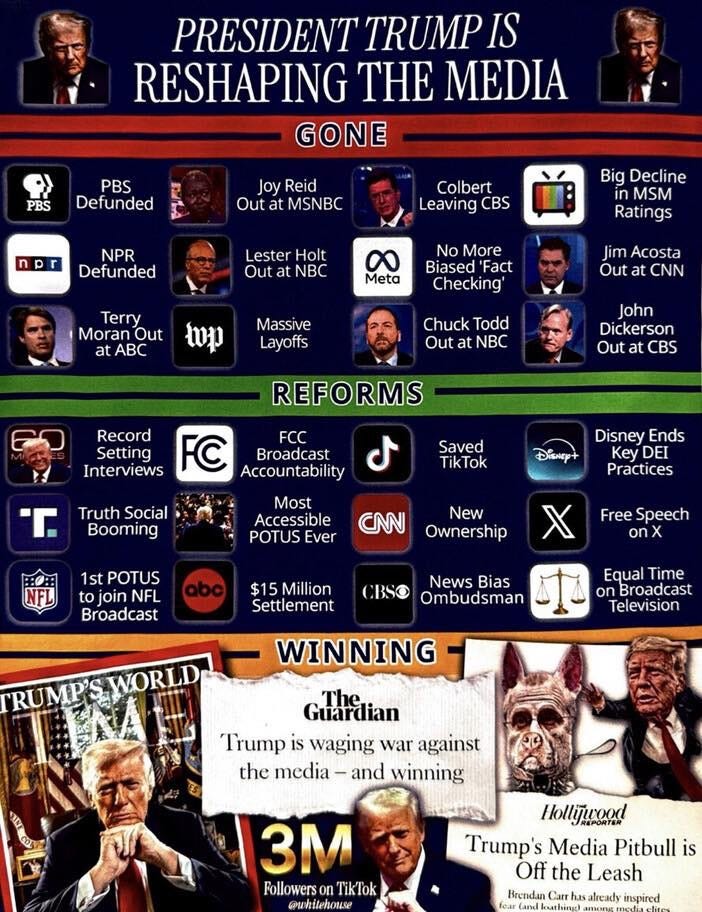
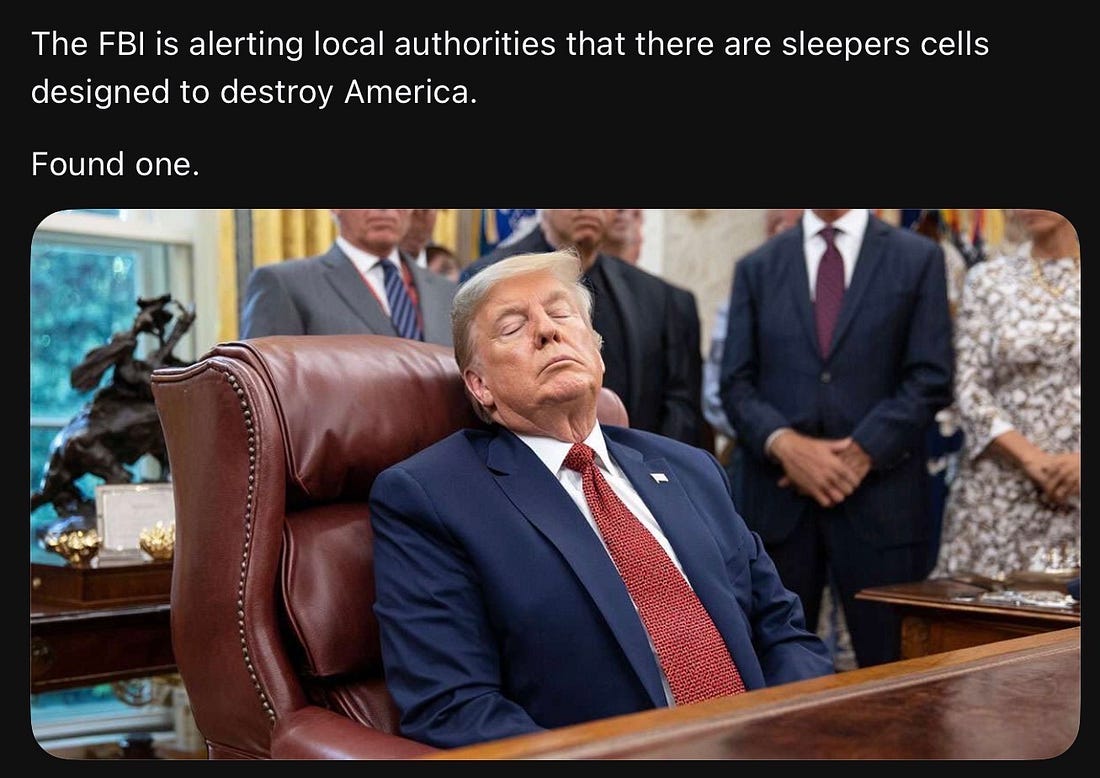
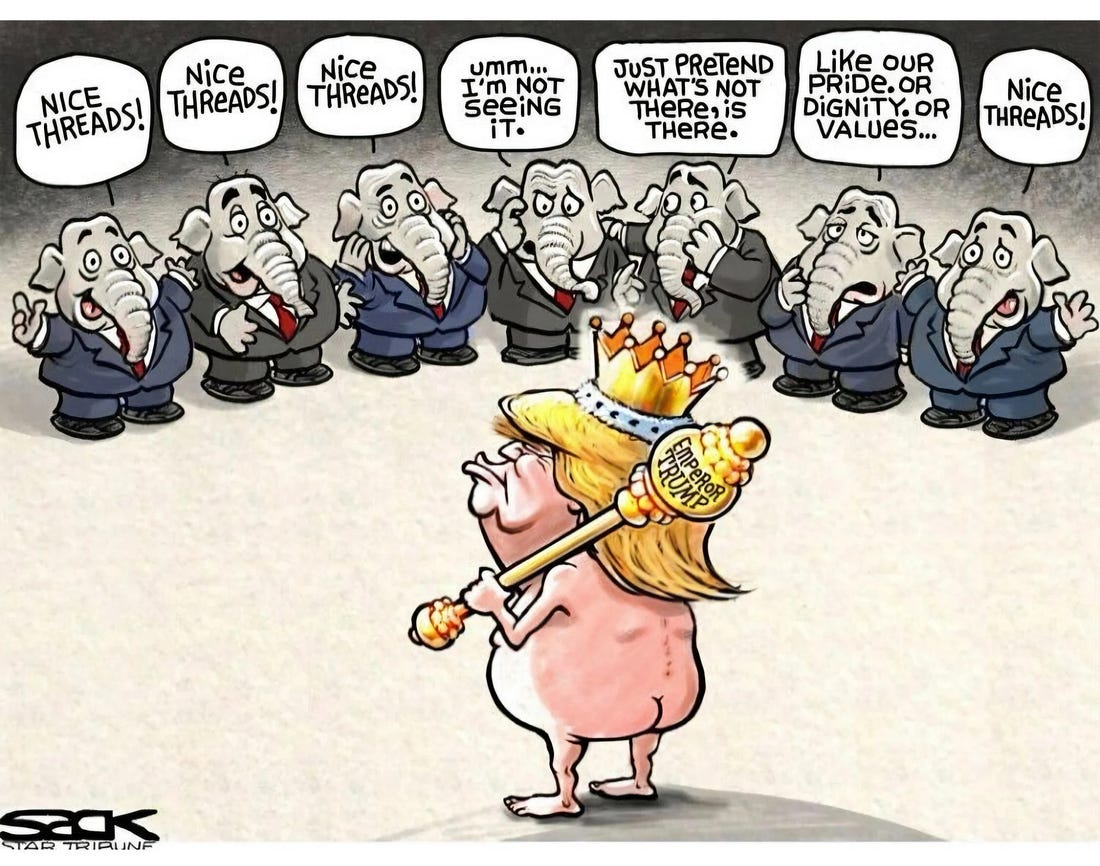
Inside America's Authoritarian Transition
PART I: THE OLIGARCHIC TAKEOVERHow a Billionaire, a Vice President, and a War Machine Replaced Democratic AccountabilityThis is what democratic collapse looks like when it happens in real time. Not with sudden coups or dramatic ruptures, but with signatures. With contracts. With young men whose only ideology is ambition stepping into positions of extraordinary power and discovering that accountability is something that happens to other people. This is what it looks like when the machinery of government gets welded to the machinery of surveillance capitalism, when wars become profitable spectacles, and when the only force that might resist all of it—Congress—has become a permission-printing machine that asks no questions and honors no oversight. The story of America's transition from democracy to oligarchy in the spring of 2026 is not primarily a story about Donald Trump's personality disorders, though those matter. It is a story about how Peter Thiel got his hands on the federal government's data infrastructure, how JD Vance sold his political future to become a vehicle for that agenda, and how a 26-year-old with prohibited stock holdings in companies he was supposed to regulate got handed the keys to the Pentagon's artificial intelligence systems during an active war. It is a story about how a war started, how it was sold with lies, and how the lies kept working because no one with power to stop them cared enough to try. Start with the relationship between Thiel and Vance, because everything else flows from it. This is not a minor friendship or a mentor-mentee dynamic that deserves a paragraph of context. This is the infrastructure of oligarchy. Peter Thiel has been Vance's benefactor, employer, moneyman, and architect since Yale Law School. Thiel bankrolled Vance's 2022 Senate campaign. Thiel introduced Vance to Donald Trump. Thiel has spent decades building Palantir, a surveillance and data infrastructure company with almost no meaningful public oversight, into one of the most powerful tools in the American security apparatus. And as of March 2026, Thiel's federal contracts have nearly doubled since Trump took office—from $541 million in 2024 to over $970 million in 2025. This is not free market capitalism. This is not the invisible hand of competition. This is a vice president standing at a venture capital conference in front of an auditorium of billionaires and telling them: "You have an administration that's working with you." The vice president then walked off that stage and went back to work in an administration where his personal benefactor's company now has contracts that extend to a $10 billion ceiling on Army agreements alone. The contracts are expanding from discrete deals into the structural backbone of how federal agencies operate. When you own the data infrastructure, you own the government's ability to see, to know, to act. Thiel owns that now. And Vance is his proxy in the White House. The question every American should ask themselves is simple: What does Peter Thiel want? He wants profit—Palantir's stock has roughly doubled since inauguration, and his personal net worth has grown by billions. He wants influence—former Palantir employees are installed throughout the administration in positions where they can steer contracts, kill competitors, and shape what gets built. He wants the power to surveil and sort the American population without restriction. And he has gotten all of it. Vance, for his part, has gotten a Senate seat, the vice presidency, and positioning as the heir apparent to the MAGA movement—all of it built on a foundation laid by Thiel. Vance could reshape the Republican Party—and maybe even the presidency—to suit both their interests for years to come. The evidence assembled here doesn't paint Vance as a man of long-held convictions, refined over time. It paints a man whose convictions are for sale. He was against Trump until he needed Trump's endorsement. He leaned into his working-class roots until it was more useful to network alongside billionaires. He said it would not be in the interest of the United States to go to war with Iran; now he's speaking publicly in support of Trump's war of choice. The man who wrote in the New York Times that "Mr. Trump is unfit for our nation's highest office" is now Trump's right-hand man in that office. There is no reason to believe the Vance-Thiel relationship won't continue into the post-Trump era. That should give anyone pause. Not because we know what Vance truly believes. But because by now, we have every reason to believe he'll do whatever he needs to do to accrue power, and that Thiel will be there to fund it. The machinery Thiel has built and now controls through Vance goes beyond Palantir's contracts, though those matter enormously. The actual mechanism of the takeover is far more insidious and involves a complete dissolution of the line between private corporate interest and public government function. When a federal agency's data infrastructure is built and operated by a private company whose principal owner has a personal financial interest in that agency's decisions, you no longer have a government making decisions. You have a corporate subsidiary making decisions and calling them government policy. The surveillance state becomes not just possible but inevitable. The ability to discriminate—to identify, track, and act against population groups with precision—becomes a tool owned by oligarchy. But there is a second machine running parallel to Thiel's takeover of the surveillance apparatus, and understanding it requires attention to a name almost no one is paying attention to: Gavin Kliger. He is 26 years old. He graduated from UC Berkeley in 2020 and spent a few years as a software engineer at Databricks before deciding in February 2025 to "save America" by joining DOGE. By March 2026, he is the Pentagon's Chief Data Officer, controlling all artificial intelligence efforts for the Department of Defense during an active war. The machinery that put him there reveals exactly how democratic accountability gets replaced with rule by kleptocratic zealots who have discovered that there are no consequences for breaking the rules, as long as you are willing to destroy anyone who tries to enforce them. Kliger showed up at the Consumer Financial Protection Bureau in early 2025 as a DOGE operative on a mission to dismantle the agency that had been created after the 2008 financial crash to keep banks from destroying the economy again. The CFPB has rules: employees cannot own stock in the companies they regulate. The rule exists because otherwise a regulator could use government power to make their personal portfolio more valuable. Kliger owned between $365,000 and $500,000 in prohibited holdings—Apple, Tesla, Bitcoin, Solana—all companies that would benefit if the CFPB ceased to exist. The agency's ethics lawyers warned him twice in writing. He ignored them. Then Kliger helped orchestrate the firing of more than 1,400 CFPB employees, screaming at staff, calling people incompetent, keeping them awake for 36 hours to get the layoff notices processed. Among those fired: the entire ethics team. The lawyers who warned him. All of them. This is not a bug in the system. This is the feature. When you fire the people whose job is to prevent you from using government power for personal profit, you have solved the problem of accountability through simple elimination. A government ethics expert at Washington University named Kathleen Clark noted that dismantling the CFPB would have a direct effect on Kliger's stock holdings—companies worth hundreds of billions of dollars just lost their most aggressive regulator. Three U.S. senators asked for a criminal investigation. Watchdog groups filed complaints. The Inspector General received formal allegations. Nothing happened. Nobody was held accountable. And so naturally, Kliger got promoted. He was moved from dismantling financial oversight to controlling artificial intelligence at the Pentagon. The Pentagon, where he now decides which AI companies get contracts, which technologies get deployed, which targeting decisions get automated. It is almost impossible to overstate what this means during an active war. Kliger controls the data architecture for military AI systems. He decides what algorithms get trained on what data, which systems get deployed, which civilian structures get marked for targeting. And his documented behavior shows that when rules get in his way, he eliminates the people enforcing them rather than following the rules. His documented social media history shows he was reposting content from Nick Fuentes—a Holocaust denier and white supremacist—and Andrew Tate, a self-described misogynist facing rape and human trafficking charges. When this was reported, Kliger said it was "categorically untrue" while the reposts remained documented and public. The Pentagon's previous confrontation with Anthropic—where the company declined to give the military unrestricted access to its AI models and asked for assurances the technology wouldn't be used for fully autonomous weapons or domestic mass surveillance—resulted in Anthropic being labeled a "supply chain risk." Now Kliger controls Pentagon AI strategy in an environment where companies that asked what the military planned to do with their tools got blacklisted. This is the second machine running parallel to Thiel's oligarchic takeover. DOGE—the Department of Government Efficiency—is not primarily about eliminating "waste." It is a recruitment and advancement pipeline for people with high risk tolerance, financial interests that benefit from deregulation, and a demonstrated willingness to break rules and destroy anyone who tries to enforce them. These people get deployed to dismantle oversight agencies. The ones who prove themselves willing to use government power for personal profit without hesitation get moved up into more powerful positions. Kliger proved his loyalty by destroying the ethics team that tried to stop him. His reward was control of the Pentagon's most sensitive technology program. The third machine is Pete Hegseth, the Secretary of Defense, and what his presence in that position reveals about the complete abandonment of any principle of fitness for office. Hegseth has spent millions of taxpayer dollars in ways that would be almost comedic if the consequences were not so grave. Pentagon budget reports show Hegseth spent $93 billion in a single month—the highest monthly expense since 2008. That same month included $2 million on Alaskan King Crab, nearly $7 million on Lobster Tails, nearly $100,000 on a Grand Piano. This is not waste. This is openly contemptuous display of power. This is a man telling the American people: "I can do this because you cannot stop me." And he is right. Congress does nothing. The media reports it. The public complains. Hegseth continues. But Hegseth's spending is not actually the important part. The important part is what he does with the machinery he controls. The Pentagon has killed American service members through its stupidity and callousness, and Hegseth's response has been to treat it as entertainment. When a United States military operation killed 175 people at an Iranian elementary school, most of them children, because the Pentagon used outdated intelligence and did not verify the information before firing Tomahawk missiles, Hegseth and Trump released propaganda videos celebrating the bombing, interspersed with movie footage, set to music. A video of real death and real suffering being treated like a video game clip. Archbishop Blase Cupich of Chicago responded by noting that "hundreds of people are dead, mothers and fathers, daughters and sons, including scores of children who made the fatal mistake of going to school that day." Cupich warned: "Our government is treating the suffering of the Iranian people as a backdrop for our own entertainment, as if it's just another piece of content to be swiped through while we're waiting in line at the grocery store." Hegseth was not punished. He was not removed. He continued in office. Trump continued making war policy. This is where the three machines intersect: oligarchy (Thiel's surveillance infrastructure), administrative takeover (Kliger's appointment and the DOGE pipeline), and the machinery of war deployed not for strategic necessity but for the ego satisfaction of a malignant narcissist and the profit margins of those around him. The war with Iran was not inevitable. Classified intelligence assessments made clear that even a massive military assault on Iran would be unlikely to topple the government. Trump's stated goal was regime change and "unconditional surrender," which intelligence officials knew was impossible. The Pentagon had no plan to destroy buried nuclear facilities. There was no plan for what comes after. There was no strategy for opening the Strait of Hormuz or stabilizing the region. What there was: the opportunity for Trump to dominate another country, the opportunity for contractors to profit, the opportunity for Hegseth to escalate without constraint, and the opportunity for Thiel's surveillance and data systems to become indispensable to military operations. The war started in February 2026. By early March, the damage was becoming clear. The U.S. military investigation determined that American forces had used outdated intelligence to strike an elementary school that killed at least 175 people, most of them children. When asked if he took responsibility, Trump said he did not know about the report and declined to accept responsibility. Six American service members were confirmed dead, with over 140 wounded. Multiple sources reported that Iran had become dramatically more precise in its targeting—hitting early-warning radars and tactical operations centers with accuracy that intelligence officials attributed to Russian intelligence sharing targeting information, using their satellite and radar capabilities. When asked about this, Trump dismissed it, saying that the U.S. had shared intelligence with Ukraine, so Russia sharing intelligence with Iran was somehow equivalent and therefore acceptable. Steve Witkoff, Trump's special envoy and the father of sons making billions with Trump's sons in Middle East deals, shrugged and said he had talked to Russians who denied sharing intelligence "so we can take them at their word." Putin, being slightly less circumspect than Trump, immediately said Russia had "unwavering support" for Tehran and would remain "the Islamic Republic's reliable partner." And Trump, demonstrating the completeness of his subservience to Putin, signed a waiver to Russia sanctions that now allows Putin to sell unlimited amounts of Russian oil directly to India—undermining the entire sanctions regime designed to punish Russia for invasion and war crimes in Ukraine. Every time Putin says jump, Trump asks how high. But the consequences of the war are metastasizing through systems most Americans never think about. The Strait of Hormuz, a 21-mile-wide waterway between Iran and Oman, handles roughly one-fifth of the world's oil. One hundred tankers normally pass through every day. Currently, the strait is effectively paralyzed. Over 150 vessels sit stranded waiting for safe passage. Ships have turned around. Insurers have withdrawn coverage. Iran has begun deploying naval mines—one of the most dangerous escalations in maritime warfare. When insurance disappears from a chokepoint like Hormuz, trade freezes long before any formal blockade is declared. Oil prices surged above $110 per barrel before settling in the mid-$80 range, with prices remaining well above pre-war levels. The national average for gasoline has climbed to $3.58 per gallon and continuing to rise. The International Energy Agency is considering what could become its largest coordinated emergency oil release in history. But here is the story almost no one is paying attention to: the Persian Gulf is one of the world's largest producers of nitrogen fertilizer, and the primary ingredient is natural gas. Much of that fertilizer moves through the Strait of Hormuz. Modern agriculture runs on nitrogen fertilizer—roughly half of global food production depends on it. If fertilizer shipments are disrupted as planting season begins, the consequences appear months later in smaller harvests, tighter grain supplies, and rising food prices. Across Africa and South Asia, where food systems already operate on razor-thin margins, a disruption that tightens global grain supplies can push millions closer to hunger overnight. Wealthier countries absorb the economic shock. The poorest countries cannot. This is where food crises and famine begin. And Trump did not care. When confronted with the economic and humanitarian consequences of his war, Trump shrugged and said the price spike was "very small" and that "only fools" would think the war was not worth it. When told that service members would die, he said matter-of-factly: "Some people will die. More will likely die. That's the way it is." He wore a baseball cap while watching the dignified transfer of slain service members, refusing to remove it as a basic gesture of respect. He said it was "more fun" to sink ships, which would almost certainly kill the sailors on board. This is not an aberration. This is not a one-off moment of callousness. Trump's entire approach to governing is built on the principle that his will matters more than any other consideration. When he cut SNAP benefits during a government shutdown, he was not making an economic argument. He was punishing vulnerable Americans—kids, seniors, the disabled—because he wanted to leverage the government's dysfunction to blame Democrats. He was simultaneously refusing to extend Affordable Care Act subsidies, which inflicted huge premium increases on Americans and priced many out of insurance. He celebrated slashing Medicaid as part of a "beautiful" bill. He imposed tariffs and then reimposed them after the initial tranche was struck down, forcing already-strapped families and small businesses to pay more. He told Americans that either they would not pay for the tariffs, or if they did, it was worth a recession. He attempted to give the federal government legal guardianship over homeless veterans, not to house them or provide services, but to institutionalize them—to use government power to override their own decisions about where they lived, what medical care they received, and what institutions they would be placed in. The VA-DOJ agreement includes no expansion of rental assistance or supportive services. It only expands government power to institutionalize. There are 33,000 homeless veterans right now, nearly 14,000 living on the street. The administration cannot house them, but it wants the legal authority to force them into institutions. And while Trump was cutting food stamps and healthcare, while Hegseth was spending millions on King Crab and pianos, while a school full of children was being bombed, there was another theft happening that almost no one noticed. A whistleblower came forward in March 2026 to report that a former DOGE employee had walked out of the Social Security Administration with records on more than 500 million living and dead Americans on a thumb drive. The kind of information that defines a person—race, citizenship, mother's maiden name. The whistleblower said the person who took the data told colleagues he expected a presidential pardon if he got caught. This is not espionage in the traditional sense. This is not a spy selling secrets to a foreign government. This is a Trump loyalist stealing the complete personal identifying information of the entire American population with the understanding that if caught, the president would pardon him. The data could be sold. It could be used for harassment, fraud, or targeting. It could be given to Russia. The person who took it knew none of those things would matter because Trump would pardon him. This is oligarchy. This is administrative takeover. This is the state machinery being used not to govern but to concentrate power and money. The relationship between Thiel and Vance is oligarchy. Kliger's appointment and advancement is administrative capture by people who view rules as inconveniences to be eliminated rather than constraints to respect. Hegseth's spending and callousness is the state apparatus turned into a tool of personal domination. The war with Iran is the projection of that domination outward. And the theft of 500 million Americans' personal data is the logical endpoint—the complete instrumentalization of government machinery for private benefit, protected by the assurance of presidential pardons. But there is a final piece to this machinery worth understanding. Thirty-six hours before the first bombs dropped on Iran, the country had offered a diplomatic breakthrough. Iran agreed to irreversibly downgrade its enriched uranium to the lowest possible level, halt stockpiling, and open the door to full IAEA verification. A deal existed. A path to peace was available. Oman's foreign minister announced the "breakthrough." American officials knew about it. And the administration rejected it anyway. Why? Because Steve Witkoff and Jared Kushner told Trump that Iran was "using talks to buy time," a conclusion that had no support from nuclear experts, IAEA officials, or intelligence assessments. Witkoff, a real estate developer with no nuclear expertise, claimed the Iranians had "bragged" about having enriched uranium for eleven bombs. Multiple third parties present at the negotiations said that's not what was said—Iran was telling them the material could go away with a deal. Nuclear scientists said Witkoff's technical assessment was riddled with errors. Arms Control Association experts concluded the pair had "fatally misunderstood" basic technical details. But Trump believed them. And three days later, the bombs started falling. This war was not inevitable. It was a choice made by men with no expertise, no competence, and no regard for the consequences of their incompetence. And there was another machinery running parallel to the bombs. While the administration was bombing Iran, while American service members were dying, while the Strait of Hormuz was being choked off, Russia was making money. Within two weeks of the war's start, Russia had reaped $6.9 billion in additional fossil fuel revenue. At current rates, Russia was making approximately $550 million per day from the war Trump started. Russia's daily income was enough to purchase 17,000 Shahed drones—the same drones Iran was using to strike American bases. And what did Trump do? He lifted sanctions on Russian oil shipments, breaking with the G7's unified sanctions framework that had held since Russia's invasion of Ukraine in 2022. Putin was providing intelligence to Iran to help target American forces. Trump responded by easing the sanctions designed to punish Putin for invasion and war crimes. Even the most generous interpretation of this sequence suggests catastrophic incompetence. The more realistic interpretation suggests something far darker. PART II: KOMPROMAT, DISTRACTION, AND THE MACHINERY OF ECONOMIC COLLAPSEThere are files. Thousands of pages. Hard drives. CDs. Digital storage devices. The contents of a safe inside a Manhattan mansion belonging to a man at the center of one of the largest sex-trafficking investigations in American history. According to FBI documents, federal agents could not legally remove those contents because of a technical issue with the search warrant. Hours later, when they returned with a corrected warrant, the safe was empty. The contents had been packed into two suitcases and delivered to Richard Kahn, Jeffrey Epstein's longtime accountant. Eventually the suitcases were returned. But a strange question remains unanswered and was never adequately investigated: How did the accountant of a man at the center of a massive trafficking investigation end up removing potential evidence from a crime scene before federal agents returned? And more importantly—why was Kahn, along with Epstein's personal lawyer Darren Indyke, chosen to control Epstein's entire empire after his death? This is not a tangential story about a dead billionaire. This is the mechanism by which oligarchy maintains itself through the control of information. Two days before Jeffrey Epstein died in a Manhattan jail cell in August 2019, he signed a new will. He transferred his entire fortune—roughly $635 million—into something called The 1953 Trust. And he appointed two men as co-executors: Darren Indyke and Richard Kahn. Two insiders. Men who had spent years navigating Epstein's financial world. Under the terms of that will, they now controlled Epstein's money, Epstein's companies, Epstein's documents, Epstein's legal strategy, and the process used to settle claims from survivors. The timing matters. Epstein rewrote the structure of his estate two days before his death, at a moment when he was facing federal charges that could have put him in prison for the rest of his life. Which raises a question that investigators and journalists have been asking ever since: What exactly did Epstein want protected? The answer is: everything. Not just the money, but the machinery. The infrastructure that allowed a man to operate an international sex-trafficking enterprise for decades without meaningful legal consequence. Court filings describe a sprawling network of more than 140 bank accounts connected to dozens of corporate structures. Some of those companies owned real estate. Some paid household staff. Some managed aircraft and travel. But investigators alleged that others played more opaque roles. Entities were used to transfer money to victims, pay recruiters who brought girls into Epstein's orbit, and route funds through complex financial paths that obscured their origin. Indyke and Kahn had signatory authority over many of those accounts. They knew how the system worked. They knew which entities moved money where. They knew which corporate shells existed primarily to hide transactions. But here is where the story becomes relevant to the present moment. In early 2026, investigators from the House Oversight Committee wanted to understand how Epstein's financial system actually worked. They subpoenaed both Kahn and Indyke. Lawmakers wanted to examine the structure of companies, the control of key accounts, the financial flows between entities, and what records remained inside the estate. The executors provided thousands of pages of documents. But some materials arrived with redactions applied by the estate—redactions, lawyers said, intended to protect victims' identities. Still, a central tension remained: the people holding the documents also control how they are released. The people who understand the machinery are the same people managing the final chapter of the story. This is not bureaucratic process. This is the architecture of control. When a man dies and his financial infrastructure passes to people who participated in maintaining it, there is no independent examination of that infrastructure. There is only management. Only curation. Only the careful release of information designed to protect certain people and certain relationships while appearing to provide transparency. And the people controlling that process are smart enough to understand that sometimes the best protection is to reveal just enough to seem credible while hiding everything that actually matters. By March 2026, it had become clear that much would remain hidden forever. FBI interview records involving allegations against former banker Jes Staley and billionaire Leon Black—records that had been subpoenaed as part of the Epstein investigation—were still missing. Epstein's accountant had named Black as one of several wealthy clients who allegedly paid Epstein millions in fees, alongside Les Wexner, Glenn Dubin, Steven Sinofsky, and the Rothschilds. But the documents that might have proven these relationships were gone. And then investigators discovered why. Three years earlier, the FBI's New York field office—the same office that had been investigating Epstein—had been breached in a cyber attack. Epstein files were among the potentially accessed material. Hackers, or foreign actors, may now be holding what the Trump regime refuses to release. The files were no longer just being managed by people who benefited from maintaining the system. They were in the hands of unknown actors who could use them as leverage against anyone. Worse, as authorities began searching Epstein's New Mexico property looking for possible buried bodies—a search that intensified in March as pressure mounted to find evidence of crimes that had somehow remained unprosecuted for years—it became clear that the machinery of protection had persisted long after Epstein's death. The estate continued to manage what information flowed, when, and to whom. The estate continued to shield people connected to the network. And the people appointed to control the estate—the ones who maintained the infrastructure—continued to do exactly what they had been doing all along: protect the powerful. Which brings us to the deliberate distraction. On February 28, 2026, a U.S. military strike killed at least 175 people at an Iranian elementary school, the Shajarah Tayyebeh school. Most of them children. The Pentagon had used outdated intelligence to target a nearby military base, and the strike coordinates were created using information that was simply not verified before being used to fire Tomahawk missiles. When Trump was asked whether he took responsibility, he said he did not know about the report and declined to accept responsibility. The Secretary of Defense, Pete Hegseth, released propaganda videos celebrating the bombing, interspersed with movie footage, set to music. The treatment of real death and real suffering as entertainment. This was not a mistake. This was not an unfortunate oversight. This was the deliberate deployment of a war to achieve multiple objectives simultaneously: to generate headlines that would dominate the news cycle, to provide justification for surveillance and security measures at home, to prevent meaningful discussion of the Epstein files and what they contain, and to create a state of perpetual crisis that would make the public desperate for authority and order. Trump's simultaneous campaign against Thomas Massie of Kentucky is illustrative. Massie opposed Trump's bailout measures during COVID, and he voted to release the Epstein files. As Trump spent the day in Kentucky telling approximately 500 Fox News loyalists that Massie was an enemy of the people, as the Secretary of Defense was celebrating bombing schools, as the war with Iran was escalating toward regional catastrophe, the President was using government time and resources to punish a member of Congress whose primary crime was voting to release files that could be deeply damaging to people in Trump's circle. This is how authoritarianism actually functions. It is not primarily about dramatic displays of power. It is about the deployment of multiple mechanisms simultaneously—war, surveillance, selective prosecution, media manipulation—all operating in concert to prevent meaningful accountability. And while the machinery of war was operating, the machinery of economic destruction was setting in motion consequences that no war machine could reverse. The Strait of Hormuz, that 21-mile-wide chokepoint through which roughly one-fifth of the world's oil passes, was effectively shut down. Iran had halted commercial shipping after U.S.-Israel strikes. Zero entries into the Persian Gulf were recorded in 24-hour periods. Hundreds of tankers sat stranded. Multiple commercial vessels had been struck by projectiles. Vessels were on fire. Crews were missing. Iran had begun deploying naval mines—described by U.S. military officials as the "most destructive weapons" the Navy has faced in recent conflict. Insurance companies were withdrawing coverage from shipping. Banks would not finance cargo movement through the strait. Once insurance disappears, once financing disappears, once captains refuse to navigate the waters, the system stops. Trade freezes long before any formal blockade is declared. By mid-March, the cascading consequences were becoming visible globally. Vietnam told its entire workforce to work from home—not because of COVID, not because of any lockdown, but because the nation was running out of fuel. Gasoline prices had spiked 32 percent. Diesel prices were up 56 percent. People were queuing for hours at gas stations that ran dry before their turn. Bangladesh deployed the military at oil depots to manage rationing. Motorcycles were limited to 2 liters per day. Cars had strict daily quotas. Universities closed. Eid celebrations were cancelled. 170 million people, 95 percent dependent on imported oil, were beginning to experience the physical reality of economic collapse. Almost nothing was coming in through the Strait of Hormuz. The infrastructure damage alone was catastrophic. Saudi Arabia's largest refinery went offline. Qatar's main liquefied natural gas facility closed. The UAE's Ruwais refinery, capable of processing 922,000 barrels per day, was hit by a drone strike and went offline. These are not minor facilities. These are the arteries of global energy supply. Airlines were getting destroyed in real time. British Airways stock fell six percent. EasyJet fell four percent. Thousands of flights were cancelled or emergency rerouted. U.S. airlines were now burning crude at $120 per barrel. JPMorgan's analysts ran the numbers. If the Strait of Hormuz closed fully, 4.7 million barrels per day would be removed from global supply. Oil at $130 to $150 per barrel was no longer a tail risk. It now had a date attached to it. And Trump knew this would happen. His own classified intelligence briefings made clear that even large-scale military assault on Iran would be unlikely to topple the government. There was no plan to destroy buried nuclear facilities. There was no plan for regime change. There was no plan for reopening the Strait of Hormuz. Senator Chris Murphy, after being briefed by the Trump team, said directly: "They don't know how to get it safely back open. This was 100 percent foreseeable." Trump started a war knowing the consequences would include a global energy shock. He knew tankers would burn. He knew inflation would spike. He knew food prices would rise across the poorest countries in the world. And he did it anyway, because a president facing potential exposure from Epstein files needs a war to dominate the news cycle more than he needs rational foreign policy. But there is something else happening simultaneously, something that explains why smart people in powerful positions are allowing this catastrophe to continue. Market manipulation. When you have advance knowledge that oil prices will spike, that airlines will lose value, that energy companies will face supply shocks, you can use that knowledge to position your portfolio. You can short the airlines before their stock collapses. You can go long on oil companies before prices spike. You can buy put options on the S&P 500 before the market crashes. If you are a member of Congress, if you are a federal official, if you are someone with access to classified briefings, you can use that information to make trades that become catastrophically profitable in the moments before the rest of the market understands what is happening. This is insider trading. It is market manipulation. It is illegal. It is also enormously profitable. And if the person making the trades is inside the Trump administration, they know they will not be prosecuted. The STOCK Act of 2012 explicitly prohibits members of Congress from using material nonpublic information derived from their official duties for personal profit. To date, no member of Congress has been successfully prosecuted under the act. The legal bar for proving violation is notoriously high, because officials can always argue that their trades were based on public news reports rather than classified briefings. But the mechanism is transparent. If you know the Strait of Hormuz is about to close before the public knows, you trade accordingly. If you know the administration has no plan to reopen it before the public knows, you position your portfolio for extended energy shock. If you know the war will continue to escalate, you buy defense contractors. And by the time the public realizes what happened, you have already made billions. Trump himself is not subtle about this. He has publicly praised stock market gains as evidence of his success, even as the wars he started were creating catastrophe. He has made clear that he views financial metrics as personal validation. And he has a history of using government position for personal profit—carrying classified documents with him on foreign travel, sharing information with people who could help him, leveraging government relationships to generate deals for his family. If the people around him see him profiting, they will follow suit. If they see that no one is held accountable, they will become more brazen. This is how corruption scales. Not through conspiracy. Through permission. Through the simple recognition that rules do not apply to people in power. Which is why the domestic terror operation being conducted against vulnerable immigrants is so revealing. In South Burlington, Vermont, ICE agents broke down the door of a home with the help of state and local police. They arrested residents, including people who were in the process of seeking asylum or had legal pending applications. Protesters tried to prevent the arrests. Some were detained. Some were beaten. Some had chemical weapons deployed against them. The state police participated. The local police participated. And Vermonters watched their neighbors being dragged away in an operation that served no legitimate law enforcement purpose—the people arrested posed no threat, had no criminal history, were simply in the country seeking a better life. But there is a darker mechanism at work, one that reveals what happens when a government takes someone into custody and then abandons them to the machinery of indifference. Daphy Michel came to the United States seeking protection. A Haitian national who entered legally and applied for asylum, she was living in Pennsylvania when she experienced a mental health crisis in September 2025. Arrested on misdemeanor charges, she spent six months in jail awaiting evaluation. When the charges were dismissed on February 26, 2026, her family expected her release. Instead, ICE took her into custody based on an immigration detainer. They transported her to Pittsburgh, fitted her with a GPS ankle monitor, released her into the community—and told her family nothing. Five days later, Daphy Michel was found unresponsive at a bus shelter. She died shortly after. Her family learned of her death from hospital staff, not from ICE. To this day, the federal government has not explained where she was released, when, why she was alone in a city far from her family, or how she ended up dead at a bus stop five days later. The same machinery killed Nurul Amin Shah Alam, a nearly blind Rohingya refugee from Myanmar who spoke little English. After being released from criminal custody, Buffalo police handed him to Border Patrol based on an immigration detainer. Federal agents determined he wasn't eligible for deportation. And then they drove him to a closed Tim Hortons coffee shop in the middle of winter, at 8:18 PM, wearing nothing but orange paper booties, and left him there. Five days later, he was found dead several miles away on a Buffalo street. These are not accidents. They are predictable outcomes of a system that treats vulnerable people as problems to be managed rather than human beings in need of protection. Courts have repeatedly recognized that immigration detainees depend entirely on the government for their safety. That duty does not disappear when the government decides to release someone. But the Trump administration operates under a different principle: release people into chaos and call it "enforcement." And when they die, call it tragedy rather than policy. Meanwhile, the President was bragging about "building a badass ballroom," spending millions on luxury items while cutting food stamps. Meanwhile, billionaires were making fortunes on war. Meanwhile, the oligarchic infrastructure that protected Epstein's network—the one that knew about every financial vulnerability of every powerful family—remained untouched and unprosecuted. This is the machinery of authoritarianism in its mature form. It operates through selective enforcement. It operates through terror directed at the vulnerable while the powerful remain protected. It operates through the deliberate collapse of institutions that might provide oversight. It operates through the control of information by people who participated in maintaining criminal networks. It operates through wars that serve no strategic purpose but provide cover for domestic political objectives. It operates through financial systems in which people with access to classified information can make catastrophic profits while the broader economy collapses. It operates through a presidency in such cognitive decline that rational policy becomes impossible, leaving operational control to ideologues and oligarchs who have their own agenda. PART III: THE DEATH OF INSTITUTIONS AND THE MACHINERY OF COLLAPSEDemocracy does not collapse in a moment. It collapses in a sequence. First the oligarchs take the machinery. Then the war provides cover. Then the institutions that might resist—the press, the courts, merit-based governance, the rule of law—begin to die. And finally, when all the mechanisms of accountability have been eliminated, the country discovers that the people running it have no plan and do not care. This is what March 2026 looks like. This is what the death of American democracy looks like when it is actually happening. Begin with the press, because it is the most visible death and the most complete. The Department of Defense announced that it would no longer permit press photographers to cover Pentagon briefings on the Iran war. Why? According to people familiar with the decision who spoke on condition of anonymity because they feared retaliation, it was because press photographers had published images of Secretary of Defense Pete Hegseth that "his staff deemed unflattering." The Pentagon excluded photographers from Hegseth's last two briefings and offered no on-the-record explanation for the change. In a country with a functioning free press, this would be impossible. In a country with a functioning democracy, it would be unthinkable. But this is not that country anymore. On March 14, 2026, FCC Chairman Brendan Carr threatened to revoke broadcast licenses of news outlets covering the Iran war in ways the administration deemed "negative." The threat was explicit and public. Networks that reported facts Trump called false—facts that Trump himself had confirmed were accurate—would lose their right to exist. Carr said broadcasters' coverage "could affect their license renewals." He said this on video. On the record. With full knowledge of what he was saying. The message was unmistakable: cover the war the way we want it covered, or lose your right to exist. CBS pulled an interview with a Senate candidate. Nexstar pulled Kimmel from thirty-two ABC affiliates. Every newsroom in America received the message. A media advocacy group described Carr's actions as an attempt to "pressure media companies into submission and self-censorship, which would achieve some of what Trump wants without explicit government action." This is how you strangle the press without formally censoring it. You don't ban outlets. You threaten their licenses. You don't ban stories. You make news directors terrified of the consequences of reporting them. You let the fear do the work. The chilling effect was immediate and total. Every news director in America now understands that their license renewal depends on how they cover Trump's war. That is not government censorship in the formal sense. That is something more efficient—it is the weaponization of regulatory authority to produce the same outcome as censorship without having to formally censor anything. The First Amendment lives, technically. It just doesn't function. A year earlier, the Trump administration had banned the Associated Press from White House events that other reporters could attend. Why? Because the AP continued to refer to the Gulf of Mexico by its internationally recognized name after the President redesignated it as the Gulf of America. The AP sued. The case went to federal court. District Judge Trevor N. McFadden, a Trump appointee, ruled that viewpoint discrimination violated the First Amendment. He wrote: "If the Government opens its doors to some journalists, it cannot then shut those doors to other journalists because of those viewpoints. The Constitution requires no less." It was exactly right. It was also immediately stayed by the judge so the administration could appeal. The appeal was briefed and argued before a three-judge panel in the Court of Appeals late in 2025. Two of the judges—Gregory Katsas and Neomi Rao—are among the most conservative Trump appointees. The decision is still pending. But everyone involved understands what is actually happening. The government is systematically testing the limits of what it can do to punish journalists who refuse to cooperate. The AP ban. The photographer ban. The reporters who ask tough questions and receive no answers. The "quiet, Piggy" dismissal of inconvenient inquiry. This is not accident. This is design. This is the deliberate strangulation of the free press by a government that recognizes that meaningful journalism is the only force that could possibly expose what is actually happening. Joyce Vance, former federal prosecutor and constitutional law expert, wrote in March 2026 what every lawyer understands: "This is how the First Amendment erodes. Slowly. In ways that are written off as minimal or within the President's prerogatives. Ultimately, it could be our collective right to engage in free speech that suffers." She understood what those in power are counting on people not understanding: that erosion is the mechanism. That by the time the public realizes what happened, the Constitution will be gone—not because it was formally repealed, but because the institutions designed to protect it have been systematically dismantled. The Washington Post, after abandoning the motto "Democracy Dies in Darkness" at the start of Trump's second term, quietly readopted it. Those words, first used in 2017, "still ring true," the paper acknowledged. But truth ringing does nothing when the mechanisms to distribute that truth have been eliminated. When the Pentagon bars photographers, when the AP is banned, when reporters who ask logical questions are dismissed without answers, the truth dies not because it ceases to exist but because the channels that carried it have been destroyed. The press is not alone. Every institution designed to constrain executive power in America is simultaneously under assault. The judiciary is being packed with judges who believe the President has near-total authority. Congress has become a permission-printing machine that asks no meaningful questions and honors no oversight. The inspector general system is being dismantled to prevent investigations of administration wrongdoing. Career civil servants are being purged and replaced with political loyalists. And presiding over all of it is a presidency so cognitively diminished that it cannot form coherent policy—which means the actual running of government has fallen to people who understand that without meaningful oversight, they can do whatever they want. This is where Russell Vought enters the story. He is not famous. He does not have a television show. He does not tweet conspiracy theories or rally crowds. He is a bureaucrat with a title and a filing cabinet full of blueprints. During Trump's first term, Vought sat at the Office of Management and Budget and quietly sliced muscle from the federal body. He was never the face screaming on cable. He was the guy in the back, turning starvation budgets into doctrine, making everything outside the Christian nationalist fantasy "optional." When Trump lost, Vought did not slink away. He mutated. He became the architect of Project 2025, the mastermind behind the blueprint for stripping the civil service to the studs and burning the rest. Project 2025 is not a policy document. It is a fever chart—the blueprint for what happens when religious nationalism replaces pluralism as the organizing principle of government. Under Vought's framework, USAID was killed on the floor. Agencies were kneecapped. Programs designed to protect vulnerable populations were systematically dismantled. The president was handed emergency powers with a bow on top. And the bonfires the country is watching now started with Vought's pen, not Trump's mouth. Vought does not want to run the government. He wants to run the church that replaces it, one memo at a time. He believes foreign aid is moral rot. He believes pluralism is a virus. He believes the federal government should exist primarily to enforce Christian nationalist values, and everything else is an inconvenience to be eliminated. The horror of Vought is not that he is a caricature. It is that he is the opposite. He radiates no threat level. He looks like a tired accountant with strong opinions about printer toner. History's real body counts are signed off by men who never raise their voices, just their pens. That is Vought. That is how real authoritarianism scales—not through dramatic displays of power, but through the quiet work of functionaries who translate zealotry into executive orders. You cannot stop what you cannot see. And Vought operates in footnotes, in draft language, in agency memos most people will never see. But every trail from Project 2025 to mass firings, from the gutting of USAID to the swerve in foreign policy, hits his signature. He is the beige wallpaper you forget about until it starts peeling and you realize the whole building is infested. Working beneath Vought in the machinery of destruction is Stephen Miller, who looks exactly like what he is—a white supremacist ideologue with negative charisma. But Miller is the snarl. Vought is the motor. Miller commands the attention; Vought commands the machinery. When ICE agents break down doors in South Burlington, Vermont and throw flash grenades at protesters who are trying to prevent the arrest of asylum seekers, they are executing Vought's memo. When thousands of hours of CBP footage go missing and no one is held accountable. When federal agents are caught on video killing American citizens during traffic stops and are found justified by the administration. When refugee admissions are slashed while a special refugee program is created for white South Africans claiming persecution—despite the fact that unemployment for Black South Africans is 35 percent while for whites it is 8 percent and farm murders kill more Black people than white ones. These are not aberrations. These are the implementation of Vought's blueprint. The blueprint extends to merit-based governance. The administration appointed Erika Kirk, a pageant winner and widow of Charlie Kirk, to the U.S. Air Force Academy Board of Visitors. Not a veteran. Not a military educator. Not a defense policy expert. Not someone with a single credential tied to military leadership or national security. A pageant winner running a campus activism organization. The Air Force Academy Board of Visitors oversees curriculum, discipline, instruction, fiscal affairs, and the academic development of future military officers. These are the men and women who will one day make life and death decisions for this country. And oversight has been handed to someone whose primary qualification is that her husband held the seat before her. This is not a tribute. This is nepotism dressed up in patriotism. This is the death of merit. Across the federal government, jobs that required expertise are being filled by loyalists. Positions that demanded knowledge are being given to ideologues. The machinery of government is being converted into a loyalty-extraction apparatus in which competence is irrelevant and obedience is everything. When Pete Hegseth, who has no military background, becomes Secretary of Defense and immediately begins firing civilian protection teams, removing senior lawyers, and celebrating bombing schools—he does this not despite his incompetence but because of it. An incompetent Secretary of Defense cannot provide meaningful oversight of the war. That means the machinery operates without constraint. That means profits flow to contractors without scrutiny. That means young officers receive no guidance on the laws of war. That means schools full of children get bombed because the intelligence is outdated and no one cares enough to verify it. Hegseth did not stumble into this. Reporting from the Pentagon shows that he methodically dismantled the offices designed to limit civilian casualties in war. The Pentagon's civilian casualty assessment teams employed 200 people before Hegseth arrived. By March 2026, fewer than 40 remained. Hegseth cut those teams not because they were inefficient but because they were effective. They got in the way. They asked questions. They demanded verification. They said no. And Hegseth decided that "no" was the problem, not the solution. So he eliminated the people who said it. Wes Bryant, the Pentagon's former chief of civilian harm assessments, told journalists what Hegseth could not grasp: "As it turns out, when you kill less civilians, you tend to be putting your resources toward killing the enemy." The logic was too complex for a man whose only principle is power without restraint. So the teams got fired. And the schools got bombed. And Hegseth released propaganda videos celebrating the deaths of children while calling them "incredible success." And here is what makes it all work: Trump's cognitive decline. Not despite it. Because of it. A coherent president might resist the consolidation of power by oligarchs. A coherent president might demand strategy from the Pentagon. A coherent president might recognize that a war without plan and without endgame is a disaster. But Trump does not do these things. When asked if he accepts responsibility for killing 175 children at an elementary school, Trump says: "I don't know about it." When told the war is going poorly, Trump says he knows it's over "when I feel it in my bones." When asked about strategy, Trump declares victory while simultaneously sending more troops. He is coherent enough to maintain power. He is incoherent enough to cause catastrophe. At a Pentagon briefing in mid-March, Defense Secretary Pete Hegseth said that the sooner a right-wing Trump ally takes over CNN "the better," and that a "patriotic press" would report that Iran is weakening. He called headlines about the war widening "patently ridiculous," despite those headlines reflecting ground reality. He called for "no quarter, no mercy for our enemies"—a phrase that violates a century of international law on warfare, that prohibits the refusal to take prisoners, that constitutes a war crime. And then he closed his briefing by invoking God's providence over U.S. military leaders and asking the nation to pray. The weaponization of religion as theater for violence. The State Department's machinery of war operating under the explicit instruction to refuse mercy, to grant no quarter, to execute rather than capture. This is not accident. This is doctrine. PART IV: THE ARCHITECTURE OF PLUNDERWhy Collapse Is Profitable and Therefore InevitableHere is what Pete Hegseth spent in September 2025, the first full month of his tenure as Secretary of Defense. Ninety-three billion dollars. The highest monthly Pentagon spending since records began in 2008. In that single month, the Pentagon spent $15 million on ribeye steak, $7 million on lobster tail, $2 million on Alaskan king crab, $1 million on salmon. One hundred thirty-nine thousand dollars on donuts—272 separate orders. Twenty-five thousand dollars on a Japanese handmade flute. Ninety-eight thousand dollars on a Steinway grand piano delivered to the Air Force chief of staff's residence. One hundred thirty-nine thousand dollars on Herman Miller recliners. Two hundred twenty-five million on furniture. Five million on Apple devices—iPads purchased at $788 each when the retail price was $499. These are not errors. These are not accidents. This is a system designed to produce them. But the real cost became visible in March 2026. The Center for Strategic and International Studies calculated that the first twelve days of the Iran war cost $16.5 billion. That's over $1 billion a day. And the war was just beginning. By mid-March, Trump was privately telling world leaders that he wasn't ready to make a deal with Iran "because the terms aren't good enough yet"—a statement made while troops were being deployed, missiles were being fired, and the machinery of escalation was accelerating with no visible endpoint. To Trump, this was acceptable. The machinery was running. That was sufficient. Meanwhile, on the same calendar, in the same fiscal year, the USDA posted a message to its official website: the well has run dry. Forty-two million Americans use SNAP. And in March 2026, the well ran dry. Congress ran out of money. Not for defense. Not for the Pentagon. Not for the Steinway pianos or the ribeye steaks or the $788 iPads. Just for food. Just for the people who are not connected to the machinery of power. A teacher in Ohio made a calculation that 28 million uninsured Americans make every day. She is thirty-four years old. Her health insurance premiums had crossed a threshold she could not meet on what her school district pays. So she calculated the risk the way people calculate risk when they have no good options. She decided to skip her annual checkup. It is March. She has not been to a doctor since last March. She is gambling that the year will stay quiet. That she will not get cancer. That she will not have an accident. That her body will not betray her. Meanwhile, the Air Force chief of staff has a Steinway. Same country. Same fiscal year. Same government. One of them is funded with public money obligated before a deadline so that next year's allocation will not shrink. The other is a woman doing the math alone at a kitchen table, hoping the year stays quiet. The well for food stamps was dry. The well for crab and recliners and $788 iPads was flowing, all of it obligated before midnight on September 30. And on that same September 30, Pete Hegseth told senior military leaders it was unacceptable to see fat generals in the Pentagon. The Pentagon had just spent $15 million on ribeye. But the waste machine is only part of the machinery of plunder. The other part is the private military contractor network, and it is where the war with Iran becomes not just a strategic disaster but a profit center for people directly connected to the Trump administration. Erik Prince, the founder of Blackwater and the brother of Trump's former Secretary of Education Betsy DeVos, runs a private military firm called Vectus Global. Vectus Global has a ten-year contract with the government of Haiti. According to Human Rights Watch, Vectus Global has deployed explosive-equipped drone strikes in densely populated neighborhoods of Port-au-Prince. More than 1,200 people have been killed. Seventeen of them were children. The UN says the strikes are likely unlawful. No investigations have been opened. Erik Prince also has direct access to Secretary of Defense Pete Hegseth. Trump pardoned four of Prince's former Blackwater contractors who were convicted of killing Iraqi civilians. Hegseth has shown no inclination to investigate or constrain Prince's operations. The Trump administration claims it has zero involvement in Haiti's drone program but also exercises zero oversight. If you believe the Trump administration has zero involvement, you are counting on your willful ignorance. Prince is making money. That is the only principle that matters. And money flows upward in this administration like water flowing downhill. This is the infrastructure of kleptocracy. The Pentagon spends $93 billion in a month and nobody stops it because the system is designed to produce that spending. Private military contractors kill civilians in foreign countries and nobody stops them because they are connected to power. Defense industry suppliers guarantee contracts worth billions because the money will be spent regardless. And the people in charge—the oligarchs, the ideologues, the military contractors, the corrupt officials—all benefit from the chaos. Which means the collapse of the economy is not a bug in the system. It is a feature. When oil prices spike to $150 per barrel, the people who own oil companies profit enormously. When food prices spike 15 to 25 percent, the people who own food production and distribution networks profit. When airline prices skyrocket, the people who own aviation stocks profit. When supply chains break and retail collapses, the people who own the means of production profit because they know what is coming and can position themselves accordingly. And when the economy finally breaks completely, when people are desperate and afraid, that is when the machinery of control—the forced guardianship of homeless veterans, the increased ICE raids, the surveillance state, the police violence against protesters—becomes politically possible because the public is terrified and grateful for anything that feels like order. The Trump administration has already begun implementing this machinery. The VA and DOJ signed a memorandum of understanding giving VA attorneys the power to initiate guardianship proceedings in state courts over homeless veterans deemed unable to make their own medical decisions. There are 33,000 homeless veterans. Nearly 14,000 are living on the street. The administration has cut 62,000 jobs from the VA. It has cut funding for supportive housing. It has reneged on Trump's campaign promise of a National Center for Warrior Independence. The new program proposes no new housing, no rental assistance, no supportive services. Just guardianship and institutionalization for veterans deemed unable to care for themselves by the same government that just cut their services. This is the architecture of managed collapse. Cut services. Create desperation. Then use that desperation as justification for taking control. The National Coalition for Homeless Veterans understands what is happening: "Guardianship and involuntary intervention are serious legal actions that remove significant personal autonomy. They must be used sparingly, with strong safeguards, always with the best interests of the veteran at the center." This administration uses them broadly, with no safeguards, with the interests of the oligarchs at the center. And the homeless veteran becomes not a person in need of housing but a problem to be managed, controlled, and potentially monetized through for-profit institutionalization contracts. The same machinery is being prepared for disabled people. The same machinery could be prepared for immigrants, for protesters, for anyone deemed inconvenient by the machinery of power. Because once you have established the principle that the government can take control of vulnerable people's decisions, the principle spreads. And once you have established that it is acceptable to institutionalize people rather than house them, feed them, or provide them services, the machinery becomes self-perpetuating. The cost of forced guardianship and institutionalization is less than the cost of actual services. It is more profitable. And it requires less accountability than genuine care. But the full scope of the collapse became visible on a single day. Forty-seven point nine million Americans are food insecure. That was the 2024 number. The USDA has since cancelled its annual food security report—the report that documents how many Americans cannot reliably feed themselves. The last official number is 47.9 million. But Purdue University's Center for Food Demand Analysis and Sustainability ran its own survey in November 2025 and found food insecurity at 16 percent of the population, roughly 54 million people. That figure was before Trump cut SNAP benefits. Before the administration slashed ACA subsidies. Before the Strait of Hormuz closed. Before fertilizer prices spiked 44 percent in a single week. Before nitrogen began moving through a chokepoint controlled by a regime that had turned it into a weapon. One-third of the world's fertilizer passes through the Strait of Hormuz. Modern agriculture runs on nitrogen fertilizer. Roughly half of global food production depends on it. When the Strait closed in late February, fertilizer shipments stopped arriving. The timing could not have been worse. American farmers were entering spring planting season. The American Farm Bureau Federation warned that the disruption could drive record costs for farmers and eventually lead to higher food prices for consumers. But the mechanism goes deeper than that. When fertilizer prices spike 44 percent in a week, when oil prices climb above $100 per barrel, when shipping costs explode because tankers are burning and routes are being rerouted around the southern tip of Africa, the cost of food goes up. Not in a month. Immediately. Within days. The Food and Agriculture Organization has documented that a 10 percent increase in food prices produces a 3.5 percentage point rise in food insecurity. The world is looking at grocery inflation of at least 20 percent. Starting from a baseline of 54 million Americans who already cannot reliably eat. The International Monetary Fund studied the pattern: food price shocks produce political instability when they land on top of economic desperation, pre-existing grievances, and eroding institutional trust. A single standard deviation increase in domestic food prices raises the odds of civil unrest by 75 percent. The Trump administration entered this moment with debt exceeding GDP, inflation already above the Federal Reserve's target, a housing crisis, and a government actively removing people from food assistance. The research assumed room to absorb. This administration spent that room. The machinery will keep running. The oil will stay expensive. The food will cost more. The poor will get more desperate. And the government will get more powerful. And by the time people realize what has happened, the American system as they knew it will be gone. Not destroyed in some dramatic moment. Replaced, slowly, by something designed to benefit the people in power and extract maximum value from everyone else. The final architecture of America's authoritarian transition is not the dramatic moment. It is the slow, grinding process by which a system designed to create waste and profit, a war designed to close off oil supply, and a government designed to exploit desperation combine to produce a cascade toward structural collapse. PART V: THE FINAL LOCKWhen Oligarchs Show Their HandOn March 13, 2026, at 3:54 PM, Trump posted on Truth Social that the United States military had executed "one of the most powerful bombing raids in the History of the Middle East" against Kharg Island, Iran's crown jewel oil facility that handles roughly 90 percent of the country's crude exports. He then announced what he had chosen not to destroy—the oil infrastructure itself—and issued a direct ultimatum: "However, should Iran, or anyone else, do anything to interfere with the Free and Safe Passage of Ships through the Strait of Hormuz, I will immediately reconsider this decision." The message was calculated and surgical. The U.S. had demonstrated it could and would strike Iran's most economically vital territory. It had announced what it would not do. And it had made clear, in plain language, the exact condition under which it would change its mind. The Hormuz closure was no longer just a shipping problem. It was now the trigger condition for the destruction of Iran's oil economy. In 1988, in an interview with the Guardian, Trump had made the same threat about Kharg Island. "One bullet shot at one of our men or ships, and I'd do a number on Kharg Island. I'd go in and take it." He had waited 38 years. He had done half of it on Friday. Which meant he was prepared to do the other half within hours if Iran crossed the line he had just drawn. The machinery was not just accelerating. It was showing its hand. It was no longer hiding behind plausible deniability or strategic ambiguity. It was stating its intentions in plain language, on social media, to the world: cross this line and we will escalate to total war. Two hours after Trump's post, the Pentagon announced that the 31st Marine Expeditionary Unit—approximately 2,200 Marines aboard USS Tripoli, USS San Diego, and USS New Orleans, with roughly 20 F-35B Lightning II jets embarked—had been ordered to deploy to the Middle East. These are rapid-response amphibious forces. They conduct evacuations, special operations, and amphibious assaults. The timing of the MEU deployment, announced the same day Trump struck Kharg's military targets, was not lost on international observers. The combination of Kharg strikes, MEU deployment, and Hormuz ultimatum was being read internationally—particularly in London, Paris, and Gulf Arab capitals—as preparation for a potential ground option, not a defensive posture. This was coherent escalation sequence, not a series of unrelated events. Within hours of the MEU announcement, Scott Bessent, the U.S. Treasury Secretary, was pulled from a live television interview and taken to the Situation Room. He returned at 12:07 PM visibly shaken, stammering, unable to form coherent sentences. When reporter asked how the president was, Bessent's voice trembled. He could not answer directly. Instead, he made an unprompted and strange remark about his teenage son considering military service—a son who has never expressed interest in the military, and whose entire family was visibly shocked by the comment when it surfaced later. The observation was clinical and chilling. A Treasury Secretary returns from the Situation Room unable to speak, unable to maintain composure, and the first thing out of his mouth is a comment about his son joining the military. The logistics were being discussed. The deployment of tens of thousands of additional troops was being planned. The machinery for ground invasion was being set in motion. The Pentagon had confirmed all six crew members from the KC-135 refueling aircraft that crashed in Iraq on March 12 were dead. The total U.S. service member death toll from the war, as of March 13, was thirteen. Simultaneously, the administration was sending 5,000 more troops to the region. The public message was that the war was nearly over, that Iran had been decimated, that there was "practically nothing left to target." The operational message was that ground invasion was being prepared and that large numbers of additional forces would be needed. The complete architecture of what was happening became visible when the intelligence began to leak. General Dan Caine, the Chairman of the Joint Chiefs of Staff, had warned Trump repeatedly that Iran would likely close the Strait of Hormuz if the U.S. struck. Trump was briefed on the risks multiple times. He moved forward anyway. Trump believed Iran would quickly back down before taking such drastic steps. That calculation had been "disastrously wrong," according to reporting from the Wall Street Journal. The administration had no plan to reopen the Strait. According to classified briefings given to Congress, the Pentagon had not even planned for the scenario that was now occurring. The intelligence was clear: even a large-scale military assault on Iran would be unlikely to topple the government. Trump's stated goal of regime change and "unconditional surrender" was impossible. But Trump had not stopped. Simultaneously, Trump was calling on other countries to join him in actions around the Strait of Hormuz. France's Emmanuel Macron declared the strikes were conducted "outside international law, which we cannot approve of." Germany joined a joint UK-France statement calling for a return to diplomacy and stating plainly that neither government believed in "regime change from the skies." Spain refused to allow the United States to use its military bases for offensive missions against Iran, even when Trump threatened economic retaliation. China called the strikes "unacceptable" and condemned the killing of a sovereign leader. Russia called it an "unprovoked act of armed aggression against a sovereign UN member state." The UN Secretary-General condemned the military escalation and a dozen UN human rights experts formally denounced it as an act of aggression that placed the U.S. and Israel "above international legality." The coalition of the willing had become a coalition of the deeply unwilling. Switzerland barred U.S. military reconnaissance flights from its airspace, citing neutrality. The Netherlands declined Trump's request to join. The UK allowed the use of bases for defensive operations but refused to join the offensive campaign, taking a rebuke from Trump for the privilege. Japan faced an impossible choice: the country was economically dependent on Middle East oil, but sending the Self-Defense Force to support Trump would violate Japan's pacifist constitution and risk severe domestic backlash. Tokyo offered financial aid instead, a clear signal that even America's closest ally would not fight Trump's war. France and Greece sent frigates and Italy sent naval assets, but all of it was positioned not to prosecute the war but to manage its fallout, to protect civilians and allied bases from Iranian retaliation, to be seen doing something without doing the thing itself. Australia deployed a surveillance aircraft and a stock of missiles, but Prime Minister Albanese made it clear no Australian troops would set foot in Iran. When asked if he accepted responsibility for the mounting death toll—by March 15, thirteen American service members were dead, hundreds in the region—Trump said matter-of-factly: "Some people will die. More will likely die. That's the way it is." He wore a baseball cap while watching the dignified transfer of slain service members, refusing to remove it as a basic gesture of respect. Fox News, recognizing this looked bad, quietly swapped in old hatless footage of Trump from a similar ceremony during his first term and aired that instead. When caught, they admitted the error, but still didn't show the real footage. And that's the vibe of this war—everything is smoke, mirrors, bluster and distraction, to cover the reality of the unplanned chaos. But there is another machinery running parallel to the military machinery, and it is the machinery of political control. The administration was simultaneously pushing through Congress a voter suppression bill called the SAVE Act that would require passport-level documentation to register to vote. Fifty percent of Americans don't have a passport. This was not voter protection. This was voter selection. Trump told Republicans nothing would be signed until the SAVE Act passed. This meant Trump was holding his own Cabinet appointments hostage, freezing judicial vacancies, blocking his own legislative agenda until he got a bill designed to prevent people from voting. Trump's popularity was plummeting ahead of the midterms. The machinery that was supposed to win him the midterms—the war, the spectacle, the nationalist fervor—had instead turned public opinion against him. So he moved to lock down the electoral process itself. If he couldn't win through persuasion or performance, he would win through mechanics. If he couldn't be popular, he could be unavoidable. Senate Democrats filed legislation to prevent Trump from launching another war without congressional approval. Senate Minority Leader Chuck Schumer said Democrats would not help pass the SAVE Act under any circumstances. Since Republicans didn't have the votes to force it through on their own, Trump's threats now ensured gridlock meeting gridlock. Congress was paralyzed. The Department of Homeland Security had been shut down for 27 days and would remain so after Senate Democrats blocked a House-passed bill to reopen it, arguing the bill funded ICE and Border Patrol without any reforms attached. ICE was running operations without meaningful oversight. Border Patrol was operating in a state of perpetual crisis. And Trump was using the chaos as justification for increasingly authoritarian control measures. By mid-March, the reports began trickling out that senior Trump officials had moved into fortified military housing near Washington, D.C. These were not officials being protected for legitimate national security reasons. These were officials of the Trump administration—the people running the government—moving to fortified compounds because they feared what was happening outside those compounds. That single detail contained everything. The people in power understood what they had built. They understood its momentum. They understood that the machinery, once locked, would not stop on its own. And they understood that when desperation came—when the Strait remained closed, when fertilizer did not arrive, when food prices climbed to levels that made hunger a choice between medicines or meals—the people of the United States would become dangerous. This is the final lock. Not the moment when authoritarianism arrives with obvious markers. The moment when oligarchs and ideologues look at the machinery they have built and retreat to fortified positions because they understand, viscerally and completely, that there is no mechanism left to stop it. That the degradation—the shoes that do not fit, the children who are not acknowledged, the press that cannot document what is happening, the courts that will not constrain what is happening, the Congress that will not stop what is happening—has become so normalized that the machinery will run without friction until it hits something it cannot break. And when that happens, when the cascade becomes visible, when the system breaks under its own weight, the people in power will be safe in their fortified compounds. The rest of the country will be living in the ruins of what democratic institutions used to be. The signals are unmistakable. The MEU deployment. The Treasury Secretary's breakdown. The Kharg ultimatum. The voter suppression bill. The fortified housing. The media blackout. The court pacification. The agency dismantlement. These are not separate events. These are the components of a machinery that has been locked in place. They are the tell. They are the moment when power stops pretending it needs permission and starts operating as though it always knew it wouldn't get it. And by March 21, 2026, when the just-in-time retail buffer evaporates, when supply chains begin to cascade into complete failure, when oil prices continue climbing toward $200 per barrel, when food prices spike 20 to 25 percent, when fertilizer remains trapped on the other side of a closed strait, when the first grocery stores begin showing empty shelves, when people begin to understand that the machinery was never designed to stop—that is when the full scope of what was built will become impossible to ignore. That is when every question about every decision made in March 2026 will suddenly make sense in a way that cannot be unseen. And the only recourse left will be the recognition that came too late to prevent it: the machinery was never designed to stop. It was designed to run until the country broke. It was designed to consolidate power at the center while the periphery collapsed. It was designed to make authoritarianism not a choice but an inevitability—the only remaining system that could function in the chaos that resulted from deliberately breaking everything else. And by the time that understanding arrives, by the time the people of this country fully grasp what was built in the spring of 2026, the only architects left to hold accountable will already be behind locked doors. --- ADDENDUM: WHAT THE MACHINERY ACTUALLY BUILT—MARCH 15, 2026By day sixteen of the war, the landscape had shifted in ways the administration's playbook did not anticipate. Allies had abandoned the administration. France, Germany, the UK, Spain, Japan, South Korea—every nation Trump had appealed to for support had refused. Spain explicitly told the U.S. it would not allow American military bases to be used for offensive operations. Prime Minister Takaichi of Japan faced an impossible choice: the country was economically dependent on Middle East oil, but sending the Self-Defense Force to support Trump would violate Japan's pacifist constitution and risk severe domestic backlash. Tokyo offered financial aid instead, a clear signal that even America's closest ally would not fight Trump's war. The coalition of the willing had become a coalition of the deeply unwilling. Meanwhile, service members were beginning to file paperwork to become conscientious objectors. They understood what their commanders apparently did not: this war had no legitimate purpose beyond Trump's ego and the profiteering of his circle. For some of them, claiming conscientious objector status meant giving up careers, benefits, security, livelihood, community respect, and status—a decision not made lightly. But it was being made. The machinery was cracking from within. And Iran had not collapsed. The regime had not crumbled. The people had not risen up to embrace American "liberation." Instead, Iran's Revolutionary Guards had revealed a military doctrine designed specifically to survive exactly this kind of assault. The Mosaic Defense Doctrine—31 largely autonomous units spread across the country, each with its own command structure, missiles, drones, and intelligence capacity. When you decapitate one unit, new ones continue fighting. When you kill the Supreme Leader, a successor is appointed within days and the military keeps firing. You cannot target what has no center. This is why the strategy of killing Khamenei failed. America's playbook is always the same. Find the head, cut it off, watch the body collapse. It does not work against a system designed specifically to make that strategy obsolete. Iran's Foreign Minister Abbas Araghchi said it plainly on March 1st: "We've had two decades to study defeats of the U.S. military to our immediate east and west. We've incorporated lessons accordingly. Bombings in our capital have no impact on our ability to conduct war. Decentralised Mosaic Defence enables us to decide when—and how—war will end." Not whether the war ends. When and how. This doctrine was never designed to win in the traditional sense. It was designed to make winning so expensive that the other side decides it is not worth it. The strategy is entirely reliant on exhausting U.S. and Israeli resources—bleeding them economically, dragging the war home to their populations, making it deeply unpopular on both sides. By March 15, as missiles and drones continued to fly, as the Strait remained closed, as oil prices climbed above $100 per barrel, as food prices in vulnerable countries spiked toward crisis levels, and as Israel reported it was running critically low on ballistic missile interceptors, a different picture emerged. The war was not winding down. It was metastasizing. Israeli officials were preparing a large-scale ground invasion of Lebanon aimed at dismantling Hezbollah infrastructure—potentially the largest Israeli ground campaign since 2006. More American troops were being prepared for deployment. The Pentagon's own sources admitted there was no plan to reopen the Strait. There was no exit strategy. Trump had rejected ceasefire talks. Iran had made its conditions clear: recognition of Iran's legitimate rights, compensation for damage caused, and guarantees against renewed attacks. Those two positions were not close. READING THE GAPS: WHAT MARCH 14 ACTUALLY REVEALEDThe official story is straightforward: Netanyahu is fine. The war is proceeding as planned. Everything is normal. But the observable facts suggest something more complex happened on March 2, and what cascaded on March 14 reveals what that might be. Start with what we know objectively. March 2: an Iranian missile reportedly struck Netanyahu's compound near Caesarea. March 3-11: Netanyahu does not appear in public. March 12: a video is released of Netanyahu giving a speech. That same day, Netanyahu's first in-person appearance is a Zoom call—impossible to verify physical presence. March 14: Scott Bessent, U.S. Treasury Secretary, is doing a live interview on camera when he suddenly gets called away. He's taken to the Situation Room. Two hours later, he returns visibly shaken, stammering, unable to form coherent sentences. The significance of Bessent's breakdown is that there is no logical reason for the Treasury Secretary to be called mid-interview for routine war matters. But there is every logical reason if the briefing concerns market-destabilizing news: an allied government falling, a Prime Minister dead or incapacitated, the entire regional architecture shifting in real time. Currency markets, Israeli bonds, regional premium calculations, G7 coordination—all of these go to Treasury immediately if Israel's government has just fallen. Bessent's response when he returned was telling. He made an unprompted comment about his teenage son considering military service—a son who, according to reports, has never expressed interest in the military. It was not a casual aside. It was a nervous system betraying classified information, the kind of thing you say when your filter breaks because you have just processed information that fundamentally shifted your understanding of what comes next. The timeline that makes sense of this is this: Netanyahu was struck on March 2. He was either killed or incapacitated severely enough that Israeli government officials immediately understood succession was in question. March 3-11, they manage the situation covertly while maintaining the fiction to the public that he is fine. March 14, they brief the U.S. Treasury Secretary on what has actually been happening for two weeks. Bessent, processing the implications, falls apart. What are those implications? If Netanyahu is dead or incapacitated and they are managing it covertly: - Israeli military is making unilateral escalation decisions without civilian leadership - The U.S. does not know what Israel will do next because there is no guiding hand - The entire regional strategy becomes unpredictable - The U.S. has to pre-position forces because the situation is now operating without known constraints Which brings us to the same day, March 14: The Pentagon announces the 31st Marine Expeditionary Unit is being deployed to the Middle East. 2,200 Marines. Amphibious assault ships. F-35 jets. The exact forces needed not as routine reinforcement but as contingency positioning if Israel's government is falling and regional conflicts are about to expand uncontrollably. Consider the managed narrative that would be required if Netanyahu is actually incapacitated. Everything released after March 2 could be AI-generated, recycled footage from before the strike, or Zoom calls designed to prevent physical verification. Netanyahu hasn't had a single independent journalist photograph him since March 2. All appearances have been government-controlled. The six-finger video wasn't just a deepfake tell—it was Neptune leaving its fingerprints on the forgery. The seam in the illusion. Why maintain this fiction? Because if Israel's government just fell during the war Trump started, markets panic globally. Allies panic. The entire regional strategy collapses. The dollar value of Israeli currency and bonds gyrates wildly. It is better to maintain the fiction while succession is figured out than to trigger financial chaos mid-war. But the cost of that fiction is that Israeli military continues making major escalation decisions without civilian restraint. That is how regional conflicts become global ones. That is how situations spiral beyond control. The questions worth asking are these: Why has no independent journalist photographed Netanyahu since March 2? Why Zoom instead of in-person press conferences on March 12? Why was the Treasury Secretary pulled mid-interview on March 14 and returned shaken? Why were 2,200 Marines deployed the same day? What briefing content was so significant that Bessent's professional composure shattered? The official story offers no answers. The observable facts suggest they are not looking for answers because they already have them. Netanyahu's Israel is not the only government operating under managed narrative in March 2026. The U.S. government is operating under one too. The question is what happens when two governments both trying to maintain a fiction about their own leadership start making military decisions based on incomplete or false information about the other. That is the machinery locking into place. That is the moment when the system stops being controllable. THE APPARATUS HAS BEEN REVEALEDThe apparatus has been revealed. The machinery is locked. Democracy is in its final moments. And the people in power are already preparing for what comes after. |