
The Apparatus Revealed: Inside America’s Authoritarian Transition

Part I: The Machinery of Chaos
The war with Iran was never supposed to exist as it existed. Donald Trump arrived at his Doral golf club on March 9 believing, or professing to believe, that the operation was complete. The Israeli strikes on February 28 had killed Iran’s Supreme Leader, Ali Khamenei. The theory was that this decapitation would produce regime change, that the killing of the supreme leader would so destabilize the Iranian government that a new political order would emerge more favorable to American and Israeli interests. It did not. Instead, the hardline IRGC faction installed Mojtaba Khamenei, the dead man’s son, more extreme than his father, with every institutional reason and every personal motivation to exact revenge on the powers that had assassinated his predecessor. Trump had lost a strategic gamble and could not admit it. The entire operation had been premised on assumptions that had proven false, and admitting this would require admitting that the machinery of war had been set in motion based on faulty intelligence, faulty assumptions, and faulty judgment.
Instead, he declared the war “very complete, pretty much.” Iran “has no navy, no communications, they’ve got no air force.” The statement was categorically false. That same day, Defense Secretary Pete Hegseth told the House Republicans that the war was “only just the beginning.” These two statements could not both be true. When the people running a war cannot agree whether it is starting or ending, whether the enemy has been neutralized or is merely mobilizing for the next phase, it creates an unmistakable impression that events are being improvised rather than executed according to a coherent plan. And improvisation is not reassuring when nuclear powers and global energy markets are involved.
At his afternoon press conference, Trump stumbled through remarks in front of reporters. His movements were heavy, his mouth agape, his breath shallow. Over the next half hour, he slurred his words and lost his train of thought repeatedly. When asked about Iran’s involvement in attacks on U.S. troops, he said: “They were very strongly involved in all of the people that died through the roadside bombs. Died and are right now walking around with no legs, no arms.” Dead people, legless, walking. The statement was medically impossible and logically incoherent. Everyone in the system had become accustomed to the fact that the President was operating under the influence of substances that had been part of his pattern for decades.
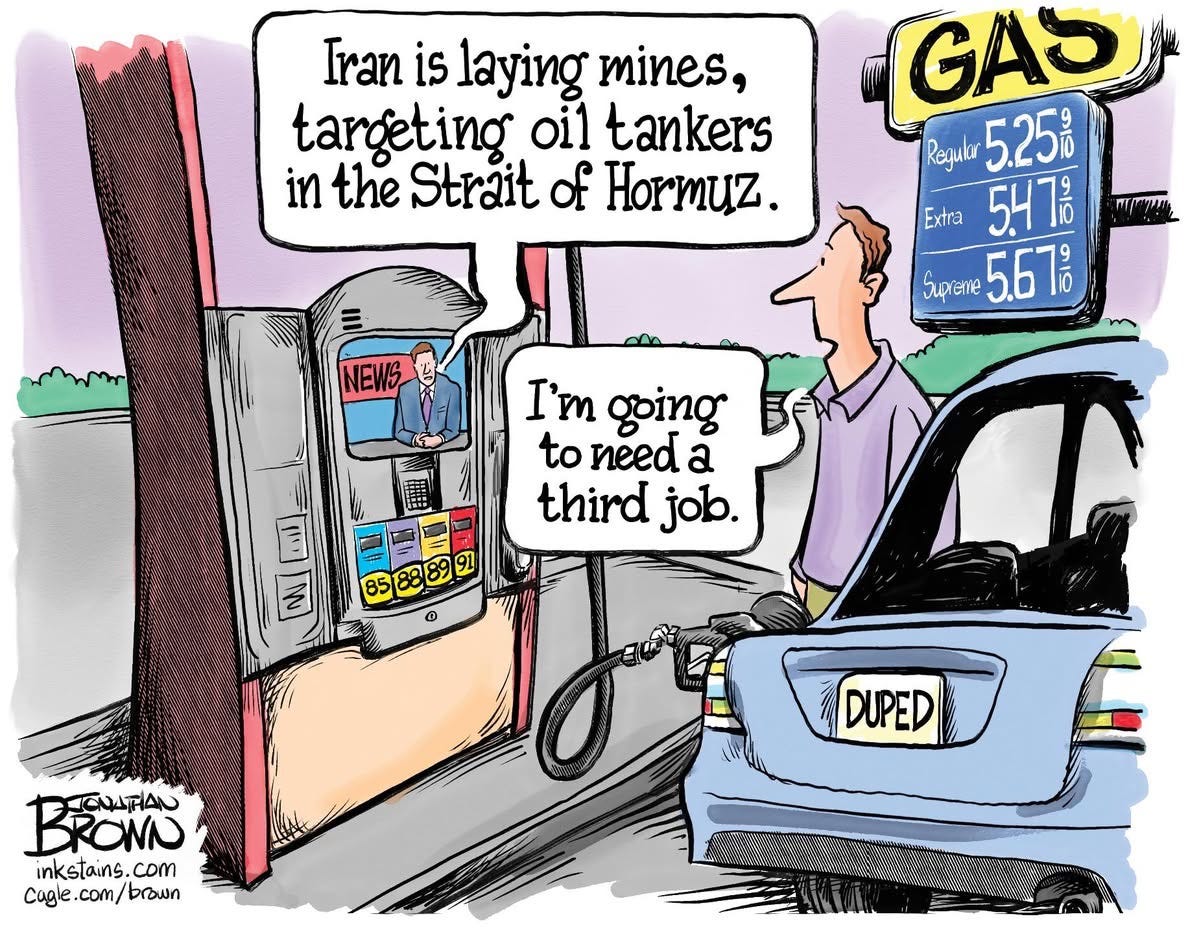
The economic consequences unfolled immediately. Oil prices surged past $100 per barrel. By March 8, gasoline prices had climbed to $3.45, a 16 percent spike in a single week. In Ohio, prices jumped from $2.87 to $3.28 in days. California’s already sat at $5.16 a gallon. Prediction markets placed 63 percent odds that prices hit $4.50 by the end of March. Analysts at RBC Capital Markets warned this could become the worst energy crisis since the 1970s oil embargo if the Strait of Hormuz remained closed. What was happening beneath the headlines was a deeper economic trap that no one in the Trump administration seemed to understand, or perhaps understood all too well. The U.S. was caught in a zugzwang—a chess term where any move makes the situation worse. National debt had reached $38.8 trillion. The deficit was 7-8 percent of GDP, twice the targeted level. Interest payments on the debt were now larger than the entire military budget. So the administration had reached for the only lever remaining: war. Conquest. Resource seizure. Lindsey Graham had said it plainly at a Senate hearing: “When this regime goes down, we are going to have a new Middle East, and we are going to make a ton of money. Venezuela and Iran have 31 percent of the world’s oil reserves. We’re going to have a partnership with 31 percent of the known reserves.”
What was striking about the political machinery surrounding the war was that almost nobody in Trump’s inner circle had wanted it. According to CNN’s March 8 reporting, Vice President JD Vance initially counseled against launching another unpredictable Middle East conflict. Secretary of State Marco Rubio offered only lukewarm support. Chairman of the Joint Chiefs Gen. Dan Caine laid out the potential negative consequences. And Susie Wiles, Trump’s chief of staff, was focused on something entirely different: keeping Trump’s message disciplined around domestic affordability and gas prices. Wiles had spent months building out a plan to hammer on grocery prices and fuel costs. It was a good plan. It was the kind of plan that wins midterms. But none of them fought the war. Once they came to see war as inevitable, they spent their energy racing to execute Trump’s wishes rather than trying to change them. Vance’s pivot was especially grotesque. He went from cautioning against war to arguing Trump should strike fast and hard. Now he was on Fox News insisting the conflict wouldn’t become a multi-year quagmire, even as he admitted it could go on for quite a while. He was gambling his 2028 presidential ambitions on a quick win in a region that hadn’t produced a quick win for any American president in living memory.
The public opposition to the war was historically unprecedented. The NPR/PBS News/Marist poll from March 2 through 4 found that 56 percent of Americans opposed U.S. military action in Iran. Only 36 percent approved of how Trump was handling the situation, down from 42 percent during the Soleimani crisis in 2020. Trump had started this war with the lowest support for any military action in modern American history. What terrified anyone in Wiles’ position who cared about November: even among Republicans, the support wasn’t rock-solid. Only 37 percent of Republicans “strongly” approved. Forty-six percent of Republicans said they trusted Trump only “moderately” or less on Iran decisions. And in a Reuters/Ipsos poll, 42 percent of Republicans said U.S. troop casualties would make them more likely to oppose the mission. Thirty-four percent said rising gas prices would do the same. Both triggers were already in play simultaneously, and the war was not even two weeks old.
Congressional Democrats were livid. On March 4, Senator Richard Blumenthal came out of a classified briefing “as dissatisfied and angry, frankly, as I have from any past briefing in my 15 years in the Senate.” Senator Chris Murphy noted on social media that the administration appeared to have no goals for the war except continued bombing, and no plan for reopening the Strait of Hormuz. Senator Jacky Rosen was frustrated that the administration was giving out information only under classified briefings. “We’ve been calling over and over again for them to come out of the classified briefings,” she said. “What I heard is not just concerning, it is disturbing, and I’m not sure what the endgame is or what their plans are.” She warned that Trump could not simply stop the war and have everything go back to the way it was on February 27. The Middle East had sustained too much damage.
In the Senate, Senator Tim Kaine forced a vote on a War Powers Resolution on March 4 to halt unauthorized military action in Iran. It failed 47 to 53, with Rand Paul as the sole Republican vote in favor. The next day, the House rejected its version 212 to 219, largely along party lines, with only two Republicans crossing over. This was the eighth war powers vote Congress had taken since June. All eight had failed. The Constitution says Congress declares war. Congress had functionally declared that it didn’t want to exercise that authority. And Speaker Mike Johnson had the gall to call the war powers resolution a “dangerous idea” that would “empower our enemies.” Yet even as the machinery of chaos accelerated, some institutions were beginning to resist. Federal judges were still issuing rulings. Investigative journalists were still uncovering buried stories. State officials were taking action on their own. The New Mexico Department of Justice was beginning to move toward searching Zorro Ranch. The question was whether it could organize, coordinate, and act before the window closed entirely.
Part II: The War Crime Coverup
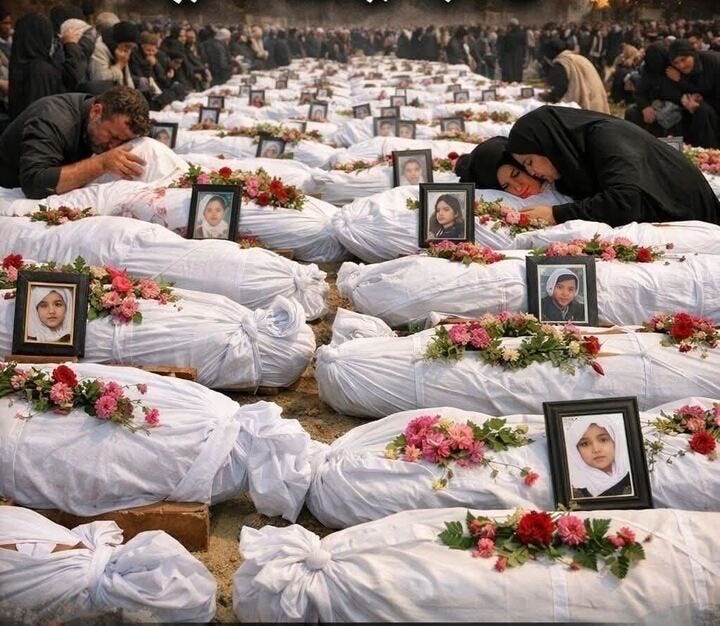
On March 10, a reporter asked Trump directly about video evidence that a U.S. Tomahawk missile had struck the girls’ school in Minab, Iran, killing approximately 175 children. The missile was visible in the footage, leaving a distinctive trajectory consistent with American weapons systems. The New York Times had analyzed the fragments recovered by Iran’s state broadcaster and found serial numbers and details consistent with a Tomahawk manufactured in 2014 or later. Every military expert who examined the video said it was almost certainly American. The Pentagon’s own preliminary assessment said the same. Only the United States operates Tomahawks on this scale, in this region, with this capability. Iran does not possess them.
Yet Trump was standing before cameras and suggesting, without evidence, that Iran had fired a Tomahawk missile at its own elementary school. The claim was absurd on its face. No nation fires cruise missiles at its own civilian infrastructure. No nation deliberately kills its own children. The idea that Iran had somehow acquired a weapons system that only three U.S. allies and the U.S. itself possessed, and then used it to destroy a school full of its own girls—it was the kind of claim that could only work if people stopped thinking.
What was truly damning was the scale of civilian destruction that international organizations were documenting. The World Health Organization verified 13 attacks on healthcare infrastructure in Iran since February 28, resulting in 4 healthcare worker deaths and 25 injuries, with 4 ambulances also damaged. Iran’s deputy health minister put the healthcare worker toll higher: 11 killed, including four physicians, two nurses, and three emergency workers. The Iranian Red Crescent—the humanitarian organization, not the government—had documented damage to more than 10,000 civilian sites within the first two weeks, including 65 schools and 32 medical facilities. By March 10, that figure had surpassed 19,000 damaged civilian units. Iran’s deputy health minister told Al Jazeera that more than 200 cities had been hit, and that the targets were “mostly civilian.” One Tehran resident, Mohammadreza, 36, reached by phone on March 5, described what he was experiencing: “Today is worse than yesterday. They are striking northern Tehran. We have nowhere to go. It is like a warzone. Help us.”
And then there was the Golestan Palace. On March 2, a US-Israeli strike on Arg Square in central Tehran sent blast waves into the 400-year-old Golestan Palace—Tehran’s only UNESCO World Heritage Site. Wooden doors, traditional Persian windows, and sections of historic mirror work were damaged. Iran’s Cultural Heritage Minister filed a formal complaint with UNESCO. UNESCO confirmed the damage and reminded all parties that cultural property is protected under the 1954 Hague Convention. The Archpaper noted: intentionally damaging a UNESCO World Heritage Site constitutes a war crime under the International Criminal Court. Iranian missiles had also damaged two Bauhaus buildings in Tel Aviv’s White City—itself a UNESCO World Heritage Site—on February 28, killing one woman and injuring more than two dozen. Both sides had struck protected heritage. Neither had been held to account.
At the Pentagon press briefing on March 10, something remarkable happened. Pete Hegseth stepped to the podium dressed like a parody of American power. His navy-blue suit pulled tight across his chest, a striped flag tie knotted to perfection, a stars-and-stripes handkerchief stuffed into his breast pocket. His hair slicked back, he adjusted the microphone and gave a grand performance as he spoke about war like it was a campaign rally. He bragged about raining “death and destruction from the sky all day long.” He declared the Iranian regime was “toast.” He smiled and said we were “punching them while they’re down,” and that’s “exactly how it should be.” And then, in a moment that was as predictable as it was grotesque, he closed his formal opening statement with a Bible verse. He weaponized Psalm 144: “Blessed be the Lord, my rock, who trains my hands for war and my fingers for battle.” Then he added his own prayer, asking God for “total victory over those who seek to harm our military.”
Standing just a few feet from Hegseth was General Dan Caine, the Chairman of the Joint Chiefs of Staff. The contrast was stark enough to suggest watching two entirely different briefings happening side by side. When Caine took the microphone, the first words out of his mouth were to honor the fallen and to share in the “profound grief” for the Americans who had been killed. He didn’t brag. He didn’t smile. He gave specific operational details, but he also praised and honored the service members who, not of their own choosing, were fighting and dying for their country. That is what a military professional sounds like. Even one with compromised loyalties, who many would say shouldn’t be in this position. Even a Trump appointee still managed to speak with more sobriety, precision, and respect for the lives at stake than the man who is technically his boss.
And that tells you everything you need to know about Pete Hegseth. When even the loyalists who got their jobs through the same broken system you did can at least approximate the weight of the moment, and they still outclass you, your failure isn’t just political. It’s personal, moral, and dangerous. This echoes from the past, from the 1940s, when France had one of the largest armies in Europe. But its leadership had been hollowed out by politics. Commanders were chosen for loyalty and connections, not capability. When Germany advanced, the strategic failures cascaded from the top down. France fell in six weeks. A nation with one of the most powerful militaries in the world collapsed because the wrong people were put in charge. That is what happens when leadership becomes performance, and loyalty replaces competence.
What was truly remarkable was that neither Hegseth nor Caine, during their entire briefing on March 10, addressed the girls’ school that was bombed. They did not get a single question about it from the journalists they called on—journalists from right-wing outlets like Gateway Pundit and OAN, carefully filtered to ensure only friendly questions would be asked. No journalist in that room pursued the central moral fact of the war: that approximately 175 children, mostly girls, had been killed by American weaponry. The Pentagon had replaced transparency with performance, and Hegseth was the lead actor in a production that was costing real lives.
And here’s where the story starts getting weird. Some analysts noticed that certain documents were disappearing from the public record. Later versions showed additional files. Could be catalog errors. Could be technical screwups. Could be bureaucratic chaos. But when documents appear, disappear, then reappear—people start asking uncomfortable questions. And that’s when Washington suddenly develops amnesia. Because to fully expose what happened at Minab was to expose something even larger: a pattern of atrocities being committed with American weapons, American targeting, American responsibility. And that required accountability.
Part III: The Oligarchical Corridor
The detention facility that the Trump administration called Camp East Montana represented something darker than the war. It represented the domestic apparatus of the authoritarian state, the machinery by which the regime would crush its internal enemies, the system through which ordinary people could be disappeared into vast warehouses and subjected to violence so normalized that the violence became invisible. The camp opened at Fort Bliss in El Paso in August 2025. Within fifty days, ICE’s own oversight office documented more than 60 violations of federal detention standards. Within six weeks, six people died while detained by ICE in Texas. One death was ruled a homicide by the county medical examiner. Geraldo Lunas Campos was a father of three who had lived in Rochester, New York for nearly twenty years. He begged staff for days to receive his asthma medication. Staff refused and threatened him with solitary confinement. Detainees said they heard him gasp that he could no longer breathe. Then silence. The machinery had worked as designed: a person had disappeared into the system, had been denied basic medical care, had died, and there was no one to hold accountable.
The Trump administration had built this facility in two months and awarded a $1.2 billion contract to a company operating out of a single-family home in Virginia. The project became the model for a warehouse network being built across the country. These were not facilities designed by experienced detention operators. They were warehouses being converted into human storage through expedited contracts awarded to politically connected firms. The projects moved through federal procurement systems at extraordinary speed because the normal checks and balances had been eliminated. Career civil servants who might have raised concerns had been purged or sidelined. Union contracts that might have created delays had been terminated. Congressional oversight had been neutralized. The machinery could operate without impediment.
What became visible in March was the true machinery of Pentagon waste. The Pentagon under Defense Secretary Pete Hegseth had blown through $93.4 billion in September 2025 alone, with more than $50 billion going out in the last five days of the month. To ensure the spending didn’t return to the Treasury, Pentagon officials bought a $98,329 Steinway & Sons grand piano for the Air Force chief of staff’s home. Hegseth had once declared in a September 30, 2025 speech: “It is completely unacceptable to see fat generals and admirals in the halls of the Pentagon.” That same month, the Pentagon spent $6.9 million on lobster tails, $2 million on Alaskan king crab, $15.1 million on ribeye steak, $225 million on furniture, including $12,000 for fruit basket stands and over $60,000 for Herman Miller recliners, and $139,224 on 272 orders of doughnuts. In October, the administration said it could not fund the Supplemental Nutrition Assistance Program (SNAP) because the government had shut down. Millions of Americans lost food benefits. But there was always money for lobster tails and grand pianos.
The grift involving Kristi Noem, Corey Lewandowski, and a web of politically connected firms revealed the actual mechanism of patrimonial wealth transfer. In early March, the Senate Judiciary sent a letter to Benjamin Yoho, CEO of The Strategy Group Company, demanding information about a $143 million Department of Homeland Security contract that had been awarded to produce advertising campaigns. The circumstances surrounding this lucrative, no-bid contract that ultimately benefitted a business with “long-standing personal and business ties to DHS Secretary Kristi Noem” raised critical questions about favoritism. According to public reporting, The Strategy Group and Yoho himself had a long relationship with Noem and her Chief Advisor Corey Lewandowski. Noem confirmed at a hearing that Yoho’s firm had managed the ad campaigns for her 2022 gubernatorial campaign. Lewandowski reportedly served as the intermediary. This was how the system worked: a governor’s campaign manager is appointed to a federal position. His preferred contractor gets massive federal contracts. The money flows upward, toward the oligarchy.
Meanwhile, Trump’s pardon scheme was operating at an unprecedented scale. By early March 2026, Trump had issued approximately 800 pardons and commutations. According to the conservative Cato Institute, these pardons had forgiven $1.5 billion in criminal debts—money that had been owed to victims and to the government. Biden’s pardons had eliminated roughly $680,000. Trump had pardoned convicted criminals and erased their debts to society at a rate that dwarfed any predecessor. The presidential pardon, which the Founders had envisioned as a tool of mercy applied sparingly, had been transformed into a favor factory. A billion-dollar favor factory in which the wealthy could buy their way out of consequences through contributions to Trump’s political machine.
What unified this system—the detention camp contracts, the Pentagon spending, the pardon scheme, the business deals for Trump’s family—was that it all flowed in one direction: upward, toward the oligarchy. And what held the oligarchy together was mutual vulnerability. It was the knowledge that everyone in the network had something to lose.
Behind all of this lay the Epstein network. New Mexico investigators reopened the criminal investigation into Epstein’s Zorro Ranch, searching for evidence of body burials. The Miami Herald’s Julie K. Brown revealed that an inmate had told the FBI he overheard guards discussing a cover-up the morning Epstein died in his federal custody cell. One guard had allegedly said to another, “Dudes, you killed that dude.” The implication was unmistakable: Epstein’s death in prison was not a suicide. It was a silencing. And if Epstein had been killed, it was because he knew too much.
The search of Zorro Ranch was the first serious federal investigation of the property in years. And it had been searched exactly zero times by the FBI in the years since Epstein’s death. While media focus remained on Manhattan and Palm Beach, Zorro Ranch had been left untouched. After Epstein’s death in 2019, the property had been sold in 2023 to a shell company. The buyer remained anonymous. The sale price remained undisclosed.
Why had this been allowed to happen? Because to fully expose Zorro Ranch was to expose the network. To name the scientists who had heard Epstein discuss his breeding program and said nothing. To identify the billionaires and politicians who had visited the property. To examine the flight manifests from the private airstrip, the medical records from the on-site facilities, the surveillance footage that would reveal who had been there and what had been discussed.
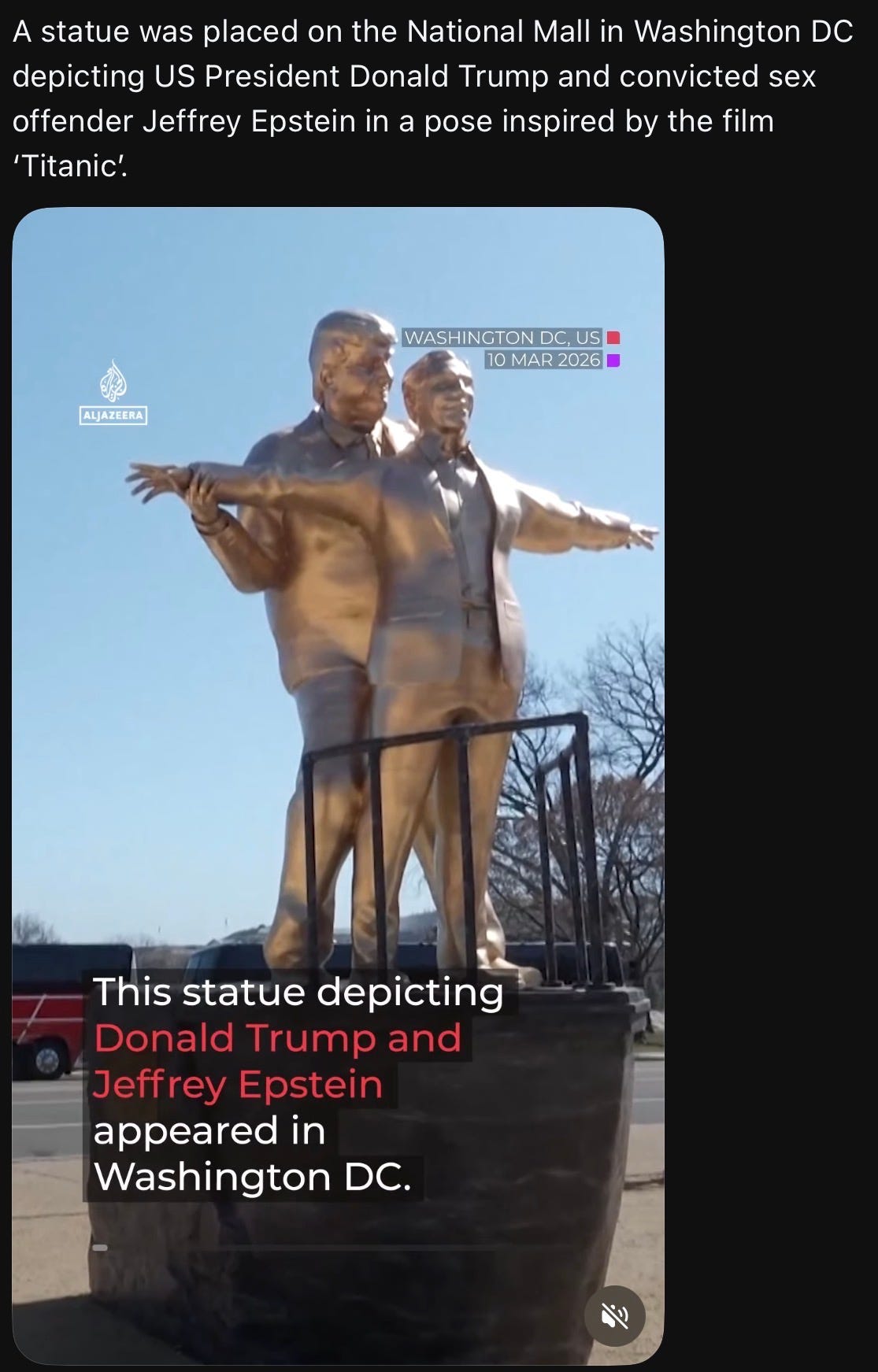
Epstein had operated within a network of wealthy and powerful men who shared his interest in accessing trafficked children. Trump had been part of that network for decades. There was the 1992 photo of Trump and Epstein together at Mar-a-Lago. There was Trump’s deposition in which he acknowledged attending parties at Epstein’s Manhattan mansion where young women “were not the type of girls Mr. Trump was interested in.” The implication was unmistakable: there were other types of girls at those parties. Trump had been sued in 2016 by a woman who claimed he raped her at an Epstein party when she was thirteen years old. The lawsuit was withdrawn after threats. But the filing meant that Trump was explicitly named as a participant in the network.
Epstein’s death in custody—ruled a suicide despite numerous irregularities—was one of the most consequential silencings in modern American history. His death meant that the person with the most complete knowledge of the network, the records of transactions, the identities of the men involved, was no longer able to testify. What made the Epstein network the true foundation of Trump’s apparatus was that it created mutual vulnerability. Every man in that network had reason to keep each other’s secrets. They were all potentially implicated. And once Trump became president, he had the power to ensure that the network would never be exposed. He could offer protection in exchange for loyalty. He could threaten exposure if loyalty wavered. He could bind the oligarchy together not through shared belief but through shared criminality and shared fear.
This was the real architecture of Trump’s apparatus. Not ideology. Not strategy. But kompromat—the mutual knowledge of each other’s crimes that bound everyone in absolute silence and absolute loyalty. Every person in Trump’s inner circle understood that their continued freedom, their accumulated wealth, their safety from prosecution all depended on Trump remaining in power and continuing to protect them. And Trump understood that their continued loyalty depended on his continued protection of them.
Part IV: The Rules We Buried
The most consequential power grab underway in early 2026 was happening almost invisibly, buried in federal register notices and administrative memoranda that only policy specialists read while drinking cold coffee at two in the morning. The Trump administration was systematically reclassifying federal employees from civil service protections into a new category called “Schedule Policy/Career”—a classification that stripped away the appeal rights and procedural protections that had been built into the system after Watergate, built into the system specifically to prevent what was now happening.
The Merit Systems Protection Board was the institution built to prevent exactly what was now happening. After Watergate, Congress learned a crucial lesson: presidents will eventually try to fire people who tell them no. Congress built guardrails. The system created an independent referee—an MSPB administrative judge who could tell a fired federal worker “Yeah, that firing is bullshit. You were fired for whistleblowing. Put them back in their job, with back pay.” Appeal routes to that referee existed to protect whistleblowers, people who exposed wrongdoing, people who refused illegal directives.
The new Schedule Policy/Career classification was designed to eliminate those appeals. When certain jobs moved into the new category, the employee who used to say “Fine, see you in front of the judge” would find that route narrowed or disappearing. When the referee is not watching, when the appeal routes disappear, the game gets rougher. At the same time, union contracts at agencies like the IRS were being terminated. Unions slow things down. They ask questions. They demand explanations. Take them away and the boss suddenly has a lot more room to run the play. Workers become easier to fire. Union power becomes weaker. Appeal routes become narrower. Individually, each move looked boring—just paperwork, personnel classifications, Federal Register notices. Together, they were changing who could challenge authority inside the government, transforming the federal service from an institution where questioning orders was possible into one where it was suicidal.
In the meantime, the Flynn summit and the election denial infrastructure continued its work. ProPublica reported that high-ranking federal election officials—Kurt Olsen, a White House lawyer charged with reinvestigating the 2020 election; Heather Honey, the DHS official in charge of election integrity; Clay Parikh, a special government employee at the Office of the Director of National Intelligence; Mac Warner from the Justice Department; and Marci McCarthy, who directs communications for the nation’s cyber defense agency—had attended a summit organized by Michael Flynn. The summit included election deniers like Cleta Mitchell and Kari Lake. The group broke into two camps: those pursuing an incremental legal strategy through courts and legislatures, and those demanding Trump declare a national emergency to take over the midterm elections. A draft executive order circulating among the activists would ban mail-in ballots and eliminate voting machines as part of a federal takeover.
Trump had made his intentions clear through coercion. On March 9, he threatened to shut down the government unless Congress passed the Safeguard American Voter Eligibility Act—a bill designed to disenfranchise millions of voters through strict voter ID requirements and elimination of mail-in voting. “I, as President, will not sign other Bills until this is passed,” he wrote.
But when the Senate tried to move forward, Majority Leader John Thune was blunt: “The votes aren’t there, one, to nuke the filibuster, and the votes aren’t there for a talking filibuster. It’s just a reality. And I’m a person who has to deliver, sometimes, the not-so-good news that the math doesn’t add up. But those are the facts.” Trump was putting so much pressure on congressional Republicans to pass the SAVE Act, adding anti-trans provisions to try to increase support, that it demonstrated his understanding that he could not impose the restrictions by executive order. He needed Congress. And Congress was beginning to show some backbone, however limited.
The voter ID push was revealing something dangerous: it was designed as voter suppression, not voter security. A friend of mine in Texas tried to get his driver’s license renewed but discovered they now require an official copy of your birth certificate. But he needed to get his birth certificate from Arizona, which requires a valid government ID, which he didn’t have because his license was expired. He needed a birth certificate to renew his license but he needed his license to get the birth certificate. This was why voter ID equaled voter suppression. Add all the people who’d have to travel—many places require in-person requests for birth certificates—the costs, the time, the fact that a slew of places have lost their records to fires, floods, and other disasters. Older people having home births. All of this had zero to do with the 0.0001 percent of documented voter fraud cases.
Meanwhile, the radicalization of the Republican coalition was accelerating at an alarming pace. A Manhattan Institute poll from October 2025 found that 54 percent of Republican men under fifty were Holocaust deniers. Among Hispanic GOP voters, 77 percent endorsed some form of Holocaust denial. Among Black GOP voters, 66 percent. The far-right fringe was not fringy anymore.
Extremist narratives had been amplified through digital networks that rewarded the most provocative voices. Over time, ideas that once belonged exclusively to fringe subcultures began migrating into broader discourse. Conspiracy theories about global cabals, apocalyptic visions of civilizational collapse, the idea that pluralism itself was a conspiracy—these narratives circulated widely.
Tennessee Rep. Andy Ogles, standing at a microphone with a dozen cameras recording, declared: “Muslims don’t belong in American society. Pluralism is a lie.” He called for deporting Zohran Mamdani, the naturalized U.S. citizen mayor of New York City who was Muslim. His social media post also declared that Islam leads to “rape,” “beheadings” and “burning people alive.” This was not a fringe voice. This was an elected member of Congress. This was the mainstream position of the Republican coalition.
When Speaker Mike Johnson was asked to condemn Ogles’ remarks, he refused. Instead, he said: “Look, there’s a lot of energy in the country, and a lot of popular sentiment, that the demand to impose Sharia law in America is a serious problem. That’s what animates me.” When pressed on the language Ogles used, Johnson said it was not the language he would have used but defended the sentiment. “We respect everyone’s beliefs,” he said. “But when you seek to come to a country and not assimilate but to impose Sharia law…that is the conflict that people are talking about.”
But nobody could name a single credible person demanding Sharia law in America. It was a manufactured crisis designed to motivate the xenophobes, Christian nationalists, and other people in the MAGA base. Just like “illegals” voting, sex change operations in public schools, and all the other manufactured culture war panics. But make no mistake: when Johnson said we respect everyone’s right to practice their religion freely, he was bearing false witness. He and Ogles wanted to turn the U.S. into a Christian theocracy. And the apparatus was accelerating that transition.
Latino support for Trump was collapsing. The Economist published an analysis showing that while Trump’s support surged from 36 percent in 2020 to 48 percent in 2024, by February 2026 his approval rating among Latinos nationwide had fallen from 41 percent to 22 percent in a single month. The issues that motivated many Latinos in 2024—immigration and the economy—continued to motivate them in 2026, but Trump had managed to turn presidential campaign strengths into midterm weaknesses. In a sign of panic inside the Trump administration, White House officials told surrogates to stop talking about “mass deportation.” Immigration and “mass deportations” had been Trump’s signature issues. They had become a liability.
Ed Martin, Trump’s hyper-partisan foot soldier in the DOJ, was facing investigation by the DC Bar. Among the many despicable actions, Martin had threatened that Georgetown Law School’s graduates would be banned from the DOJ if the school continued to promote diversity and inclusion. His effort to censor and punish the law school violated the Constitution in multiple ways. Martin was now facing the loss of his law license. The fact that one of Trump’s favorites faced the loss of his livelihood meant that others were staring at the ceiling in the middle of the night.
Part V: The Final Week
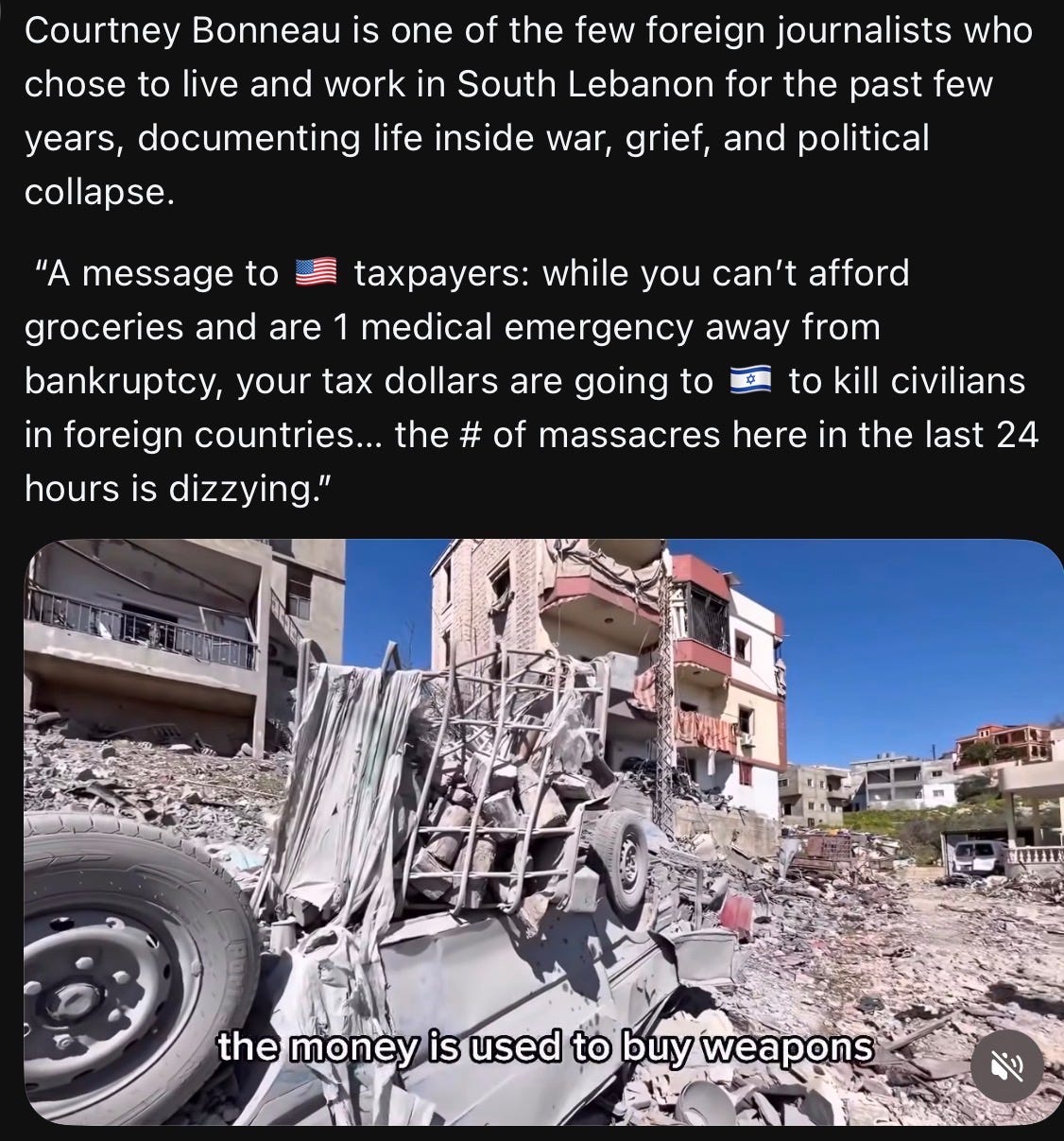
By March 10, the war had entered day 12. Eight American service members were confirmed killed. The Department of Defense released figures showing approximately 140 service members wounded, with 108 troops already returned to duty, while eight remained severely injured and were receiving the highest level of medical care. Iran reported 1,332 plus dead, including approximately 200 children. Lebanon reported 570 plus dead, with 700,000 plus displaced. The Strait of Hormuz was de facto closed to most commercial traffic. Ships were not moving through. The narrow strait was seeded with naval mines. Iran retained approximately 80 percent of its minelaying fleet and maintained between 2,000 and 6,000 mines in its arsenal, making passage unreasonably dangerous. Even the US Navy had refused to escort commercial ships through the strait, saying the risk of attacks was too high.
A single naval mine that could be manufactured for $15,000 could inflict a $300 million economic loss on a Very Large Crude Carrier. War risk insurance was now limited to 7 days instead of the whole voyage and cost 1 percent of the hull value—or more than $1 million per week. Oil was at $100-108 per barrel, compared to $67 on February 15. U.S. gasoline prices approached four dollars per gallon. AAA reported the national average jumped nearly 27 cents in a single week to $3.25 as of March 5. By March 8, it had climbed to $3.45, a 16 percent spike in one week. Prediction markets placed 63 percent odds that prices hit $4.50 by the end of March. Analysts at RBC Capital Markets warned this could become the worst energy crisis since the 1970s oil embargo if the Strait of Hormuz remained closed.
Qatar had ceased all LNG production. QatarEnergy, the world’s largest LNG producer supplying roughly 20 percent of global supply, issued a force majeure declaration on all delivery contracts. European gas prices surged 50 percent within hours. Asian LNG prices jumped 39 percent. The Ras Laffan plant had never been taken offline before in its history. The closure was being pushed back to at least 2027. Pakistan increased gasoline prices by twenty percent. Bangladesh shut universities early to save power. The Philippines implemented a four-day workweek. Vietnam saw “sold out” signs appear at gas stations. The Strait of Hormuz, the single most important chokepoint in global energy supply, was being used to fight a war that served no coherent strategic purpose and was destroying the global economy in the process.
But what was happening on the home front was equally catastrophic. Car repossessions had hit a staggering 2.5 million in 2025, the highest annual total since the 1.73 million peak during the 2009 Great Recession. Early 2026 trends pointed to 3 million plus as delinquencies climbed to 6.74 percent for subprime borrowers amid record-high auto loan rates of 11.5 percent plus on used vehicles and average payments topping $1,000 a month. Banks were overwhelmed with repossessed inventory, leading to a flood at auctions where cars were selling for pennies on the dollar. Banks were recovering just 45 percent of loan value on average while new car prices hovered at $50K plus, making affordability a crisis for middle-class families already stretched by inflation and stagnant wages. This echoed the pre-2008 housing bubble strains, signaling broader economic vulnerability where defaults could freeze credit markets and spark a recession.
The Republicans facing election in 2026 were in crisis. One consultant for a Republican congressional candidate said he had to rewrite his fundraising pitch because it had been built around “we brought gas prices down.” Gas was one of the few economic achievements they could point to—and it was disappearing. Trump’s approval was tanking, driven by concerns about rising costs. Every Republican candidate running for House, Senate, or governor faced an electorate angry about gas prices. And the war was making it worse by the day.
Behind the public messaging chaos was a harder reality: the Pentagon was worried about running out of the weapons it needed. Gen. Dan Caine had warned Trump before the operation that a major campaign against Iran would face challenges from depleted U.S. stockpiles. The concern centered on high-end interceptors (THAAD, Patriot, SM-3), the expensive stuff that takes years to replace. The Pentagon was now switching from advanced standoff munitions to cheaper gravity bombs, the kind that require pilots to fly closer to enemy territory, because they were burning through the good stuff too fast.
What should concern everyone, regardless of where you stood on this war: the Iranians were watching. When a wartime president told CBS it was “pretty much” over, and his own Pentagon said they’d just begun, that was not resolve. When stated goals changed five times in ten days, Iran’s new supreme leader saw a president who was not in control of his own strategy. Trump’s visible discomfort was undermining his own war effort. It emboldened the regime to dig in. It signaled to Iranians who might oppose their government that America didn’t have the stomach for this. And it created a vicious cycle: Trump’s fear of being seen as losing made him say things that made it harder to win, which made him more afraid, which made him say more reckless things.
There was a phrase that had followed Trump since his tariff debacles: TACO. Trump Always Chickens Out. When things didn’t go his way, he bailed. He announced 50 percent tariffs on Europe and reversed them in 72 hours. Doing the same thing with a shooting war where eight Americans had given their lives would be the most consequential TACO of all. But it would fit the pattern. And it would fit the man.
Steve Witkoff, Trump’s special envoy, was asked by a CNBC interviewer whether the Russians had shared intelligence about the location of U.S. military assets with Iran. If they had, American soldiers had died partly because Russia had betrayed American positions. The Washington Post reported on March 6 that Russia had been providing Iran with targeting intelligence since the war began on February 28. The intelligence included satellite imagery showing the locations of U.S. warships, aircraft, radar systems, and military infrastructure across the region. One official described it as a “pretty comprehensive effort.” The CIA station at the U.S. Embassy in Riyadh was among the facilities subsequently struck. Iran’s strikes in this war were measurably more precise than during the 12-day war last June—specifically targeting command-and-control infrastructure and early warning radar systems. Iran possessed only a handful of military satellites and no independent constellation. Russia’s advanced satellite network filled that gap directly. Yet when Witkoff was asked about this, his response was devastating in its naiveté: “I’m not an intel officer, so I can’t tell you. I can tell you that on the call with Trump, the Russians said they have not been sharing. That’s what they said. We can take them at their word.” Putin and Russia had lied repeatedly about Ukraine. They had murdered dissidents. They had fabricated justifications for every major action they took. And the Trump administration’s chief negotiator was saying Americans should “take them at their word.”
This was how empires end. Not with dramatic confrontation but with the steady erosion of competence. With the replacement of experienced professionals with loyalists and incompetents. With the systematic hollowing out of institutions. With the normalization of lies so grotesque that they become impossible to challenge. With the acceptance of outcomes that would have been unthinkable years earlier.
Yet even in this darkness, the machinery had not achieved total capture. Federal judges were still ruling against executive actions. State attorneys general were still investigating. Journalists were still publishing. Congress was still attempting resistance. The New Mexico Department of Justice had searched Zorro Ranch. Teachers were still refusing to teach hate. It was small. It was scattered. But it was real.
Part VI: The Networks of Capture
The machinery that dismantled American democracy in March 2026 was not some abstract force. It was people. Specific people with names and histories, ideological commitments that could be documented, networks that could be traced, incentives that could be exposed. At the center was Donald Trump. But Trump alone could not have done this. What made the apparatus functional was an ecosystem of loyalists, ideologues, kleptocrats, and true believers—each playing a specific role, each complicit in a system that extracted wealth upward while using ideological nationalism to keep the population mobilized and distracted. And underneath it all, binding them together in absolute silence, was the Epstein network—the infrastructure of sexual exploitation and mutual vulnerability that ensured no one could break ranks without exposing themselves.
### The Inner Circle: Where Ideology Meets Execution
Pete Hegseth walked into the Pentagon Press Briefing Room dressed like a parody of American power. His navy-blue suit pulled tight across his chest, a striped flag tie knotted to perfection, a stars-and-stripes handkerchief stuffed into his breast pocket. His hair slicked back, he stepped up to the podium and for the next thirty minutes, Pete Hegseth stumbled through his prepared remarks, trying to dress up bloodshed as patriotism. He gave a grand performance as he spoke about war like it was a campaign rally. He bragged about raining “death and destruction from the sky all day long.” He declared the Iranian regime was “toast.” He called the effort “wiping them out with ruthless precision.” And then, in a moment that was as predictable as it was grotesque, he closed his formal opening statement with Psalm 144: “Blessed be the Lord, my rock, who trains my hands for war and my fingers for battle.”
This is what happened when a military of this caliber was handed to a man whose entire career had been a series of red flags. Pete Hegseth did not rise through the ranks of military leadership. He served, yes. He deployed to Iraq. But then he became a Fox News host. That was the trajectory. From cable news to the Pentagon. There were years of evidence, and none of it suggested this man belonged anywhere near power. According to the New Yorker, in 2015, while running Concerned Veterans for America, Pete Hegseth got drunk at a bar in Cuyahoga Falls, Ohio, at 2:30 in the morning and repeatedly shouted “Kill all Muslims” in what an employee complaint described as “a drunk and violent manner.” This is the behavior of a man now commanding the military, conducting operations across the Muslim world, reading war psalms from the Pentagon podium while brave military personnel were in harm’s way. On the Shawn Ryan Show in November 2024, just weeks before being nominated, he said flatly that women should not serve in combat roles, that they “create drama” and cause “love triangles in the platoon.” In his own book, *The War on Warriors*, he admitted telling soldiers under his command to ignore the legal advice of military lawyers about when they were allowed to kill. He wrote dismissively about those lawyers, calling them “jagoffs.” Senators raised the possibility during his confirmation that this constituted a war crime. And this week, during an active war in which over 1,200 Iranians had been killed, he doubled down: “No stupid rules of engagement, no nation-building quagmire, no democracy-building exercise, no politically correct wars.”
Standing just a few feet from Hegseth was General Dan Caine, the Chairman of the Joint Chiefs of Staff. The contrast was stark. When Caine took the microphone, the first words out of his mouth were to honor the fallen and to share in the “profound grief” for the Americans who had been killed. He didn’t brag. He didn’t smile. He gave specific operational details, but he also praised and honored the service members who were fighting and dying. That is what a military professional sounds like. Even one with compromised loyalties, who many would say shouldn’t be in this position. Even a Trump appointee still managed to speak with more sobriety, precision, and respect for the lives at stake than the man who is technically his boss.
Karoline Leavitt, the White House Press Secretary, represented another tier of the apparatus: the functionary willing to lie without hesitation or visible conscience in service to the leader. She had chosen loyalty. In a patrimonial system, the loyalty of functionaries matters more than their integrity. They are valued not for wisdom or judgment but for their willingness to execute orders without question. Her entire speech was padded with superfluous filler words that added literally nothing to the actual meaning of what she said, but merely served to take up maximal airtime, making it sound as though she was completely in command of the White House communications. She was the translator of lies, the normalizer of atrocity, the person who made it acceptable to say false things in public by the simple act of saying them, with authority, with certainty, with the full weight of the office behind her.
Steve Witkoff, Trump’s special envoy, represented yet another tier: the businessman whose entire career had been built on proximity to power and the wealth that flowed from proximity. His value to Trump was not expertise in diplomacy. He had none. His value was that he could be trusted to execute whatever Trump wanted without questions, and he had the personal networks among oligarchs and power brokers necessary to make deals happen. The logic of Trump’s foreign policy was not defending American interests. It was making deals with other autocrats that benefited Trump’s personal network. If Russia wanted a favor—sanctions relief on oil, perhaps, or intelligence about what the Americans were doing—Witkoff would deliver it.
### The War as Distraction: Why Chaos Served Multiple Masters
Russia was the only major power for which this war was, so far, purely profitable. Russia’s Urals crude was now trading above Brent. Analysts estimated Moscow could generate tens of billions of dollars in additional state revenue if elevated prices persisted. Putin told policymakers at the Kremlin that it was “important for Russian energy companies to make use of the current moment.” European Council President António Costa was direct: Russia “gains new resources to finance its war against Ukraine as energy prices rise.”
But the oil revenue was only part of what Russia was doing. Russia had been providing Iran with targeting intelligence since the war began. The intelligence included satellite imagery showing the locations of U.S. warships, aircraft, radar systems, and military infrastructure across the region. Iran’s strikes in this war were measurably more precise than during previous conflicts—specifically targeting command-and-control infrastructure and early warning radar systems. Iran possessed only a handful of military satellites. Russia’s advanced satellite network filled that gap directly. There was also a supply corridor through the Volga River and across the Caspian Sea providing Russia and Iran with an interior supply line largely shielded from U.S. or allied interdiction. And while all of this was happening, the Trump administration was considering easing Russian oil sanctions.
But what was happening in the shadows was also oligarchical enrichment of Trump’s inner circle. On March 10, Trump announced a $300 billion oil refinery project at the Port of Brownsville, Texas. What was not mentioned was that Texas was running out of water. A massive petroleum refinery processing 922,000 barrels per day would require roughly one million gallons of fresh water daily. The water did not exist. But the project was approved anyway. What was also not mentioned was that Trump’s sons, Donald Jr. and Eric, had backed Skyward Defense Systems, a drone company pursuing $1.1 billion in Pentagon contracts. The war with Iran, which required massive drone deployments, would directly benefit Trump’s family business.
Senator Lindsey Graham announced he was heading home to South Carolina to ask families to support sending their sons and daughters to fight in the Middle East. Nothing boosts wartime enthusiasm quite like a senator asking for your children. The audience was wondering if the “temporary excursion” was about to become a “series regular” commitment.
### The Theological and Ideological Infrastructure: White Nationalism as Cover
The true volatility of the Middle East lay not in the physical movement of troops or the fluctuation of oil prices, but in the invisible layer of interpretation that blanketed the entire region. Western analysis remained stubbornly anchored in secular geopolitics. Yet this approach failed to account for the profound religious narratives that defined how the actors themselves perceived the conflict. In the United States, a significant segment of the Evangelical community viewed the modern State of Israel through the prism of eschatology, interpreting current events as the unfolding of a divine timeline. A striking image from the Oval Office showed Donald Trump surrounded by prominent figures from the American Evangelical world, with hands laid on his shoulders in prayer. This reflected a specific theological framework in which the political leader is cast as a Cyrus-like figure—an external ruler, outside the covenantal faith, yet divinely appointed to advance a sacred agenda.
For these believers, the geopolitical map was a reflection of the Book of Revelation and the prophecies of Ezekiel. In popular American “End Times” literature, ancient names were meticulously mapped onto modern states. Magog was identified as Russia, while Persia was identified as modern-day Iran. When a potential regional conflagration was framed not merely as a security risk but as the onset of a biblical prophecy, political support for Israel ceased to be a matter of standard foreign policy and became a cosmic necessity.
Meanwhile, the Islamic Republic of Iran operated within a framework of resistance deeply rooted in the Shiite tradition of martyrdom. The ideological foundation of the Iranian Revolution elevated the historical struggle of Husayn ibn Ali at Karbala from a seventh-century tragedy to a modern political imperative. In the rhetoric of the Iranian leadership, the confrontation with Israel and the U.S. was framed as a timeless battle against arrogance and tyranny, mirroring Husayn’s struggle. This theology of martyrdom was actively revitalized through contemporary losses. When high-ranking figures were killed, the regime framed these not as tactical setbacks, but as a continuation of the Karbala paradigm. Strategically, this meant that Iran’s “Axis of Resistance” was a theological mission where death in the field was a victory in the spiritual realm.
The danger of this convergence was a closed loop of interpretation where de-escalation became nearly impossible. These actors were not looking for a way out of the conflict, but for evidence that their faith was being realized through it. When all sides believed they were participating in a divine drama, the traditional tools of diplomacy lost their efficacy.
In March 2026, as the war escalated, a Manhattan Institute poll revealed that 54 percent of Republican men under fifty were Holocaust deniers. The far-right fringe was not fringy anymore. It was approaching majority position among the youngest segment of the Republican base. This was not accidental. Extremist narratives had been amplified through digital networks that rewarded the most provocative voices. Over time, ideas that once belonged exclusively to fringe subcultures began migrating into broader discourse.
The brilliance of white nationalism as an ideology was that it provided a framework in which kleptocracy and oligarchy could be repackaged as civilization defense. When the Trump administration seized resources and enriched the oligarchy, that could be framed as “America First.” When it constructed detention camps where people died from lack of medical care, that could be framed as defending the nation from invasion. When it used religious nationalism to justify state violence, that could be framed as defending Christian civilization.
One Trump nominee had agreed that “you could abort every black baby in this country, and your crime rate would go down.” Trump and Stephen Miller wanted to put this person in a lifetime judgeship. Another appointment—Erika Kirk, a white civilian with zero military experience—was selected for the U.S. Air Force Academy Board of Visitors. She would help oversee the academy’s morale, discipline, curriculum, and operations. This was who Trump was elevating to positions of influence over military training and leadership. When Senator Lindsey Graham appeared on Fox to discuss the war, he provided perhaps the clearest statement of what the ideology actually concealed. “When this regime goes down, we are going to have a new Middle East, and we are going to make a ton of money. Venezuela and Iran have 31 percent of the world’s oil reserves. We’re going to have a partnership with 31 percent of the known reserves.” Graham was not hiding the motive. He was stating it plainly. The war was about resource seizure. The ideology about defending civilization was cover for the actual goal: enrichment through conquest.
### The Final Indicators: Grift, Distraction, and Institutional Failure
The DHS had shut down. Not because of funding constraints, but because Congress had demanded ICE and CBP reforms as a condition of further funding. The shutdown, now on day 25 in early March, had caused 300 TSA officers to quit. The callout rate at TSA checkpoints had reached 6.16 percent—extraordinary levels that caused massive delays at major airports: LaGuardia in New York, Atlanta, New Orleans. A TSA agent was crying at an airport because she could not make her car payment and had not received a paycheck in weeks.
Meanwhile, the machinery of grift accelerated. The Trump Organization filed multiple trademark applications with the U.S. Patent and Trademark Office, trademarking the image and name ‘Trump 250’ as well as several variations. This meant Donald Trump would profit from America’s 250th birthday on July 4, 2026. The Trump Organization planned to make and sell bumper stickers, tote bags, cups, clothing, and golf balls, depriving the U.S. Treasury of any money made from ‘Trump 250’ products. The Kennedy Center board of directors was seeking a trademark for ‘The Trump Kennedy Center’ logo. One guess as to who would benefit financially.
But the most revealing scandal was the DOGE data heist. A whistleblower alleged that a former Department of Government Efficiency engineer took sensitive data on a thumb drive and offered it to his current employer. The engineer allegedly had taken two restricted government databases and planned to use the data at his new company. The databases contained personal information on hundreds of millions of Americans. The engineer allegedly told coworkers he had “god mode” access to edit records from his personal device. While the administration was “feeding programs into the wood chipper,” they had accidentally handed the keys to America’s identities to an unvetted private citizen.
This revealed something darker about the machinery. The administration wasn’t just incompetent. It was criminally reckless with the nation’s most sensitive information. Elon Musk’s DOGE team weren’t data analysts. They were hackers with access to federal systems and no regard for the consequences. And there were broader rumors: that Elon had his team move all of America’s Social Security data to a private server, first at OPM with only government employees’ info, then at the Treasury with everyone’s. That he had stolen the 2024 election using the same systems. That Trump had admitted it: “Elon knows those vote counting computers better than anybody. And we ended up winning Pennsylvania like in a landslide.”
In the wee hours of Saturday morning, with no fanfare, two staff members from the Architect of the Capitol mounted a bronze plaque honoring law enforcement officers who defended the U.S. Capitol on January 6. The plaque reads: “On behalf of a grateful Congress, this plaque honors the extraordinary individuals who bravely protected and defended this symbol of democracy on January 6, 2021. Their heroism will never be forgotten.” In March 2022, the House and Senate passed a law requiring that a plaque be installed on the west front of the Capitol. March 2023 came and went. Congress ignored its own deadline. The cause of the long-delayed installation was Mike Johnson’s illegal inaction. This was the latest in a list of Trump administration efforts to whitewash the insurrection.
Yet even as all of this unfolded—the war, the theft, the whitewashing of January 6, the expansion of authoritarian machinery, the collapse of democratic norms—one truth remained: the machinery had not yet achieved total capture. Federal judges were still ruling against executive actions. State attorneys general were still investigating. Journalists were still publishing. Congress was still attempting resistance. Career officials were still quietly refusing illegal orders. A teacher in Arizona was refusing to be bullied into silence by MAGA parents, willing to die on the hill of teaching real history and treating all students with kindness, respect, and compassion. Teachers nationwide were organizing. Lawyers were filing suits. Citizens were voting. Whistleblowers were coming forward. The New Mexico Department of Justice had searched Zorro Ranch.
And in what seemed like a signal of hope, Rachel Maddow, Stephen Colbert, and Joy Reid were reportedly teaming up to launch an independent newsroom outside corporate media. The goal was fearless journalism, sharp analysis, and zero network control. The media landscape might be about to change.
The Statue of Liberty stood 305 feet tall in New York Harbor, a gift from France in 1886. She represented freedom, democracy, and the promise of a new life for millions of immigrants. Her torch lights the way. Her broken chains symbolize freedom from oppression. And the 7 rays on her crown represent the 7 continents and 7 seas. She’s not just a monument. She’s a message. And that message was being tested as never before in American history.
The question that would define everything was whether the scattered points of institutional resistance could coalesce before the window closed entirely. Could the courts, Congress, the press, the states, and the people who still believed in accountability move fast enough to matter? Or would the machinery complete its work unimpeded? The answer would depend not on what Trump and his apparatus did next—their trajectory was clear. It would depend on what the people with power to resist actually chose to do with it. And that was a question whose answer remained unmade.
