
Civil Discourse with Joyce Vance
Mar 24, 2026
Today marks the 60th anniversary of the official demise
of the poll tax at the hands of the Supreme Court of the United States. On
March 24, 1966, the Court banned their use in state and local elections
in Harper v. Virginia Bd. of Elections. The Court held that “wealth or fee paying has . . .
no relation to voting qualifications; the right to vote is too precious, too
fundamental to be so burdened or conditioned.”
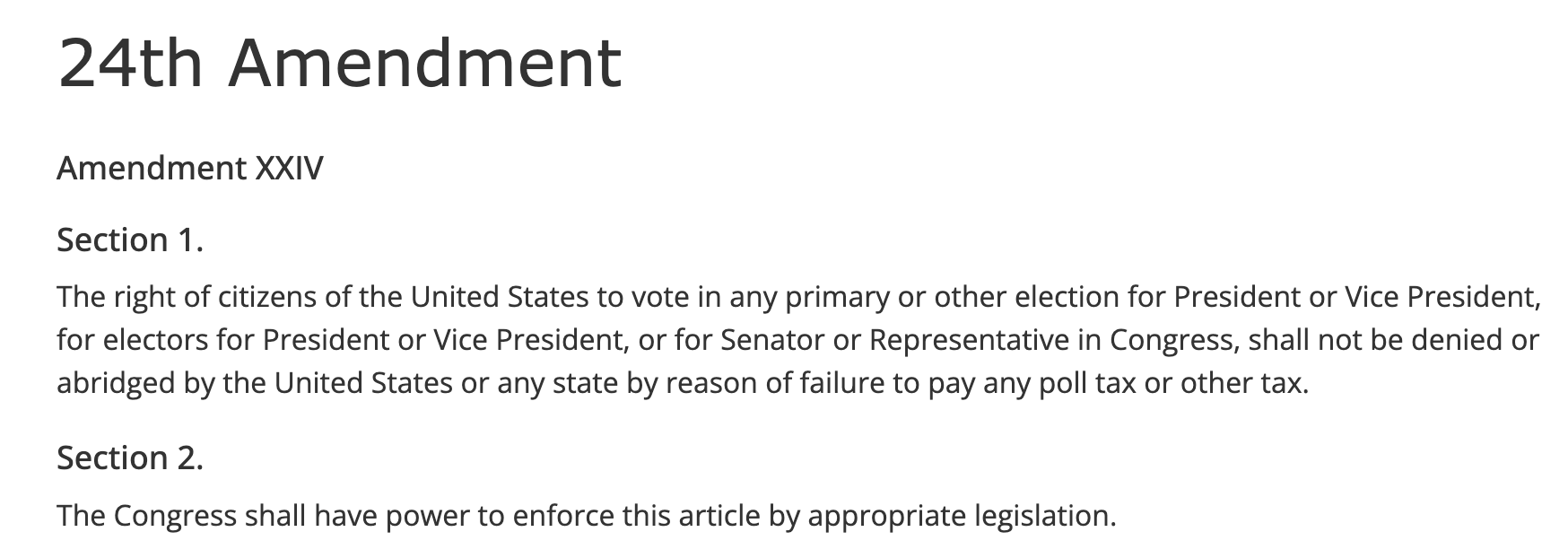
Harper was necessary because there was a loophole in the 24th Amendment, which had been ratified two
years earlier. The Amendment abolished poll taxes in federal elections, but
failed to address state and local ones. The Court slammed the door shut on any
notion that states could discriminate against voters’ fundamental rights when
the federal government was forbidden to do so.
“Undoubtedly, the right of suffrage is a fundamental
matter in a free and democratic society. Especially since the right to exercise
the franchise in a free and unimpaired manner is preservative of other basic
civil and political rights, any alleged infringement of the right of citizens
to vote must be carefully and meticulously scrutinized."
Today’s Harper anniversary is ironic, with Donald Trump
pushing the SAVE Act and Senate Republicans considering it, although it seems
to be foundering. The Act, which would require voters to prove they are
citizens, functions like a poll tax. Voters would need passports or other forms
of identification that are expensive to obtain in order to exercise their right
to vote. Additional costs would be borne by certain voters, like married women,
whose current name doesn’t match the one on their birth certificate.
It’s clear Republicans understand what the SAVE Act is
about: it’s not preventing non-citizens from voting, because that’s not a real problem. It’s about
maintaining Republican control despite what the voters want.

Harper: “To introduce wealth or payment of a fee as a measure of a voter's
qualifications is to introduce a capricious or irrelevant factor. The degree of
the discrimination is irrelevant. In this context -- that is, as a condition of
obtaining a ballot -- the requirement of fee paying causes an
"invidious" discrimination…that runs afoul of the Equal Protection
Clause.”
Today, Democracy Docket reported that Texas Republican Chip Roy,
one of the leading proponents of the SAVE Act in the House of Representatives,
and someone who has repeatedly dismissed “concerns
that millions of Americans would face unnecessary barriers while registering to
vote if the draconian bill became law,” took a different view in private.
In a video obtained by independent media organization
Call to Activism, Roy discusses how difficult it was for one of his employees,
a woman, to obtain the identification she needed to get a REAL ID, which is
similar to what the SAVE Act requires. In the recording, Roy says, “So, she had
to go through a bunch of hoops. She’s gonna have to go back to the DMV twice
because they want the paperwork. That’s just part of the issue with how we try
to set up the ability to identify people.”
This March 13 exchange between Senators Cornyn
and Durbin is illustrative:
·
Senator Cornyn: I don't
understand how the SAVE Act could disenfranchise millions of Americans.
·
Senator Durbin: You have
to present identification, but your driver’s license is not acceptable. 50% of
Americans do not have a passport. Those who want to obtain it so they can vote
will pay $186
The Court in Harper: “In a recent searching
reexamination of the Equal Protection Clause, we held, as already noted, that
‘the opportunity for equal participation by all voters in the election of state
legislators’ is required…We decline to qualify that principle by sustaining
this poll tax. Our conclusion, like that, in Reynolds v. Sims, is
founded not on what we think governmental policy should be, but on what the
Equal Protection Clause requires.”
We shouldn’t have to “go through a bunch of hoops” to
exercise a fundamental right. Republicans know exactly what they’re doing with
the SAVE Act and other measures designed to make it more difficult for
Americans to vote.
The Court concluded Harper like this:
“[T]o repeat, wealth or fee paying has, in our view, no relation to voting
qualifications; the right to vote is too precious, too fundamental to be so
burdened or conditioned.”
We’re in this together,
Joyce
