
Pretend I'm on the Ballot
PART I: The Price on the Sign
On the night of Friday, October 2, 2026, Donald Trump stood on a stage at the University of South Alabama's Mitchell Center in Mobile and asked a crowd to perform an act of collective imagination. "Can everybody just close your eyes and pretend I'm on the ballot?" he said. The arena seats 10,041 people, and in the footage that circulated afterward, entire rows behind the president sat empty, in a state he carried by thirty points less than two years ago. The request was strange on its face and revealing underneath. A president in the middle of his second term, constitutionally barred from standing again, was begging for a fiction because the reality in front of him was a Congress that could be taken from his party in thirty-two days, and with it the protection from consequence that Republican majorities have purchased for him since January of 2025. Everything in this account hangs on that single word, pretend. Pretend the prices are falling, pretend the war is nearly over, pretend the checks are in the mail, pretend the man at the lectern is the man who once filled football stadiums. The pretending is not incidental to how power is being held in America this autumn. It is the method, and the officials, donors, broadcasters and lawmakers who have agreed to help him pretend are the true subject of this story.
Mobile was a revealing choice of venue. The Mitchell Center rally was one stop in a swing through deep-red territory that also took the president to Texas and Oklahoma and, on Saturday, to Ohio, rather than to the traditional battlegrounds, and the Daily Beast reported that entire rows sat empty behind him even as he bragged that he had won "the highest vote total of any candidate in Alabama history." Doug Jones, the Democratic nominee for governor, said the president came because he "sees what we're doing in this state." The rally also produced the president's remark about a $3.2 billion bridge over the Mobile River, which he credited to his administration: "maybe they'll name the damn bridge after me." The Biden administration awarded a $550 million grant for the project in July 2024, and Representative Shomari Figures reminded the crowd at the groundbreaking that he "would be remiss not to thank the Biden administration." Jones put it more sharply on MS NOW, noting that the entire Alabama Republican delegation voted against the bridge, that Biden got the money approved, and that Republicans in the state legislature are now making the naming a priority. A president who must travel to the safest states he has in order to ask for votes is telling reporters something about the shape of the map, and about the grocery bill that every voter in those states opens at the end of the month.
Tom Schaller put the problem plainly in a Friday essay for Public Notice. When Trump ran in 2016 he lied about unemployment, claiming it was thirty or even forty percent when it was roughly four, and he could get away with it because no public billboards display the monthly jobs report. But the retail price of fuel is lit up in bright numerals at every filling station, truck stop and highway rest area in the country, and it cannot be spun. Gasoline has risen about a dollar since Trump launched his war against Iran, and diesel has nearly doubled in the twenty months since he took office. Average diesel prices have been reported at about $6.37 a gallon nationally, with a record near $6.52 in late September, and North Carolina's state average sits at $6.03, and the Labor Department's August reading already showed consumer prices 3.4 percent above a year earlier, before September's diesel surge worked its way through. Brent crude sat at $102.30 a barrel on Saturday, regular gasoline averaged $4.38 a gallon according to AAA, and the war that began the spiral is now in its eighth month. Most drivers never looked at the differently colored hose on the left of the pump. They are looking now, because diesel is the fuel that moves everything else.
The people who feel diesel most are the ones who built Trump's coalition. Writing in the New Republic, Virginia Heffernan noted that ninety percent of diesel truck buyers are men, more than eighty-four percent are white, and by one analysis Republicans purchase eight heavy-duty trucks for every one bought by a Democrat. The Washington Post observed that deep-red districts in farming country are especially exposed, because diesel powers the tractors, combines and grain haulers that agriculture depends on. Two long-haul truckers, one in Florida and one in West Virginia, went viral this month by posting receipts showing diesel fill-ups costing more than $1,000. In Indiana, one farmer told reporters he expects to burn about 9,000 gallons this harvest, with fuel costing roughly three dollars a gallon more than a year ago, and estimates suggest the war and supply disruptions could add $12,500 in fuel costs for every 1,000 acres harvested. A flooded ExxonMobil refinery in Illinois and a six-month labor dispute at a major BP refinery in Indiana made the Midwest's September worse than anywhere else, and experts warn that the Strategic Petroleum Reserve sits at its lowest level in forty-three years, leaving little cushion going into winter. Farmers who voted for tariffs and a wall are discovering what the bill looks like when it arrives.
The cost does not stay on the farm, and that is the reason it has become a national political event. Diesel prices are baked into the price of every commodity delivered by truck, which means food, building materials and nearly every consumer good, and Nobel laureate Paul Krugman has pointed out that higher diesel costs feed indirectly into the commodity prices the Federal Reserve uses in its core inflation measure, pushing up what Americans pay for car loans and mortgages. More than half of school districts are running over their diesel budgets, and a national survey found nearly forty percent consolidating bus routes or cutting field trips. In Maine, where roughly half of households heat with oil, Republican Senator Susan Collins has begged the federal government to double her state's heating-oil subsidy now that a 250-gallon home tank costs about $700 more to fill. Governors Jeff Landry of Louisiana and Greg Abbott of Texas issued emergency orders letting farmers haul crops on dyed off-road diesel normally banned from highways. San Francisco's ferry service will cut a daily Vallejo run in November to save $250,000. Meanwhile, mortgage rates posted their biggest weekly jump in four years, to above seven percent, and when CNN's Jake Tapper asked about it on Sunday, economic spokesman Kevin Hassett replied that the economy is booming.
The war that put those numbers on the pumps is, by any plain reading, one of choice. The United States and Israel launched it against Iran earlier this year, critics note that Congress never authorized it, and the administration's stated reason for fighting has wandered as the months passed. First the argument was a nuclear weapon. According to reports of his remarks in Texas this week, Trump said he bombed Iran partly because "they were doing drugs," and that the United States would win "very easily" right after the election, and he has threatened Iran with "annihilation." Tallies published Saturday from HRANA, Lebanon's health ministry, Israel's INSS and the Defense Casualty Analysis System count 3,684 killed in Iran, 4,386 in Lebanon, more than 1,200 in Israel, and, among Americans, 23 military dead and 861 wounded. The Pentagon has deployed the USS Theodore Roosevelt carrier strike group and sent about 9,000 more troops to the region, and it intends to keep the force in place even if diplomacy succeeds. Defense Secretary Pete Hegseth, meanwhile, called the Hormuz blockade "ironclad" after two vessels were struck in two days.
What has changed in the past week is not the war's morality but its politics, and the change is instructive about who enabled it. Iowa Representative Ashley Hinson, now the Republican nominee for Senate, voted repeatedly, including last week, against measures to restrain the war, and this week called for ending it, citing the war's effects on fuel prices in her state. Her Iowa colleagues Mariannette Miller-Meeks and Zach Nunn joined five other House Republicans in voting for a resolution limiting the president's war powers in Iran. A handful of Republicans, including the three Iowans, called for a diesel export ban, an idea Trump's own Energy Secretary, former oil executive Chris Wright, dismissed because trapped fuel would force refiners to cut output and raise prices elsewhere. Trump blamed Ukraine, floated a ninety-day export ban with Treasury Secretary Scott Bessent, an idea that drew immediate warnings that it would backfire. The G7 agreed to release up to 100 million barrels, though one analyst estimated the effect at perhaps twenty-five cents a gallon.
Schaller's most cutting observation was about timing. Trump's corruption, the human rights abuses, the vanity construction, the swelling deficits, the targeting of political opponents and the coddling of China and Russia were all insufficient to make these Republicans break ranks, he wrote, but surging diesel prices finally did. That is not a flattering portrait of a governing party, and it is also an accurate map of incentives. For nearly two years the cost of defying Trump was a primary challenge, as Representative Thomas Massie and Senator Bill Cassidy learned when they lost their primaries this cycle, while the cost of obeying him was nothing, because the voters who would have punished obedience were not yet feeling it. The calculation inverted when the pain reached the pickup trucks. Republicans who voted for the war when the war was abstract now speak against it when it is a number on a pump, and they speak against the very policies they voted for as if they had been bystanders. The reversal is not conversion. It is a reading of the polls, and the people reading them are the same ones who gave a president unreviewable war powers in the first place.
The labor market has joined the fuel market in telling the same story. The Bureau of Labor Statistics reported Friday that employers added just 29,000 jobs in September, the unemployment rate rose to 4.2 percent, and July and August were revised down by a combined 60,000. Hourly earnings rose 0.1 percent for the month and three percent over the year, below the pace of inflation, so most workers are losing ground even if they keep their jobs. The unemployment rate for Black Americans jumped a full point to seven percent, nearly double the 3.6 percent rate for white Americans. On Wednesday, nearly 1,400 people were laid off from what had been the Navistar truck factory in southwestern Ohio, three days before Trump's Saturday rally at a nearby high school, layoffs large enough to erase an entire year of job growth in the greater Dayton area, the Associated Press reported. Kyle Bos, who has two daughters and a third due in January, listed the ways his life is changing, including that five items at the grocery store now cost as much as a full cart once did. Asked how many times he had voted for Trump, he held up three tattooed fingers, and he plans to spend the final weeks before the election canvassing for Democrats. "Something has to change politically in this country," he said. "Seems like it just kept getting worse and worse and worse."
Faced with that evidence, the administration's answer has been to disbelieve it. On Saturday, Vice President JD Vance told Fox viewers that this is "not the time to sort of gripe about all the little things," a sentence that waved off gasoline, groceries, health care and rent in the week diesel hit the highest price ever recorded. On Sunday, Hassett told Tapper the economy was booming and the pollsters were wrong, even as Tapper read the jobs numbers back to him, including the 29,000 and the downward revisions. "What are you gonna believe?" Hassett asked. "The government hard data or the polls that have been wrong about every single election?" It was an extraordinary question, because the government hard data was the thing Tapper had just recited. In his TIME interview Trump claimed, "I would beat anybody running today by 20 points," and this weekend he wrote that the polls have always underestimated MAGA. A government that treats unfavorable measurement as a conspiracy of the measurers is practicing a form of preparation, one that matters enormously when the measurement is an election.
The measurements themselves are, in the language of pollsters, historic. The Associated Press-NORC poll released this week found just 31 percent approving of Trump's performance, 26 percent approving of his handling of the economy, and only 17 percent approving of how he is handling the cost of living. Quinnipiac put his economic approval at 31 percent and his handling of Iran at 28, CNN put his overall rating at 33, and NBC found that only 62 percent of self-identified MAGA Republicans now support him, down from 71 in the spring. Emerson and Marist have Democrats ahead on the generic ballot by eleven or twelve points, and a Navigator Research survey found that twenty percent of Trump's 2024 voters say they regret their vote. G. Elliott Morris of Strength in Numbers gives Democrats a 99 percent chance of winning the House, a probability that, like any forecast, depends on the polls being roughly right. These numbers are measurements of a mood at a moment, not guarantees. But when House Republicans tell CNN they have entered "triage mode," pulling money from Miller-Meeks in Iowa, Tom Kean in New Jersey and an open Nebraska seat to hold a potential Speaker Hakeem Jeffries's majority under ten seats, they are conceding what the polls say.
The same triage is visible in the Senate. The Senate Leadership Fund, the party's principal Senate super PAC, pulled out of North Carolina entirely, abandoning former Republican National Committee chair Michael Whatley in his race against former Governor Roy Cooper. The money is moving to Kansas, a state that has not elected a Democratic senator since 1932, where the committee booked $8.2 million to protect Senator Roger Marshall against Adam Hamilton, a pastor and former Republican. Marshall is entangled in a New York Times investigation of his aggressive debt collection from about 700 of his former obstetric patients, which led to the arrests of 81 of them, and two of Kansas's four living Republican governors have endorsed Hamilton. In Texas, the Senate Leadership Fund alone has put a record $131 million into the state, and outside Republican groups are on track to spend more than $200 million to rescue Attorney General Ken Paxton against Democrat James Talarico, an expenditure one GOP senator called "a five-alarm fire." One Texas Republican strategist, who put the chance of a catastrophic outcome at seventy-five percent called it a slow-moving car crash. Paxton, who survived an indictment and an impeachment on bribery and abuse-of-office charges without a conviction, is being propped up by the same donors who once told voters that character mattered.
Not every Republican is waiting to be rescued, and the manner of their exits is its own kind of record. Retiring North Carolina Senator Thom Tillis, in texts that will appear in his coming book, "How to Lose Friends and Antagonize Presidents," told Trump that he does not "take this bullshit from anyone, including you Mr. President," and told him to save his threats and head games for cowards and fools. Texas Senator John Cornyn said of the taxpayer-funded ad campaign that it is not an appropriate use of taxpayer money and "not even a close question." Florida Representative María Elvira Salazar ran an ad in front of the White House telling Trump his immigration crackdown has "gone too far," in a district he carried with 57 percent, and Wisconsin Representative Tom Tiffany broke with him on data centers, beef tariffs and the renaming of Lake Ontario. Senator Ted Cruz, meanwhile, answered Vice President JD Vance's suggestion that he is already running for president by calling Vance "insecure." None of this reflects a change of conscience. These Republicans are not apologizing for what they voted for or cheered. They are protecting their own seats, and the party that built its identity on loyalty is discovering how little loyalty is worth when it stops winning.
Alabama offers a close-up of what loyalty has cost. Former Senator Doug Jones, the Democratic nominee for governor, faces Tommy Tuberville, who used the president's rally to return to his favorite subject, asking the crowd to imagine a child coming home to announce that she is taking drugs and preparing for surgery "because my teachers and my principal says I can." The attack is of a piece with a Senate Republican ad in Ohio claiming that Sherrod Brown supports "irreversible surgery on kids," which News 5 Cleveland found features a woman who is not from Ohio and did not have surgery until she was nineteen, in Texas; surgery on minors is already illegal in Ohio. Behind these fights sits the Supreme Court's decision this spring in Louisiana v. Callais, a 6-3 ruling that a Louisiana map creating a majority-Black district was an unconstitutional racial gerrymander and that the Voting Rights Act did not require it. The Court's conservative majority, three of whose members Trump appointed, narrowed the reach of the Voting Rights Act, and the consequences for maps across the South are still being drawn. Candidates who cannot talk about prices talk about culture and districts, and voters in Alabama are being asked to choose which conversation matters.
History has a template for this moment, and Richardson and others have begun to use it. When Richard Nixon began his second term in January 1973, he enjoyed a 68 percent approval rating after a landslide, and by August, as Watergate and inflation ate away at him, his support had fallen to 31 percent. Commentators have noted that the same 31 percent now appears in the AP-NORC poll for Trump, and that he has now surpassed Nixon's record for appearances on the cover of TIME. In November 1974 the voters rebuked the party of the president, sending 49 new Democrats to the House and four to the Senate, the so-called Watergate Babies. The comparison has limits. Nixon resigned after senior Republicans told him the votes were gone, and no such delegation has yet appeared. Trump has, by his own account, no intention of conceding that he is weak. But the parallel is useful for another reason, which is that it reminds a reader that in 1974 the system's response depended on people inside the party choosing the institution over the man.
The pump price has a slower companion in the weather, and the week supplied evidence of it. Southern California is sweltering under a late-season heat wave, with temperatures expected to run 15 to 20 degrees above normal for at least a week, and a UCLA professor said Friday was nearly seven degrees hotter than the hottest October 2 on record and about thirty degrees above the historical average. Experts attribute the heat to a marine heat wave driving a strong El Niño, with a warmer climate adding to the strength of heat waves. In Hawaii, the roughly 550-year-old Hōlei sea arch in Hawaii Volcanoes National Park, which was still standing on September 23, had fallen into the Pacific by September 27, after Tropical Storm Nolo intensified into a hurricane, the third major storm to hit the islands in recent months. The cliffs had been unstable for years, and the United States Geological Survey wrote in 2014 that "it will not be here for ever." One collapsing arch is not proof of anything, and one hot week is not a climate. The pattern is the evidence, and the pattern is arriving at the same time as the price of fuel. A country that cannot afford the war also cannot afford the weather, and the people who pay for both are the ones filling their tanks.
Saturday night in Vandalia, Ohio, put the president's mood on display. Reese, whose newsletter is openly partisan and should be read as analysis rather than neutral reporting, described a rally that began forty-five minutes late after the motorcade rerouted around protesters. Trump told the crowd that Democrats "tried to kill me," that Republicans were going to "put them down once and for all," that Democrats were "a bunch of dumb sons of bitches," and that Republicans would win big and "shove it up their ass." Reese read the phrase "put them down" as the language used for euthanizing an animal and as evidence of intent to end opposition permanently, an interpretation that supporters would contest as political idiom. What is not contested is the transcript, in which Trump also promised every adult $5,000 if Republicans keep Congress, called Democrats "communist, socialist, radicalized lunatics," pointed at the press section as the crowd booed, and called CNN's Kaitlan Collins "such an unhappy person" who never smiles. He also recited "The Snake," dedicating the poem to Springfield, Ohio, a town of 32,000 where, he said, 35,000 people were put and "they're being removed," drawing chants of "De-port! De-port!" The same day, Springfield was mourning a Haitian high school student whose family says he died by suicide after being fitted with an ICE ankle monitor, and Governor Mike DeWine was among hundreds at the funeral.
The most consequential words of the week were spoken in the Oval Office on Monday, September 28, in an interview with TIME whose transcript was published this week. Asked whether he would use the Insurrection Act or other federal powers around the midterms, Trump refused to rule it out. Asked what would happen if Democrats won, he threatened, "I'll go after them." He said that Neil Gorsuch, Brett Kavanaugh and Amy Coney Barrett, the three justices he appointed, had become "a shell of their previous selves," and told TIME, "I gave them the position of a lifetime, and they vote against me often," framing their independence as a failure of loyalty. He threatened Iran with "annihilation," did not rule out "demolishing" the Kennedy Center, and spent much of the conversation on renovations and gold decor. Asked what he will miss most when he leaves office, he answered immediately: "This beautiful room." The sentence was a confession about what the presidency means to him, and everything else in the interview explains why it matters.
Whether the man answering those questions is fully capable of the office has become an open argument, and the argument deserves to be reported with care. Commentators have pointed to a six-minute-and-fifty-two-second press appearance before the Alabama trip in which, they say, the president fixated on whether the White House driveway should be stone or asphalt and was confused about a crane. Asked about South Korea's statement that it had not agreed to a $50 billion Alaska pipeline investment, he told a reporter to tell them he would double it. At a Saturday rally he said he takes a daily aspirin and described it as "the 386" dose against his doctors' wishes. Aaron Rupar called the TIME transcript evidence of "grave cognitive impairment," and Heather Delaney Reese wrote Saturday night that the president appeared to be in a "serious mental health crisis." These are the characterizations of critics, and no clinician has examined him publicly. The institutional question does not depend on the diagnosis, however. Behind a president whose public performance is under challenge stand people with their hands on the levers: chief of staff Susie Wiles, budget director Russell Vought, adviser Natalie Harp, and Vance. The Constitution has a procedure for presidential incapacity, and no officer who could invoke it has shown the slightest interest.
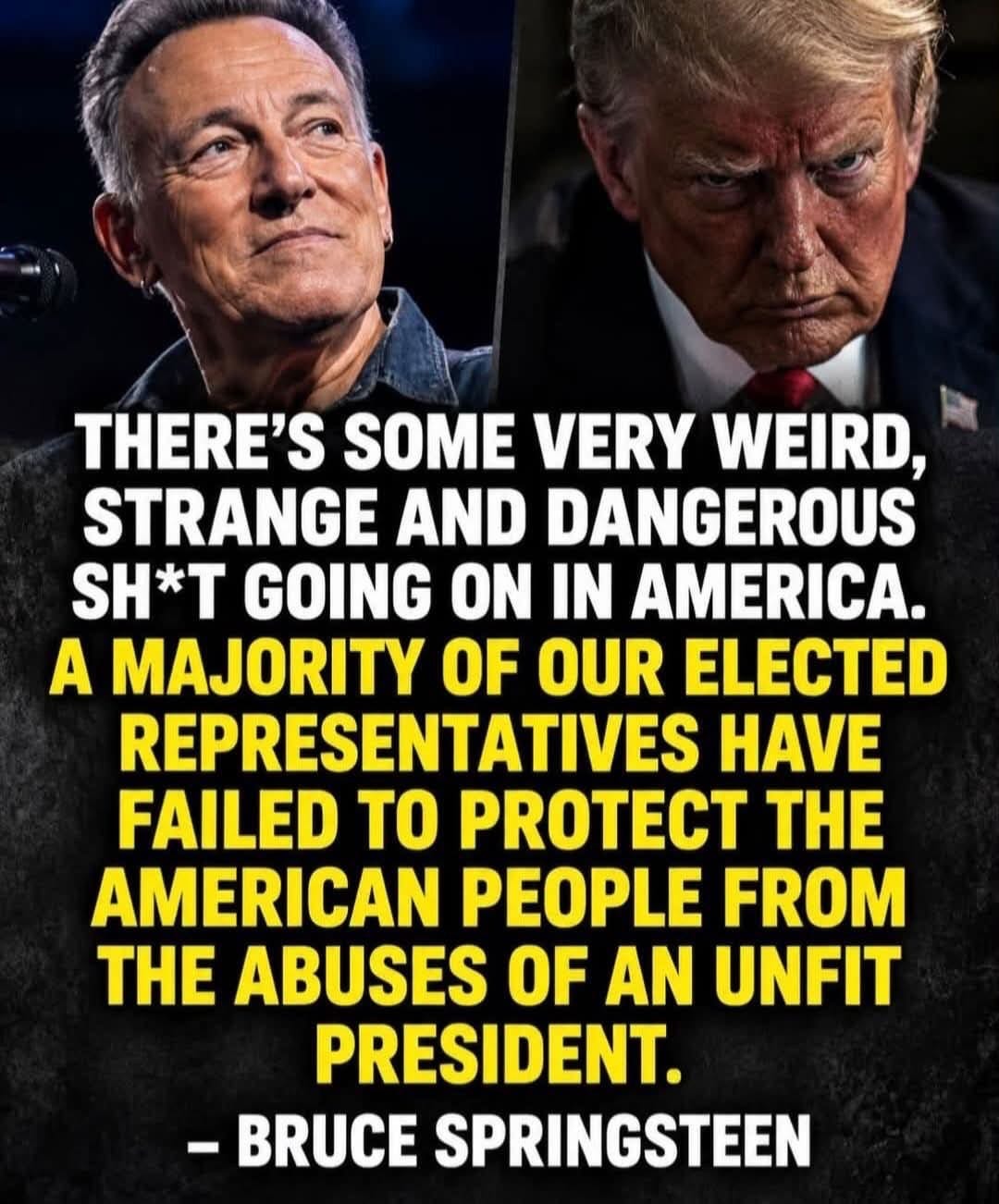
Saturday afternoon, twenty-five miles from the White House, the other America showed up. Roughly 20,000 people filled the Merriweather Post Pavilion in Columbia, Maryland, for guitarist Tom Morello's Power to the People festival, where Bruce Springsteen, Joan Baez, the Foo Fighters, Dave Matthews, Public Enemy, Killer Mike, Cypress Hill, Dropkick Murphys, Serj Tankian and others played for ten hours, and organizers donated a portion of ticket proceeds to VoteRiders, a nonpartisan group that helps people overcome barriers to voting. Springsteen sang "Streets of Minneapolis," describing Renee Good as a "mother of three, brutally murdered" and Alex Pretti as a "VA nurse, executed by ICE, shot in the back and left to die in the street," and told the crowd, "This is still America and this will not stand." Baez and Nathaniel Rateliff sang Woody Guthrie's "Deportee," the Dropkick Murphys played a song called "Don't Call Me a F*cking Terrorist," and the night ended with the whole bill singing "This Land Is Your Land," Morello adding the verse about the relief office that usually goes unsung. Guthrie, who died on this date in 1967, painted "This Machine Kills Fascists" on his guitar. Jack Smith, the former special counsel, was in the crowd, and Dave Grohl, mocking Senator Eric Schmitt's questioning of Smith at a recent Senate hearing, wore an Iowa Hawkeyes shirt during the Foo Fighters' set. Thousands chanted "ICE out now," the Baltimore Banner reported, and across social media Americans mocked a president who calls Democrats "Dumocrats" and James Talarico a "vaygan," because satire had become the common language of the week.
The word on the street, and on the stage, is that thirty days is a long time. The president who asked an Alabama arena to pretend he was a candidate told Ohio voters in his closing argument, "Even if you hate Jon Husted, even if you hate Vivek Ramaswamy, you're gonna go out, you're gonna vote," and urged his supporters to vote by mail after calling it a scam. That posture, along with his refusal to rule out the Insurrection Act, Senator Tammy Baldwin's warning that Trump is weighing sending armed agents to polling places, and the Justice Department's plan, defended by Todd Blanche, to send a thousand monitors to the polls, raises a question about the legitimacy of an outcome before a single ballot is cast. A single bad poll cannot topple a democracy, and a single bad month need not. What decides the matter is whether the people in the rooms, the governors and county clerks and judges and senators who have gone along for twenty months, believe they still have a reason to say no. The price on the sign is telling them that they do, and the Republicans who have already begun to distance themselves from him know exactly why.
PART II: Paid for by the U.S. Government
A viewer in front of a television on a recent evening, watching a football game or a morning show or a late-night comedy, could have seen a commercial that looked precisely like the work of a super PAC. The narrator describes a man with arms strong enough to "rustle the deep state" and gentle enough to deliver his own grandchild, and ends with the words "So God made Trump." The three-minute spot is a riff on the radio commentator Paul Harvey's celebrated "God Made a Farmer," was produced by a pro-Trump meme group, and was first shown to delegates at the Republican midterm convention in Dallas. The disclosure at the end is not the usual one. It reads, "Paid for by the U.S. Government." CNN has obtained at least thirteen such ads, including "King of the Jungle," which intercuts lions stalking prey with images of Barack Obama, Joe Biden, Nancy Pelosi, Hillary Clinton and Gavin Newsom; "Resilience," which features the Fulton County mugshot; and a spot promoting the UFC fight Trump hosted at the White House. The scale of what has been done, and the ease with which it was done, tells a reader more about this administration than any speech.
The New York Times established how the money moved. Twelve people familiar with the matter said Trump was eager to see laudatory advertising on television and personally told Office of Management and Budget director Russell Vought to find the money inside the government. Both Trump and chief of staff Susie Wiles spoke with Homeland Security Secretary Markwayne Mullin, who took over the department after Kristi Noem left, about the plan, and OMB counsel Mark Paoletta and White House counsel Will Scharf both said it would be legal to use Homeland Security funds. In an August Oval Office meeting that was supposed to concern super PAC spending for struggling Republicans, the Times reports, Trump showed more interest in having his aide Natalie Harp play videos of himself. On September 19, OMB shifted $20 million out of Customs and Border Protection funds into a budget line called "commemorative events," and the next day CBP awarded a $20 million contract to a Maryland public relations firm. At least $5.5 million has been spent so far, and the White House says the campaign will expand. Asked about it, Trump said, "If somebody said that that's wrong, I'll gladly pay the money," and insisted, "I'm not promoting myself because I'm not running for office. I'm promoting the country."
The legal and moral problem is that Congress said what that money could buy, and propaganda was not on the list. According to the Washington Post, the border-security appropriation allowed Customs and Border Protection to spend on port inspection equipment, border surveillance and screening unaccompanied children, while the "commemorative events" line was meant to pay for memorials to officers killed in the line of duty and commendation ceremonies. Aaron Parnas, an independent journalist who is preparing his own investigation of the spending, put the point directly: funds that Congress set aside for fallen officers' memorials were used to air advertisements worshipping a living president. Since the 1950s, Congress has attached to its spending bills a ban on using public funds for "publicity or propaganda," and the Government Accountability Office has found violations under both Barack Obama and George W. Bush. But those cases involved promoting policy, such as health-care enrollment campaigns, and none involved advertisements praising the president personally in the weeks before an election. The administration's defense, offered by Trump himself, is that the ads promote the country, a claim contradicted by the lions and the mugshot.
What makes the episode unusual is how quickly Republicans abandoned the defense. Representative Jamie Raskin called the spending potential "felony criminal theft and conversion of government property for political campaign purposes," and he and Representative George Whitesides asked the GAO to investigate violations of the Hatch Act, the Antideficiency Act and statutes against embezzlement, an inquiry Democrats could pursue with subpoenas should they win the House. Senators Patty Murray and Chris Murphy called it "a shockingly corrupt misuse of taxpayer dollars." More striking was the reaction on the other side. Texas Senator John Cornyn said the ads are not an appropriate use of taxpayer money and "it's not even a close question," and North Carolina's Thom Tillis said Trump should pay for them from his super PAC. That PAC, MAGA Inc., holds more than $400 million, and Trump has said of it, "This is my money that I control." Why would a president with $400 million at his disposal reach into border funds? The Times could not say. Senators Murray and Murphy gave Mullin 48 hours to explain, a deadline that passed Thursday, and when asked about the letter DHS pointed to the White House's earlier response.
The same impulse to buy political loyalty with public resources explains the checks. Nearly a million Americans opened their mailboxes this week to find a $500 refund from the Treasury along with a letter from the president claiming "the Biden Administration overcharged you." The White House says the refunds return excessive exchange fees, but UNC health policy professor Jonathan Oberlander noted that the fees rose and fell under Biden and were at times lower than in Trump's first term. Only 950,000 of the nearly 19 million Obamacare enrollees qualify, because the payments go only to people in the 30 states using HealthCare.gov who pay full price after Republicans let enhanced subsidies expire at the end of last year. A Reuters analysis found that 71 percent of the money, or $339 million, is going to residents of 13 states that host eight of the nine most competitive Senate races and ten of the twelve most competitive governor's races. Democratic strategist Eric Stern said it is "pretty damn obvious" what is going on. Cornell political scientist Douglas Kriner, who studies such efforts, estimated they could be "worth a percentage point or two," mostly by consolidating Republican voters.
The check is a small gift set against a very large bill. KFF, the health policy research group, estimates that premiums for the full-price enrollees could quadruple in some states to more than $2,200 a month, so the $500 will not offset the increase for most of them, and the increases land on the same households whose refund checks are being mailed this month. Medicaid cuts and the expiration of subsidies, the policy choices that preceded the checks, are projected to push many families past the point where they can afford coverage, and researchers have long linked medical bills to personal insolvency. A widely shared 2019 study, cited again this week, found that roughly two-thirds of personal bankruptcies involve medical expenses. The administration's answer is to point to tax cuts on tips, overtime and Social Security in the One Big Beautiful Bill Act. For a worker whose employer has just closed a plant, or an enrollee in Texas facing a premium notice in November, the question is how those two ledgers net out, and the answer is arriving in the mail.
The promises keep multiplying. Friday night Trump announced a one-time payment of "nearly $100," in fact $90, to more than 20 million Medicare enrollees, drawn from a $2 billion Medicare Improvement Fund that Congress created to improve the program, which he called "a pointless 'Slush Fund.'" The standard Part B premium is $202.90 a month, so the payment covers less than half of one month. In Oklahoma and again in Ohio he promised $5,000 to every adult citizen if Republicans keep the House and Senate, a pledge he acknowledged would cost about $1 trillion and which Reese calculates would reach $1.2 trillion across roughly 245 million adults. Polls show 66 percent of voters call the offer "inappropriate" and 61 percent of likely voters in the Economist/YouGov survey do not believe he will deliver, though a Harvard CAPS/Harris poll found 57 percent in support. A list circulated online tallies earlier promises, among them DOGE checks and $2,000 tariff checks, none of which has been issued. Trump told an Oklahoma crowd, "I never fail people," and told an Ohio audience that $500 "refund checks" were "already in the mail." The president's own words are the best evidence of the strategy: offer a number, collect the vote, blame the Democrats.
The clemency record tells a related story about whom the government protects. In a video posted this week, Trump asked Congress to impose mandatory minimum prison sentences on anyone who steals from Medicare and Medicaid, ban probation and double sentences for repeat offenders. A widely shared thread summarizing the record noted that in December 2020 he commuted the 20-year sentence of Philip Esformes after about fourteen months; Esformes was convicted in what the Justice Department called the largest health-care fraud scheme it had ever charged, $1.3 billion, and later pleaded guilty to additional Medicare fraud counts after a retrial. Trump also commuted the sentences of Judith Negron, convicted in a roughly $200 million scheme, and Salomon Melgen, who was serving 17 years for defrauding Medicare of $42 million, and in his second term he commuted that of Lawrence Duran, convicted in a $205 million case. The thread cites a KFF Health News review that counted at least 68 pardons or commutations for people convicted of fraud or of interfering with fraud investigations, at least thirteen of them involving more than $1.6 billion in false claims. The pattern fits the larger design: harsh words about fraud when speaking to the voters, and mercy for the convicted when the convicted are connected.
If a president can spend what Congress forbade, it follows that he can also decline to spend what Congress ordered, and the same week brought two more instances. Reporting this week indicates that the State Department is redirecting $52 million in military assistance that lawmakers appropriated for European and Middle Eastern countries damaged by Russia's war on Ukraine to the right-wing governments of Panama, Peru, Ecuador and Colombia. When the department told Congress of the plan last month, Senator Jeanne Shaheen and Representative Gregory Meeks placed a hold on the funds. Late Wednesday the administration told Congress it was defying the hold, and the State Department explained that the Western Hemisphere is a priority and the money would be better spent there. The Constitution gives the purse to Congress, and it makes no exception for allies of the president. The pattern is not confined to foreign aid. On September 29 the Government Accountability Office found that the administration's "pocket rescissions," which froze about $810 million for housing counseling, refugee resettlement, programs for the children of migrant workers and minority businesses until the money expired, violate the Impoundment Control Act. Representative Rosa DeLauro said the finding confirms that the White House "is breaking the law to steal resources from our communities," and a coalition of states including California, Maine, Maryland, Michigan, New Mexico, Nevada and Oregon has sued. Budget director Russell Vought told a Senate hearing in April, "We have not impounded anything."
Congress, meanwhile, has barely been in town to notice. Representative Joe Neguse noted that under Republican control the House has been in session just 72 days this year, 26 percent of the calendar. The arithmetic of absence matters. A House that does not meet cannot hold hearings, cannot subpoena, cannot vote on measures such as the resolution limiting the president's war powers in Iran, which drew seven House Republicans. Johnson has argued he remains "absolutely still convinced" that his party can hold the House, and he is probably right that gerrymanders in Texas and Florida could save some seats. But his choice to keep the chamber dark during a war, a fuel emergency and a spending scandal is a decision to let the executive branch act without interruption. Congress, a branch whose reason for existing is to interrupt, has chosen to be absent. One widely shared reaction observed that Republicans hold the House, the Senate, the White House and the Court and still have little to show beyond letting the president govern by executive order. Representative Jamie Raskin, the top Democrat on the House Judiciary Committee, told the Washington Post that reversing the president's uses of power will take decades, saying, "We have a massive reconstruction task ahead of us," and that reconstruction, "when it's allowed to work," has been far more successful than "either authoritarianism or revolution."
At the Kremlin on September 5, according to the New York Times, Vladimir Putin raised an idea with Trump's envoys Jared Kushner and Steve Witkoff: a sale of the international assets of the Russian oil giant Lukoil, frozen abroad since American sanctions, as a way to rebuild business ties between the two countries. The negotiators, neither of whom the Senate confirmed to any post, have since helped set terms for the sale, in which the leading bidders include a group involving Trump donor Todd Boehly, who gave $2 million to the president's political efforts; Qatar-based investors with business ties to Kushner; an Abu Dhabi fund linked to Sheikh Tahnoon; and an arm of the U.S. government, which would take a stake. Treasury rejected an earlier bid for Lukoil's refineries and gas stations last November, calling the would-be buyer "the Kremlin's puppet." The assets include about 200 gas stations in New York, New Jersey and Pennsylvania. According to the Times, U.S. approval for the sale would release the assets from American sanctions, instantly increasing their value. The administration says the sale would lower energy prices. The Times noted there is no indication Kushner or Witkoff would personally profit, and that the overlapping business relationships have nonetheless raised conflict-of-interest concerns, a description that is accurate and that understates how unusual the arrangement is.
The Lukoil talks have to be read alongside the war that Russia is waging. This week, three missiles and two drones from a Russian attack on Ukraine crossed into Moldova and exploded on Moldovan soil, scattering debris across several eastern districts, and President Maia Sandu said, "Its war is dangerously reaching Moldova." Russian missile strikes knocked out three of Kyiv's six road bridges, and Putin warned NATO earlier in the week that he might use nuclear weapons. The administration, according to reporting this week, did not invite Britain, France, the Baltic states or other allies to a NATO meeting in Poland organized by Pentagon policy chief Elbridge Colby, a decision that suggests a plan to sort allies by loyalty. Against that backdrop, a sanctions-easing oil sale negotiated with the Kremlin's participation is the kind of arrangement critics have in mind when they ask whether foreign influence has found an entrance, which is why a Bluesky commenter quoted George Washington's farewell warning that foreign influence is "one of the most baneful foes of Republican Government."
Washington's warning has a cousin in the way the administration treats other countries' resources as American entitlements. At the Alabama rally Trump said the United States will soon refill the Strategic Petroleum Reserve "for nothing" by taking billions of dollars of oil from Venezuela, and bragged that the United States took over that country in just "148 minutes." Historian Timothy Snyder, speaking this weekend, compared the administration's approach in Latin America to Soviet tactics in Eastern Europe after World War II, calling it "smash and grab." It is not a settled factual question how much oil Venezuela can provide, or on what terms. What can be said is that a government that tells its own voters the oil is free is describing a policy of seizure, and one widely shared reaction called the proposal looting. The hosts of a MeidasTouch program this weekend added claims that the administration is orchestrating a judicial coup in Bolivia and interfering in Brazil's elections, which are the hosts' characterizations and are not established here, but which Snyder's comparison invites readers to weigh. What is documented is the claim itself, made on a stage in Alabama: that a country taken in 148 minutes will now pay, in barrels, for the American stockpile that the war has drained.
The president's appetite for ownership extends to the physical center of the capital. A federal judge ordered his name removed from the Kennedy Center in May because "only Congress can change it," and the center has been closed since September 15 after a partial ceiling collapse. Trump has said he will not fund the renovation unless the name change is approved, and the Kennedy Center Honors will be held for the first time at the Capital One Arena. At a rally Friday, Trump said of a $3.2 billion Alabama bridge that was started with $550 million from the Biden administration, "maybe they'll name the damn bridge after me." Palm Beach's airport is now the President Donald J. Trump International Airport. In a New York magazine interview he explained that he is remaking Washington in his image because "nobody will do it once I'm gone." A man who believes the buildings should carry his name does not expect the country to outlast him.
The people who pay for such an order are rarely the powerful, and the cases that make the point are the ones of people with the least leverage. A federal judge, at the request of the Trump administration itself, has stripped the "integration" requirement from the Section 504 disability regulation, which for nearly fifty years required federally funded programs to serve people in "the most integrated setting," meaning at home, not in a nursing facility. The case, Texas v. Kennedy, began as a Republican-state challenge to protections for transgender people, but by September the administration had joined Alaska, Florida, Louisiana, Montana and Texas in asking the court to vacate its own rule. "It is pretty significant and pretty unprecedented to see the federal government asking a court to vacate its own rules," said disability rights lawyer Jennifer Mathis. In June the Justice Department said it no longer reads federal law to require the most integrated setting, even acknowledging that its position is out of step with the Supreme Court's 1999 Olmstead decision, and in August it asked a court to throw out its own 2023 victory requiring Florida to provide in-home care so that medically fragile children are not placed in nursing facilities. Mathis called the reversal "incredibly heartless."
For one Louisiana mother the case is not a regulation. Cravins, whose toddler with Down syndrome relies on publicly funded therapies delivered at home, told reporters that the stakes are simple: "This affects children, this affects adults, it affects your elderly parents. It affects everyone." Her family's situation rests on the idea that a disabled child belongs in a home and a neighborhood and not a facility, an idea written into American law by disability activists who spent decades fighting for it. Bruce Darling of the Center for Disability Rights said the ruling felt "like a knife in your chest." Delaware has written the stripped protections into state law, at least a dozen state leaders have called professor Alison Barkoff about doing the same, 100 members of Congress have urged the Justice Department to rescind its June opinion, and advocates are pushing the Latonya Reeves Freedom Act to codify the mandate. At the same time Vought's budget office has proposed a rule barring federal grant money from voter registration drives, which would threaten the $10 million a year that has helped narrow the gap among about 740,000 disabled voters, and a former OMB general counsel called it "a massive across-the-board power grab."
A parallel retreat is under way in how the government treats sexual violence, and its human face is a young woman identified only as Jane Doe. She has sued Cornell University and seven members of the Chi Phi fraternity, alleging that they sexually assaulted her over several hours while she was under the influence of ketamine, alcohol and marijuana. Records obtained by NBC News show Tompkins County District Attorney Matthew Van Houten declined to prosecute in November 2024 after reading only her six-page statement and without reviewing witness interviews or other evidence campus police had gathered, and she was not told for nearly two months. Governor Kathy Hochul appointed Attorney General Letitia James as special prosecutor, asking, "In what world does the district attorney not even interview her?" A USA Today analysis found Cornell suspended or expelled students found responsible in 41 percent of cases against 59 percent at comparable New York schools. Jane Doe told the university hearing, "I felt like bait. I felt like lions around me." On September 28 the Trump administration formally reinstated its 2020 Title IX rules, which make it harder for schools to find students at fault. Asked about James's appointment, Trump replied, "I feel badly for whoever she's looking at, because they won't get a fair shake."
The power to punish is exercised just as casually in other corners of the state. Tennessee's attempt this week to execute Christa Pike, who was sentenced to death at eighteen for a 1995 murder, left her alive on a ventilator after two full doses of pentobarbital apparently entered her tissue and not her bloodstream, her lawyers say, and her attorney Randall Spivey counted at least seven needles in her left arm. Corrections Commissioner Frank Strada, who was a deputy prison director in Arizona in 2022 when three executions were classified as botched, announced his resignation Saturday, and Governor Bill Lee suspended executions for the year pending an independent investigation. Asked what makes an execution successful, Strada once answered, "The condemned is put to death." In Florida, a jury acquitted former deputy Eddie Duran in the shooting of Roger Fortson, a Black Air Force airman killed in his own apartment, after two hours of deliberation. In Austin, Wilber Garcés Pérez, a Venezuelan DoorDash driver shot by ICE officers, waited eleven days for surgery to remove a bullet near his spine, while an ICE memo barred vehicle chases and required body cameras, the same day testimony showed the officers who shot him broke nearly every new rule.
The ledger of who benefits and who pays is, finally, a ledger of who agreed. The $5.5 million already spent on the ads bought time on Fox, CNN, CBS, ABC and NBC, on "Good Morning America" and "Jimmy Kimmel Live!," and on NFL broadcasts, which means that the networks and leagues that frequently describe themselves as guardians of independent information accepted checks drawn on the border-security account and ran the commercials, labeled correctly and without comment. The clerks at OMB who moved the money, the officials at CBP who awarded the contract to a Maryland firm, and the Homeland Security secretary who discussed it with Trump and Wiles all had the opportunity to ask whether it was legal. The Republican senators who now say the ads are inappropriate had the opportunity to restrain such spending in the appropriations bills they wrote. Democratic Senator Jon Ossoff said at a rally that the money "they took from you when they slashed Medicaid and defunded hospitals" is being used to promote "the failed and broken president." The measure of a captured institution is not whether anyone in it objects. It is whether anyone's objection changes what happens, and so far the answer, in the language printed at the end of every ad, is that the government paid for it.
PART III: The Arithmetic of Promises
This weekend the president posted a message to his followers that was, in the plain meaning of its words, a claim about reality that anyone could check. The polls, he wrote, have always underestimated MAGA, and they try to suppress the vote, but he won all seven swing states, the popular vote, 86 percent of counties and 99 percent of primaries this year, and he closed with a sentence in capital letters: "I AM ON THE BALLOT!" Critics who circulated the post offered the obvious correction, which is that he is not on any ballot this November and was not a candidate in the primaries he claims to have swept. He is a president constitutionally barred from a third term, and the names that will actually appear on voting machines are those of House members, senators and governors who have spent the autumn working to put distance between themselves and him. The post is worth reading closely anyway, because it is a compact example of the method that governs this whole season. It states a number, wraps the number in a grievance, attaches a slogan, and invites the follower to treat the act of checking as the enemy's work. The numbers have to be measured against the record, and the record is the subject of everything that follows in this account.
The most useful defense of the president's position came from the pollster and commentator Dick Morris, whose message the president reposted. Morris pointed out that in monthly McLaughlin polls since November of 2025 the president's job approval has stayed between 47 and 50 percent, a consistency he said he had never seen in fifty years of polling, and that the latest reading of 49 percent exactly matches the 49.8 percent of the popular vote Trump won in 2024. In the same poll, Morris noted, the generic congressional ballot stands at 50 to 48 for the Democrats, which he argued is close enough to keep the House Republican, since history suggests that anything under a four-point Democratic margin points to a Republican hold. That is a coherent argument built on one pollster's numbers, and it deserves to be stated fairly. It also stands alone. The Associated Press-NORC poll has the president at 31 percent, CNN at 33, and Quinnipiac at 31, and the generic ballot in other surveys runs from roughly eight or nine points for Democrats to eleven or twelve in Emerson and Marist. A reader cannot resolve the dispute by choosing the number that feels better. The only honest course is to note how far apart the measurements sit, and to remember that every election eventually ends the argument.
The promises are easier to audit than the polls, because the audit requires only a calendar. On September 9, at the Republican midterm convention in Dallas, Trump told voters that if Republicans win they would receive $5,000 each, a payment he said would be called the "Trump Dividend." This weekend he repeated the offer in writing, promising every adult citizen $5,000 if Republicans win the House and the Senate, and told an Ohio rally that $500 "refund checks" were "already in the mail." The $5,000 figure is the descendant of earlier ones. A list that circulated online this weekend, marked item by item with red crosses, tallies what was promised and not delivered: DOGE checks, lower mortgage rates, gasoline under two dollars, $2,000 tariff checks, electric bills cut in half, a ten percent cap on credit card interest, falling grocery prices, a paydown of the $40 trillion national debt, and prescription discounts of "1,500 percent." Whatever one thinks of any single item, the pattern is the argument. A promise that has not been kept is not retired. It is replaced by a larger one, and the larger one is offered to the same audience.
The mortgage promise is the cleanest example, because it was made in a single sentence and can be tested against a single number. Jake Tapper reminded Kevin Hassett on Sunday that two years ago the president said he thought he could bring mortgage rates down to 3 percent or even lower, and that last week saw the biggest weekly jump in mortgage rates in four years, to more than 7 percent. Hassett answered that the president had not failed to deliver at all and that the economy is booming. When Tapper cited only 29,000 jobs created last month, Hassett said, "Oh come on! That's just last month," and when Tapper added that July and August had been revised down by 60,000 jobs, Hassett fell back on the argument that inflation rose about twenty percent under Joe Biden and has come down since. Tapper replied that inflation has gone up under Trump. Another post this weekend, circulated by critics, claimed that Hassett had looked at soaring mortgage rates and called them good news because the money is going to corporations building data centers instead of to homeowners. Whether or not the paraphrase is exact, the exchange on the record is the point: an administration spokesman asked about housing costs reaching for stock-market gains in artificial intelligence.
The data-center remark has a number behind it that deserves to be set beside the others. According to the Kobeissi Letter, construction spending on data centers surged 73 percent over the year to August, to a record annualized rate of $85 billion, following a 65 percent increase in June, and it has risen $76 billion, or 823 percent, since the start of 2021. Over the same period, general office construction fell 10 percent to $46 billion, one of the lowest readings since 2015, so that the gap between the two kinds of building has grown to a record $39 billion. The figures describe where capital is going, and they do not describe where people are living. A boom in buildings that house servers is not a boom in housing, and workers who lose a plant do not find employment in a facility that runs on a few dozen technicians. At the Ohio rally the president suggested that opposition to data centers was a Chinese psychological operation, according to a summary of the speech circulating online that says the crowd fell silent. That claim is reported rather than documented here. What is documented is that the investment is real, the benefit to ordinary households is unproven, and the person who asks about the cost of living is told to admire the construction.
The White House has also begun to dress its claims in the language of official analysis. A Council of Economic Advisers report released Friday under the title "The Real Cost of Socialism in America" asserts that the policies of the Democratic Socialists of America would cost $49 trillion over ten years, more than $350,000 per household. The president posted the report with the warning that America would be destroyed and made a Third World country. Critics who read it noted that the document scores seven selected DSA proposals and that Medicare for All alone accounts for $47.4 trillion of the total, after which the White House declared that "these are the Democrats' policies." Seven proposals went in and the word Democrats came out in the headline. The same release makes claims on the other side of the ledger, among them that the president added more than a million jobs in under two years, that manufacturing wages have risen by more than $3,000, and that more than three million people have been deported. Each of those claims may be argued, and some can be checked. The jobs claim must be set beside a September report showing 29,000 jobs added and a downward revision of 60,000 for the two months before it.
The same week produced the president's warning about what a Democratic victory would bring. At the Ohio rally he told the crowd that if Democrats win, "you will end up in a 1929-style economic depression," that the country would face "a disaster on our hands," and that had Kamala Harris won in 2024 he believed the country would be destroyed. In the next breath he said that if Republicans win, each person in the room would have $5,000 in a pocket. Critics noticed what the sentence implies. A president who warns that the economy will collapse into depression in the second half of his own term, unless the voters hand his party both chambers of Congress, is describing the outcome he expects without them. Whether the warning is sincere or a device for frightening older voters is a question about motive and cannot be settled from the transcript. The structure of the offer can be described, however. It pairs a threat with a bribe, and it attaches both to the same ballot. Reese, writing Saturday night, observed that the president also promised $2,000 tariff dividend checks that never arrived, and predicted that if the $5,000 promise fails the blame will be placed on Democrats who, in his telling, blocked it.
What the audience saw during the same rally was a president who spoke for long stretches about himself. He said he had a nice simple life before this and could have been in Monte Carlo instead of working his "ass off" on a Saturday night. He said he knew more about inflation and everything else than anybody in the room or anywhere in the world, then pointed to a woman nearby and said she was a housewife with a natural instinct for business who perhaps knew more than he did, though he did not think so. He described his daily aspirin, a dose he called "the 386" that his doctors want reduced to 80. He mocked James Talarico as a "vaygan" and said he did not know what that was until he decided it meant eating lettuce all day. Asked for four more years by the crowd, he said he would love to do it. He said China is great, and he said of Kim Jong Un that when a man has 112 nuclear missiles it is nice to get along with him. New York Times reporter Katie Rogers wrote that people began streaming out of the upper deck at the 45-minute mark, around the time he recited a poem called "The Snake."
Reese, whose newsletter is openly critical, wrote that the president appeared to be having a "serious mental health crisis" on the stage and that there were moments that would have prompted serious talk of the 25th Amendment in any other presidency. That is an opinion, and the more cautious account is that observers reached very different conclusions about the same words. Supporters hear a performer who has always talked this way. Critics hear a man who no longer tracks his own sentences. What does not depend on the argument is the practical consequence. The people who travel with him, including aide Natalie Harp, who returned with him to the White House late Saturday night, and a delegation that included Boris Epshteyn, Bill Pulte, CIA Director John Ratcliffe and five House Republicans, are the ones who see him up close and who decide what is relayed to the public. Whether he is sharp or struggling, the way government actually works around him has become opaque, and the transcript is the only window most citizens have.
The president has also turned his attention to the television network that did the most to build his audience. On Sunday he posted a long complaint that Fox & Friends was not covering the "packed house" at his Ohio rally or the ones in Alabama, Texas and Oklahoma, wrote that his people would "very quickly stop watching (like I am doing right now!)," and said Fox spends more time talking to "Communists, Socialists, and Dumocrats." He named Jessica Tarlov as someone "forced down MAGA's throats," recalled that Maria Bartiromo was fired because she complained about not being allowed to cover him, and warned that Fox could end up with the ratings of CNN. The rally itself drew its own reviews from the press section he pointed to, and he led the crowd in booing CNN's Kaitlan Collins, calling her "such an unhappy person" who never smiles. None of this changes a policy. It does show the pressure he applies, in public, to every institution that tells the story of his presidency, and it shows that the pressure is applied even to those that have been friendly. A president who demands favorable coverage from his friends is not expecting a fair hearing from anyone else.
His treatment of his own party's members follows the same logic. On Saturday he appeared to post Senator Tom Cotton's personal cellphone number on Truth Social, telling Arkansans to call and "let him know" that Cotton, whom he called a friend, was holding up a bill to make daylight saving time permanent. In a third post he wrote that if Cotton were putting Arkansas first he would give them an extra hour of daylight. Cotton replied that Congress has enacted permanent daylight saving time before and repealed it "once Americans experienced absurdly late sunrises in the winter," and that Arkansans do not want their children going to school in the pitch dark. The House passed the bill in July with bipartisan support, and the Senate has not taken it up. Trump also cited PGA Tour chief executive Brian Rolapp as a supporter, who he said needs it so tournaments do not run out of sunlight. In Ohio he said of Senator Jon Husted that he is "a pain in the ass" who "always wants money," and that if Amy Acton were to win the governorship he probably would not help her. A president can be funny about clocks and golf. He is not being funny about phone numbers.
The same president who has called mail voting a "Nation Destroying SCAM" is now urging his own voters to use it. Over the weekend he told supporters to vote early, vote by mail, or vote in person on Election Day, and Newsweek reported that he has mailed his own ballot twice this year. Democracy Docket described the reversal as a break from his "nonstop, baseless accusations about mail voting fraud," and noted that Democrats' odds of taking Congress have improved. At the same time, the Justice Department is pursuing a different kind of case. Todd Blanche, who leads the department, held a news conference to announce charges against a Utah mail carrier who admitted dumping mail out of "laziness," insisting, "Remember, folks. Voting fraud is real," and calling the case "just the tip of the iceberg" without offering evidence. On Fox he defended the department's plan to send a thousand monitors to the polls by telling senators they should say "thank God." Trump also urged Ohio voters to approve Issue 3 and require voter identification. The record shows an administration that tells its supporters to vote by mail while building a narrative around the fraud it says mail voting invites.
Voters who once leaned toward him are the ones changing their minds, and nowhere more visibly than among Latinos. An NBC News analysis found that Trump's approval among Latino voters sits at 27 percent, that two-thirds say his deportation policies have gone too far, and that 75 percent disapprove of his handling of the economy and the cost of living. Two years ago Latino voters gave him a four-point edge over Kamala Harris on the economy, and today they give Democrats a 21-point advantage on the same question. Democrats lead by 24 points, 59 to 35 percent, on which party Latino voters want in control of Congress. In Houston, NBC interviewed more than three dozen residents, and a plumber named Alberto Riseno said, "I'm guilty as charged. I voted for Trump. But I never thought it was gonna happen the way that this happened." A resident named Julio Roa, born a U.S. citizen to Mexican parents, said he lives it day by day "when they're scared to go to the corner store." Their refrain, in NBC's account, was the same: that could have been my dad, my brother, my uncle, my son, or me.
The pressure is also visible in farm country, where the president's coalition was thickest. A summary of Al Jazeera's reporting notes that diesel and fertilizer costs have surged since the war with Iran began in February, squeezing Minnesota corn and soybean farms before harvest. Nearly 70 percent of rural America voted for Trump two years ago, and his approval is now negative in nine of the ten biggest farm states. Minnesota leads the country in farm bankruptcies, with filings tripling from 2024 to 2025 and 2026 on pace to exceed even that. The administration points to $12 billion in aid and tax cuts, while farmers say they want lower fuel costs and the return of export markets, particularly China's, which is shut. The summary's conclusion is blunt: input costs up, a foreign market closed, aid checks in the mail, and a November election ahead. A farm is a business with a calendar, and the calendar does not wait for diplomacy. When the loan comes due after harvest, the question of who caused the bill will be settled by whoever the farmer believes.
The newest polling from the New York Times and Siena College shows how far the problem extends beyond the federal ballot. The survey found Democrats within reach of flipping four Republican-held governorships, opening a wide lead in Iowa and an expanding advantage in Ohio among likely voters. In Texas, Governor Greg Abbott, a fixture in the state for decades, is narrowly behind Democrat Gina Hinojosa. Democrats also have an advantage in the governor's race in Alaska, and the only state surveyed where a Republican leads for governor is Kansas, where the current Democratic governor is retiring. On the Senate side the polling shows Democrats ahead in Texas and Alaska, with an edge in Ohio, while Kansas and Iowa are neck and neck. The Times noted that governorships matter beyond this November because governors will influence the electoral process and shape the redistricting wars heading into a wide-open presidential race in 2028. These are survey results and not outcomes, and the margins in several states are narrow. They are nonetheless a map of where a party that has tied itself to one man is exposed.
Nowhere is that exposure more expensive than in Texas. The Senate Leadership Fund put another $60 million into the state this week, bringing its spending there to a record $131 million, and with MAGA Inc. and other reservations, outside Republican groups are on track to top $200 million to save Ken Paxton, according to Politico. A Trump operative said MAGA Inc. and its affiliates expect to spend about $45 million in Texas through October 12, up from $20 million, but would not commit beyond that date. Elon Musk's America super PAC added $500,000 last week, bringing its total against Talarico to more than $8.7 million, according to the Houston Chronicle. On the other side, the musician Don Henley has become the top donor to Democratic candidates for several statewide offices and gave $250,000 to Lone Star Rising, the group that has put more than $6 million of digital advertising behind Talarico. Operatives in Michigan and New Hampshire are complaining that the money should be going to their states, and one ally of New Hampshire nominee John Sununu asked, "Why? We've never had a problem in Texas."
Talarico's own message has the virtue of directness. "Asking Texans to close their eyes and vote for a political party instead of the best person for the job is exactly what's wrong with today's politics," he said, adding that his team "isn't any political party, it's the people of TX." The sentence answers, perhaps unintentionally, the president's request in Mobile that a crowd close its eyes and pretend. Angela Paxton, a Republican state senator who is divorcing Ken Paxton on grounds of alleged adultery, appears in an advertisement funded by a PAC affiliated with the Senate Republicans' main super PAC, in which she says the election is "not as much about the individual players on the team" and that she is voting for "the Republican ticket on Nov 3rd." She does not mention her husband by name. A Paxton internal poll shows him ahead 48 to 45, while most public polling for two months has shown Talarico with an edge, and a Republican senator told Politico, "Sometimes, I think [Paxton] wants to lose." The costs are mounting, and the fear inside the party is stated openly.
The arithmetic of public money tells a harsher story than the arithmetic of promises. In the last hours of Kristi Noem's tenure as Homeland Security secretary, according to the New York Times, her agency bought five airplanes from a firm owned by one of her political donors. The department agreed to pay Daedalus Aviation $108 million for a Boeing 737 converted into a private jet with a stand-up bar, two bedrooms, marble showers and a table covered in manta ray skin, a plane the firm had bought a few months earlier from a seller who asked for less than $90 million. At the same time the agency agreed to buy two smaller Gulfstream jets for $106 million that the firm had acquired for about $83 million, and paid $45 million apiece for two 17-year-old Boeing 737 passenger planes. Six aviation experts told the Times those prices were millions of dollars above typical market value for jets of that age. The Times framed the purchases as a windfall delivered to a donor. The department did not, in the material available here, dispute the figures. A mark-up of this size on a government purchase is a question investigators can answer by comparing invoices.
That purchase followed a pattern the investigator and journalist Aaron Parnas traced in a roadmap for Congress published Monday. In February 2025, weeks after taking over DHS, Noem launched a taxpayer-funded advertising campaign that grew to more than $220 million, tripling the department's ad budget, and the department invoked a "national emergency" at the border to skip competitive bidding. ProPublica found that $143 million went to Safe America Media, a Delaware company created days before the deal was finalized, and that $77 million went to a Louisiana Republican ad firm. A subcontractor, the Strategy Group, had run Noem's 2022 campaign advertising and its chief executive is married to Noem's chief spokesperson at DHS, Tricia McLaughlin, who told ProPublica she had recused herself and said, "My marriage is one thing and work is another." The department said it has no involvement in selecting subcontractors and that its contracting is done "by the book." Contracting authority Charles Tiefer called the arrangement "corrupt," saying hiding friends as subcontractors is "like playing hide the salami with the taxpayer." These are allegations and expert opinions, and the investigations Tiefer wants have not been announced.
The pattern extends to money Congress had already approved. On September 29 the Government Accountability Office found that the administration's "pocket rescissions," a maneuver that freezes appropriated money until it expires before Congress can vote, violate the Impoundment Control Act. The targets totaled about $810 million, including housing counseling for struggling families, refugee resettlement, education programs for the children of migrant workers, and funds for minority businesses. Representative Rosa DeLauro said the finding confirms that the White House "is breaking the law to steal resources from our communities." Budget director Russell Vought told a Senate hearing in April, "We have not impounded anything." The Justice Department meanwhile announced a $1.776 billion fund to compensate people it described as victims of "lawfare," created by settling a lawsuit Trump himself filed against the IRS, with an addendum that blocked IRS action on pending tax probes of Trump, his sons and their businesses. Senator Thom Tillis called it "a payout pot for punks," a bipartisan group of 35 former federal judges argued the settlement was a "fraud on the court," and an appeals court this week refused to lift sanctions over what it called a "collusive" settlement.
Then there is the family business. ProPublica reported that the Pentagon's Office of Strategic Capital approved a conditional $620 million loan to Vulcan Elements, a rare-earth magnet company in which Donald Trump Jr.'s firm, 1789 Capital, had taken a stake three months earlier, and that the loan request was reportedly initiated by Trump adviser Peter Navarro. Trump Jr., the Pentagon and the company all deny any political influence. A company backed by Eric Trump won a $24 million Pentagon contract, which Senator Elizabeth Warren called "corruption in plain sight." The historian Sean Wilentz, writing in Rolling Stone, documented a $500 million investment in the family's World Liberty Financial by an Abu Dhabi firm tied to the UAE's national security adviser, and Public Citizen found that more than half the publicly identified corporate donors to Trump's White House ballroom later received new or expanded federal contracts worth more than $50 billion. Parnas's roadmap reminds readers that in 2019 a court ordered Trump to pay $2 million for misusing his own charity's money for political purposes. In his phrase, first it was a charity and now it is the Treasury. That is his argument, and these are allegations to be tested.
The arithmetic ends where it began, with a number printed on a sign. A president who says he is on the ballot is not, and a promise of $5,000 is not a check. The retail prices of diesel and groceries are real, the jobs numbers are published by the government's own statisticians, and the money spent on ads, jets and settlements is traceable in contracts that investigators can subpoena if the House changes hands. Voters are not asked to master the accounting. They are asked to compare what they were told with what they have, and the comparison is already being made at kitchen tables from Dayton to Houston. A thirty-day campaign cannot rewrite twenty months of experience, and the most expensive advertising in the country cannot make a price at the pump read lower than it is. The advice offered by one widely shared post this weekend was brief and practical: check your registration, make a plan, bring friends. That advice is not partisan. It is the one instruction that works whichever way a person intends to vote.
PART IV: The Watchers and the Watched
On Sunday morning Axios reported that a Russian laboratory worker broke a test tube containing pneumonic plague, and that a week later she was dead. Moscow has called the illness "pneumonia of unknown etiology." Critics who circulated the report added details attributed to Russian state media and independent accounts, including that more than a hundred and eighty others at the facility are being quarantined and that about two hundred people she had contact with are under observation, and those figures should be treated as reported rather than confirmed. The question the Axios report posed was practical: who is watching for us? The United States left the World Health Organization in January and no longer has a seat at the global outbreak table. The Centers for Disease Control lost thousands of staff and went almost a year without a permanent director. The Department of Health and Human Services is run by Robert F. Kennedy Jr. The White House says it is "assessing options" and will not say what the options are. A country can be the best prepared in the world on paper and still discover, in a week like this one, that preparation is a budget line someone chose to cut.
The same weekend showed what happens to the ordinary instruments of allied watchfulness. The New York Times reported that the United States rushed to withdraw its B-1 bombers from a base in England after commanders received new threats about an Iran-backed plot against the installation, and a Pentagon spokesperson said the bombers were removed following a security incident. Critics seized on the contradiction. An administration that has told Americans Iran is defeated is withdrawing aircraft from a NATO country because Iran may be able to strike them. The point does not require a verdict on the war. It requires only that the two statements be held side by side. Either the threat is serious enough to pull strategic bombers from an allied base, or the claim of victory is premature. The Pentagon, for its part, is also reported by a widely shared post to be cutting its top generals and admirals by 20 percent while handing a project on the future of warfare to Elon Musk, which critics describe as pushing out commanders who were modernizing the Army. That claim comes from a critic's summary and awaits confirmation from defense reporting.
Russia, meanwhile, continues to test the edges of the alliance. Moldovan President Maia Sandu wrote Saturday that three missiles and two drones from a Russian attack on Ukraine violated her country's airspace and exploded on its soil, scattering fragments in the eastern districts of Hincesti, Anenii Noi and Causeni and starting a fire without causing casualties. "Its war is dangerously reaching Moldova," she wrote. It was the latest in a string of incidents for the pro-EU government, which faced three separate airspace violations last Wednesday alone. Lithuania briefly shut down the Vilnius airport and scrambled NATO jets after an object was spotted in its skies, possibly crossing from Belarus, as Europe faces a growing wave of airspace violations, sabotage attempts and hybrid attacks tied to Russia. Russian attacks across Ukraine killed at least eight civilians and injured 83 in a day. A podcast conversation with the historian Timothy Snyder this weekend added a report that Ukraine's energy minister had shown the New York Times a document describing Russian plans to destroy the country's power grid and bridges this winter.
The Americans asked to manage these crises include two men the Senate never confirmed. Steve Witkoff and Jared Kushner, who help set the government's terms in the Russian oil talks, are also the subject of a list Democrats are assembling for the day they might hold subpoena power. Senator Ruben Gallego told the Daily Mail that Kushner is at the top of his list, saying the president's son-in-law is "negotiating with Saudi Arabia" on behalf of the country "and also having clients in Saudi Arabia." Senator Richard Blumenthal, the top Democrat on the Permanent Subcommittee on Investigations, has World Liberty Financial in his sights and wants to examine the financial ties between the administration and Tether, whose dollar-pegged token he claims is "enabling Iran to evade sanctions during the war." Cantor Fitzgerald, the firm once led by Commerce Secretary Howard Lutnick, has ties to Tether, and Lutnick's children benefit from a trust that received a loan from it, according to the account, though Lutnick has divested his stake. Republicans on the House Foreign Affairs Committee blocked a measure earlier this year to call Kushner, Witkoff and Marco Rubio in over the Iran war.
Kushner has pushed back publicly. In a post on X he wrote that CNN published a "deeply misleading story and headline" suggesting that his diplomatic work benefited investments in Israeli defense companies, and that Phoenix, the company in question, "is not a defense company" but one of Israel's largest publicly traded financial institutions, highly regulated and managing about $220 billion across thousands of investments. A critic answered that Phoenix is heavily invested in companies that make weapons the Israeli government buys. Both statements can be true at once, which is exactly the problem conflict-of-interest rules exist to solve. The argument is not about whether Kushner is a good or bad negotiator. It is about whether a man who brokers peace and war in the Middle East should hold investments that move with the outcome. The New York Times reported this week that talks to end the war in Ukraine have expanded to include a deal for Lukoil's international assets benefiting executives tied to the two envoys' families. The administration says the sale would lower energy prices. The envoys' critics say the structure invites suspicion.
In the Pacific, North Korea fired at least one ballistic missile from Wonsan on Saturday morning that flew more than 700 kilometers before landing outside Japan's exclusive economic zone, prompting an emergency alert in Japan. South Korea's presidential national security office called the launch a violation of UN Security Council sanctions. It followed Kim Yo Jong's dismissal of Seoul's demand for an apology over September 21 landmine blasts that wounded three South Korean soldiers, which the UN Command attributed after a joint investigation to an active North Korean mine. North Korea denies it. On Tuesday, asked by a reporter why North Korea can have nuclear weapons and Iran cannot, Trump said Kim "is a friend of mine," and at his Ohio rally he said he gets along great with Kim and that when people have 112 nuclear missiles "it's nice to get along." South Korea's defense minister says the North holds between 80 and 120 warheads. Trump has put the number at 57 and says he plans to meet Kim in person before the end of the year.
The war the United States and Israel began against Iran is now in its eighth month, and the casualty counts published Saturday show its scale. Iran has recorded 3,684 killed according to HRANA, Lebanon 4,386 killed and 12,413 wounded according to its Ministry of Public Health, and Israel more than 1,200 killed according to the INSS, with the United States counting 23 military dead and 861 wounded. Defense Secretary Pete Hegseth called the U.S. blockade of the Strait of Hormuz "ironclad" after two vessels crossing the strait were struck in two days, and the Houthis claimed an attack on a Riyadh Aramco refinery. At home, the war has become a problem for the Republicans who voted for it. Ohio Senator Jon Husted, an embattled Republican facing Sherrod Brown, denied supporting the war, and the headline on a Common Dreams report quotes him as saying "Not what I did," a claim critics rebutted by pointing out that, in the words of one, "Husted voted for the war FOURTEEN TIMES." Democratic candidates Abdul El-Sayed and Josh Turek have called out Republican opponents who now say the war must end.
In Gaza, an Israeli air strike on the al-Asala building in the Remal neighborhood of Gaza City killed at least five people early Saturday and wounded six, according to medical staff at al-Shifa Hospital. Remal is one of the most crowded areas of the city and shelters thousands of displaced people in makeshift camps. Accounts differ on how the building was hit and on who died, with one medical source describing four women and a young man and a reporter counting three women, a child and a young man. The report carries no statement from the Israeli military. Before the strike, Gaza's health ministry had counted at least 1,439 Palestinians killed and 5,052 wounded since the "ceasefire" of October 2025, and the total killed in the war has passed 74,000. In the West Bank, the United Nations humanitarian office counts 322 Palestinians killed, including 74 children, since January 2025. The rapper Macklemore, appearing by video at Saturday's festival, said there is a genocide happening in Gaza and in Sudan, an assertion others dispute, and the question of what to call it is itself part of the argument the world is having.
That argument has reached American stadiums. Country singer Zach Bryan wore a black shirt reading "Free Palestine. An appeal to heaven," a phrase from the Revolutionary War era that once appeared on Massachusetts' maritime flag, onstage at Gillette Stadium, while members of his band wore Palestinian soccer jerseys. In September the stadium's owner, Robert Kraft, blocked Macklemore from opening for Ed Sheeran at the same venue after the rapper said "Free Palestine" and accused Israel of genocide at a New Jersey concert, calling the speech deeply offensive to the Jewish community. Bryan is scheduled to play Gillette again on Saturday night, and it is unclear whether Kraft will act. The Kraft Group did not respond to a request for comment. Representative Ro Khanna, a Democrat, said this weekend that politicians should be able to say plainly that a genocide took place in Gaza and that money is corroding American politics and preventing it. The question is not settled in the country or inside either party, and the stage in Foxborough has become one place where it is being argued.
Elsewhere, wars with far less American attention continue to widen. In Yemen, the army says it killed or wounded 1,540 Houthi fighters in 24 hours, a figure that is the army's alone, and closed the al-Houban crossing in Taiz that had been open to civilians since 2024. The World Food Programme says 74 percent of households in accessible government-held areas cannot meet basic food needs, a record for this year, and that 18.3 million Yemenis face severe food insecurity, including 2.2 million acutely malnourished children under five. In Ethiopia, federal forces have taken several towns in Tigray and are closing on the regional capital, Mekelle, in the most severe clashes since the civil war of 2020 to 2022, which killed hundreds of thousands of people. Eritrea cut ties with Ethiopia on Thursday after Addis Ababa announced it would close its embassy in Asmara. In Sudan the army says it has taken al-Mazroub in North Kordofan from the Rapid Support Forces. Each claim in this paragraph is the claim of a party to the conflict, as the reporting notes, and each sits inside a country where food and fuel prices are tied to the same chokepoints as American diesel.
France offers a lesson of a different kind. At least 400 of the country's 3,700 high schools were closed on Friday, and another 560 reported protests or disruption, as student protests that began in the Paris area spread nationwide. Students cite classes of 32 to 35 pupils, absent teachers who are not replaced, and buildings with poor insulation and no air conditioning. Justice Minister Gérald Darmanin said about 2,000 people have been detained, the vast majority of them children, and Education Minister Édouard Geffray said 170 students and 65 school staff have been wounded and more than 100 high schools have sustained severe damage. Amnesty International said that students "must be protected, not beaten with batons." The protests coincide with a public-sector strike against a draft budget that includes 54 billion euros in cuts and savings. The reporter who compiled the account, who lives in Paris, added that claims the city is burning are nonsense and that most residents are behind the students. The American relevance is the question of what a government does when young people ask for desks.
Back at home, the watched include the youngest people in the system. A widely shared post this weekend reported that 25 migrant children, some as young as three, were brought before immigration court in Texas, and a Common Dreams report this week described children as young as three facing deportation orders without legal representation, with one advocate urging people not to become immune "to the inhumanity and dehumanization of what the Trump/Miller project is doing to children and families." The Guardian has reported that ICE lost count of miscarriages among the women in its custody while detaining a record number of pregnant women. And on Fox, Todd Blanche, asked about deportations to third countries where people have no connection, said that the idea that the United States is violating human rights and putting people in harm's way is "just categorically false." A filing at the Supreme Court says otherwise, stating that class members removed without meaningful notice or a chance to present country-specific protection claims "have faced prolonged and arbitrary detention." Those are two accounts of the same program, and the Court will have the chance to weigh them.
The enforcement reaches voters, too. Florida Representative María Elvira Salazar said in an advertisement filmed in front of the White House that her immigration crackdown has "gone too far," and said some Hispanics who voted for Trump now feel "betrayed" as the administration deports a record number of Cubans, including some sent to Africa and older men sent to Mexico. The ad angered Trump, who promoted criticism of her on Truth Social, and House Majority PAC has reserved about $4.2 million to try to flip her district, which Trump carried with 57 percent. Her Democratic opponent, former CBS Miami anchor Eliott Rodriguez, said, "We raised a lot of money, thanks to my opponent!" The Department of Homeland Security, for its part, has said it is "absolutely sickening" to compare ICE officers to the Gestapo and that attacks and demonization of ICE are wrong. The comparison is contested, and this essay does not make it. What is not contested is that a Republican member of Congress concluded that the enforcement posture had become a political liability.
The question of the courts' reach abroad is also open. A federal judge, Engelmayer, has rejected the administration's rationale for hiding a secret memo justifying the military's strikes on boats in the Caribbean and the Pacific, ordering that it be revealed to the court, according to Common Dreams. Critics have called the killings in those strikes extrajudicial. "No president can arbitrarily assassinate people from the sky based on their sole say-so," one legal expert said, in the headline of the report. The administration's position, as the headlines convey it, is that the memo's contents are secret. A court has ruled that the secrecy is not enough to withhold it from a judge. This account does not have the memo and cannot say what it argues. It can say that a federal court is now in a position to read the legal theory behind the strikes, which is more than the public has been allowed to see. The distinction matters for a reason that has nothing to do with partisanship. A legal theory that authorizes the use of lethal force is the kind of document a self-governing country is supposed to be able to argue about in the open, and when it is withheld even from the courts the argument cannot begin.
Japan has its own grievance with the American presence. A U.S. Marine, twenty-year-old Lance Corporal Devin Ballard, was arrested in Okinawa on suspicion of murdering and robbing a 39-year-old Japanese woman whose body was found in a hotel in Naha, according to Japanese media. Prime Minister Sanae Takaichi called the killing an "extremely brutal and heinous incident" and said Japan had lodged a strong protest with the United States. The case is a criminal matter and the suspect is entitled to the presumption of innocence, and nothing in the reporting suggests the crime reflects policy. It still lands on a long and sensitive history, because incidents involving American service members have been a recurring source of tension on Okinawa, where much of the American military presence in Japan is concentrated. An administration that leans on alliances for oil, basing and trade has little margin for new frictions with a government whose cooperation it needs in the Pacific, and a protest from a prime minister is a diplomatic cost that no one in Washington has publicly acknowledged.
The alliance in Europe is under a different kind of strain. According to reporting summarized in the sources for this account, Vladimir Putin warned NATO that he might use nuclear weapons, a threat that Germany answered by calling it "desperation," while Russian strikes knocked out three of Kyiv's six road bridges. The administration, the same reporting says, did not invite Britain, France, the Baltic states or other traditional allies to a NATO meeting in Poland organized by Pentagon policy chief Elbridge Colby. A podcast conversation this weekend added a claim that some of the remaining air-defense interceptors in American hands have gone to Qatar and Saudi Arabia and not to Ukraine's president Volodymyr Zelensky as the administration prepares for escalation against Iran. That claim is the program's characterization and has not been confirmed in the material available here. Whatever the truth of the details, the pattern they describe is one that European officials have noticed: decisions about the security of the continent are being made without the countries that live there, and the allies who are sidelined have begun to draw their own conclusions.
The Middle East posture shows the same preference for force over negotiation. The president has threatened Iran with "annihilation" and has ordered about 9,000 more troops to the region, and the carrier group led by the USS Theodore Roosevelt has been deployed, according to the sources for this account, with the Pentagon intending to keep the force in place even if diplomacy succeeds. Iran is advancing a bill to charge ships for transiting the Strait of Hormuz, a measure that would turn a chokepoint into a source of revenue and raise costs for every importer that depends on it. The president, asked about the prospects for peace, told TIME that with Iran he does not think you could ever have peace. Set that sentence beside the president's promise to a Texas crowd that the war would be won easily right after the election and the contradiction is plain. Either the war is nearly over or it is permanent. The administration has said both in the same week, and the families of the 23 American service members killed and the 861 wounded are entitled to know which statement is operative.
The final pattern that emerges from the foreign reporting is the distance between how the administration describes its conduct and how others describe it. The White House calls the Venezuelan operation a quick victory achieved in 148 minutes that will refill the Strategic Petroleum Reserve "for nothing." Critics call the plan looting. The administration calls its deportations to third countries lawful and humane, and a filing before the Supreme Court describes prolonged and arbitrary detention. The president calls Kim Jong Un a friend, and South Korea calls his launch a violation of sanctions. He calls the Iran war nearly won, and the Pentagon moves bombers out of Britain. None of these disagreements can be resolved by a columnist, and this account does not try to. Its limited claim is that when the official description and the independent one diverge this consistently, in this many places, the most useful habit a citizen can acquire is to ask who is in a position to check, and what they have been allowed to see.
The last sentence of the week's foreign reporting returns to the thing the president asked an Alabama crowd to imagine. Historian Timothy Snyder, in a conversation on the MeidasTouch podcast, compared what the administration is doing in Latin America to Soviet tactics in Eastern Europe after World War II, to rigging elections, applying threats and installing the leadership you want, and called the approach "smash and grab." The hosts added claims that the administration is orchestrating a judicial coup in Bolivia and interfering in Brazil's elections, which are the hosts' characterizations and are not established here. The same logic of watching and being watched applies at home. In thirty days the Justice Department plans to send a thousand monitors to the polls, and Senator Tammy Baldwin has warned that the president is weighing sending armed agents. Blanche says senators should be thankful the government is "ready to show up." A democracy is a system in which citizens watch the government. The question this autumn is which direction the watching runs on Election Day.
PART V: The Hand on the Door
On the same day in Austin that a federal immigration agency issued a memo banning high-speed vehicle chases and requiring body cameras at every vehicle stop, court testimony established that the officers who shot Wilber Garcés Pérez had broken every one of those new rules. The shooter wore no body camera. The sequence of those two events, a policy announced and a policy violated within the same twenty-four hours, is worth pausing over, because it describes how a rule functions inside an agency that has decided it answers to no one. A memo is a piece of paper. It costs nothing to write, it can be released to reporters as proof of reform, and it changes nothing about what a man with a gun does at a traffic stop unless somebody is positioned to enforce it, to review the footage, to discipline the officer, to take the consequences upstairs to someone who cares. The footage in this case does not exist because the camera was not worn. The discipline has not been reported. The upstairs, according to the sources assembled for this account, is occupied by officials who have spent the autumn describing immigration enforcement in the language of war and who are not known to have lost sleep over the particulars. What the memo accomplished was the sentence in the news story: the agency has banned the practice. What the testimony accomplished was the sentence beside it. Readers are invited to hold both sentences at once, which is what democratic citizens are increasingly asked to do.
Garcés Pérez is twenty-eight years old, a Venezuelan who drove for DoorDash in Austin, and what happened to him after the shooting is as instructive as the shooting itself. A bullet lodged near his spine, and for eleven days it stayed there before surgeons were finally able to operate. On the day he was shot, he was taken from the hospital to an ICE detention center 140 miles away, a transfer that moved a gravely wounded man out of the care of the doctors treating him and into the custody of the agency whose officers had fired the weapon. He now faces up to twenty years in prison on charges that he struck an officer with his vehicle's side mirror. Consider the architecture of that charge. The man with the bullet near his spine is the defendant. The officers who broke the chase rule and wore no camera are the witnesses. The side mirror, the object that supposedly constitutes the assault, is a piece of a delivery driver's car. Nothing in this description requires an assumption about anyone's motives to be disturbing. It requires only the observation that when the state shoots a person, the state also controls what the person is charged with, and a charge of this size converts the victim into a negotiating position. A man facing two decades does not easily make a public case about the chase.
A second case in Ohio shows a different face of the same enforcement posture. The family of a Haitian high school student in Springfield blames his death by suicide on the ankle monitor that immigration authorities had fastened to him, a device that tracks a person's movements and marks him in his own community as someone the government is watching. That is the family's account, offered in grief, and it deserves to be reported as exactly that: the account of people who loved him and who see a cause. What is documented is what surrounded the funeral. On the same weekend, Donald Trump stood in front of a rally crowd in Ohio and said that Springfield is better off without Haitians, while the city itself was burying one of them. Governor Mike DeWine, a Republican who has not been a critic of the president's, was among the hundreds who attended the funeral. A reader does not need to resolve the question of causation to feel the contrast, which is between a political performance in which a community's neighbors are treated as a problem to be removed, and a church full of Ohioans, including their governor, treating a boy as a loss. It is the second scene that tells you who Springfield is.
At the Power to the People festival in Maryland on Saturday, Bruce Springsteen dedicated his song "Streets of Minneapolis" to Renee Good and Alex Pretti, describing Good as a "mother of three, brutally murdered" and Pretti as a VA nurse "executed by ICE, shot in the back and left to die in the street." Those two names, spoken by one of the most famous musicians in the country to a crowd of roughly twenty thousand, do something that the official record has not done, which is to attach grief to the statistics of an enforcement campaign. A nurse who works for the Department of Veterans Affairs spends his days caring for people who served the country, and his death, which Springsteen attributed to ICE, sits oddly beside the official story that the agency is removing dangerous people. This essay does not have the investigative files and will not pretend to adjudicate each shooting. What it can say is that the roster of the dead and wounded is no longer confined to people who fit the administration's description of its targets, and that a growing number of Americans, including a rock singer in a pavilion in Columbia, Maryland, have decided that naming them is a civic duty. Naming is not a policy. But every movement that has ever corrected a state's violence began with someone insisting that the names be said aloud.
The state has also learned to use the image of its detainees as an instrument of recruitment and ridicule. Kyle Frankovich, a Harvard data scientist, and Maureen Foody, a court reporter, are reportedly suing the commentator Benny Johnson for defamation after Johnson called them left-wing terrorists during an ICE ride-along with Kristi Noem. The Department of Homeland Security then took a photograph of Frankovich with his hands zip-tied and used it as an ICE recruitment poster captioned with the acronym FAFO, shorthand for a vulgar threat that means, roughly, behave this way and discover the consequences. Pause on what that poster does. It takes a man who, by the terms of his own lawsuit, did nothing to deserve the label of terrorist, and turns his restraint into an advertisement for the agency that restrained him. The caption addresses every other American who looks at it, communicating that the zip-tie is available to anyone who finds himself in the wrong room. Whatever the courts eventually decide about Johnson's words, the poster itself is a statement of government intent, and the intent is intimidation. A free society does not recruit its law enforcement officers by photographing the people it has detained and mocking them.
The question of how far the executive means to go in the final weeks before the election is not rhetorical, because the president himself declined to answer it. In the TIME interview conducted on September 28 and published October 1, he refused to rule out invoking the Insurrection Act before the midterms. The Insurrection Act is a statute dating to the early nineteenth century that lets a president deploy the armed forces inside the United States under defined circumstances, and its history is a history of both necessary and abusive use. A president who invokes it for a narrow, legally defensible purpose is exercising a power Congress granted. A president who invokes it to influence the conduct of an election is doing something else entirely, and everyone who has studied the subject knows the difference. According to sources assembled for this account, the president also appeared during a related exchange to forget what the Act is, a lapse his critics have treated as evidence of decline and his defenders may treat as a gaffe. Either reading leaves the central fact standing. He was asked whether the military might be used near an election, and the answer he gave was not no. Anyone who thinks the question is too extreme to take seriously should consider that he is the one who left it open.
He left something else open in the same interview, and it concerns what happens if he loses. Asked about a Democratic victory, Trump said that Democrats would probably go after him and that he would go after them. The sentence is easy to read as bluster, and it may be. It is also a statement from the head of the executive branch, which controls the Justice Department, the Department of Homeland Security, the military, and the machinery of investigation, that a congressional defeat will be answered with retaliation. At the Ohio rally the following Saturday, he told the crowd that Republicans were going to "put them down once and for all," a phrase that the commentator Heather Delaney Reese read as the language used for euthanizing an animal. Reese's reading is an interpretation, and supporters will say it was a figure of speech about winning elections. The words, in either case, were spoken by a man who commands armed federal agents, to a crowd that was cheering. In a country with working institutions, a head of government who promises to punish the opposition if the voters choose it is a scandal that ends careers. In the country this essay describes, it is one sentence among many.
His relationship to the judges he appointed is the clearest measure of what he means by loyalty. In the same interview, Trump told TIME that he had given Neil Gorsuch, Brett Kavanaugh, and Amy Coney Barrett the position of a lifetime and that they vote against him often, and he described all three as a shell of their previous selves. He characterized the independence of the Democratic-appointed justices as a kind of loyalty to Barack Obama, which he said he found admirable. Read slowly, the logic is startling. The justices who rule against him have, in his account, failed a duty owed to the person who appointed them. A judge who follows the law and reaches a result the president dislikes has committed an act of betrayal. This is the philosophy of a man who has never understood a lifetime appointment as freedom from obligation, and who regards the Court as an extension of his own staff. The most revealing word in the whole exchange is the one he chose to describe the justices he likes, which is loyal. Nothing in the Constitution requires a judge to be loyal to the president. Everything in the Constitution requires the opposite.
Justice Samuel Alito, 76, told CBS News that he thinks about retiring "every term" but chose to stay because he can still "make a valuable contribution," resisting pressure from Republicans who wanted him to step down while the party still controls the Senate. His retirement would not change the Court's six-to-three balance, but it would give Trump a fourth appointment, and Trump said in April that "it'd be nice to say now I have somebody for 40 years." Alito also told CBS that the Dobbs decision "required courage" and that he lost friends over it, and his autobiography is due Tuesday. This is a forward-looking scenario and should be treated as speculative, since Alito has made no announcement. But it illuminates something about the way the midterm election connects to everything else in this account. The Senate, in the hands of whichever party wins it, determines who sits on the bench for a generation. An election thirty days away is therefore not only a referendum on diesel prices and ad campaigns. It is a decision about the shape of the courts that will decide whether the executive branch may spend money Congress did not authorize, invoke emergency powers over elections, or punish citizens for what they say. People who cannot imagine the Supreme Court mattering to their lives should imagine a delivery driver with a bullet near his spine and a twenty-year charge.
The record of the lower courts is mixed, and an honest account has to say so. A federal judge, Kathleen Cardone, halted border wall construction across more than five hundred miles of the Texas frontier near Big Bend, a ruling that interrupts one of the administration's signature projects. Federal courts have also blocked, repeatedly, the effort to rename the Kennedy Center, and the administration's attempt to cut federal funding to Democratic-led states, Minnesota and New York among them, has stalled in litigation. The Government Accountability Office also found on September 29 that the administration's pocket rescissions violate the Impoundment Control Act. These are not small things. They show that judges exist who will tell the executive branch that it cannot do what it wishes to do. In the same period, however, a federal judge at the administration's own request stripped the integration mandate from the disability rights regulation known as Section 504, and the Justice Department reversed a 2023 victory that required Florida to provide in-home care to medically fragile children. The courts, in other words, are neither a wall nor a door. They are a contested terrain where the outcome depends on who files, who appeals, and who sits on the panel. The administration appears to understand this, and its strategy is to litigate everywhere, to lose where it must, and to win where it can.
The Kennedy Center offers the plainest illustration of the strategy. Part of the ceiling collapsed, and the building has been closed since September 15. Trump has declined to fund the renovation unless a change of the building's name is approved, which a federal judge has blocked on multiple occasions. The Kennedy Center Honors, the annual ceremony that has recognized American artists for nearly half a century, will be held for the first time at the Capital One Arena. The sequence is worth restating without adjectives. A national cultural institution was damaged. The president attached a condition to repairing it. The condition is that his name be placed on it. A court said no. The building remains shuttered, and the artists who would have been honored will go to a basketball arena. If you were designing an experiment to determine what a leader values, you could hardly do better. When a public building falls down and the leader's first response is to ask whether he will receive credit for fixing it, the choice reveals what the building was to him in the first place. It was a stage, and the question was whose name appears on the marquee.
In Louisiana, the abstractions of disability law resolve into a single household. A mother named Cravins has a toddler with Down syndrome who relies on therapies delivered at home, and the legal fight over the integration mandate is, for her, a question about whether her child will be allowed to grow up in a living room or in a facility. The Latonya Reeves Freedom Act, introduced by a bipartisan group in Congress, would write the protection into statute so that it does not depend on the shifting positions of a Justice Department. The story of this mandate is the story of how rights work in America. They are won in the streets and the courts, written into regulations, and then left to be defended by whoever holds the office that enforces them. When the office holder decides to reverse position, the family downstream feels it first, and often feels it alone. The proposal from Russell Vought's budget office to bar federal grants for voter registration drives would add a second layer, affecting around 740,000 disabled voters. A child who loses her home care and a parent who loses the registration drive that would have made her vote count are two ends of one policy. The thread that connects them is a belief that some Americans are a burden to be managed.
A Tennessee prison on the day of Christa Pike's scheduled execution showed what happens when the state's power to kill meets the state's power to conceal. Pike survived two doses of pentobarbital, and her lawyers allege that the intravenous line was botched. Her attorney counted seven needles in her left arm, one of them bent, and reported that her right arm turned purple and that she moaned, kicked, and said her arm felt like it was about to burst open. She remains on a ventilator. The state's corrections chief, Frank Strada, has resigned, and Governor Bill Lee has suspended all executions. A voicemail was left at the Supreme Court. These facts are not about immigration or the midterms, and they belong in this account for a reason. A government that has been permitted to act in the dark, whether in a prison or on a roadside or in a detention center 140 miles from a hospital, tends to produce injuries that the public learns about only through the efforts of lawyers and reporters. Public support for the death penalty has fallen to 52 percent from 80 percent in 1993, a shift that suggests Americans are not as indifferent to the machinery of state killing as their leaders sometimes assume.
Public health is another place where the state's retreat shows up in bodies. Pennsylvania officials are tracking the spread of a measles outbreak at the same time the Department of Health and Human Services has been gutted, in the words of the sources assembled here, of much of the public health infrastructure that once allowed local authorities to contain such outbreaks. Measles is a disease that exists in the public imagination as a historical memory, the kind of illness that vaccines were meant to retire. Its return is a reminder that the achievements of public health are not permanent features of the landscape. They are the product of budgets, trained staff, surveillance systems, and a willingness to take the problem seriously before it becomes a crisis. When those things are removed, nothing visible happens for a while, and then something does. The hand on the door in this case is not a gun or a monitor. It is the absence of the people who used to answer the phone, and its effects are felt by parents in waiting rooms, who find out that the thing they assumed would always be there has quietly gone.
The question of who is actually governing is one the sources raise without answering. A six-minute-and-fifty-two-second press conference before the Alabama trip, in which the president fixated on whether the White House driveway should be stone or asphalt, struggled with a crane, relayed a message to South Korea through a reporter, and appeared to lose his place, was characterized by commentator Aaron Rupar as showing grave cognitive impairment, and others have made similar claims. No physician has examined the president in public, and an observer who is not a clinician should be careful, so this essay treats these as the assessments of critics. The institutional point does not depend on the diagnosis. Around the president are people with their hands on the levers: chief of staff Susie Wiles, budget director Russell Vought, aide Natalie Harp, Vice President JD Vance, Defense Secretary Pete Hegseth. If a president's capacity is in doubt, the constitutional answer lies with those officers and with Congress. Not one of them has acted on the doubt. They continue to treat his statements as policy and his moods as direction, which means the loyalty of the people around him is the thing that keeps the whole arrangement intact.
The same pattern of official indifference appears in a case far from any border. A woman identified in court filings as Jane Doe says she was assaulted at a Cornell fraternity, and the prosecutor who decided not to bring charges, Tompkins County District Attorney Matthew Van Houten, never reviewed the witness statements or police interviews beyond her own six-page statement. A Snapchat thread showed a fraternity member announcing "free p----." Jane Doe has said she felt like bait, like lions were around her. Governor Kathy Hochul responded by appointing Attorney General Letitia James as special prosecutor. When the president was asked about it, he said he felt badly for whoever James was looking at, because they would not get a fair shake. Set that sentence beside the account of what the district attorney did not read, and the inversion is complete. The woman who says she was assaulted was not given a full review by the office responsible for it, and the president's sympathy went to the people who might be investigated. Whatever the facts turn out to be, the instinct on display is the same one that charges the wounded driver in Austin: to defend the powerful against the process, and leave the person with the injury to explain herself.
Timothy Snyder, the historian of authoritarianism, has written that much of the work of tyranny is done by people who comply in advance, who adjust their behavior to what they think the powerful will want before anyone has asked. The pattern is visible in this account at every level. A network accepts an advertisement it knows is paid for with border security funds. An agency announces a rule and breaks it the same day. A prosecutor charges a wounded man instead of the officers who shot him. A governor attends a funeral and says nothing about the rally. A legislator votes for a war and then discovers the price of diesel. None of these people was ordered to do what they did. Each one read the room, judged the risks, and chose the easier course. That is how a political system changes without a visible break. The tanks never appear, because the people who might have stood in front of them have already stepped aside. It is also how it changes back. If enough ordinary participants decide that the cost of complying has risen above the cost of refusing, the system reverts, sometimes abruptly. A midterm election is one of the few occasions when the participants are asked to register that decision all at once.
James Loewen, who spent his career correcting the stories Americans tell about their own past, taught that national myths survive because they are comfortable, and that they fail when ordinary people encounter facts that cannot be squared with them. The myth at stake in the autumn of 2026 is that the American system corrects itself automatically, that courts will always rule, that watchdogs will always bark, that excesses will always be checked by the next branch down the line. The evidence in this account suggests that the system corrects itself only when people use it. A court halts a wall because someone sued. A name is spoken at a festival because a singer decided to say it. A rule is exposed as paper because a lawyer cross-examined the officers in a courtroom in Austin. A measles outbreak is tracked because a county health official is still on the job. Every one of those correctives was a decision by an individual or a small group to do the work. The hand on the door is real, and it is pressing. The door has not yet opened, and whether it does depends on how many people lean the other way.
PART VI: The Forgotten Verse
By late Saturday afternoon on October 3, roughly twenty thousand people had gathered at the Merriweather Post Pavilion in Columbia, Maryland, for a festival organized by the guitarist Tom Morello and called Power to the People. The bill ran for hours and included Bruce Springsteen, the Foo Fighters, Joan Baez, Public Enemy, the Dropkick Murphys, Dave Matthews, Jack Black, the Linda Lindas, Killer Mike, Cypress Hill, and Serj Tankian, with a pre-recorded appearance by Macklemore, and former special counsel Jack Smith was in the audience. It was the anniversary of the death of Woody Guthrie in 1967, a coincidence organizers had not been shy about using. What made the day significant was not the lineup, impressive as it was, but the choice of its audience to treat a concert as a civic act. People who might otherwise have spent an October Saturday at a stadium or a shopping center drove to a pavilion in Maryland to sit through ten hours of music that was openly, unapologetically political. Morello told the crowd that every act of art is an act of resistance, and he said the country needed to drive fascists from the White House. Whether one agrees with the phrasing, the crowd's reaction showed that a significant portion of the public no longer regards such language as extreme.
Springsteen's contribution was the moment most remembered. He dedicated "Streets of Minneapolis" to Renee Good and Alex Pretti, naming Pretti as a Veterans Affairs nurse who had been shot by ICE. Anyone who has watched his career knows that he has long been a chronicler of working-class American life, of the factory towns and veterans and families who make up the audience that built him. His decision to say two names from the stage placed the festival in the tradition of the songs that mark particular moments, the ones that sit alongside the record of what actually happened. The dedication did not argue anything. It did not need to. It reminded twenty thousand people that the debate about enforcement is a debate about individuals, and that each of them had a life. The most effective political speech is often the least political in form: a name, a place, a fact. The president speaks in superlatives, in claims about numbers and victories and enemies. Springsteen spoke in the register of a funeral. The contrast between the two is, in its way, the whole contest of the autumn, which is a contest between those who count the cost of a policy in people and those who count it in applause.
The festival closed with the oldest song in the American protest canon, and with a decision that carries more weight than it appears to. "This Land Is Your Land," written by Guthrie as a response to the complacency of another song, was sung by the whole bill, including the verse that most Americans learn never to sing. In its original form, the song contains stanzas that observe a sign reading "private property" and a relief office where people stand in line, verses that were dropped from the versions taught to schoolchildren because they complicate the comforting message of the chorus. By restoring them, the performers made an argument without saying a word. The land, the verses suggest, belongs to people who work it and walk it, and a nation that forgets the people in the relief line has forgotten what the song is about. In an autumn when the federal budget has been used to pay for advertisements praising a living president, when family farmers are watching diesel eat their harvest, and when a trucker's receipt can reach a thousand dollars, the line about who owns the land stops being nostalgia. It becomes a question that people sing back to the stage because they already know the answer.
The politics of the moment can be stated in numbers, which should always be read with care. In the Associated Press-NORC poll, Donald Trump's overall approval stood at 31 percent, his approval on the economy at 26, and on the cost of living at 17. Other surveys put him at 33 in CNN's polling and 31 in Quinnipiac's. The share of Americans who identify as part of the MAGA movement has fallen from 71 percent to 62. On the generic congressional ballot, Democrats lead by eleven or twelve points in Emerson and Marist surveys. The analyst G. Elliott Morris puts the probability that Democrats win the House at 99 percent and the probability of a Senate takeover in the seventies, and his turnout model shows a potential Democratic popular-vote margin of thirteen points in House races. Every one of these figures is a measurement of a moment and a projection, not a result, and polls can miss. Anyone who treats them as a verdict risks complacency, which is exactly the condition the opposition most needs to avoid. What the numbers do establish, without ambiguity, is that the political ground has moved, and that Republicans who read the same data are making decisions accordingly.
The Senate map shows what that decision looks like in practice. Democrats need four pickups to take control. North Carolina is the likeliest, where former governor Roy Cooper faces Michael Whatley, and the party's main Senate super PAC has pulled out of the state entirely. The Texas race, where Republicans are spending more than two hundred million dollars to protect Ken Paxton against James Talarico, is competitive, as are Ohio, where Sherrod Brown is running, and Iowa, where Josh Turek is the Democrat. Maine, Michigan, Kansas, and Alaska are also in play. The group that abandoned North Carolina is moving its money to Kansas, where it plans to spend $8.2 million to defend Senator Roger Marshall against Adam Hamilton, a pastor and former Republican who is leading in polls in a state that has not elected a Democratic senator since 1932. Marshall's trouble stems in part from the aggressive debt collection against about 700 of his former obstetric patients, which led to the arrest of 81 people, and two former Republican governors of Kansas have endorsed Hamilton. When a party is defending Kansas, it has already conceded that it is fighting on terrain it expected to own.
A word attaches to these figures that political professionals rarely use, and it is regret. Between fifteen and twenty percent of those who voted for Trump in 2024 now tell pollsters that they regret the choice, and in a Navigator Research survey, twenty percent agreed with the word itself. Morris offered a framework for understanding what that could mean. If Trump loses a quarter of that twenty percent, he said, the result is a Dukakis-style defeat for Republicans, a reference to the 1988 landslide that remains a byword for a decisive loss. Regret is not conversion. A person who regrets a vote may stay home, may vote for the same party out of habit, or may cross over for one cycle and return. But regret is the precondition for change, because nobody revises a political loyalty without first admitting that it has disappointed them. The reasons are visible in the economic data: 29,000 jobs added in September, unemployment up to 4.2 percent, and hourly wages rising 3 percent over the year, which is less than inflation. Black unemployment jumped a full point to 7 percent. A voter does not need a theory to feel those numbers. Rent and groceries supply the theory.
One of the most concrete expressions of that regret comes from southwestern Ohio. Nearly 1,400 workers lost their jobs on Wednesday at what had been the Navistar truck factory, three days before Trump held a rally at a nearby high school in Vandalia. One of them, Kyle Bos, who has two daughters and a third on the way in January, held up three tattooed fingers when the Associated Press asked how many times he had voted for Trump, and he plans to spend the final weeks before the election canvassing for Democrats. The sequence is the kind political scientists find hard to model and ordinary people find easy to understand. A person who believed in a candidate's promises about American manufacturing watched the plant where he worked change hands and close its doors, and he drew a conclusion. He did not need a pollster to tell him the economy was in trouble. He had a layoff notice. His new activity, knocking on doors in his own neighborhood and telling neighbors what happened, is the most persuasive political technology there is: a person who changed his mind, explaining why, to someone who has not yet decided.
The same pressure is visible among farmers, who built much of the coalition that elected the president. An Indiana farmer, speaking about the coming harvest, estimates he will burn 9,000 gallons of diesel this season and that the fuel will cost about three dollars a gallon more than it did a year ago, which works out to an additional $12,500 for every thousand acres he harvests. Four of the five states with the largest diesel price increases in September were in the Midwest, and the Strategic Petroleum Reserve is at its lowest level in forty-three years. The Group of Seven agreed to release 100 million barrels, an intervention one estimate says might reduce prices by twenty-five cents a gallon for a short time. A farmer is a small businessman who operates on margins that can be erased by a single input. When the price of that input doubles because of a war the president started and has no plan to end, the farmer does the arithmetic and then goes to the ballot box. Several Iowa Republicans who voted to support the Iran war, including Ashley Hinson, Mariannette Miller-Meeks, and Zach Nunn, have broken with the president since the price of diesel rose, which suggests they have done the same arithmetic.
The Republicans who are breaking away have done so with varying degrees of grace. Senator Thom Tillis, who is retiring, sent the president text messages that will appear in a forthcoming book titled "How to Lose Friends and Antagonize Presidents," in which he wrote that he does not take this nonsense from anyone, including the president, and told him to save his threats and head games for cowards and fools. Senator John Cornyn said of the taxpayer-funded advertising campaign that it was not an appropriate use of public money and that the question was not even close. Representative María Elvira Salazar ran an advertisement breaking with the president on immigration in a Florida district he carried by 57 percent, and Representative Tom Tiffany of Wisconsin broke with him on data centers, beef tariffs, and the renaming of Lake Ontario. None of these figures has repudiated the policies they voted for. Their dissent is a calculation, not a conversion. But calculation is how institutions change. When the people who protected the president decide it is no longer in their interest to do so, the protection thins, and the things it was hiding come into view.
The issue that most surprised the political class is the one least connected to partisan identity. Data centers, the sprawling facilities that power artificial intelligence and cloud computing, have emerged as a top concern, with large majorities telling pollsters they oppose hyperscale facilities in their communities. Greg Abbott, the Republican governor of Texas and no enemy of business, has issued moratorium orders, and the president's post saying "Let data reign" has become a liability. The significance of this is not that data centers are the great question of the age, though they may become one. It is that voters from both parties, in rural and suburban districts, are expressing a view about the shape of their own communities that does not follow the script written for them. They are saying that decisions about land, power, and water should involve the people who live there. That is an old American idea, the idea behind town meetings and zoning boards, and its reappearance in the middle of a national election suggests an appetite for self-government that the party machinery has not fully suppressed.
Across the Atlantic, young people have been making a similar point at higher volume. In France, at least 400 of the country's 3,700 high schools were closed on Friday by student protests against overcrowded classrooms, absent teachers and budget cuts, and about 2,000 people have been detained, the vast majority of them children, according to the justice minister. The French case is not the American case, and it would be a mistake to press the analogy too far. But the pattern is familiar. Young people who have been told that the institutions around them will provide an education and a future discover that the institutions are being starved, and they do what young people have always done. The state's response, to detain children by the thousands, answers the question of what the state thinks of their demands. For American readers, the relevance is the reminder that politics is not only a matter of elections. It is also a matter of who is permitted to protest, who is arrested, and what the arrest teaches. A generation that learns to associate public dissent with a police van learns something that outlasts the news cycle.
The costs of silence are visible in other countries as well. In Egypt, authorities arrested the entire editorial team of Matsadaash, an independent news outlet. Six journalists are being held with their whereabouts unknown, denied contact with their families and lawyers. In the same period, the director of the Food and Agriculture Organization's Egypt office fired a worker for organizing silent protests over Gaza. These cases are far from American elections, and they would be easy to dismiss as foreign news. They belong here because they illustrate the lesson of a regime that has finished the work other regimes are still attempting. When the press is arrested and the workplace is policed for sympathy, there is no further need for subtlety. The journalists in Cairo are gone, and their disappearance is an advertisement, aimed at every other reporter in the country, for what happens when you do the job. Americans who read the story should hold it in reserve, as a picture of where certain tendencies can lead if they are not checked, and as a reminder of what a free press is for.
The wars the United States has helped sustain produce their own ledger, which keeps growing while the political arguments continue. At the time of the latest published tallies, 3,684 people had been killed in Iran and 4,386 in Lebanon, and the American military had lost 23 service members, with 861 wounded. In Gaza, more than 74,000 people have been killed, including 1,439 since the October 2025 ceasefire, and an Israeli airstrike on the Remal neighborhood, an area where displaced people shelter, killed five people, four of them women and one a young man. In Yemen, the World Food Programme reports that 74 percent of households in government-held areas cannot meet their basic food needs, 18.3 million people face severe food insecurity, and 2.2 million children under five are acutely malnourished. The Trump administration has sent nine thousand more troops to the Middle East, deployed a third carrier group, and told reporters it intends to keep its forces in place even if diplomacy succeeds. The numbers are large enough to become abstractions, which is why this account has tried to attach them to names.
One of those names is Mohammed Abed, a thirty-six-year-old Palestinian systems engineer who now sells goods from a tricycle on the streets of Mexico City. His daughter was killed in an Israeli airstrike in 2025, and he arrived in Mexico in May of that year with seventeen members of his family. His brother Fadi has 48,000 followers on Instagram, where he presents himself as a son of Palestine. Abed's youngest son, Yusuf, was born in Mexico City in May, a child whose first country is one his father did not choose. The story contains no politician, no policy, and no theory. It is the account of a family that lost a daughter, left home, and began again, and it demonstrates what the large numbers conceal. Each of the thousands killed was someone's child. Each of the families displaced has a version of Abed's ordinary stubborn effort to keep going. The question the story raises for an American audience is not abstract. It is whether the country that supplied the weapons and the diplomatic cover for the war is willing to look at the person pushing the tricycle.
Robert P. Jones, who studies American religion, put the question of responsibility in terms that are meant to be uncomfortable. Just as Germans who backed Hitler and the Nazi Party after 1933 were fully aware of what they were joining, he wrote, so Christians who have backed Trump and the MAGA movement a second time know and bear responsibility for what they are now endorsing. The comparison is a hard one, and it will draw objections that deserve to be heard, since historical analogies always flatten differences. But the core of Jones's argument is about knowledge and choice. A voter in 2016 might have said that she did not know what he would do. A voter in 2024 had four years of evidence, and a voter in 2026 has twenty months more. The moral weight of a vote increases with the information available when it is cast. That standard applies to every voter, not only the ones Jones is addressing, and it applies equally to those who stay home. In a democracy, a citizen who has been shown the record and declines to act has still made a choice, and the record will show it.
The natural world has been keeping its own count. In Hawaii, the Hōlei sea arch, a formation roughly 550 years old, collapsed into the Pacific between September 23 and 27, after Tropical Storm Nolo intensified into a hurricane, the third major storm to hit the islands in recent months. The United States Geological Survey had predicted the collapse more than a decade ago, writing in 2014, "One day, it will be gone." It is a small event on a national scale, and it carries the weight of a symbol. A structure that survived half a millennium came down in the span of a few years because the conditions that sustained it changed. The institutions of a democracy are older than the arch by only a few centuries, and they, too, depend on conditions: a press that can report, courts that can rule, voters who can reach the polls, officials who will obey the law. Those conditions can be maintained or allowed to erode. The difference between a monument and a ruin is attention, and attention is the one resource that citizens can supply without permission from anyone.
What remains is the plain business of the next thirty days. Voters will decide whether to check their registration, whether to find their polling place, whether to bring a neighbor, whether to volunteer, and whether to treat the election as a chore or an obligation. The reasons to do each are not mysterious. The party in power has spent public money on its own praise, redirected funds Congress set aside for other purposes, promised checks it has not issued, floated the use of military power near the polls, and told its opponents that retaliation would follow a defeat. The responses available to citizens are modest: a ballot, a conversation, a few hours of work. Modest responses add up. They are how the Navistar worker became a canvasser, how a pavilion in Maryland became a forum, how a farmer in Indiana became a skeptic. Nothing in the record suggests that the outcome is guaranteed. It suggests only that it is open, which is the condition democracy exists to produce.
In the Oval Office, asked what he would miss most when he leaves, the president answered in four words: this beautiful room. He was describing a place with gold on the walls and a desk that has held other men's decisions. The rest of the country is a different kind of room, larger and plainer and full of people who were never asked what they would miss. They would miss their jobs if the plant closes, their children's therapies if the mandate is lifted, their neighbors if the monitor stays on, their names if no one says them aloud. A president who invites a crowd in Alabama to close their eyes and pretend he is on the ballot is asking them to imagine a world in which the verdict has already been rendered in his favor. The verdict belongs to the people in the other room, who can open their eyes, count what they have lost, and decide in thirty days what they are willing to pretend any longer. The song says the land was made for you and me. It does not say whose job it is to keep it that way.
