
Stephen Colbert and the First Amendment
As if CBS hasn’t drawn enough fire for tampering with 60 Minutes’ journalistic integrity, on Monday, Stephen Colbert shared that he was told by the network’s lawyers that he couldn’t have Texas Democrat James Talarico, who is running in a contested primary for the U.S. Senate, on his show because of Federal Communications Commission (FCC) rules that require broadcasters to give “equal time” to opposing political candidates.
So, Colbert put the segment on YouTube, where it has garnered almost 7 million views as of tonight. That’s closing in on three times as many views as the show typically gets on CBS.
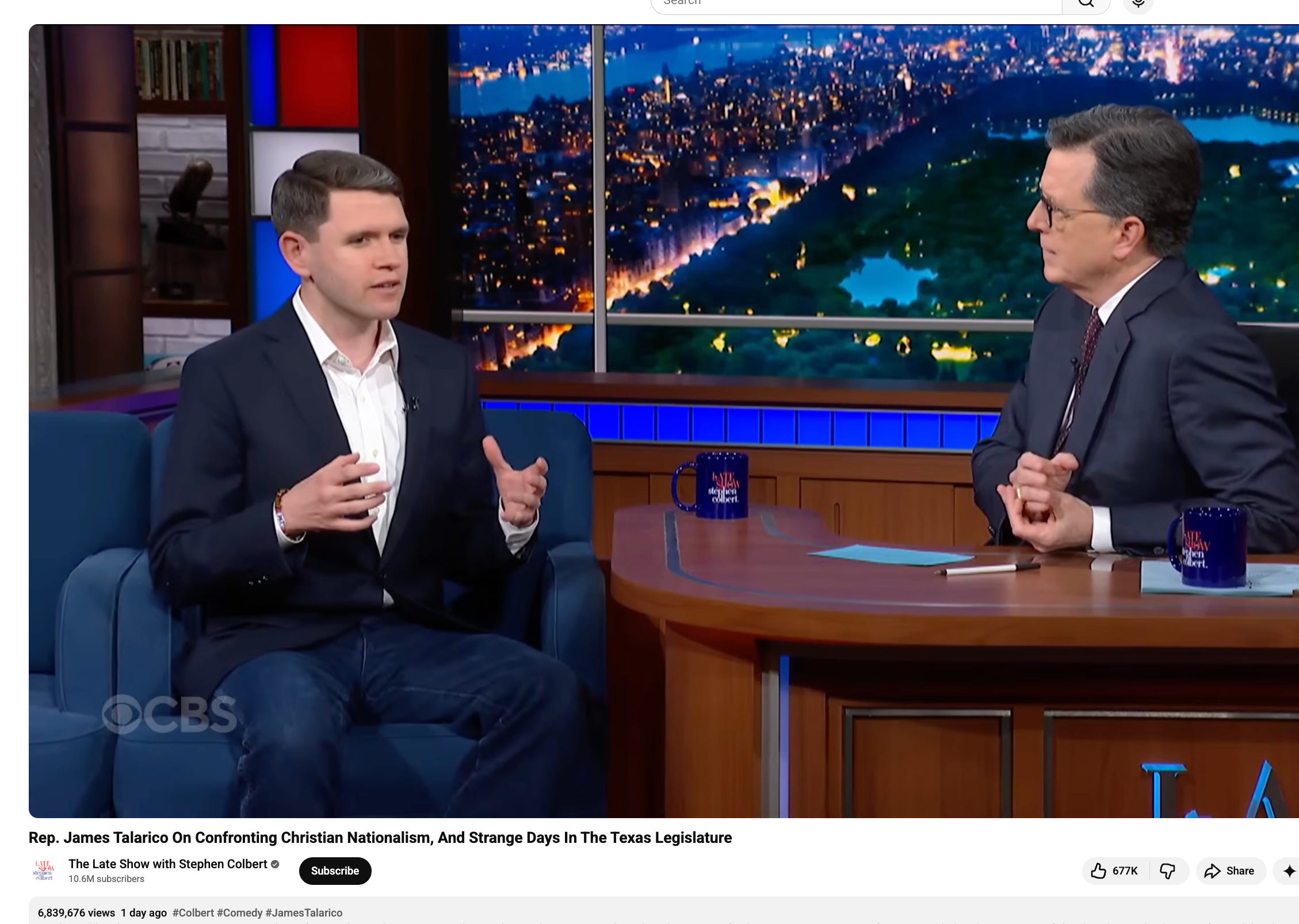
CBS issued a statement on Tuesday claiming Colbert was “not prohibited” from broadcasting the interview. They said he received “legal guidance” that airing it could trigger the equal time rule, which requires opposing political views to be shown on network TV. The statement said that Colbert was “presented options for how the equal time for other candidates could be fulfilled.”
Colbert pointed out that he’d had Talarico’s primary opponent, Jasmine Crockett, on his show. But this is obviously about the Democratic nominee’s eventual Republican challenger. That could be incumbent John Cornyn or Ken Paxton—they’re currently locked in a tight primary race. But either way, here’s the thing: Does anyone think Colbert wouldn’t relish having either Cornyn or Abbott on his show?
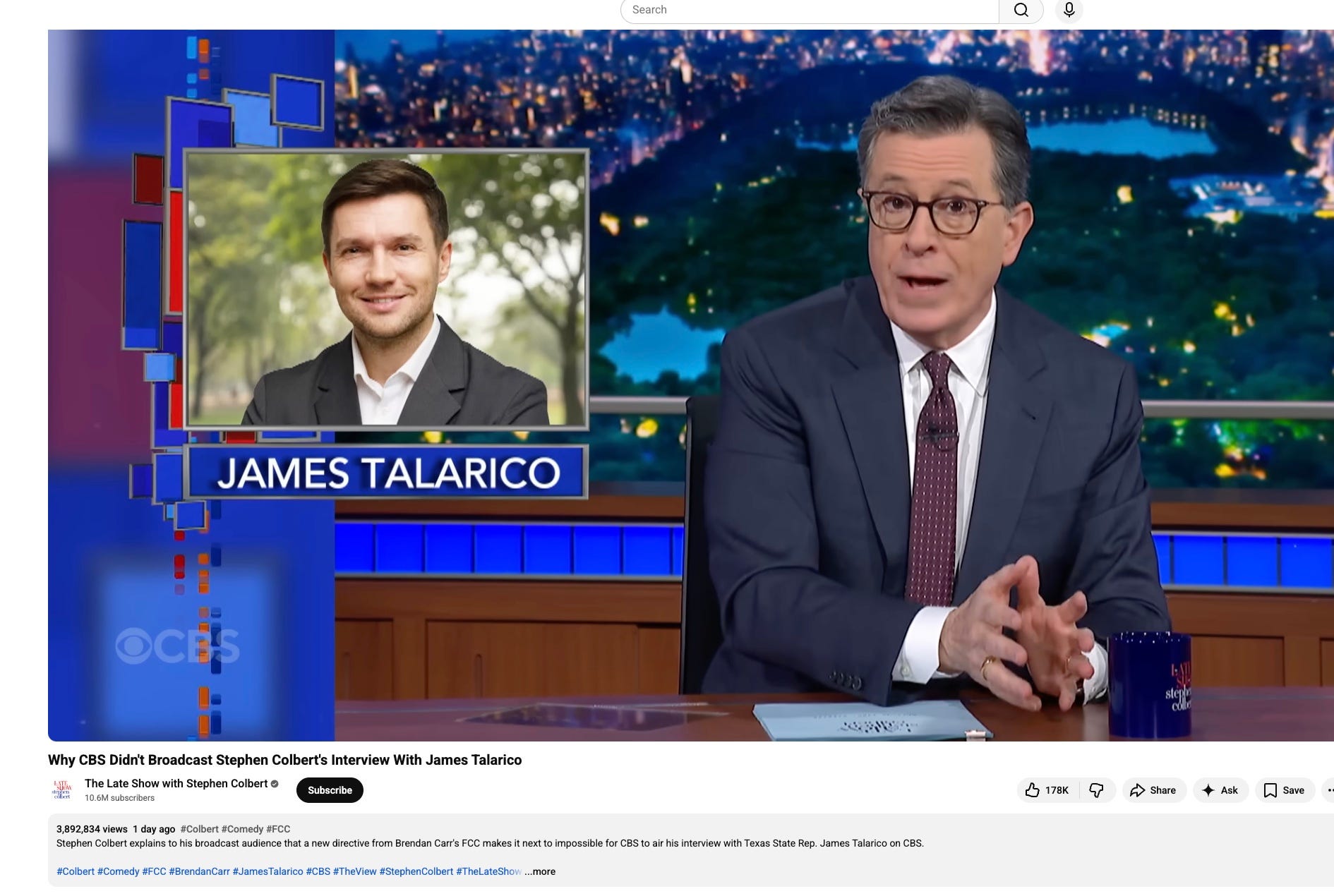
Using the equal time rule as a dodge for suppressing political speech is almost expected at this point in the Trump administration. But there’s rarely been a time in our nation’s history when the First Amendment mattered more.
Justice Louis Brandeis: "If there be time to expose through discussion... the remedy to be applied is more speech, not enforced silence."
Benjamin Franklin: “Freedom of speech is a principal pillar of a free government: When this support is taken away, the constitution of a free society is dissolved.”
Justice William J. Brennan Jr.: “If there is a bedrock principle underlying the First Amendment, it is that the government may not prohibit the expression of an idea simply because society finds the idea itself offensive or disagreeable.”
George Orwell: "If liberty means anything at all it means the right to tell people what they do not want to hear."
Then there’s Donald Trump. He has frequently called media outlets "dishonest" and the "enemy of the American people." He has attacked individual journalists over questions he doesn’t want to answer (“Quiet, Piggy”) and unfavorable coverage. In his second term, Trump barred The Associated Press from the press pool because it continued to call the Gulf of Mexico “the Gulf of Mexico” after Trump renamed it the Gulf of America.
Suffice it to say, Trump is no fan of the First Amendment, despite having sworn the oath of office, which requires him to “take Care that the Laws be faithfully executed,” which includes the First Amendment.
Colbert’s show has already been canceled. That happened shortly after he criticized CBS’s parent company, Paramount, for handing Trump a $16 million bribe when it settled Trump’s lawsuit against 60 Minutes, which accused the show of deceptively editing an interview with Kamala Harris during the campaign. Paramount was attempting a merger with entertainment company Skydance at the time, and it needed the administration’s sign off to make it happen. That came less than a month after Colbert was canned. The merger went through.
Trump, even after Colbert’s show was canceled, can’t seem to leave it alone. He posted this in December 2025.
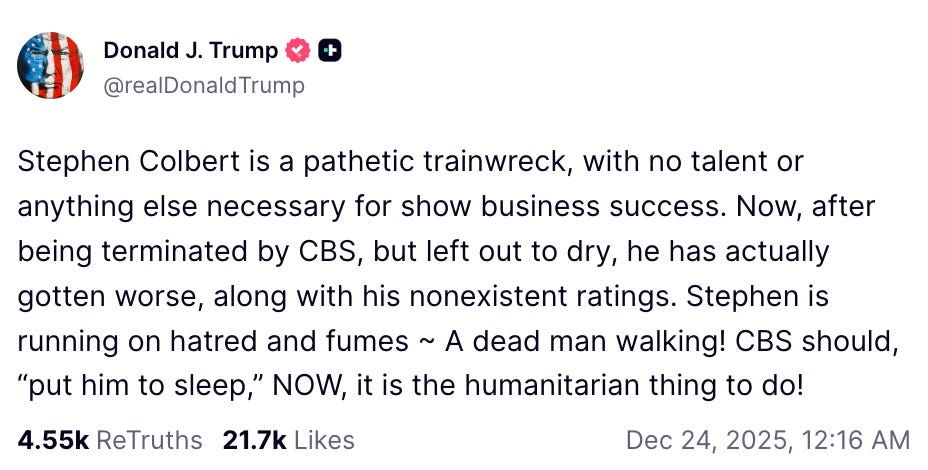
So much for the sanctity of the First Amendment.
I adore Stephen Colbert. During the 2008 and 2012 presidential election cycles, my husband and I made it a ritual to watch The Daily Show and The Colbert Report every night. They kept us sane. (Full disclosure: We also made it through every season of NCIS and Supernatural). My only real regret from my book tour is not getting invited onto The Late Show with Stephen Colbert. (Stephen, I’m still out here if you ever need a last-minute fill-in guest!)
Since the first of the year, a Washington Post reporter's home has been searched. Don Lemon, the former CNN host who is now an independent journalist, has been indicted for his coverage of ICE in Minneapolis. This administration is doing everything it can to intimidate the media from reporting on it.
The FCC administers rules and regulations regarding access to airwaves by political candidates. Section 315(a) of the Communications Act of 1934 requires stations to give "equal opportunities to all other such candidates for that office" if they permit a candidate for public office "to use a broadcasting station." Violating FCC rules can cost a station’s owner their license.
But the rule has exceptions, including for when a candidate appears on a "bona fide newscast" or in "on-the-spot coverage of bona fide news events." News interviews are typically excepted. Then, last month, the FCC issued a Public Notice warning television broadcasters that news interviews with political candidates conducted “on a program that is motivated by partisan purposes” are not exempt from the rule.
Trump’s FCC Chair, Brendan Carr, wrote the Project 2025 chapter on the FCC. We talked about that here, back in November of 2024. I wrote that Carr claimed that “bipartisanship on the FCC is a matter of tradition, not law, suggesting without coming out and saying it that Trump could change that. The FCC regulates radio, television, wire, satellite, and cable networks. In response to an LA Times tweet, suggesting Carr might ‘make life more difficult’ for media companies, Carr confirmed it, suggesting he could take away broadcast licenses from media companies that don’t ‘operate in the public interest.’ That’s preparation for authoritarianism.”
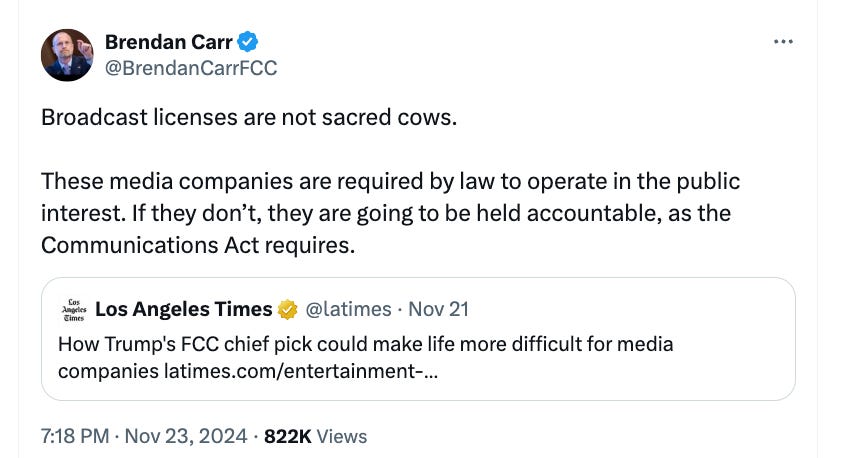
That has turned out to be the case.
It was Colbert who coined the term “Truthiness” in his first show on October 17, 2005. It became the word of the year in 2006, and proved prescient when Trump advisor Kellyanne Conway insisted the new administration was entitled to its own “alternative facts” shortly after Trump’s first inauguration, when the president insisted his crowd size was bigger than it was.
Life imitating art.
The last episode of Colbert’s late night show will run in May—CBS called it a “financial decision.” But canceling a top-rated show doesn’t make much financial sense. And our public discourse will be the poorer for it.
Colbert’s handling of this incident is illustrative. “Because my network clearly doesn’t want us to talk about this, let’s talk about this,” he said, claiming CBS attorneys were caving to “guidance” from the FCC. “Let’s just call this what it is. Donald Trump’s administration wants to silence anyone who says anything bad about Trump on TV, because all Trump does is watch TV.”
Your paid subscription makes Civil Discourse possible—independent, informed analysis that connects the dots between law, politics, and the truth. In a moment when noise drowns out reason, your support ensures facts and context still have a home. Join a community that refuses to give up on democracy—or on understanding it.
We’re in this together,
Joyce
