
Heaven and Hell in American PoliticsWhat is the proper response to white Christian nationalism in the U.S.? What isn't?In social media, as in many other less brutal sports, the secret to greatness is to have the memory of a goldfish. In other words, don’t dwell on your mistakes. Usually, I am able to abide by this principle. That’s because I make so many mistakes that if I didn’t, I’d never get anywhere. That said, a few days ago, I posted something on Bluesky that I came to regret. It’s not a big deal in the scheme of things. But it led me to some introspection and some thoughts that I thought were worth sharing in the broader context of our general conversation here. In brief, after watching a segment on “Morning Joe” in which Kentucky governor Andy Beshear spoke of his new book that apparently centers in large part on the role faith plays in his life, I quickly skeeted off a few words about how uncomfortable I am with politicians who spotlight their own religious beliefs. My comment also made reference to another politician who has been in the news recently, James Talarico of Texas, who has made something of a name for himself doing likewise. The Wall Street Journal has just run an article on Talarico entitled “The 36-Year-Old Bible Scholar Trying to Flip a Texas Senate Seat Blue.” The subhead of the article is “James Talarico is testing whether progressivism wrapped in a faith-based message can win over Democrats.” I indicated in the clipped confines of the post that I prefer my politics to be as religion-free as possible, that there are very good reasons for the separation of church and state, and that I didn’t think the approach was a great political strategy that was going to win over “evangelicals” who supported MAGA. This generated a variety of comments that said, among other things that Talarico emphasizes that he, too believes in separation of church and state, that Beshear is a great governor who is well-liked in Kentucky, and Democrats could learn something from that, and that the point was not to win over evangelicals but rather to reach out to other voters of faith. After a couple of dozen such comments, I did something I rarely do. I deleted the post. I only take that action when either I feel like I am being bombarded by trolls and bots, or I feel like social media is not the place to conduct a big discussion about a complex issue. In one response to a post about the exchange, I said I would address it here on Substack, where I can go into more depth. So, let me begin by acknowledging that in my view my primary error was in where I chose to have the discussion, not with regard to my core point. More on that in a minute. Should I have acknowledged Talarico’s statements about the separation of church and state? Yes. Should I have not suggested this was all or even in large part about winning “evangelicals?” Yes. Should I have spent more time enumerating the many virtues of Beshear and Talarico? Yes. Both are, as far as I can tell, well-intentioned public servants. I wrote something to that effect the very same day in a column I did for the Daily Beast about the emerging Democratic candidates for the 2028 . nomination. A lot of people I know and respect like and admire Beshear. Many are taken with Talarico. Plenty feel that both are modeling behavior “red state” Democrats should adopt. I get it. Those arguments make sense. Nonetheless, I have deep concerns about politicians from either party…or any party anywhere…making religious views a centerpiece of their campaigns or their political personas. Does that mean that there is no place in politics for people with religious convictions or who practice whatever their religions may be? Of course not. Politics and politicians should reflect the societies they serve. 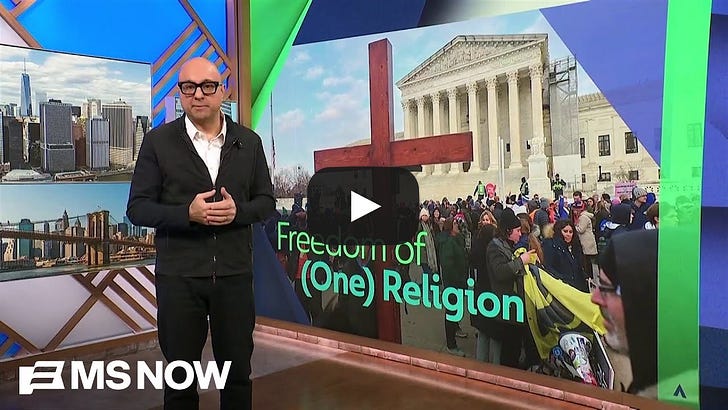 In my view, however, history suggests…no, history shouts at the top of its lungs…that religion can easily pervert political processes, promote division, lead to conflict, and worse. My Baggage (Yes, We All Have Baggage) As the son of a Holocaust survivor whose family saw three dozen of its members die at the hands of the Nazis, I come to this discussion with a particular perspective. As the son of two parents who, while valuing their Jewish heritage, eschewed actively practicing religion and were skeptical of all religious approaches created and administered by mortal men (and rarely, women) with manifold flaws and sometimes dubious motives, I also have those views baked into me. My Dad was a scientist and a skeptic in the best way possible (in my view). That colors my views, too. Among the last acts I remember from my mother was when, during her final days, while propped up in a hospital bed, she was asked if she wanted to speak to a rabbi, and she said that no, she was an atheist. To me, it was an act of incredible courage and moral fortitude. At such moments, most people hedge their bets. I might, too. You can’t know until you face that starkest of all the transitions we face in life. Why do I bring these very personal views up moments after I have just said I am uncomfortable with politicians who weave religion into their public personas? Because, among us here, discussing a highly sensitive and, for many, a triggering issue, I want you to be able to judge where I am coming from. I have biases and I know it. Nonetheless, I also try when addressing issues like this, to filter out my personal views to the degree that is humanly possible. I think there are arguments in support of my views that succeed on their own merits and quite apart from whatever my own personal experience has been. History is the Best Teacher The best arguments come from the pages of history. For all the good religions may have done to feed the souls of human beings as they grappled with the great issues that loom over our short lives on this earth, we can all think of the manifold examples of death and destruction caused when religious views were woven into the governance of states, used to shape or motivate their actions, or hidden behind by unscrupulous leaders seeking license from so-called “Higher Powers” to achieve their very earthly wants and ambitions. No major religious group on earth has not been victimized by such realities. None has clean hands when it comes to having their teachings or their brand used to attack those seen as “others,” to divide “us” from “them,” to justify immoral acts or the infliction of suffering and death on millions. There is a reason that those who founded the United States were so compelled to provide guarantees against state sponsored religions or the practices that any among us may follow in our daily lives. It is not an accident that such explicit guarantees appeared in the very first amendment to our Constitution along with other foundational freedoms that tragically are currently under attack from our authoritarian, anti-Constitutional president and his aides and enablers. It is not an accident that those on the right who claim to represent God-guided and scripture-guided leadership are those who seem most comfortable attacking other First Amendment protections for free-expression. It is because many of them also believe that we should place certain religious views ahead of all others and protect and advance them using the tools of the state. Many of them have been working on that enterprise throughout their lives—asserting that America is a “Christian” nation, that the founders were “Christians” who gave us laws of Biblical origin, and that we had special obligations to protect Christian views or those of other religious groups (including for example, right-wing Israeli Jews) whose beliefs were seen as superior to those of groups we denigrated (see the many recent examples of GOPers attacking Islam or political leaders like Ilhan Omar or Zohran Mamdani who are proudly Islamic.) It is especially concerning that the trend lines on the right in America suggest that even more extreme such views may become the centerpiece of the Republican Party in the future. I have written here before that I fear that the successor to MAGA will be a more focused and pernicious form of white Christian nationalism—as we have recently seen manifest in the words and actions of people like Charlie Kirk, his wife, the Turning Point movement, J.D. Vance and House Speaker Mike Johnson. Such a movement is not such a departure from where we are at the moment. While Donald Trump may view religion and the religious as just tools via which he can enrich or empower himself, the movement that has sprung up around him has embraced policies and positions that are manifestations of the worst sort of perverting influence in the name of religion. Take Marco Rubio’s recent Munich speech focusing on the preservation of the values of Western Civilization. This is coded language and not such subtle code at that. It is, consistent with the views of right wing view across Europe, in Russia and in Israel, an argument that all influences from outside the so-called “Judeo-Christian tradition” are corrupting and to be rejected. Sometimes ethno-nationalism is purely racist. But often it is also in support of a different kind of hateful intolerance, that suggesting that one religious viewpoint or group is better than others, truer than others, and should be superior in power to all others. While there has always been a strain of religious-inspired demagoguery in American politics, it cannot be denied that recent decades have seen a drift away from the scrupulousness with which men like Washington and Jefferson and Madison sought to keep religion except in the most abstract, acknowledgement-of-a-deity level sense out of most or all public discourse. The Jefferson Bible We have come a long way from Jefferson editing his Bible so as to exclude references to Jesus’ divinity, to miracles, to what he considered the supernatural. Indeed, we have come a long way from the particular pride he took, as evidenced by the words he asked to have engraved on his tombstone, in his authorship of Virgina’s statute on religious freedom. He ranked it second among his accomplishments after the Declaration of Independence. Now, most of our political leaders feel that they have to profess a belief in God, to participate in public displays of faith, to embrace religious leaders and institutions, and to imply, in one way or another, that having religion is better than not and that some religions are better than others. They may not say those words. But make no mistake, that is the message that they send, intentionally or otherwise, when they wrap themselves in “scripture” in much the same way they wrap themselves in the flag. I also know and feel this from personal experience as well as from objective analysis. I attended a public school in New Jersey in which, during my first years, we had to recite The Lords Prayer every day at the start of the day. Even as a five or six-year-old I sensed this was an incantation that was not meant for me, that excluded me. I can only imagine the message sent or that people want to send by posting the Ten Commandments in a school or suggesting that somehow the Bible represented an inarguably accurate depiction of history or natural science. We all know that messages suggesting Democrats were waging a “war on Christmas” were just code saying that the Blue Team was not as Christian and therefore virtuous as the Red Team. Do all who publicly embrace faith do so hypocritically? No. Are there faith leaders who have played important roles in our national life? Yes. There are even, as today, religious leaders who have become politicians who (Senator Warnock, to choose one example) who have made great contributions. Should the views of political leaders reflect those of the communities they seek to represent? Yes. To a degree. The crucial question is, however, does playing up religion by politicians potentially do more harm than good…or at least do so much harm that it should be avoided or toned-down. Some communities are home to prejudices or traditions that the majority embrace but that are dangerous or have done damage. Racism certainly comes to mind. And none of us would suggest that should a community embrace racism, political leaders ought to be racist, too. (Although sadly, that is often the case.) The discussion becomes more complicated for Democrats, especially when the issue of racism arises—because a foundation of Democratic strength for a long time has been Black churches and key groups, including African-Americans, who support Democrats are among the most religiously active Americans. Tolerance, decency and our core values should say that we no more want to discriminate against the very religious than we want to discriminate against atheists or agnostics or others with different systems of belief. However, given the nature of politics, it is often very difficult to send a message supporting one religious group that does not make another uncomfortable or serve as a warning sign to them. Especially in this particular political moment when the right is trying to make religious belief a dividing line issue in our society. A Treacherous Set of Choices Lie Ahead Hence, the interest in the candidacies of people like Talarico and Beshear. Even if Democrats do not seek to “win evangelicals” there is a belief among some party leaders that key to our success will be “reclaiming” faith, showing that we are not “godless Democrats” as we are portrayed by rightwing nutjobs to be. Can it be done by walking a fine line as Talarico and Beshear are trying to do? Perhaps. But we must also beware of the unintended messages of exclusion and division it sends. We must beware of the creeping corrosion such approaches have on the very idea of separation of church and state even if political leaders repeat their belief in it like it was a catechism. “I believe in separation of church and state yet faith and my church are a critical part of who I am,” leads to reasonable questions. Like why, if you belief in separation of church and state, do you talk so much about church or religion? And even if you profess tolerance, do you realize that when you talk about your own beliefs—especially when you do so to win support from others who share those beliefs—that you are sending unintended messages to many who do not come from the same tradition or embrace the same views? Worse, I cannot help but dread what future political discourse will look like if the GOP continues in the white Christian nationalist direction it is heading and Democrats feel like the proper response is to get into a debate about whether we are good enough Christians or believers or church-goers or people of faith ourselves. Turning American politics into a religiosity contest—no matter how it is framed, no matter whether it is actually even intentional—is profoundly dangerous, antithetical to the carefully reasoned ideas underlying the foundation of this country, and runs the risk of leaving us more divided, perhaps divided in even more dangerous ways. And that is to say nothing of the dangers of having leaders who seek to use religion as a way to suggest they are actually closer to the deity, that they are chosen by Him or Her or Whomever, as Trump has done. (His fellow ethno-nationalists do this worldwide and often as a way of identifying themselves in opposition to targeted minorities—see Netanyahu or see Modi in India.) It is also important for Americans to understand that in much of the world, such debates seem remote because, having born the consequences of centuries of religious division and seen the corruption that often infects major religious organizations or the infuses religious-political partnerships, that they have moved on and away from the battles and bloodshed of their paths. (And some other nations that are theocracies or theocratically inclined remain to underscore the perils of that path, as well.) The Trend Lines Are Not What Many Seem to Think They Are Consider, for example, whereas 49 percent of Americans consider religion very important in their lives, In Canada, the number is 27 percent. In Australia, it is 23 percent. In the UK, it is 20 percent. In France, it is 13 percent, Germany, 18 percent, Sweden and Denmark 10 percent, Japan 7 percent. The data I am using here is from Pew Research, Gallup, the European Social Survey, etc. That said, for those that think what Democrats (or America) needs is more religion in our politics, let’s take a good look at what is happening here, too. First, I would like to go back to the above number, that the number of Americans who consider religion as very important in their lives is 49 percent. And, I think we need to be honest about how people answer such polls when evaluating such a number. But let’s look at other data (also gathered from similar sources), the number of Americans self-identifying as Christian has fallen from 83 percent at the turn of this century to 62 percent in 2023-2024. The number of religiously unaffiliated has almost tripled (from 11 percent to 29 percent) in that time. Throughout that period, weekly church attendance has fallen, considering religion very important has fallen, etc. While there is some suggestion that some of this fall has slowed or stabilized in the past couple years, there is not enough data to suggest the forward trends or to negate the impact of what has happened during the past decades. (That said, Pew Research modeling suggests that while perhaps 58-62 percent of Americans will consider themselves Christian in 2030, by 2070 that number is likely to fall to 35-46 percent, while the religiously unaffiliated will continue to be the fastest growing group in America’s religious composition, growing from around a third in 2030 to about half in 2070. Other data, from Pew: 78 percent of Americans identified as Christian in 2007, in 2023-2024, the number was 62 percent. However, a majority of Americans seldom or never attend church/synagogue/mosque/etc. (56 percent.) Of all those who identify as Protestant, over a third seldom or never attend church. Among Jews the number who seldom or never attend is 65 percent. Among Buddhists/Hindus/Orthodox, the number is over 60 percent. Among Catholics it is 48 percent. The above represents a massive change. As recently as 1999, 70 percent of Americans said they were affiliated with a church. It is now around 45 percent. In the same period, roughly 35 million Americans who belong to a church no longer attend on a weekly basis. It is also important to look at age demographics. Again, according to Pew and other studies, whereas 80 percent of those 65 or older identify as Christian, only 46 percent of those between 18 and 24 do. 43 percent of the 18 to 24 year olds identify as “none,” roughly three times as many as among the over 65s. Looking at that another way, 70 percent of Boomers identify as Christian, but only 46 percent of Gen Z and 48 percent of Millennials. Why does this matter? As I have noted before, the 2028 election will be the first in which the majority of the electorate are Gen Z or Millennial. In other words, we should not base our political calculations on old assumptions (nor should we base our moral conclusions on politics.) And we need also to note that some disparities in regional or ethnic communities run counter to the above trends. Further, in the 2024 election, white Christians, who make up roughly 41 percent of the adult population, account for nearly 70 percent of GOP membership. And Democrats have become the home for larger groups of Christians of color, members of minority faiths and…importantly…the religiously unaffiliated. (And it should be noted that the religiously unaffiliated rejected Trump resoundingly…with only 1 in 4 supporting him. (Important given that they represent a big chunk—nearly a third—of the population.) Even black church affiliation and attendance, key support groups for Dems, has fallen and unaffiliated members of the black community have increased to now represent fully a quarter of the population. Heaven and Hell in American Politics I raise the above not to suggest that questions of religion in American politics are not complicated. They are. Winning matters. Building coalitions matters. Respecting regional and local realities makes sense. Furthermore, of course, it would be immoral for political leaders to espouse religious views for merely political purposes…or to renounce their views for similar reasons. It is equally wrong, I would add, to suggest that religion is the only source of morality in life or even that religious teachings are essential to elevate a society. Often they do the opposite. That said, the role of religion in American life is changing and not in the way you would think if you just judged by the tone or the words of politicians or pundits. As people approach these issues, those changes should be kept under consideration. (And I say this fully aware that some will wrongly suggest that the rise in secularism in the US is somehow at the root of our problems. I would suggest that a strong case can be made that heightened religiosity bears a lot of the blame.) Candidates and the politically active, especially the politically well-intentioned, should be aware of all of these things. But they also must keep in mind history. They should remember that the existence of the United States depends to a large extent on the consequences of centuries of political violence in Europe…and the laws of our new government were heavily informed by that history. (We should also remember the hideous consequences of the forced conversions of indigenous peoples in this hemisphere…and elsewhere…by people who felt religion would elevate and ennoble them.) Further, all of us need to be highly conscious of the grievous mistake we would make taking the bait of the far right’s arguments that our future or our goodness as a nation depends on our Christian-ness or how closely we adhere to Judeo-Christian traditions. Because even if the Democratic response is “we are better Christians” or even “we are Christians that believe in the separation of church and state and DEI and tolerance” (which is undoubtedly a more enlightened view from Christian politicians) there are still unintended messages of exclusion and of cultural superiority/inferiority that go with such debates. That is why when it comes to religion in American politics, less is more. Demonstrate moral leadership by example. But recognize the perils of seeking to infuse religion or religious traditions or religious values into any aspect of our political life. If you truly believe in the separation of church and state, then recognize that the role of the state is to ensure we all have the ability to practice and pursue our beliefs in private so long as they do not infringe on the rights of others. It is to model ethical, values-driven behavior. And a core part of that is to demonstrate a resistance to the draw of demagoguery or virtue-signaling that infusing political debate with the language and postures of religion carries with it. The path we seem to be on in this respect is fraught with risks. I hope we will proceed cautiously and recognize that lived virtue informed by clear-eyed, fact-based awareness of our shared reality is really the only path to salvation. |
