The ICE killing of Alex Pretti, the second in Minneapolis, prompts quick legal action
After ICE agents killed Alex Pretti on Saturday, lawyers responded quickly — leading to one TRO issued before the night's end aimed at preserving evidence of the killing.
Alex Pretti, a nurse who worked for the U.S. Department of Veterans Affairs at the Minneapolis VA Health Care System, was killed by ICE agents who shot him repeatedly on Saturday morning.
The outcry to the Trump administration’s increasingly deadly immigration enforcement plans in the Twin Cities and across the country was immediate and sharp — including the news from Senate Democratic Minority Leader Chuck Schumer that Democrats would not provide the votes needed to keep the government open if the funding measure that comes to them includes the Department of Homeland Security appropriations bill passed by the House this past week.
The statement from Pretti’s parents — who found out that their son had been killed when a reporter called them for comment — is righteous and does not hold back about “[t]he sickening lies told about our son by the administration.”
Of their “kindhearted” son, they said, “Alex wanted to make a difference in this world. Unfortunately, he will not be with us to see his impact.”
In the litigation pending in Minnesota that challenges the Trump administration’s extreme immigration efforts, and from a new lawsuit filed on Saturday evening challenging the federal government’s refusal to cooperate with state and local officials investigating a crime scene, it was clear that the lawyers were, despite the horror of the morning, ready to respond if something like Pretti’s killing happened.
In less than 12 hours, a clear picture had emerged:
A nurse, Alex Pretti, was trying to help members of his community — directing traffic amidst an immigration enforcement action — before being confronted by a federal agent, surrounded by several agents, taken to the ground, and shot multiple times — including in the back.
A person who had received help from Pretti minutes earlier was feet away from him, recording as the federal agents killed him.
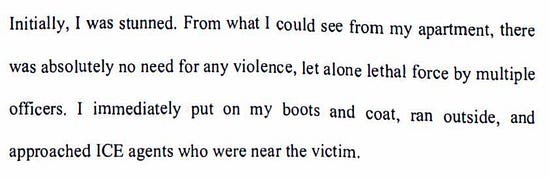
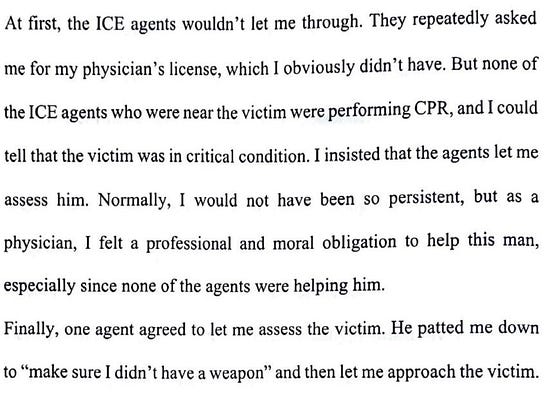
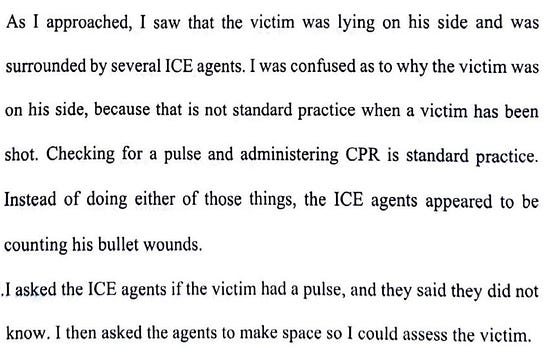
A doctor who saw the shooting from their apartment and rushed out in the cold to provide help found the federal agents not attempting to provide any medical help to Pretti.
Instead, the federal agents worked to prevent state and local law enforcement from doing their jobs, taking witnesses away from the scene and refusing state and local law enforcement with access to the crime scene.
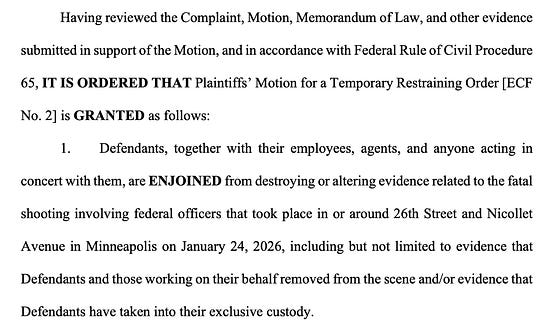
Before the day’s end, U.S. District Judge Eric Tostrud, a Trump appointee, had taken the first step toward addressing that final aspect, granting a temporary restraining order in the new case barring the federal government from “destroying or altering evidence” related to the killing of Pretti.
It is an astounding order that reflects the Trump administration’s complete failure of governing for the people, a horrifying reality.
In the case challenging Operation Metro Surge’s actions on First and Fourth Amendment grounds, lawyers quickly submitted new information before the district court judge and the appeals court.
After U.S. District Judge Katherine Menendez, a Biden appointee, had issued a preliminary injunction — covered previously at Law Dork — the Justice Department appealed and the U.S. Court of Appeals for the Eighth Circuit issued an administrative stay on January 21.
At 7:00 p.m. CT, the lawyers for the plaintiffs in the case filed a motion at the Eighth Circuit asking it to “immediately lift the administrative stay.”
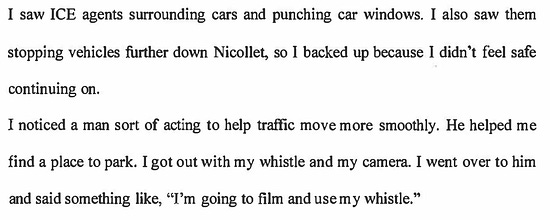
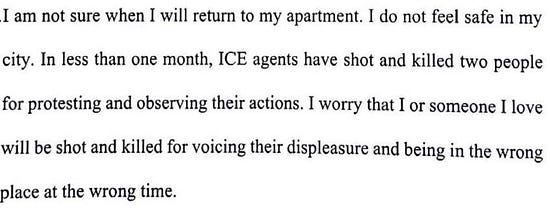
Along with that filing, the lawyers filed a declaration from one of the named plaintiffs in the case, Lucia Webb, and from a witness to Saturday’s killing of Pretti who had been recording the interaction — and, eventually, shooting — with her phone.
From the witness:
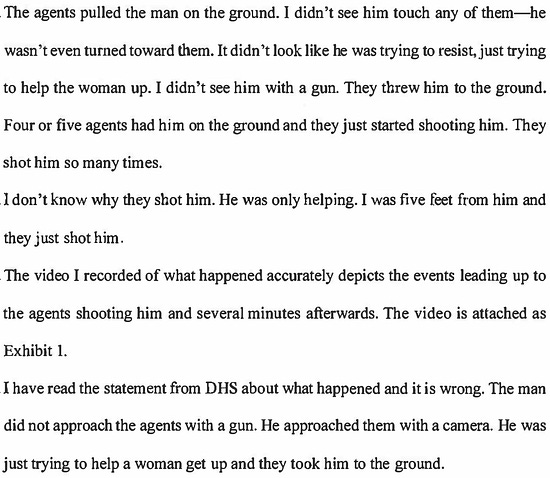
The witness, who was recording, then saw the situation escalate due to the ICE agents’ actions:
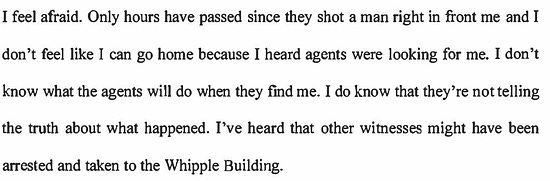
This is how their declaration ended:
Before that, they lawyers had filed both of those declarations at the district court in front of Menendez, along with a declaration from a doctor who lives near the location of Pretti’s shooting and notice that they are filing the video recorded by the first witness.
From the doctor, a 29-year-old resident, upon witnessing the shooting from their apartment:
Then, outside, a similar moment to that faced when a doctor sought to help Renee Good. Luckily, this doctor eventually got through — after being patted down:
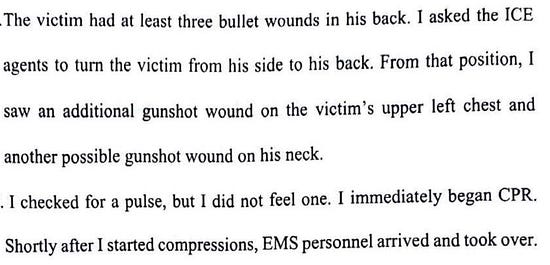
Then, the doctor tried to do their job:
After returning home and being distraught, the doctor left their home once “tear gas began seeping into [their] apartment.“ This is how their declaration ended:
The new lawsuit challenging the refusal to allow state and local investigation of the crime scene — filed by Minnesota Attorney General Keith Ellison and Hennepin County Attorney Mary Moriarty — was paired with the motion for a temporary restraining order, memorandum of law supporting it, and another damning declaration — this one from Drew Evans, the Superintendent of the Minnesota Bureau of Criminal Apprehension (BCA).
After detailing how BCA agents “were blocked by federal agents with the DHS from accessing the scene“ — even after obtaining a search warrant — Evans concluded, “In my 20-plus years at the BCA, prior to 2026, I had never encountered a situation in which federal authorities blocked BCA access to an incident where there is concurrent federal and state jurisdiction.“
Before 9:00 p.m. CT, the lawyers for Minnesota, Minneapolis, and St. Paul also returned to court in their pre-existing case, broadly challenging Operation Metro Surge.
In their filing, and in advance of a previously scheduled hearing on Monday, Minnesota Solicitor General Liz Kramer, Minneapolis City Attorney Kristyn Anderson, and Saint Paul City Attorney Irene Kao asked for “an immediate stop – in a Temporary Restraining Order that by its terms is limited in length – of Operation Metro Surge.”
In the filing, they warned, “If unchecked, Operation Metro Surge will only continue to inflict irreparable harms and wreak havoc on Plaintiffs and their residents,” concluding, “Emergency relief is not only warranted, it is essential.“