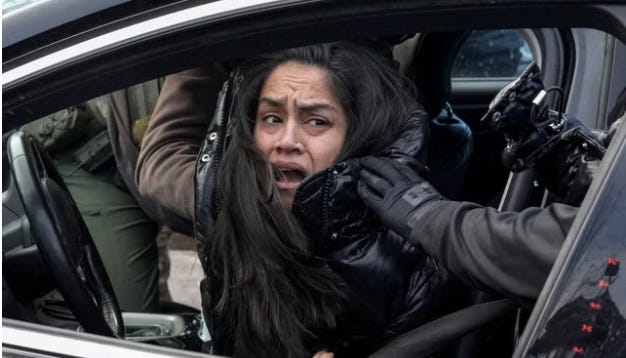
Renée Nicole Good’s murder marks a major turning point in American history, especially for millions of white Americans, but also for the course of this country’s entire future. Of course, these types of murders for Black and Brown communities at the hands of thuggish, racist law enforcement are nothing new for them, and they have been warning us, telling us that we’re next, for a long time. The majority of white Americans did not heed these warnings. Yes, they did feel a sense of grief when George Floyd, Breonna Taylor, Sandra Bland, and others (the list is grievously endless) were murdered in cold blood, but they foolishly and naïvely believed that they were insulated from such events happening to them or their loved ones. Not anymore. Good’s murder was a queerphobic, misogynistic-driven hate crime by ICE agent Jonathan Ross, all of which was entangled in white supremacy. After all, she, along with her wife and others, was out there protecting marginalized Black and Brown people in her community, which meant she lost her proximity to her whiteness. Whiteness no longer protected her. Good was doing the real work, and she wound up murdered as a result. We’re in this moment now where even white women can get shot and murdered, and we’re not going back. We should have cared more and listened when the body counts of Black and Brown people piled up. But most of us didn’t and chose to look the other way, until it was one of our own. (And I know many white people showed up to protest for the murders of innocent Black and Brown people, but there weren’t enough of us who did, not to mention the 77 million, most of whom were overwhelmingly white, who voted a white supremacist back into office.) With Trump’s terroristic paramilitary group now running roughshod in Minneapolis and other cities in the U.S., millions of white Americans now realize this moment is one of extreme urgency. This means that dismantling white supremacy isn’t just about posting black squares on Instagram when a Black or Brown person is murdered anymore. Performative “allyship” has completely disintegrated in the face of unmasked, brutish fascism. As for unleashed state violence itself, pure and unadulterated violence, a fascist spectacle on full display, the good, brave people in Minneapolis are leading the charge (as they have in Chicago, Portland, and elsewhere), showing us what it means to be there for those in their communities most at risk. White people there are showing up and doing the work, just like Good did. It may not seem like millions of Americans are aware or participating against these domestic terrorists and the regime, especially at first glance on social media, as the tech ecosystems have been flooded with pro-regime propaganda. Ryan Broderick wrote in his essay, “We’re All Just Content For ICE,” “The public social networks once relied on to mobilize a community, meanwhile, are full of right-wing propaganda, distorting what’s happening on the ground.” But that skews the reality across the country, where protesters, even in small towns located in Maine, New Hampshire, Vermont, and elsewhere, have shown up to denounce the murder of Good. The time is now, not a moment later, to become ungovernable, and people are already doing it. It is no longer hyperbolic to say that this situation is about life and death, and choosing between fascists and oligarchs or the people. Again, we’re here, and we’re not going back to the semblance of normalcy that many white Americans once enjoyed. But this new reality is providing us with fertile ground for revolutionary possibilities. Minneapolis, again, is providing us with another model. Faith leaders, union leaders, business owners, and others have called for a general strike on January 23rd to drive out ICE. One day might not seem like much, but it’s a start. First, it’s one day, then a week, and after that a month. We learn from them, and then we adapt to their model. In addition, we target private-sector companies that support ICE. There are other measures that can be taken, too. Lady Libertie outlines them in meticulous detail in her piece titled, “What We Do To Fight Back: The Strategy ICE Can’t Outrun.” This essay provides information on the framework for municipal resistance. As Libertie states, everything discussed is legal. This document is not for “the people” but for government officials to enact, as they would in times of emergencies, such as natural disasters. That might make you wonder how it applies to you as a reader. First, if ICE has already arrived in your town or city, show up at City Hall or call your elected officials and demand that these plans be implemented as you assess the situation on the ground. Second, disseminate this information widely and encourage others to do the same. Again, there are further revolutionary possibilities in store for us, as the regime grows increasingly violent and unpopular, and brazenly violates the Constitution. Hyperlocal and translocal communities bound to one another in their shared resistance and in formation can emerge in dire situations like this one, interlocking and expanding as they strengthen and scale. From a broad view, we are most likely witnessing the death of liberal democracy here, at least the one we once knew. But we will collectively determine what comes next. This regime is recklessly out of control—kidnapping a sovereign leader, unleashing paramilitary groups into Democratic states and cities, discussing plans to bomb Iran, and threatening to invade Greenland. Furthermore, what’s going on within our own borders indicates that we are in a civil war. And more bloodshed, unfortunately, is inevitable, whether or not we choose to arm ourselves. How much more can the populace endure under these conditions? It seems to me that it’s only a matter of time before people begin to fight back and not just with slogans and whistles. But I’ll leave it at that, as I’m speaking of inevitabilities and not encouraging anyone to act violently. On a final note, in this neoliberal system of ruthless individualism and competition, we have been taught that we are overwhelmingly powerless. But we’re not. The people, together, in cities I mentioned above—Minneapolis, Chicago, and Portland—are already showing us what collective action can do, and right now they’re doing it nonviolently. We need to develop ways to ensure mass mobilization, which means we need to get to work quickly in our own communities so we can scale our efforts. We don’t have the luxury of time on our side, as the window of opportunity to fight back is closing fast. We are facing polycrises, and right now, the invasions of our cities by paramilitary groups should be our primary focus. The mantra should be: Community, community, community. Get to know one another. Become connected to your neighbors. Build bonds. There is no time to waste. ABOLISH ICE! |