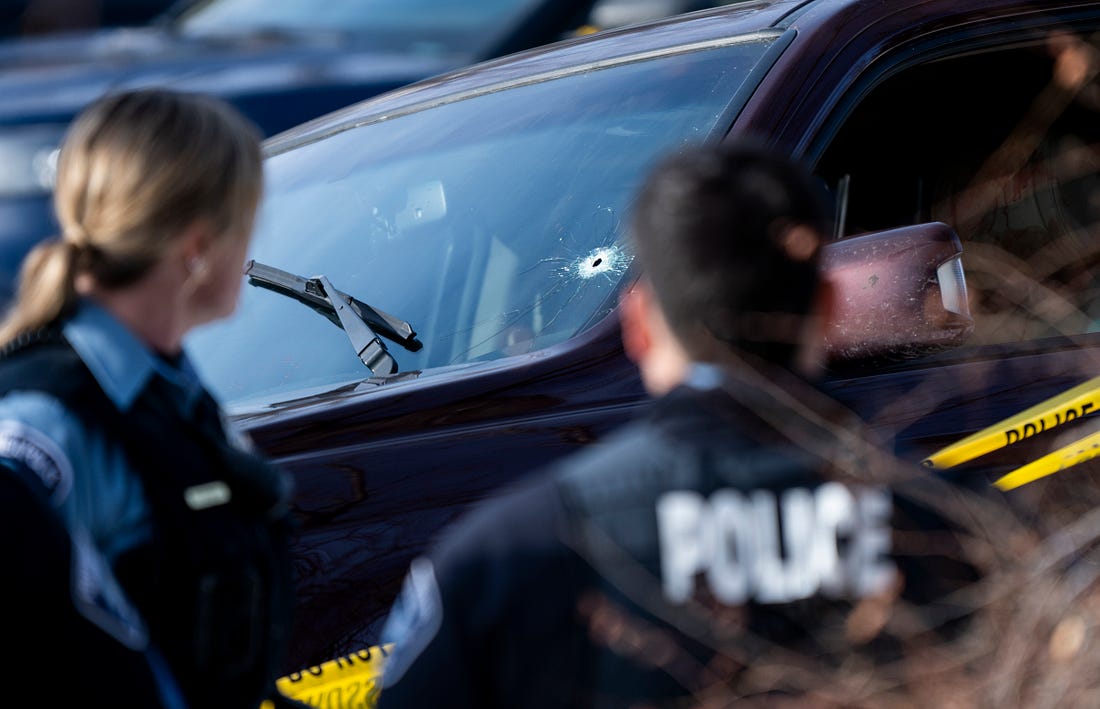
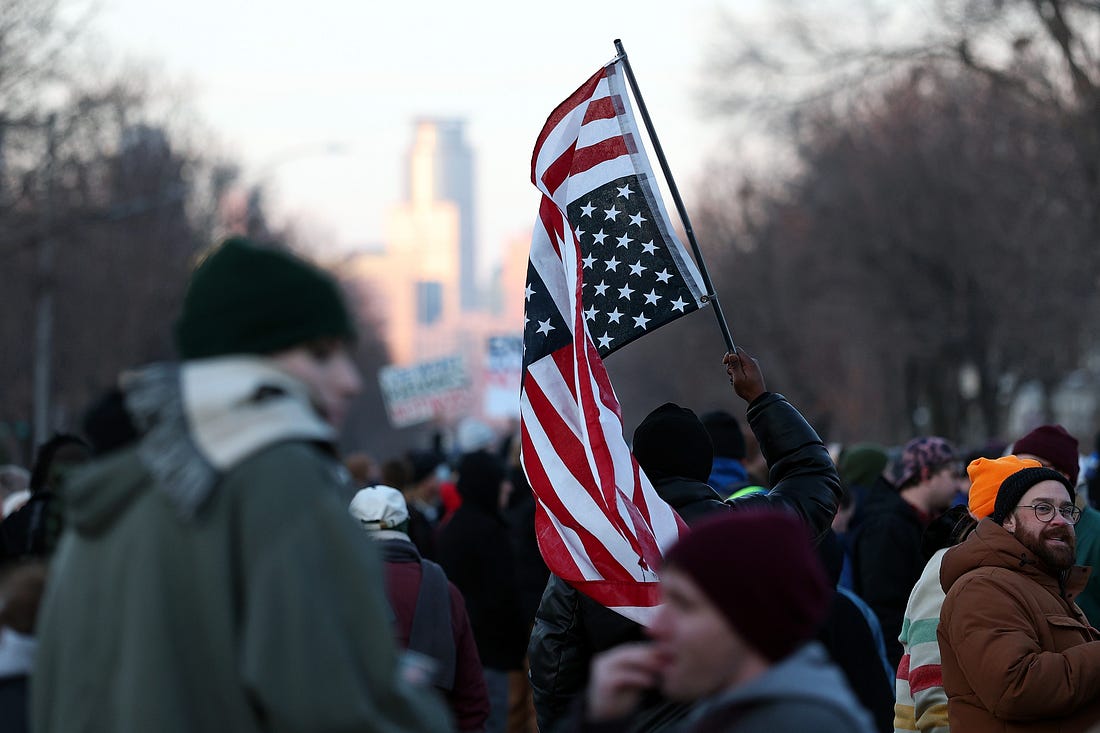
An Immigration and Customs Enforcement agent shot and killed Renee Good, age 37, in broad daylight in Minneapolis yesterday. Despite Homeland Security Secretary Kristi Noem blathering about how ICE agents are under assault and President Donald Trump’s outright fiction that Good ran over the agent and put him in the hospital, anyone with eyes can see it was murder.  Noem: "People need to stop using their vehicles as weapons ... it's clear that it's being coordinated. People are being trained"  Wed, 07 Jan 2026 23:34:01 GMT View on BlueskyThere’s video, which is how we all know that DHS and Trump are lying, but seeing someone get murdered by the government is not an easy thing to watch. MPR News posted the footage, but this is just a reminder that you don’t have to subject yourself to the horror to know it is a horror. What you see on the video it is a federal agent demanding Good get out of the car, at which point she starts driving her SUV forward at about five miles per hour. That’s when an ICE agent near the front of her car fires multiple shots into Good’s vehicle, killing her. In another video — which, again, is really tough to watch — a bystander yells that he’s a physician and asks to render aid, to which the agent responds, “I don’t care.” So what we have here is a federal law enforcement officer firing into a car at an unarmed person driving away slowly, and then other federal officers refusing to let someone come to her aid. It’s absolutely terrible and a disgrace to our nation. But can the officer who killed Good ever be held accountable for his actions? Charges would have to be brought by the stateLet’s dispense with the possibility that ICE or DHS or the Department of Justice would do anything about this. There’s no path to justice that runs through this administration or the federal courts. Hell, Trump will probably give the shooter a medal, and would certainly give him a pardon. But is there a path to justice that runs through Minnesota? Maybe. Sort of. This isn’t about whether the state could successfully prosecute the shooter, but whether the state could even attempt to do so. The latter question has to be answered before the former. Stephen Miller went on Fox last October to tell ICE officers they couldn’t be touched: “You have federal immunity in the conduct of your duties. And anybody who lays a hand on you or tries to stop or obstruct you is committing a felony.” Stephen Miller on Fox threatens to arrest JB Pritzker for "seditious conspiracy" and says, "to all ICE officers: you have federal immunity in the conduct of your duties. And anybody who lays a hand on you or tries to stop or obstruct you is committing a felony."  Fri, 24 Oct 2025 20:15:46 GMT View on BlueskyIs this ghoulish little creep — who, it bears mentioning, is not a lawyer — right that ICE officers can do whatever they want? No. At least not yet. While federal officials enjoy substantial protection from state prosecutions, that isn’t absolute. Sure, the fact they have protection at all may be maddening, but it does make some sense within our system of federalism. That’s not to say it’s good or right or moral that such protection exists, but just that it does exist. The Supremacy Clause of the Constitution says that federal law “shall be the supreme law of the land,” meaning that it generally prevails over any conflicting state laws. That, in turn, forms the basis for Supremacy Clause immunity.
Over 100 years ago, the Supreme Court held in In re Neagle that if a federal officer is performing a duty they were authorized to do by federal law and it was their duty to perform it, and if they did “no more than what was necessary and proper,” they could not be guilty of breaking any state criminal law. Supremacy Clause immunity isn’t the same thing as qualified immunity, which is the kind of immunity you hear about far more often when discussing the violent actions of law enforcement officers. Qualified immunity applies only in civil cases and protects law enforcement officers from being sued for damages unless there is existing case law that clearly explains that their conduct was unlawful. So, there may come a time in the future when the ICE agent gets sued in civil court, and that would be the point where we’d have a fight over whether the ICE agent knew that there was a clearly established precedent saying you can’t shoot at someone in a car multiple times because they happen to be driving near you. Supremacy Clause immunity, on the other hand, can be invoked by law enforcement in criminal prosecutions as a bar to prosecuting a federal officer for their crimes.
In a situation where the federal government is not a lawless nightmare, this isn’t a bad thing. A good example is federal officers escorting Black children to newly desegregated schools, protecting them from an angry crowd. In that instance, those officers were performing a duty they were both authorized and required to do under federal law, and as long as they did no more than was necessary and proper, states couldn’t prosecute them for violating a state law. That’s obviously not the situation here. First, these days, it isn’t at all clear what federal authority ICE is operating under. They just do what they want and handwave away any limitations on their power. But if we pretend there is some valid federal authority behind their reign of terror, there is still the question of whether the ICE agent did no more than what was necessary and proper to execute whatever made-up justification they are using these days. If the ICE agent’s behavior was no more than what was necessary and proper, that pretty much ends the possibility that Minnesota could prosecute him. But if shooting an unarmed woman in her car exceeded that, there is a narrow path forward for prosecution in a state court.
Where there’s a will, there’s a wayThe shooting occurred in Hennepin County, where the county attorney, Mary Moriarty, is a former public defender who isn’t running for reelection. That puts her in the same position as Gov. Tim Walz, who is considering calling up the National Guard to protect the state from ICE and saying the state “will stop at nothing to seek accountability and justice.” Tim Walz: "Our administration is going to stop at nothing to seek accountability and justice. The state Bureau of Criminal Apprehension is working on the investigation."  Wed, 07 Jan 2026 21:06:28 GMT View on BlueskyHilariously, the mere possibility that Walz would call up his own National Guard in his own state is being framed by conservatives as “dangerous neo-confederate rhetoric” and a direct confrontation with the federal government. So, calling up your own Guard to protect your own people is like treasonously seceding from the Union, but Trump’s attempt to federalize state National Guards over the objection of their governors and desire to drop Guard troops wherever he pleases is totally cool and great and constitutional. Got it. As with Walz, since she isn’t running again, Moriarty doesn’t really have much to lose by taking a chance here. So let’s say Moriarty wants to charge the ICE shooter under Minnesota law. She would first have to determine whether his actions were beyond the scope of his duties or so egregious that state prosecution was warranted. DHS has already insisted that the officer acted in self-defense, which is effectively a way of asserting that his actions were not egregious, but come on. There is no world where DHS would say otherwise, no matter what one of their ICE goons did. Q: After you told ICE to get the F out, Republicans are criticizing you for escalating tensions FREY: I'm sorry if I offered their Disney princess ears, but if we're talking about what's inflammatory, on one hand you got someone who dropped an F bomb & on other you have someone who killed someone  Thu, 08 Jan 2026 03:25:29 GMT View on BlueskyIf the agent was charged in Hennepin County, their first move would likely be to remove the case to federal court under 28 U.S. 1442. That statute allows a federal official to have their case tried in the federal district court instead, as long as they have a plausible federal defense to the state charges. If this sounds vaguely familiar, that is because Mark Meadows, Trump’s final first term chief of staff who was charged in Georgia court for election interference, kept trying to get his case into federal court so he could have a more favorable jury pool. A federal appeals court told Meadows to pound sand, saying that the right to remove applied only to current, not former, federal officials, and the Supreme Court declined to hear his appeal. Here, the ICE agent is currently a federal official and presumably still would be when charged. You might be wondering what the point of this all is if a federal officer can just slide his case on over to the federal court where, if convicted, Trump could just pardon him. But it doesn’t work that way.
When a state criminal case is removed to federal court, the underlying state criminal charge goes right with it. Put another way, removal doesn’t mean that somehow the state criminal charges disappear. Instead, it just means that those state charges are tried in the federal court, but if the officer were convicted, he would have been convicted of a state crime. And of course, much to his chagrin, Trump can’t pardon anyone for state crimes. States have been successful in prosecuting federal officers since the late 1800s, but such cases remain relatively few and far between. But it may be that the ICE officer’s case is similar enough to what happened at Ruby Ridge, for example, when an FBI sniper killed Randy Weaver’s unarmed wife during the standoff. The federal government declined to prosecute, but an Idaho state prosecutor charged the agent with involuntary manslaughter. The Ninth Circuit ruled that the state prosecution could proceed, but it was eventually dropped when that prosecutor left office. This is a long, and somewhat depressing, way of saying that it would be hard, but not impossible, to try the ICE shooter on state charges and obtain a state-law conviction that Trump couldn’t wipe away. It might seem like the longest shot in the world, but honestly, we have to try something, anything, to stop this — not just in Minnesota, but everywhere. |