
They Want Us Afraid
The dangerous act of not looking away
The street looks ordinary, the kind you drive without thinking about it, with snow-darkened curbs and a thin film of winter grit and brake lights sewing the evening together, until doors suddenly swing wide and masked men spill out in black jackets, radios clicking like nervous insects, heavy soles striking pavement with the practiced sound of authority, and a woman is still sitting behind the wheel telling them she’s on her way to the doctor, telling them she’s disabled, her voice already worn by a body that’s spent too much of its life fighting itself, when the car shudders, a pane of glass collapses inward, shards scattering across the dashboard, and hands plunge into her hair as her head snaps back and she’s torn from the driver’s seat into the cold as if the vehicle itself has betrayed her.
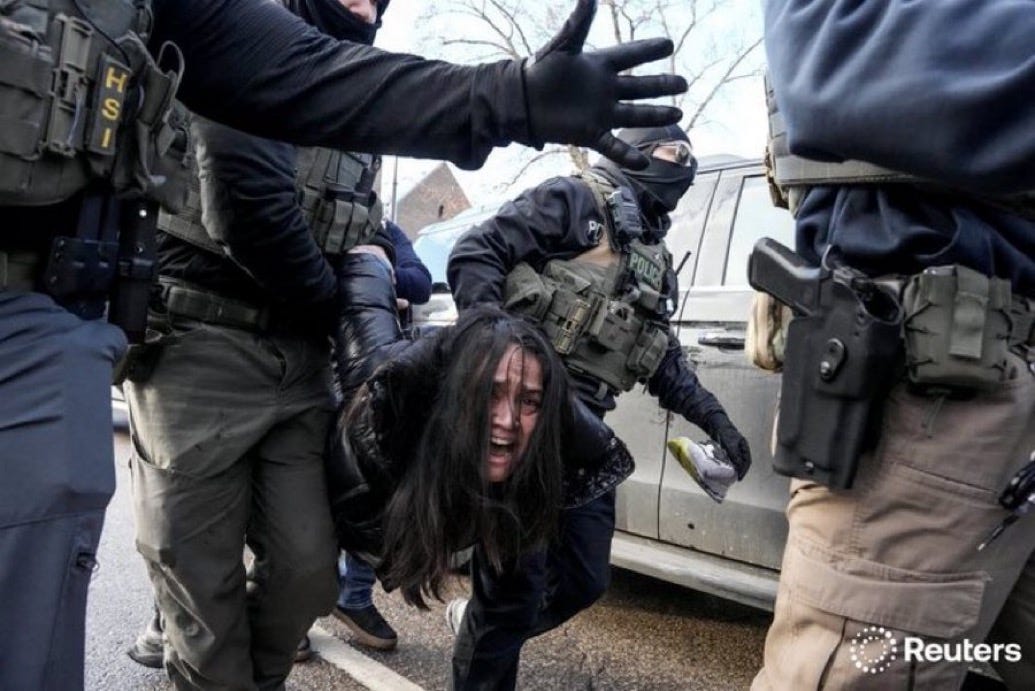
Somewhere else, under the washed-out glow of parking-lot lights, a teenage boy in a red vest is crushed against asphalt while he says he’s a citizen, that he has a passport, that he’s only seventeen and just at work, and in Minnesota a mother has already been shot and buried, leaving behind children and a city still hollowed by grief, schools quiet but not numb, neighborhoods awake and watching, people standing along their front steps and texting one another not to go out, not because they’re indifferent but because the air itself feels unsafe.
Fear moves the way weather does, sliding across state lines, slipping through open windows and into living rooms where children bend over homework while their parents pretend not to hear sirens, and it moves because nothing’s stopped it yet, because the men doing this keep being told, again and again, that no one’s going to make them stop.
A windshield caves in, a teenager’s forced down, a woman’s hauled into open air by her hair, and uniforms and masks and weapons begin to feel fused together, no longer signaling protection but something closer to menace, the arrival of a force that doesn’t pause to explain itself and doesn’t need to, because it moves with the confidence of impunity, backed by the weight of the state.
They speak in clipped words—procedure, operation, protocol—while breath’s knocked loose, bodies meet cold concrete, radios murmur that everything’s under control, even as the smell of gasoline and cold metal and the sharp, coppery tang of fear settles into lungs, grit bites into skin, splintered glass clings to eyelashes, and hair pulled too hard sends fire through the scalp.
A country starts slipping into something unrecognizable this way, not all at once and not with a single dramatic rupture, but through small permissions granted again and again: permission to breach a car, permission to disregard a passport, permission to fire a weapon and let a mother fall, permission to call it complicated and move on, while paperwork waits and people don’t.
Minnesotans haven’t been silent. They’ve stepped out into the cold with faces still raw from crying, with signs made at kitchen tables, with names written in ink that keeps bleeding through, because some things can’t be allowed to fade just because the news cycle is hungry for something else. And across the country, others felt that same pull, that same ache to keep these lives from being swallowed by silence, and they showed up to make sure what happened here stayed seen.
And as if the killing itself weren’t terrible enough, something even darker began taking shape around it. In Minneapolis, seasoned federal prosecutors — people who spent their careers standing between wrongdoing and the rule of law — walked out rather than be part of what was unfolding. In protest, six of them resigned from the U.S. Attorney’s Office after Justice Department leadership signaled it would not pursue a civil-rights investigation into the ICE agent who shot Renée Good and, instead, pressed for investigations directed at her widow, a shift that struck them as grotesquely backward. Those lawyers, whose lives had been devoted to fairness and accountability, walked away rather than lend their names to a version of justice that places the dead and their families under scrutiny while shielding the man with the gun in bureaucratic silence, turning a woman’s killing into a procedural shrug and her mourning loved ones into targets.
The people running this have learned something too, not just how far they can go but how fear spreads, how communities tighten and fracture when they’re hunted, how outrage flares and pulls others in, even as the men with badges and masks keep moving through grocery-store lots and school pickup lanes and down slow residential blocks where someone’s just trying to reach a doctor’s appointment, leaving behind a message that hangs in the air heavier than winter, telling everyone, whether they want to hear it or not, that this can happen to you.
The cruelty is intentional, engineered and rehearsed, built one crossed line at a time, each new violation widening what’s allowed, until people are reduced to silhouettes instead of names and bodies become obstacles to be pushed aside. A country can survive many things—recession, scandal, even violence—but something inside it mutates when brutality becomes routine, when it happens in daylight, when it’s filmed and still shrugged away, teaching children, not from books but from what they see, that their bodies are conditional and their safety is negotiable.
Every ruptured pane leaves a crack somewhere else, every child forced down takes something with him, every woman yanked into the open pulls another thread loose, even as there are those who are desperately trying to turn away—not the protesters and not the people filling the streets, but the ones who voted for this, the ones who handed power to the men now breaching cars and seizing bodies, because to really look would mean having to carry the weight of what they set in motion, to see how their ballots have landed on these people in the street, how their choices now live in bruises and broken glass and terrified voices.
And somewhere inside all of this, inside the glass and the sirens and the armored footsteps and the bruises, there’s something quieter that hurts even more. There’s what it does to the people who love, who parent, who try to keep their children safe in a world that’s no longer pretending to be gentle. As women. As mothers. As people who know what it is to carry another human being inside your body and then spend the rest of your life trying to keep them from harm.
These images don’t stay on screens. They crawl into kitchens and bedrooms and the spaces where families whisper to each other after the news is off. They seep into the way a sixteen-year-old looks at their mother when she grabs her keys. They live in the voice of a twelve-year-old who’s learned too much, too fast, about what happens to people who stand too close to power and point a camera at it.
Because here, near home, where these agents are ramping up their operations too, two children recently sat across from their parent and pleaded—not about homework, not about curfews, but about survival. They asked, with eyes already wet, for a promise not to go out and film. They begged for it. They needed to hear it. They had to be told that the person they love wouldn’t walk into the path of armed, masked men with a phone in her hand.
And that’s the world they know.
A world where telling the truth might get you killed, where recording the government might get you disappeared, where teenagers have already learned that a camera can be a threat to power and that power responds with guns.
They’re sixteen and almost thirteen, and they already understand that their mother could die simply for bearing witness—for documenting agents who seize people from walkways and parking lots, who wrench human beings out of vehicles and into the dark, who take teenagers from their jobs and mothers from their families.
Children old enough to do algebra and fold their own laundry are now old enough to fear that their parent could be killed for recording what the state is doing, and that weight now lives in their living room the way a storm lives in the sky, always present, always pressing.
But the stories won’t let them go.
They’ll keep coming from parking lots and city streets and cracked pavement, from shaking hands holding phones and voices that refuse to be quiet, stacking up until the weight of them makes it impossible to pretend this is just noise, because it keeps spreading and rehearsing itself and demanding to be seen, until the images lodge where denial can’t reach, the boy in the red vest, the woman pulled from behind the wheel, the sound of glass collapsing, the memory of a mother gone too soon.
Enough to make anyone imagine it: their son in that vest, their mother in that driver’s seat, their own block filled with radios and armored feet and the brittle sound of windows giving way, until there’s nowhere left to hide from the question burning in the air, asking whether this is what was wanted, whether this is what was chosen, whether this is the country anyone meant to make, and pressing on all of us, as witnesses and neighbors and human beings, to look, to see it, to see them, to see all of it, and to refuse, with everything we have left, to look away again.
