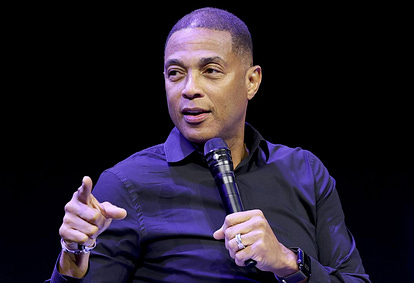
I thought about this all day, and wanted to get my thoughts together before I weighed in on the arrest of Don Lemon, a former colleague of mine, by President Trump’s Justice Department. It gnawed at me for many reasons that I’ll get to, but also, if I’m being very honest, because I have a complicated relationship with Lemon that I was trying to carefully and thoughtfully consider before I commented. Frankly, because of that complicated relationship, I’d prefer to say nothing. But it’s an important story – a really important story – and so I decided it would be irresponsible to ignore it. (And I could probably only ignore it for so long anyway, as reporters and producers are of course nudging me and everyone else to talk about it.)
There are a few things I need to get out of the way before I dive into the actual merits of the case and what it means politically, for journalism, and for democracy in America. First, it goes without saying that if Don Lemon coordinated, colluded, or conspired with protesters to commit a crime, this becomes an entirely different story. Journalism is not a shield for breaking the law. The DOJ indictment against Don, to my reading, does not suggest that, nor does the video evidence we’ve all seen thus far. But if evidence of that emerges, we’ll all be looking at this through very different eyes. The next thing I have to say is, I don’t like Don Lemon. This column would be extremely disingenuous if I pretended otherwise. We aren’t friends, we don’t pretend to be, even at public events. There are, in my view, legitimate reasons I don’t like Don, some of which are public and clear for anyone to read about, others which are private and do not need airing out here. But they have nothing to do with his politics or his journalism. I don’t share this to be petty or gossipy, but to underscore just how important I think it is to separate politics, partisanship, and even personal feelings from what happened today. Though my issues with Don involve our personal interactions, I’m hardly his only detractor. Just as he has a sizable fan base, he’s got an equally sizable cohort of critics. Some of that is earned -- none of us are perfect or above reproach -- and some of that is simply part of the job. He puts his opinions out there, something I do, too, and it’s hard. It’s uncomfortable. It’s risky. It’s often brave. And yes, it’s sometimes dangerous, lamentably. But whatever you or I think of Don’s work, his personality, or his opinions, is frankly irrelevant. Lemon -- if what we know is true -- followed protesters into a church in Minneapolis to record, observe, ask questions and capture what was clearly a story worth covering. Without getting too much into the merits of what the protesters did -- but I disagree with it -- what Lemon and other journalists with him did was JOURNALISM. Journalists follow a story and point a camera at it. It doesn’t matter if they’re self-employed, citizen journalists, or paid by giant media outlets. It doesn’t matter if what they’re capturing is good or bad, or even safe or unsafe. If it’s a story worth telling, a journalist will find a way to tell it. Legally, of course. What Trump’s DOJ is doing is criminalizing journalism. The indictment outlines a multitude of “overt acts,” lumping Lemon in with the group of protesters he was covering, that the DOJ says are evidence of a conspiracy. (You can read the full indictment here.) For example, it claims one “overt act” was when Lemon was livestreaming and “explained to his audience that he was in Minnesota with an organization that was gearing up for a ‘resistance’ operation against the Federal Government’s immigration policies.” That’s journalism. Another “overt act:” “Defendant LEMON told his livestream audience about congregants leaving the Church and about a ‘young man’ who LEMON could see was ‘frightened,’ ‘scared,’ and ‘crying’ and LEMON observed that the congregants’ reactions were understandable because the experience was ‘traumatic and uncomfortable’...” That’s journalism. Another “overt act:” “As the operation continued, defendant LEMON acknowledged the nature of it be expressing surprise that the police hadn’t yet arrived at the Church, and admitted knowing that ‘the whole point of [the operation] is to disrupt.’” Again, that’s journalism. Another “overt act:” “While the takeover operation was underway, defendant LEMON asked defendant ARMSTRONG, ‘Who is the person that we should talk to? Is there a pastor or something?” That’s journalism. Another “overt act:” “With other co-conspirators standing nearby, defendants approached the pastor and largely surrounded him (to his front and both sides), stood in close proximity to the pastor in an attempt to oppress and intimidate him, and physically obstructed his freedom of movement while LEMON peppered him with questions to promote the operation’s message.” I can’t speak for what the protesters did, but what Lemon is alleged to have done is journalism. Again, the protesters may have engaged in a crime. That’s another issue entirely. But it appears that Lemon was tipped off about a newsworthy story, as journalists often are, followed the story while broadcasting it, asked questions, and provided his viewers with context, in real time. That’s journalism. Just because President Trump doesn’t like him… Just because President Trump wants to squash protests he doesn’t like… Just because President Trump prefers propaganda to facts… Just because President Trump tries to intimidate and silence dissension… Does not give the Justice Department the right to criminalize journalism. It’s chilling, it’s illiberal, it’s dangerous, it’s wrong. We can argue about the kind of journalism Don does, and whether it approaches activism or advocacy, but to be clear, journalism allows for both. Journalists are often moved to cover atrocities, war, genocide, and injustices because they feel strongly about them, and want to document and expose them. But embedding in a group that’s got a story to tell – regardless of whether you agree or disagree with their cause – isn’t a crime. This will most likely backfire on the DOJ. It’s a weak case, and Lemon will likely benefit from it. But that shouldn’t stop anyone from worrying about the creep of totalitarianism that Trump is pushing. While my relationship with Don is complicated, defending him is not. And I hope he’d do the same for me. “First they came for the journalists. We don’t know what happened after that.” |