
Minnesota and Elsewhere
Today, more from Judge Schlitz in Minnesota. Last night, we read about his order in Juan, T.R. v Noem that the acting Director of ICE, Todd Lyons, would have to appear in court on Friday, in person, unless ICE complied with his order to either hold a bond hearing for or release the petitioner in the case, Juan. Subsequently, ICE released him. But that wasn’t the last word in the matter.
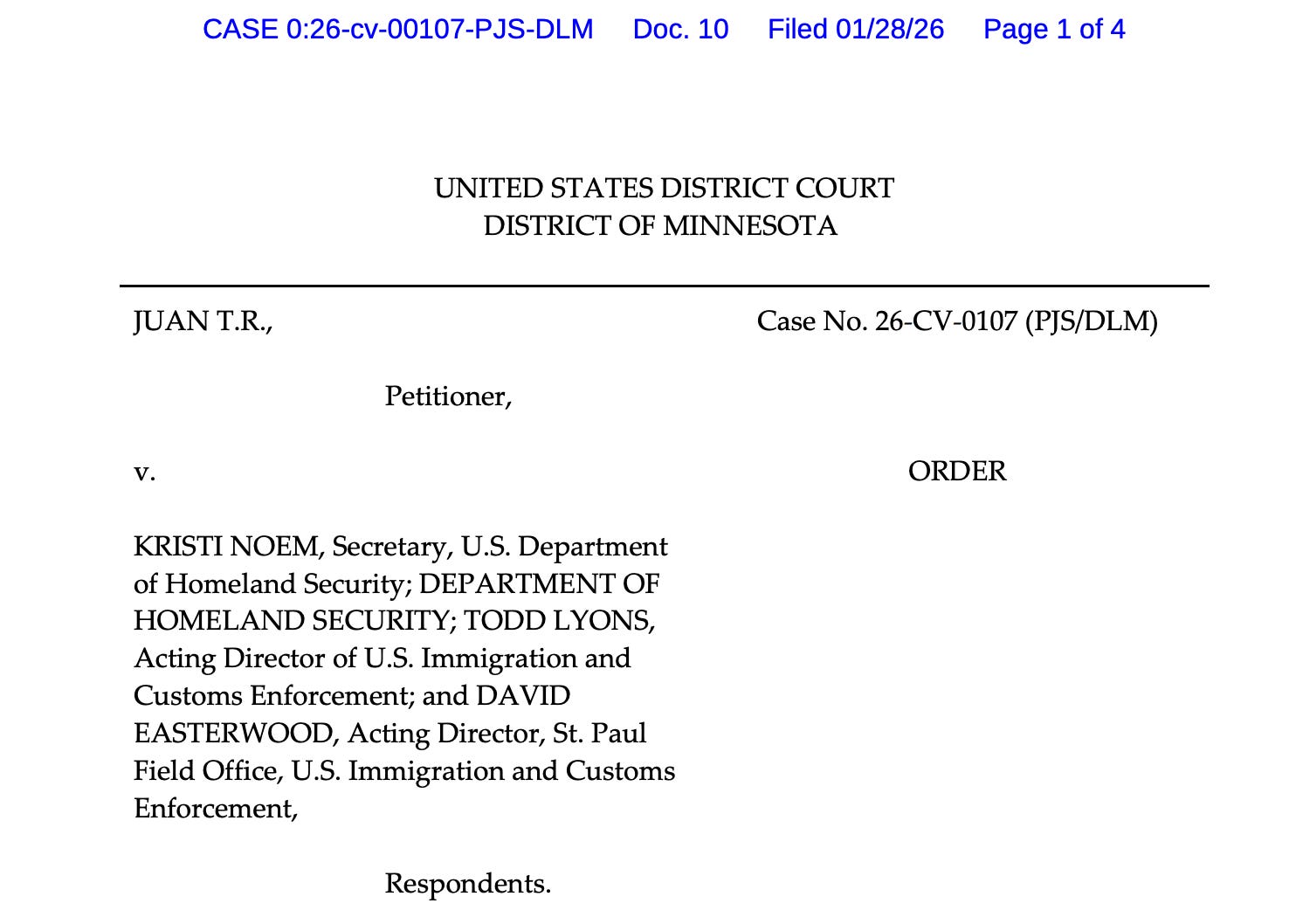
This morning, Judge Schiltz canceled the contempt hearing he had set for Friday, as he said he would if ICE complied with his earlier order. But he had more to say. He savaged ICE, justifiably, for how the agency has conducted itself, just in the last month and just in his court. The full passage is worth reading:
“Attached to this order is an appendix that identifies 96 court orders that ICE has violated in 74 cases. The extent of ICE’s noncompliance is almost certainly substantially understated. This list is confined to orders issued since January 1, 2026, and the list was hurriedly compiled by extraordinarily busy judges. Undoubtedly, mistakes were made, and orders that should have appeared on this list were omitted. This list should give pause to anyone—no matter his or her political beliefs—who cares about the rule of law. ICE has likely violated more court orders in January 2026 than some federal agencies have violated in their entire existence…ICE is not a law unto itself. ICE has every right to challenge the orders of this Court, but, like any litigant, ICE must follow those orders unless and until they are overturned or vacated.”
We have been, and with good reason, far more focused on ICE’s behavior on the streets of Minneapolis than its egregious, confrontational stance with the rule of law in the city’s federal courts. But both have reached a boiling point. Judge Schlitz wrote that additional violations would likely be met with additional contempt proceedings and orders for agency personnel to appear. The courts appear to have hit their stride.
Yesterday, Donald Trump whined about his unfair treatment: “If we get one person a little bit wrong, headlines,” Donald Trump said, in reference to the murder of Alex Pretti. Yes, Mr. President, that’s exactly how federal law enforcement works. Welcome to the serious responsibility of protecting people on the streets of America, where their lives and liberty take priority, and not just the people that you want in your tribe—everyone who is here, citizen or not. That’s how our Constitution and our rule of law work. If you violate court orders, there are consequences. If you trample on people’s rights, if your militarized agents kill American citizens, there are consequences. That’s something this president has only rarely had to deal with in the past, and it showed in the childish way he complained about being held to account when people have been killed.
Greg Sargent wrote last night that Trump doesn’t want to de-escalate tension on Minneapolis streets; he wants to “defuse anger among congressional Democrats,” but he has no intention of changing his policy objectives. “An administration official gave away the game to Punchbowl News, admitting that these “de-escalatory measures” are about placating Senate Democrats so they don’t seize this moment to demand restrictions on ICE as part of any government funding package.” As the clock ticks toward the Friday deadline, Trump is trying to use his stable of tried and true tactics to keep the Democrats from gaining the upper hand.
Today, Bruce Springsteen gave us an anthem. “We'll remember the names of those who died. On the streets of Minneapolis,” he sings.
As Trump continues to push his mass deportation agenda, it’s increasingly clear he’s not fulfilling campaign promises to remove violent criminals from American cities. Trump and Stephen Miller have been confronted with the fact that those cases were already being prosecuted by the Justice Department; they’ve always been a priority. The idea that there were plenty of cases lying around, undone in sufficient numbers to permit ICE to meet the massive arrest quotas they’ve established, has now been thoroughly debunked. In fact, the local outlet MPR News reported that DHS was overstating its accomplishments in Minnesota. Most of the people identified on a “worst of the worst” list released by DHS earlier this month, which they used to boast about ICE arrests in the state, had been transferred to ICE custody before Operation Metro Surge started in December 2025.
Civil deportation, the place where they’re trying to make up the numbers, is an entirely different matter. It doesn’t involve violent criminals—they’re already in custody and under prosecution for the most part. The civil proceedings ICE is largely using to detain people in Minnesota, and also in Maine, involve five-year-olds and grandfathers. It’s the “low hanging fruit cases,” people who are here without legal status but who are visible because they work in our communities and care for their families. It involves terrorizing school children. It does not make our communities safer; if anything, it leaves them worse off with absent workers, school kids, and community members.
ICE has become a parody, a stereotype of bad law enforcement. With each day bringing fresh outrages from an agency that is undisciplined in the field and receives no discipline from the top.
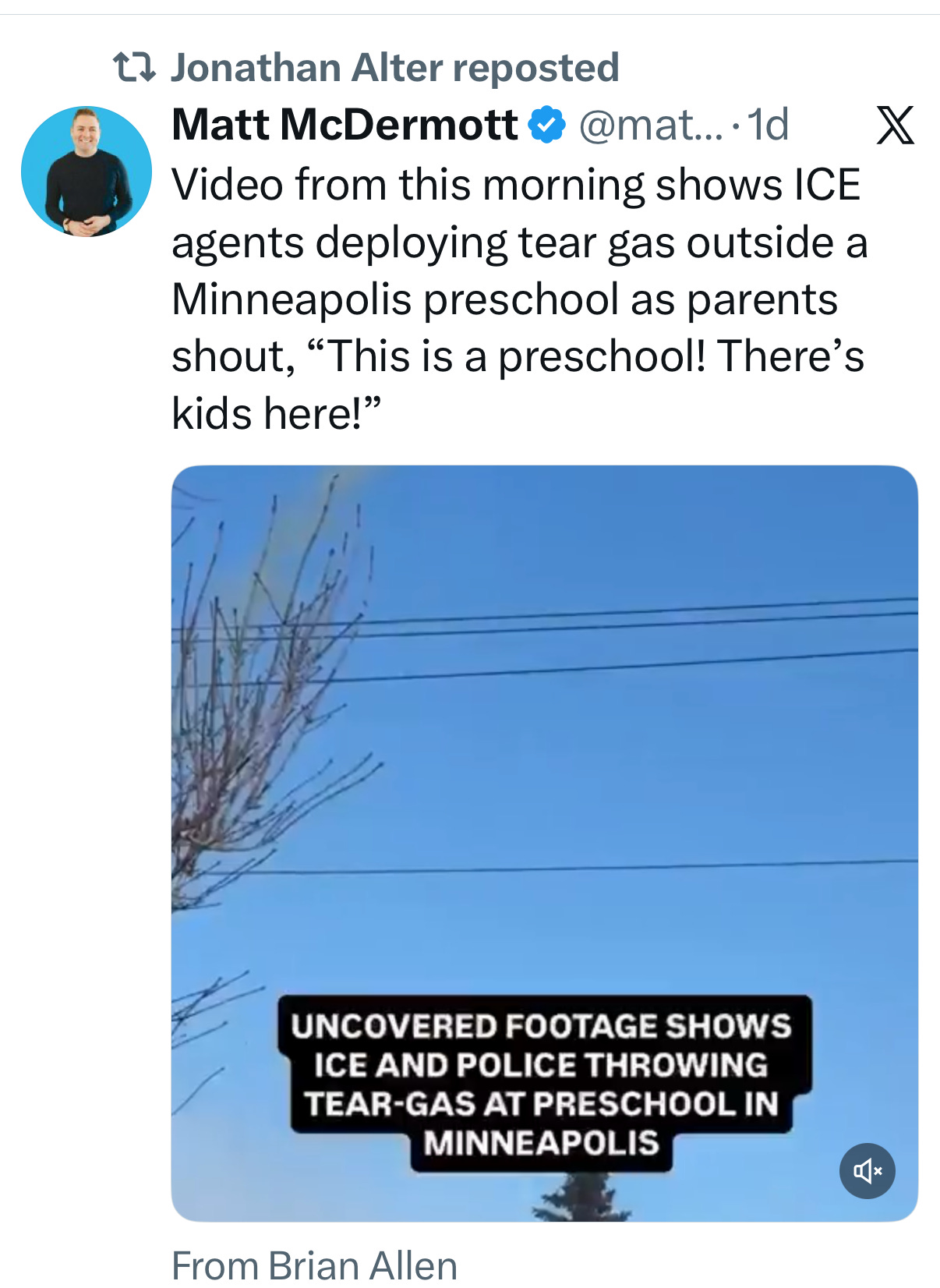
At this point, the predominant emotion so many of us are feeling is anger. Anger that people are being treated like this. Anger that our government is doing it. Anger that it’s doing it with our tax dollars.
Last night, Heather Cox Richardson wrote about one of those stories that just does you in, a five-year-old U.S. citizen who was deported with her mother to Honduras, a country she had never been to. They were denied due process before they were deported. They did not have a hearing before a judge or even access to a lawyer. ICE appears to have made efforts to conceal their presence from an immigration attorney who was looking for them prior to their removal from the U.S.
In Maine, the Lewiston Sun Journal reported that more than 200 people have been arrested since ICE came to Maine just over a week ago. Agents’ presence in two cities, Lewiston and Portland, has led “to fear among immigrant communities and the region broadly. The impact on public schools has been stark: districts in some of the cities targeted by enforcement say they’ve seen notable drops in attendance and widespread fear among immigrant families about sending their children to school.”
One of those children is Keyli Camila Espin Vaca. The Boston Globe reported that she “expected her mother to come pick her up after school on Friday, just as she always did. But her mother never came. Mayra Vaca Latacunga, 25, had dropped Camila off at the Biddeford Primary School that morning, then went to get groceries. Soon after, ICE agents stopped her car and requested her documentation, her brother said. She didn’t have it. The agents handcuffed her and transferred her to Massachusetts.”
Vaca Latacunga is a single mother from Ecuador, her daughter’s sole caretaker. The Globe reported that she did not appear to have any criminal history.
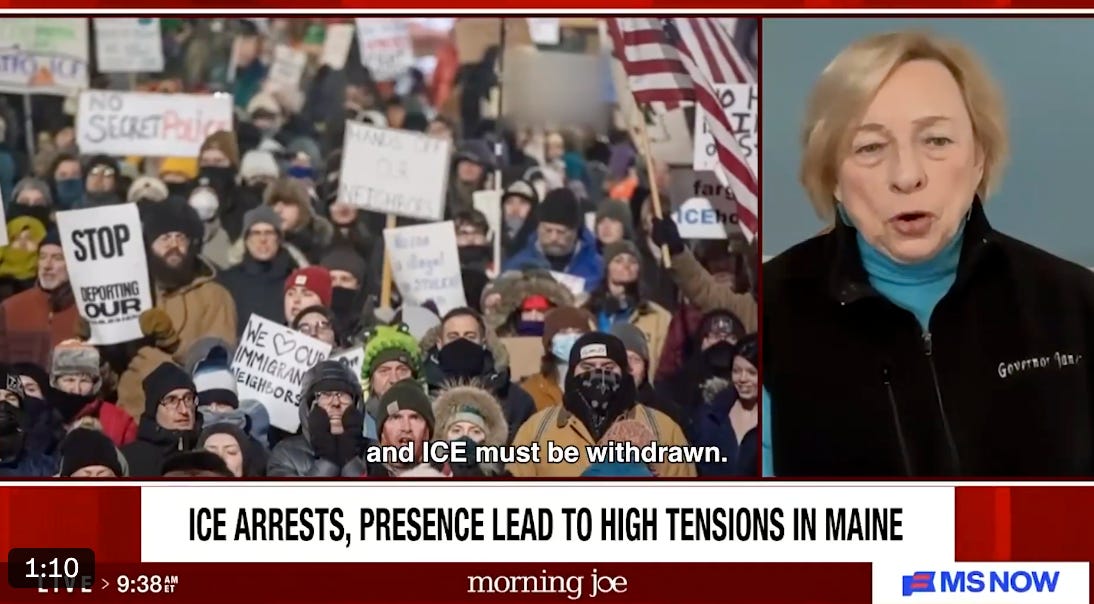
Vaca Latacunga isn’t the only one. Maine Governor Janet Mills said on “Morning Joe” on Monday, “They arrested a civil engineer who is working here in Maine. They arrested a mother of four children in front of her kids. What the heck, what does that prove? . . . These are people who are contributing to our society.”
Thank you for being here with me at Civil Discourse and for supporting independent journalism with your paid subscriptions. Hopefully, Civil Discourse gives you the opportunity to learn, to understand, to think for yourself, and to decide what the right course of action is. That’s civics education at work, and I’m grateful to be part of a community that believes it’s essential.
We’re in this together,
Joyce
