What Happens When You Pay Ex–Gang
Members to Stop Crime? Ask Chicago.
Illinois pays former
gang members to prevent shootings in Chicago. Critics say the billion-dollar
experiment has become a revolving door for crime.
By Olivia Reingold
This fall, a Chicago headline caught my eye: A man who had
posed with Governor J.B. Pritzker at a “Peacekeepers” anti-violence event had
just been charged with murder.
The man was part of a state-funded program designed to
prevent gang violence by paying locals—often former gang members—to mediate
conflicts on the street. About a week after appearing with the governor,
prosecutors say, the man participated in a smash-and-grab robbery of a Louis
Vuitton store. In the chaotic getaway, another man was killed: Mark Carlo
Arceta, whose son was born the next day without a father.
The story raised obvious questions: What exactly is a
Peacekeeper? And how often do people in this program end up back in cuffs?
The local press quickly moved on. I started digging.
After three months of Freedom of Information Act requests,
door-knocking, and speaking with ex–gang members, I answer those questions in
today’s story.
The Peacekeepers program is just a single piece of an
experiment in crime-fighting that has attracted around a billion dollars. It
also is a program that a growing chorus of city leaders, law enforcement
officials, and even a donor now say doesn’t work. One city alderman called it a
“scam.” A member of the mayor’s own public safety team told me it is a
“revolving door” for gang members.
I: “The Biggest Lobby in
Chicago”
CHICAGO, ILLINOIS — Darron Randle said he used to believe
anyone could change—even the hardened ex–gang members he counseled on the South
Side.
“I was extremely optimistic,” he said.
As a life coach at the Firehouse Community Arts Center, a
violence-prevention nonprofit that has received more than a million dollars in
public funding since 2022, Randle advised participants on how to live an honest
life. The men attended therapy sessions, worked toward their high school
diplomas, and met with Randle twice a week. In exchange, they received up to
$550 every two weeks.
Everything was fine, Randle said. Until the checks ran late
one payday. Almost immediately, a mob of about 30 men gathered, some of whom
blocked the office doors so no one could leave.
“We were held hostage almost. . . . It
really was scary,” said Randle, who grew up in a Bronzeville
project. “I was uncertain as to what could happen, like a fight
could break out. I didn’t feel safe.”
Eventually, he said the organization’s director dispersed
the crowd.
Though the director remembers it differently—he says he
never had to break up a group—Randle stands by his memory and the lesson he
took from it. “This isn’t working,” he remembered thinking.

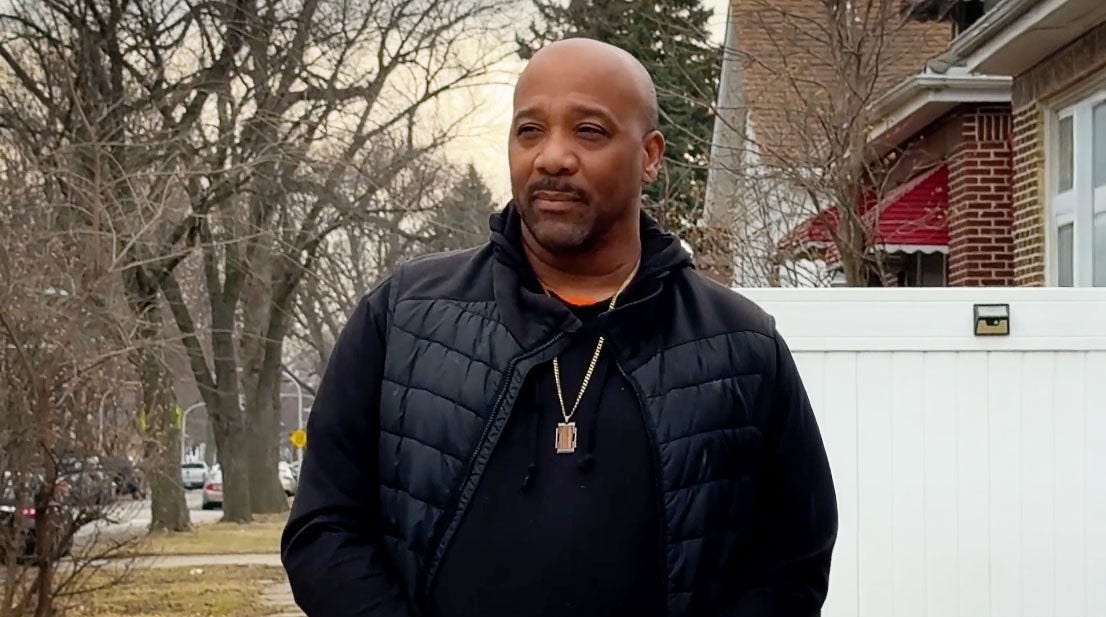
Darron
Randle. (The Free Press)
“There’s so much blood that’s been spilled in these
streets, I don’t know what the answer is anymore.”
The idea of fighting crime by paying ex–gang members might
be new to you, but this sort of program, which often goes under the name of
“community violence intervention,” has become the norm in blue cities like
Chicago, Los Angeles, and New York City over the past decade.
Proponents of this approach argue that, rather than relying
on policing to prevent gang violence and reduce shootings, some amount of
police work can be replaced with state-backed, man-on-the-street initiatives.
In Chicago, that includes hiring former gang members to counsel current ones
and resolve disputes. The programs go by different names: violence prevention,
violence interrupters, Peacekeepers.
In recent weeks, I’ve investigated whether this strategy is
working—or whether taxpayers and philanthropists are inadvertently funding gang
violence in Chicago. Randle is one of many outreach workers, South Side
residents, and donors we spoke to who say they’re losing confidence in
community violence intervention.
Over the past decade, taxpayers and private donors have
spent around $1 billion on community violence intervention (CVI) programs in
Chicago, according to an analysis by The Free Press.
The funds have gone toward dozens of programs. They include
things like trauma-informed therapy
sessions, financial literacy courses, and a state-funded
program called the Peacekeepers, which pays former gang members
and other “justice-impacted” participants up to $150 a day to mediate gang
conflicts and reduce gun violence. But public records obtained by The
Free Press and interviews with three dozen former gang members,
high-ranking city officials, and even one prominent CVI donor, reveal an
ecosystem in which a number of participants have been arrested for everything
from murder to battery, and funding has sometimes gone toward causes only
loosely connected to violence prevention.
Craig Carrington, a community court case manager for the
Restorative Justice Community Court in Cook County told me he sees violence
interrupters at the courthouse.
“They’re supposed to be out here stopping crime, but then
they go and catch a case themselves,” Carrington told me.
CVI is backed by some of the biggest names in Chicago—and
the country—including mega-philanthropist Laurene Powell Jobs, the billionaire
widow of Apple co-founder Steve Jobs, Illinois governor J.B. Pritzker, and
Chicago’s mayor, Brandon Johnson, a progressive who has helped secure funding for these programs. But
not all city leaders have bought in.
At City Hall, Alderman Silvana Tabares called CVI a “scam.”
She said nonprofits are lobbying legislators to push violence intervention as
an “alternative to law enforcement.”
“The biggest lobby in Chicago is not big business,” Tabares
said. “It’s the nonprofits, and they’re using the blood flowing in the streets,
demanding funding with no strings attached. There is no accountability for how
the money is being flown into these programs. No accountability whatsoever.”
While the mayor is supportive of CVI, a key member of his
public safety team told me CVI is a “revolving door” for gang members. “Some
of these guys who are collecting money through CVI are still committing
crimes,” the public safety team employee said. “It’s a huge problem.”
“They are actually paying people for
being a gang member—that’s what they’re doing.”
The chairman of the Committee on Public Safety, Alderman
Brian Hopkins, told me that legacy media in Chicago has ignored a glaring
problem.
“We’re giving too much money to the wrong people with no
accountability. I know it’s hundreds of millions,” he said. “The mayor, in this
last budget cycle, was proposing a so-called ‘community safety fund’ where he
wanted to spend $100 million, and we asked him on what? And he said, ‘Well,
violence interruption.’ Can you be more specific? It’s $100 million. You don’t
get a blank check for $100 million in government.”
Hopkins said one of the reasons the budget didn’t pass was
because of suspicion “that money would be squandered.”
“When things are intentionally obfuscated behind, you know,
the red velvet curtain where nobody’s allowed to peek,” he continued, “that’s
what’s happening right now in Chicago, and that’s very dangerous.”
II. Recasting Crime as a
“Disease”
After spending a decade abroad fighting tuberculosis,
cholera, and AIDS in Africa, epidemiologist Gary Slutkin had an idea: What if
gun violence was best understood as a disease?
In 1995, he founded CeaseFire (now known as Cure Violence),
a Chicago-based nonprofit that trained “violence interrupters” on how to defuse
conflict and deployed them throughout their communities. It was an idea Slutkin said could “begin to make
violence a thing of the past as we have for other contagious diseases.”
Within a decade, its approach had spread across
America—and even to Iraq, Syria, and the West Bank. Yet,
more than two decades later, there still appears to be no cure for crime in
Chicago. The city remains the murder capital of the U.S., according to
the latest data.
Some parts of the city—especially the
South Side—have a murder rate on par with Tijuana.
In the first week of February alone, three masked
gunmen shot and killed a 26-year-old mother in
broad daylight; two teenage boys carjacked a Lyft driver at gunpoint;
and two shootings broke out less than a mile
apart within an hour on the West Side.
Slutkin’s idea—the notion that civilians can help stop
violence—has only found more backers since he founded CeaseFire, with
proponents hoping that violence intervention will become a permanent part of
the city’s gang-prevention infrastructure. Between 2017 and 2023, the budget for CVI programs increased at more
than 15 times the rate of the Chicago Police Department budget.
In 2016, Powell Jobs co-founded a Chicago foundation with
Arne Duncan, an Obama administration alumnus, called Chicago CRED (Create Real
Economic Diversity). It’s now the linchpin of the city’s violence-protection
infrastructure. What began with a $170,000 contribution from Powell Jobs’
philanthropy Emerson Collective has grown into a behemoth that spent more than
$36 million in 2024.
Not only does CRED run its own programming for young men it
deems at-risk, it is a magnet for philanthropic capital and a public advocate
for expanding CVI funding at all levels.

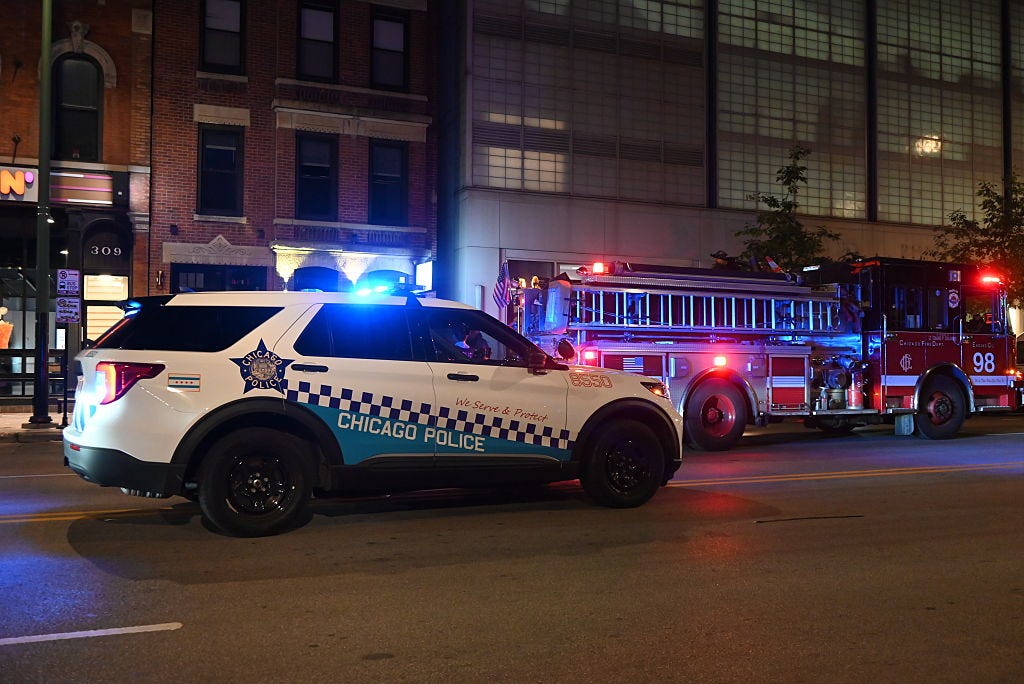
Chicago
police respond to a mass shooting on July 3, 2025. (Kyle Mazza/Anadolu via
Getty Images)
Since its founding, CRED has “graduated” 730 participants
out of a pool of more than 2,500, Peter Cunningham, the spokesperson for CRED,
told me. Most of the individuals are former gang members (and some, current),
though Cunningham noted he prefers the terms cliques or crews.
In order to graduate, they must complete 18 to 24 months of programming,
including trauma treatment, job training, and education for those without a
high school degree, Cunningham said.
While the majority of the approximately 1,770 remaining
participants are still active in CRED, Cunningham wrote in a text that others
“have dropped out. Some moved away. Some got jobs and quit. Some are
incarcerated. Some are no longer alive.”
In 2018, CRED helped launch what would become the most
controversial arm of the city’s CVI apparatus: a program called FLIP
(Flatlining Violence Inspires Peace). Young locals—many of whom have criminal
records or are “justice-involved,” as CRED puts it—are paid to
de-escalate conflict, monitor social media for gang tensions, and participate
in daily check-ins regarding hot-spot activity. They eventually got rebranded
as Peacekeepers. They wear neon vests and are meant to hang out in contested
areas. When gang violence explodes, more than 1,000 Peacekeepers are sent to hot spots
throughout the city to intervene. What began as a privately funded program
under CRED is now a state-funded program, which received $33 million for this fiscal year.
In 2024, state- and city-funded entities performed more
than 10,000 mediations, meaning a “third-party and one or more
participants meet to reduce the likelihood of a conflict or to resolve a
conflict,” according to the Government Alliance for Safe Communities, the
interagency task force that distributes violence prevention funding in Chicago.
Chicago’s Peacekeepers have been deployed for Memorial Day
weekend, a historically high time for shootings, and to help diffuse so-called
“teen takeovers,” when teenagers flood
downtown, wreaking havoc.
Peacekeepers are sometimes dispatched to the scene of a
shooting in hopes of preventing retaliatory action.
That was the case on September 2, 2021, when
Jacob Ellzey, a 48-year-old South Shore native, tried to mediate an ongoing
dispute at a nearby apartment building. Two local families had been going at it
for almost a month after an earlier shooting. He showed up that day hoping to
cool tensions.
“I was trying to say, ‘Hey, let’s bridge the gap and move
on from here,’ ” he recalled.
That’s when shots rang out. Ellzey told me he was shot five
times, with one bullet shattering a leg bone.
“I thought I had calmed the situation to where I thought we
could speak face-to-face, and it just didn’t work,” he said. “Sometimes it
happens like that.”
More than four years later, he said the feud between the
two parties rages on. He estimates that at least two others have been shot in
the fallout.
In September, the Peacekeepers program became the subject
of a national scandal after Governor J.B. Pritzker, a potential Democratic
presidential hopeful, visited a CVI organization on the South
Side. A video clip from that day shows him
listening intently and nodding as a Peacekeeper explains why locals trusted him
more than the police.
“I think one thing you said was they feel safe, or safer,
around you,” the governor said.
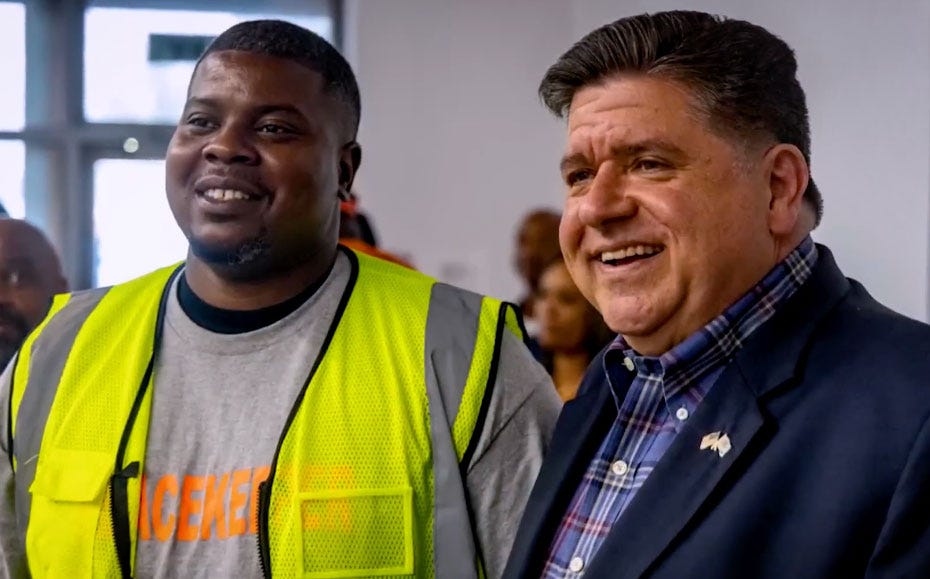
Pritzker was all smiles as he shook hands and posed for
photos with other CVI participants. Among them was a Peacekeeper named Kellen McMiller.

Governor
J.B. Pritzker poses for photo with Peacekeeper Kellen McMiller (screen grab
from footage provided by the Office of the Governor)
Six days later, McMiller allegedly helped steal nearly
$700,000 in merchandise from the Louis Vuitton store on Michigan Avenue. One of
the getaway cars collided with another vehicle while traveling 77 miles per
hour. Mark Carlo Arceta, 40, was on his way to his shift at a nearby hospital’s
animal research laboratory when he was killed in the crash. The next day,
his fiancée gave birth to their son, naming
him after his dead father.
Prosecutors charged McMiller and his six
co-defendants with first-degree murder, retail theft, and burglary a few days
later. When the news broke, McMiller had four active arrest warrants. Despite
his criminal record, he was paid by the state—up to $600 a week—to try and
prevent crime.
In a statement sent to media outlets after McMiller’s
Chicago arrest, the governor’s office said it was “extremely troubled” but
defended having felons in the program.
“We want people who’ve fallen into that lifestyle to work
now to deter people from entering a life of crime,” Pritzker told reporters. (McMiller was indicted in
October, and his next court appearance is scheduled for the end of the month.)
Others came to different conclusions in the wake of the
incident. Alderman Hopkins, whose ward includes the strip of Michigan Avenue
where Arceta was killed, is a believer in CVI—he said he used to serve on
CeaseFire’s board in the ’90s. But the McMiller debacle, he said, exemplifies
the program’s need for oversight.
“Every time we have some shadowy nonprofit agency that does
nothing but take the money with no accountability and squander it or spend it
on cars, it undermines the whole concept,” Hopkins said. “It’s very damaging to
have incidents like this one.”
And McMiller is not the only example. Since January
2023—when the Peacekeepers program expanded from a summer initiative to a
year-round operation—The Free Press found 28 additional arrests
involving people who identified themselves as Peacekeepers or “violence
interrupters” or wore Peacekeeper vests. The charges range from drug possession
to violent assault.
In one case, police arrested a man for alleged heroin
possession and unlawful possession of a firearm after finding him naked under his bed with $50,000 in cash
nearby (he was later acquitted). In another, officers allegedly
discovered 24 suspected ecstasy pills on a man who
identified himself as a Peacekeeper who had been arrested for battery and
resisting the police. Another police report describes a man who said he worked
as a Peacekeeper who allegedly beat a woman unconscious, leaving her
hospitalized with a brain hemorrhage. Another Peacekeeper, who told police he
was a member of the Satan Disciples gang, was arrested twice within the span of
10 days.
(We couldn’t confirm the outcome of all the criminal
proceedings.)
Duncan, the former education secretary under Barack Obama
who now runs CRED, told me he recently fired one of their “star Peacekeepers”
after she was arrested. “It broke my heart,” he said. “She may well not get
convicted for what she was charged with, but you have to be held accountable.”
The arrests also include another Peacekeeper who posed with
Pritzker that September day: Christopher D. Brown, who was arrested two months
later for possession of cannabis over the legal limit and an unspecified
controlled substance. It was his third arrest that year.
Steve Robinson, a Los Angeles police officer who married
into the Crown family, one of Chicago’s wealthiest families, has been lobbying
his brothers- and sisters-in-law to cut off funds to CRED and other CVI
organizations. The multigenerational dynasty is worth billions, largely due to
a long-standing share in defense contractor General Dynamics. The Arie and Ida Crown Memorial foundation
gave an average of about $100 million annually to charities across the country
between 2019 and 2024. Since 2020, more than $5.4 million of that has gone to
CVI organizations, including CRED. The Crown family’s foundation did not
respond to our request for comment.
Robinson said the money is just being wasted on gang
members.
“I’m not saying it’s a universal truth, but the vast
majority don’t change,” Robinson said. “Politicians and do-gooders get sucked
into the rhetoric. ‘We’re different. We change. We can do good work.’
Bullshit.”
III. A Lost Cause?
In the eight weeks I spent reporting this story, I went to
nearly every block on the South Side known for gun violence.
I went to O Block, the home turf of the Black Disciples, a
gang that once executed an 11-year-old member. I visited the Dearborn Homes,
the historical stronghold of the Mickey Cobras, a gang faction that arose in a
maximum security state prison in the ’80s. And I walked around Englewood with a
member of the Gangster Disciples, the mortal enemies of the Black Disciples.
I didn’t see a single Peacekeeper.
Devaughen Stringfellow wasn’t surprised.
He’s a former Gangster Disciple, who told me he was “born
into” gang life.
“I was born around nothing but gangsters,” he said,
standing in his Englewood backyard. “My mama was a gangster, my daddy was a
gangster. My grandma was a gangster. Everybody was a gangster—I just grew up in
it.”
Behind us is his tow truck’s transmission, placed atop a
wooden stool. His truck is his prize possession—it’s his main source of income
since Acclivus fired him, and a handful of other Peacekeepers, in 2024, due to
a lack of funding, according to Acclivus.
In the five years he worked as a Peacekeeper, he said he
started to feel like the program had lost its way. Many of his colleagues, he
said, would often show up to the morning check-in, then disappear
for the rest of the day.
“They ain’t doing nothing wrong but a lot of them ain’t
doin’ shit, I ain’t gonna lie,” Stringfellow said. “Just getting a check,” he
added.
Stringfellow told me he still believes in the concept of
violence intervention—that locals with street cred can help prevent shootings
in their neighborhoods—but that the Peacekeeper program has “gone to hell.” He
complained of low wages for dangerous work, chronic absenteeism, and a culture
that rewards friendship over merit.

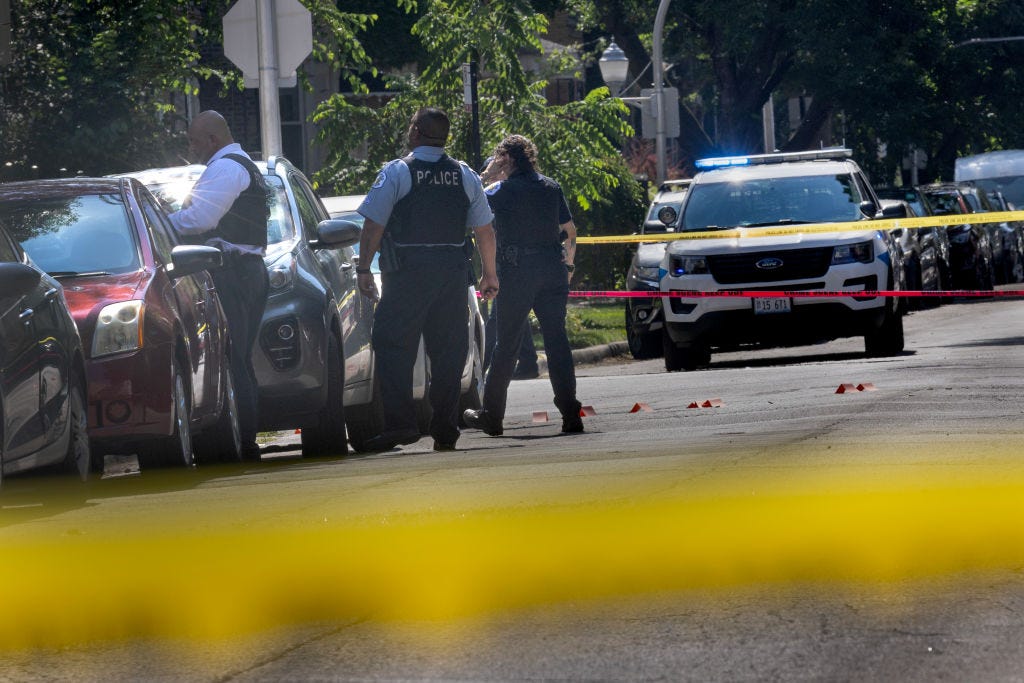
Chicago
police investigate a drive-by shooting on July 6, 2024, after a violent Fourth
of July weekend that left 19 dead and dozens wounded. (Scott Olson via Getty
Images)
“Anything that’s run by gang members and dope fiends, it’s
all gonna be run the same,” Stringfellow said. (Acclivus did not respond to
requests for comment regarding his claims.)
That’s not the case for David Murray, a 50-year-old
violence interventionist, who told me he’s in Roseland most days, distributing
free food and flyers.
“We do pop-ups in each neighborhood where there’s a
shooting,” he said. “We go out there and set up for two or three hours, and
just bless them with as much love as we can.”
Murray, a former member of the Mickey Cobras, said he feels like he’s making
up for his past—and making a difference.
“Just the fact that I got some type of peace and solace, I
feel like I’m doing the right thing,” he said.
Cunningham told me that while the paycheck might be what
gets participants in the door, “Over time they realize the paycheck is the
least important thing they gain from CRED. We want them to start earning money
in the legal economy and understand what is possible.”
But Stringfellow told me that many of the men he used to
work with reverted to their old behavior.
“They got to shoot-outs, robbin’, all of them end up in
jail,” he said. “They ain’t had nothing else to do. So they got back to what
they was used to doing.”
A life coach at CRED who works with troubled teens told me
he was so sick of seeing participants sneak off to the bathroom to vape or doze
on their desks that one session, he asked them: “Let’s keep it a buck: Who’s
here for the money?”
He said about 40 percent of the class admitted that they
were only there for the money, which Cunningham said is a weekly stipend that
starts at $175.
I asked Cunningham about something I had heard—that
participants had died on CRED property before. He confirmed that two men were
killed on CRED’s property, with about 38 others having been shot or killed
while enrolled with the organization.
Community violence intervention “only works because we
engage with individuals at the highest risk of shooting or being shot,”
Cunningham told me. “Most of our participants are still at risk even when they
are in the program and every loss is an absolute tragedy. That is why we are
trying to scale up CVI and reach a critical mass in the neighborhoods we
serve.”
One victim was 28-year-old Ronnie Roper, who had been convicted several
years earlier of a drug-related offense but was trying to change his life. On
May 17, 2023, he was fatally shot in the parking lot of CRED’s Roseland
facility.
A second life coach I spoke with was there that day.
He told me that he normally walked Roper to his car and
“told him I loved him,” but that day he was “distracted” by a Zoom call.
“Next thing I know, all I heard was a bunch of noise. And
they were saying somebody got shot.”
Paul Robinson, CRED’s chief program officer, told me CRED
participants’ “lives are complicated, fraught with risk.” He said Roper was
likely shot and killed “because of something he had done in the past.”
“Making a change is hard,” added LaQuay Boone, who helps
run CRED’s programming. “So relapse is not simply expected—we know that it may
happen.”
IV. The Big Business of
Violence Intervention
Violence intervention is a sprawling enterprise in
Illinois. There are interagency task forces, public and private partnerships,
and entire state and city agencies dedicated to preventing gun violence.
There are two nonprofits with state grants to run
Peacekeepers programs: Metropolitan Family Services and Acclivus, both of which
distribute grants to smaller nonprofits that provide most of the boots on the
ground. Acclivus is the smaller of the two, with a budget of about $13.5 million in 2023, more than 95
percent of which came from government grants.
Between 2021 and 2023, Acclivus distributed more than half a
million dollars for “violence prevention” and “program support” to two entities
whose connection to the cause is unclear.
A total of $323,567 went to True Star, a nonprofit that
teaches youth the basics of digital content creation (the group did not respond
to a request for comment). And $199,409 went to an LLC called I Said What I
Said Podcast & Apparel, run by a man named Allen Toussaint Werner. The
address listed on Acclivus’s tax filing was his personal home, a modest
townhouse near Washington Park. When reached by phone, Werner declined to
comment. Since late February, the LLC has been deemed “NGS” (not in good standing)
by the state.
The spokesperson for Acclivus emailed that its grantees
were selected through a “competitive, open application process.”
“All subgrantees and their funded projects are reviewed and
approved by the appropriate state agency, including approval of budgets,
program deliverables, as well as validation of their IRS designation and good
standing status,” the spokesperson wrote.
All grant recipients, she added, are subject to “ongoing
program and fiscal monitoring.” The spokesperson didn’t answer how a digital
content and a podcast/clothing company had anything to do with shootings.

Police
investigate a fatal shooting in Chicago’s Lawndale neighborhood on February 14,
2017, that killed a toddler and a young man and wounded a pregnant woman.
(Scott Olson via Getty Images)
State audits uncovered by The Free Press reveal
two different nonprofits that have misspent taxpayer dollars. Illinois
regulators report that one nonprofit named Project H.O.O.D., a Peacekeepers
subcontractor, spent $132,208 on “disallowed costs” out of $676,331 worth of
state funds allocated between February 2022 and June 2024. That includes
purchases at the Apple Store, vodka from Costco, and $3,750 worth of food from
a taco truck. The state audit also lists $14,451 worth of gas cards as
“non-personnel expenditures” that were itemized as supplies for “client
support.”
“Vodka + tax, clothing for women, aleve, tequila + tax, and
bodywash are items not listed in the approved budget,” the audit reads for one
Costco purchase.
Desmond Marshall, the executive director of Project
H.O.O.D., told me these costs were because an employee had “turned in the wrong
receipt.” He added that the nonprofit was in the process of paying the funds
back to the state and “remains committed to transparency, accountability, and
the responsible stewardship of public resources.”
Robinson thinks his family’s money is better off being
donated to other charities with a proven track record.
With Chicago’s violence intervention, “You often find out
two or four years down the line that a program that said it helped out a couple
hundred people, maybe only two or three of those people would still be
considered a success,” Robinson said.
In 2020, Duncan, the head of CRED, wrote that the nonprofit was spending
roughly $10 million annually in the Roseland and West Pullman neighborhoods. He
wrote that if $300 million were diverted away from the police force toward the
remaining 13 neighborhoods they wanted to move into, it could “reimagine public
safety.”
Yet according to a 2021 report from Northwestern
University’s Institute for Policy Research, only 27 participants from Roseland
and West Pullman who entered the program in 2019 had since graduated. That was
out of an initial pool of 234 men.
Northwestern’s research (which receives funding from CRED)
shows favorable CVI stats, including a 32 percent decrease in gunshot
victimizations in hot spots manned by Peacekeepers in the 2025 fiscal year when
compared to 2024. Another study from 2023 found that people in the
violence-prevention program were 73.4 percent less likely to be arrested for a violent
crime in the two years following their enrollment.
“We just had the fewest number of homicides in 60 years,”
Cunningham wrote in an email. “There are clearly changes in behavior and that
points to CVI. Something is clearly working.”
But to Robinson, the drop in crime should be credited to
the work of the Chicago Police Department, which has stepped up its total arrest rates since 2022 and its clearance rates for most major crimes
since 2023.
Even the faculty director of the lab, Andrew Papachristos,
said he “could not attribute that reduction in shootings directly to the
program.” But he added that Peacekeepers are “likely one of many factors at
play in overall trends toward less gun violence.”
People in the violence-prevention
program were 73.4 percent less likely to be arrested for a violent crime in the
two years following their enrollment.
Alderman Michael Rodríguez, a Democrat representing Little
Village, a Mexican American neighborhood on the South Side with Peacekeepers,
said CVI nonprofits have helped turn his neighborhood around, even painting a
mural in a nearby park and mentoring local kids. A billion dollars over a
decade, he said, is a small price to pay for safer streets.
“When you think about the scale of the problem and the
amount of lives that we’re saving at the end of the day, this is an economic
investment,” Rodríguez said. “As long as they’re needed, I’ll be supportive.”
But Antoine Dobine, a 56-year-old former Gangster Disciple,
said the only way to save lives is to focus on the kids, not the rehabilitation
of young men.
“Why can’t we cut the bad tree down at the bottom, instead
of trying to start at the top? The tree has already grown. Let’s nip it in the
bud,” said Dobine, who runs a kids sports league, Hands Around the Hundreds.
Dionell Hill, a 41-year-old resident of Fuller Park, a
Chicago area with one of the highest rates of shootings, said it took
getting in trouble with the law for him to change his ways.
“I had to keep bumping my head. I got tired of being in
trouble,” he said. “It’s about the fact, why are you putting your life at risk
like that? I got tired of being broke.”
He said he needed to learn to provide for himself—not
through stealing, but by installing drywall and rehabbing old businesses. CVI,
he said, “ain’t doing nothing.”