Monday, March 02, 2026

Joyce Vance

 Civil Discourse with Joyce Vance

The Week Ahead
February 27, 2026

I spent the better part of today reading judges’ opinions so you don’t have to — and tonight’s piece includes the key excerpts so you can see the language for yourself. It’s longer than I’d usually publish on a Sunday evening, but these are the times we live in, and the details matter. What I’m doing here — connecting dots between rulings in different districts and putting them in context — is experience-based analysis you won’t find anywhere else.

If Civil Discourse helps you make sense of this moment, I hope you’ll become a paid subscriber. Be part of a community of people committed to saving democracy — and help to keep this work accessible to readers who otherwise wouldn’t have it.

This week: All the tails, wagging all the dogs, as Trump tries to avoid what is steadily coming for him with the Epstein Files. Yes, he bombed Iran overnight, as we learned Saturday morning. But it’s hard to avoid the lingering feeling that at least in part, it’s all about the missing documentation about complaints he sexually assaulted young girls.

Last Thursday, there was reporting that Republican Senators—Republicans—are pressuring Pam Bondi to release files that DOJ has withheld. “Republicans are on the defensive as Senate Democratic Leader Chuck Schumer (N.Y.) is vowing that Democrats will use every tactic at their disposal to force the release of the missing records.” Louisiana Senator John Kennedy is quoted as saying, “Release the documents. Redact the names of the victims. Don’t release photographs, naked or otherwise, of minors. Release the documents. This is not going to go away until there is full disclosure.” When you’ve lost the good Senator from Louisiana, you’re in trouble if you’re the man in the White House.

I’m trying to learn how to use AI to make images, and I’m not quite there yet; but the good news is that if you want to use this one, you can!

So what better than to bomb a deeply hated, and rightly so, cruel regime in the Middle East? All of the distractions that surface this week, and you’d be correct to anticipate weighty and important ones ranging from Iran to Trump’s long-desired takeover of federal elections, and more, should be viewed in this context. What is Donald Trump trying to hide from you?

Now that Hillary and Bill Clinton have testified under oath about Epstein, there is no reason Donald Trump and his third wife, Melania, shouldn’t as well. So while the media headlines Iran around the clock, make sure you tell your elected officials that you expect the Trumps to testify, and that you’ll be waiting with your ballot in hand come November to make sure that they do.

Beyond that, I want to flag a serious development that won’t get the coverage it should this week. Trump may have bombed Iran, but the Federal Judiciary is Declaring War on ICE.

Minnesota

Minnesota is leading the way, because of the occupation of Minneapolis. Chief Judge Patrick Shiltz, who longtime lawyers in that District characterize as extremely smart, and not someone a lawyer should pick a fight with, entered an order in a case called Juan T.R. v. Noem, that concludes with this sentence, “This Court will continue to do whatever is required to protect the rule of law, including, if necessary, the use of criminal contempt. One way or another, ICE will comply with this Court’s orders.” That happened on February 26.
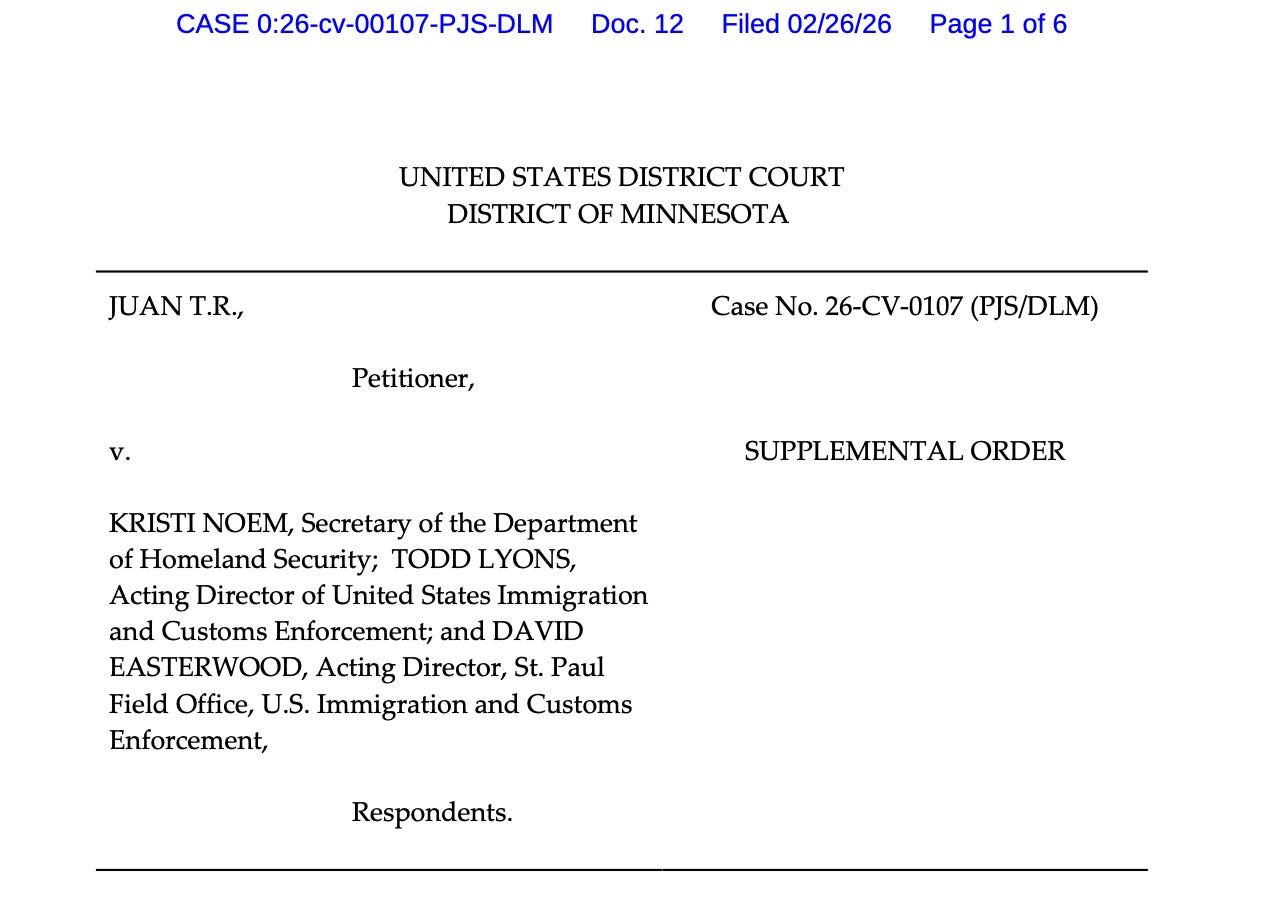
Here is what led to that rather remarkable statement. On January 8, Juan T.R. filed a petition for a writ of habeas corpus. That’s Latin for "you have the body." The writ is frequently used by convicted inmates to challenge their conviction or confinement, and I’ve handled many of them in the course of 25 years at DOJ. The writ ensures that a judge will make a determination about the legality of the petitioner’s detention, providing essential protection from arbitrary or unlawful confinement. People in immigration detention can use the writ too, which is what happened here, and is happening in many cases where people who are wrongfully held in immigration detention have access to a lawyer.

The Court issued an order that required the government to respond by January 12. They didn’t.

That may not seem remarkable, but let me assure you that it is. The government does not miss filing deadlines. You can always ask a judge for an extension if necessary. Failing to file on time? Never acceptable. Any Assistant U.S. Attorney who did this would be facing discipline from their own chain of command, to say nothing of the court.

Because the government failed to respond, Judge Schiltz granted the writ in part and ordered the government to either give Juan a bond hearing within seven days or, if they didn’t, to release him from detention.

It gets worse. The government neither held a bond hearing nor released Juan.

So, the Judge, apparently bending over backwards to be patient, issued what’s called a “show‐cause order” and scheduled a hearing. Not just any hearing. He ordered the personal appearance of Todd Lyons, Acting Director of ICE. Show cause orders require a party—here, that’s Mr. Lyons—to appear and explain (“show cause”) why the court shouldn’t take action it’s contemplating. This type of order can be used to address violations of court orders, in which case the party the judge enters it against has to justify its actions to avoid an adverse decision, or even some form of penalty or sanction.

The Judge advised Lyon that if it advised the court Juan had been released, he would cancel the hearing and Lyons would not have to appear. The government filed a joint stipulation with Juan’s lawyer, advising the court it had met those conditions, and the Judge canceled the hearing. But the Judge expressed what he called “grave concerns about ICE’s noncompliance with court orders.” He identified 96 court orders that ICE had violated in 74 cases and listed them in an appendix, noting that “the list was hurriedly compiled by extraordinarily busy judges” and that, “[u]ndoubtedly, mistakes were made.”

Judge Schiltz explained what happened next in his order. “Unfortunately, the government’s response to the Court’s order was not to do a better job complying with court orders, but instead to attack the Court. In an email to the undersigned dated February 9, 2026, Daniel N. Rosen, the United States Attorney for the District of Minnesota, accused the Court of wildly overstating the extent of ICE’s noncompliance with orders. Specifically, Rosen said that he had asked a lawyer in his office to review ‘a statistically strong sample of the 75 cases’ listed in the appendix to the Court’s January 28 order. That ‘statistically strong sample’ consisted of the first 12 cases on the list.”

The Judge set forth Rosen’s summary of his evaluation: “So as I am seeing it, in eight out of eleven cases [the twelfth case was a duplicate], the Petitioners were released on time. In six of those eight cases, there was no violation at all. In one there was a violation regarding an interim step, but the release was on time. In one, the release was on time, but the status report was filed late. In one, where no specific deadline was set for return and release, the return and release took six days. In two cases, the releases were after the deadline”

Judge Schiltz continued to quote from Rosen’s communication with the court, “Judge, please pardon me for being so direct, but your order of January 28 did not merely contain some errors, as you anticipated it may. Assuming the statistical sample we chose is as representative of the whole as I believe it likely is, the information compiled by others for your order was far beyond the pale of accuracy for an order that would be wielded so publicly and so sharply. The lawyers in my civil division didn’t deserve it.”

Judge Schiltz asked the other judges in his district to review their cases. He had his own law clerks check the accuracy of all of the information. He explained there had been a few errors, “But the bottom line is that ICE violated 97 orders in 66 of the cases referred to in the January 28 order. The January 28 order had identified ‘96 court orders that ICE has violated in 74 cases.’ … Obviously, the January 28 order was not ‘beyond the pale of accuracy,’ as claimed by Rosen.” The Judge also went to bat for AUSAs in the Minneapolis’ office’s Civil Division, noting they had “struggled mightily to ensure that respondents comply with court orders despite the fact that respondents [that would be DOJ and ICE leadership] have failed to provide them with adequate resources.”

Then comes the kicker, “The judges of this District have been extraordinarily patient with the government attorneys, recognizing that they have been put in an impossible position by Rosen and his superiors in the Department of Justice (leading many of those attorneys—including, unfortunately, Ana Voss [who had been the Civil Chief]—to resign). What those attorneys ‘didn’t deserve’ was the Administration sending 3000 ICE agents to Minnesota to detain people without making any provision for handling the hundreds of lawsuits that were sure to follow.”

But Judge Schiltz wasn’t done. He took Rosen to task for claiming “we commit to the court that we will redouble our efforts.” Rosen claimed that “The truth is that efforts we have already been undertaking for weeks have led to considerable improvement—efforts which have apparently gone unrecognized by some on the bench.” Judge Schiltz punched back: “This, too, appears to be untrue. Attached as Appendix B is a list of additional cases in which ICE has violated court orders, most of which violations occurred after entry of the January 28 order. Despite Rosen’s assurance of ‘redouble[d]’ efforts that have ‘led to considerable improvement,’ Appendix B documents 113 additional orders that ICE has violated in 77 additional cases—again, above and beyond the 97 orders that ICE violated in the 66 cases identified in Appendix A.”

There will be more in this case this week. It’s fair to say that this is a Judge with knives out.

There are also a bunch of consolidated habeas cases in Minneapolis, presumably including some of those Judge Schiltz refers to, that are scheduled for a hearing on Tuesday in front of Judge Jeffrey Bryan. Judge Bryan’s order refers to “numerous unlawful violations of court orders,” including alleged failures by federal agents, repeated, to return seized property to illegally detained people upon their release.

This fact situation reminds me of a case I prosecuted many years ago, where officers at a small police department in Northeast Alabama where arresting workers at poultry factories in the area, “unarresting them” in the morning, but keeping their property, including cashed paychecks. We successfully prosecuted them for civil rights violations. I have to question whether this attorney general will insist on similar prosecutions—she absolutely should—if these allegations hold up in court. Federal agents who steal from people should be fired and prosecuted. Full stop.

But this is not a situation where wrongdoing was identified and addressed. Instead, Judge Bryan is holding a combined contempt hearing for the cases, because although he ordered the return of seized property by February 25, that didn’t happen.

“These habeas cases come before the Court for the enforcement of the Court’s prior orders. In each case, the Court ordered the release of Petitioners, all of whom had been unlawfully detained by Respondents. Additionally, in each case, the Court ordered Respondents to return all personal belongings taken from Petitioners during their unlawful detention because Respondents have no lawful claim to such property.

The property at issue includes personal belongings such as cash, cellphones, jewelry, driver’s licenses, work permits, passports, clothing, and other identification and immigration documents.”

The Judge has ordered officials, including Rosen, the U.S. Attorney, and an official from ICE, to appear in court unless they file an explanation of the status of the property belonging to each of the petitioners with the court in advance.

The bench in Minneapolis is not amused. The Trump administration may have eviscerated the career prosecutors in the U.S. Attorney’s Office in Minnesota, but they can’t do the same thing to the court. And the judges seem determined to pursue justice, not the president’s political agenda.

It’s not just Minnesota. In West Virginia, where ICE is conducting “Operation Country Roads,” four judges have made it clear that they intend to impose consequences if state and federal officials (this is a red state, and many of the state and local police agencies are working with ICE to make arrests and detain people) don’t stop illegal, unconstitutional detentions. The operation led to an estimated 650 arrests, and the court has been deluged with lawsuits brought by people seeking their release. Few of them have criminal records and most have longstanding ties to the community. The judges have been ordering ICE to release people it has detained.

Judge Joseph Goodwin, a Clinton appointee whose son served as the Obama U.S. Attorney in the District, wrote in one order that “Antiseptic judicial rhetoric cannot do justice to what is happening. Across the interior of the United States, agents of the federal government — masked, anonymous, armed with military weapons, operating from unmarked vehicles, acting without warrants of any kind — are seizing persons for civil immigration violations and imprisoning them without any semblance of due process. The systematic character of this practice and its deliberate elimination of every structural feature that distinguishes constitutional authority from raw force place it beyond the reach of ordinary legal description. It is an assault on the constitutional order.”

Politico’s Kyle Cheney has been doing a superlative job of tracking rulings from judges across the country who are handling ICE detention cases. Late last week, his tally was at 393 rulings against the administration, including ones from a panoply of Republican appointed judges, and only 33 in favor of the administration.

Friday night, another federal judge, this time back in Minnesota, had had enough. The case involves ICE’s arrests of refugees in Minnesota who hadn’t yet obtained lawful permanent resident status. Using a strained interpretation of the law, ICE was detaining people who had no removal orders pending against them. In a 66-page order, Judge John Tunheim wrote that the administration “seeks to transform a system built on promised opportunities and freedom into one of uncertainty and indefinite confinement.” He continued, “The court will not allow those who relied on this nation’s promise of safety to be met instead with handcuffs. The Constitution requires steadiness, fidelity to statute, and respect for promises made. The rule of law demands no less.”

The government can’t seem to win. And that should tell you all you need to know. It’s not difficult for the government to win these cases—when they are doing it right. Here, they are doing it wrong. And federal judges are increasingly unwilling to give them additional time or courtesy. That’s important. District court judges are upholding the law and doing the work the Constitution demands of them—deciding cases based on the facts and the law without fear or favor. Doing it without fear in this environment makes them all heroes.

We close where we began. Tails are wagging. Do not let this administration distract you from what matters.

We’re in this together,

Joyce

Sunday, March 01, 2026

JOYCE VANCE


The Law of War

Joyce Vance

Feb 28, 2026


I am not a law of war expert. I don’t play one on TV. But I wanted to share some basic principles and offer some suggestions for further reading as we watch the news unfold in Iran. The White House hasn’t offered the public a reason for the attack on Iran that would make it legal, and CNN is reporting they haven’t provided a “full accounting” to members of Congress either. This afternoon, Jake Sherman at Punchbowl News reported that “A senior Trump administration official said that U.S. intelligence ‘had indicators’ that the Iranians were going to use their missiles ‘preemptively, but if not, simultaneous’ to any American action on Iran.”

But if the real reason for our attack was warding off casualties from an Iranian first strike, you would have expected to hear the White House using that explanation from the start, which they didn’t. And now that we have struck, we haven’t seen any proportional response, “simultaneous” or otherwise, from Iran. The legality of the U.S. strike is, at best, highly questionable.

Of course, we all know that under the Constitution, Congress, not the president, has the power to declare war. We also know that for the past few decades, the executive branch has been assuming more of that power, adopting a “beg for forgiveness,” rather than an “ask for permission” stance. But no one has been as brazen about it as Donald Trump, who has bombed 7 different countries in just over a year in office and is at in a second time in Iran, after claiming, in June 2025, that he had “obliterated” their nuclear program. It’s not a good thing when the man with the nuclear codes is punch-drunk on the amount of power at his disposal, and it behooves us all to keep a close watch.

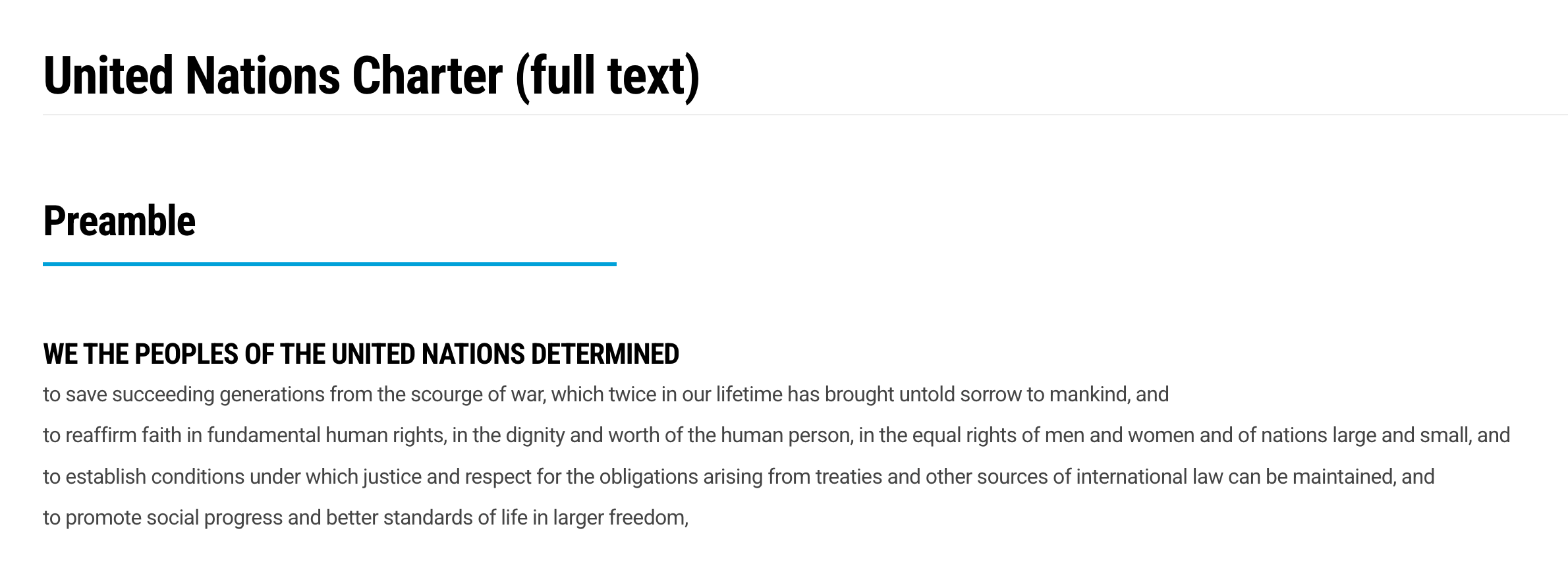
The UN Charter prohibits the threat or use of force against the territorial integrity or political independence of any state in Article 2(4), which reads, “All Members shall refrain in their international relations from the threat or use of force against the territorial integrity or political independence of any state, or in any other manner inconsistent with the Purposes of the United Nations.” Launching attacks, like the U.S. strike on Iran, is generally illegal. There are exceptions for self-defense against an armed attack (Article 51) or an attack authorized by the Security Council, but neither of those is in play here.

Treaties ratified by the U.S. Senate, like the UN Charter, have the status of federal laws under Article VI, Section 3 of the Constitution, which reads, “This Constitution, and the Laws of the United States which shall be made in Pursuance thereof; and all Treaties made, or which shall be made, under the Authority of the United States, shall be the supreme Law of the Land.” (emphasis added). Upholding them is part of a president’s duties and the oath of office he takes under the “take care” clause of the Constitution.

If you want to read about this in more detail, there is an excellent explainer from Just Security at NYU Law in the context of Venezuela. (Full disclosure: I’m a member of the Board of Editors at Just Security.)

Tess Bridgman, President Obama’s Deputy Legal Advisor on the National Security Council, with whom we discussed war powers in January, posted this on Bluesky:

“To: House and Senate Foreign Relations, Armed Services, and Judiciary Committees:

Time to stand up for Art. I of our Constitution and the representatives of the people deciding when to go to war, not the whims of one man in the White House (or Mar-a-Lago).”

Tess and her co-author Brian Egan have a backgrounder here.

Senate Minority Leader Chuck Schumer called for Congress to return to Washington immediately, so it could vote on a War Powers Resolution. But whether Republicans will agree to impose a legislative check on military action isn’t at all clear. While the strikes on Iran are very likely illegal under both U.S. and international law, the regime itself is very unpopular, and politicians may be willing to cast aside the law in hopes of regime change (although many experts have assessed success in that regard as unlikely). Schumer tweeted:

“The administration has not provided Congress and the American people with critical details about the scope and immediacy of the threat. Confronting Iran’s malign regional activities, nuclear ambitions, and harsh oppression of the Iranian people demands American strength, resolve, regional coordination, and strategic clarity. Unfortunately, President Trump’s fitful cycles of lashing out and risking wider conflict are not a viable strategy.

The administration must brief Congress, including an immediate all senators classified briefing and in public testimony, to answer these vital questions. The Senate should quickly return to session and reassert its constitutional duty by passing our resolution to enforce the War Powers Act.”

So, legally, the administration is on thin ice under both U.S. law and international law. But many people will be pleased to see a ruthless dictator, one who gruesomely killed tens of thousands of his own people, done in. They may be willing to ignore legal niceties to get there.

That sort of rationale underscores the importance of holding fast to the rule of law and insisting that the Trump administration comply with it. Today, people may try to justify ignoring the law because they think it will lead to regime change. They may claim that it will benefit the Iranian people, as well as our own country. The law could be ignored.

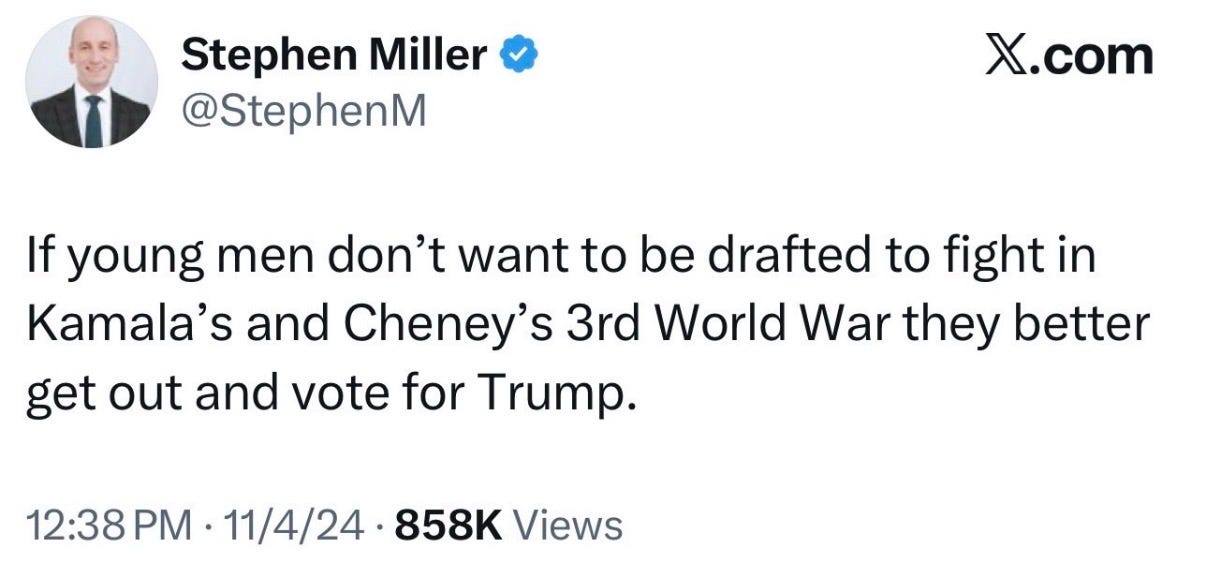
But who gets to decide when the end justifies the extra-legal means and when it’s acceptable to ignore a law that stands in the way of certain actions? Is it you? Me? Donald Trump? Stephen Miller? You can readily see the problem with abandoning it.

Laws provide us with fairness and stability. They prevent arbitrary exercises of power and protect rights. They ensure justice. When you get right down to it, they prevent chaos. And the rule of law is preferable to the rule of dictators.

Like this guy, and the people who shamelessly lied to Americans during the campaign—and continue to do so.

As we evaluate what happens in the days ahead, we need to insist that the administration do this the right way. Senator Schumer is on the right track. Congress has to follow through.

Tonight’s piece isn’t about the hot take of the hour. It’s about the guardrails. We’re talking about first principles — why the rule of law exists, why it restrains all of us (especially the powerful), and why “doing whatever feels good in the moment” has never been a substitute for constitutional order. These aren’t abstract debates. They determine whether we live in a country governed by laws or by impulse.

If you value clear-eyed analysis instead of outrage, and memory over amnesia, this is the work your subscription makes possible. Paid subscribers make it possible for me to connect the dots, and explain not just what is happening — but why it matters in the long arc of our legal tradition.

If that kind of thinking matters to you, become a paid subscriber tonight, so that this kind of serious, principled analysis has a place to live and grow.

We’re in this together,

Joyce

War and Peace Cannot Be Left to One Man — Especially Not This Man


David French

War and Peace Cannot Be Left to One Man — Especially Not This Man

March 1, 2026, 1:00 a.m. ET


By David French

Eight minutes.

That’s the length of President Trump’s social media video announcing his war with Iran. He didn’t go to Congress. He didn’t obtain a U.N. Security Council resolution. Instead, he did perhaps the most monarchical thing he’s done in a monarchical second term: He simply ordered America into war.

I take a back seat to no one in my loathing of the Iranian regime. I am not mourning the death of Iran’s supreme leader, Ayatollah Ali Khamenei, who was killed in an airstrike on Saturday. My anger at the Iranian regime is personal. Men I knew and served with during my deployment to Iraq in 2007 and 2008 were killed and gravely injured by Iranian-supplied weapons deployed by Iranian-supported militias.

But my personal feelings don’t override the Constitution, and neither do anyone else’s. As I mentioned in a round-table conversation with my colleagues on Saturday, I’m worried that all too many people will say: Well, in a perfect world Trump should have gone to Congress, but what’s done is done. That is exactly the wrong way to approach this war.

Here’s the bottom line: Trump should have gotten congressional approval for striking Iran, or he should not have struck at all. And because he did not obtain congressional approval, he’s diminishing America’s chances for ultimate success and increasing the chances that we make the same mistakes we — and other powerful nations — have made before.

To make that argument is not to sacrifice our national interests on an altar of legal technicalities. Instead, it’s to remind Americans of the very good reasons for our country’s constitutional structure on matters of war and peace.

The fundamental goal of the 1787 Constitution was to establish a republican form of government — and that meant disentangling the traditional powers of the monarch and placing them in different branches of government.

When it came to military affairs, the Constitution separated the power to declare war from the power to command the military. The short way of describing the structure is that America should go to war only at Congress’s direction, but when it does, its armies are commanded by the president.

Perhaps the most important aspect of this constitutional structure is that it creates a presumption of peace. Our nation cannot go to war until its leaders persuade a majority of Congress that war is in our national interest.

This framework applies both to direct declarations of war and to their close cousin, authorizations for the use of military force, such as the authorizations for Desert Storm in the first gulf war, Operation Enduring Freedom in Afghanistan and Operation Iraqi Freedom in Iraq.

But the constitutional structure, when followed, does much more than that. It also helps provide accountability. To make the case to Congress, a president doesn’t just outline the reasons for war; he also outlines the objectives of the conflict. This provides an opportunity to investigate the weaknesses of the case for the conflict, along with the possibility of success and the risks of failure.

I’m getting a disturbing sense of déjà vu for example, from the idea that degrading regime forces from the air will give unarmed (or mostly unarmed) civilian protesters exactly the opening they need to topple the Iranian government and effect regime change.

By the end of Desert Storm, the United States had devastated the Iraqi military and inflicted casualties far beyond anything that Israel or the United States has inflicted on Iran this weekend. When the Iraqi people rose up, there was a wave of hope that the dictator would be deposed and democracy would prevail. But Saddam Hussein had more than enough firepower — and enough loyalists — to crush the rebellion, retain power for more than a decade and kill tens of thousands of his opponents.

The Iranian regime deserves to fall, but I’m concerned that we’re creating the conditions for more massacres of more civilians, without offering the protesters any reasonable prospect of success.

But if the regime does crack, there is no guarantee that we will welcome the eventual results. From Iraq to Syria to Libya, we’ve seen how civil war sows chaos, fosters extremism and terrorism and creates waves of destabilizing migration.

In a real public debate before a real Congress, these points could have been addressed. The administration could have prepared people for the various contingencies, including casualties and economic disruption. Instead, near the end of Trump’s cursory speech on Saturday, he said, “The lives of courageous American heroes may be lost, and we may have casualties. That often happens in war.”

Well, yes, that’s certainly true. But that’s not the full extent of the risk; not even close. The American people needed to hear more. They deserved to hear more.

There was a case for striking Iran.

As my colleague Bret Stephens has argued, the Iranian regime is evil, hostile to the United States and militarily aggressive. It has engaged in a decades-long conflict with the United States. Beginning with the hostage crisis in 1979 — when Iranians seized and held American diplomats and Embassy employees for 444 days — Iran has conducted countless direct and indirect attacks against the United States.

Iranian-backed terrorists are responsible for the Marine barracks bombing in Lebanon in 1983 that killed 241 Americans. Iranian-backed terrorists killed 19 Americans in the Khobar Towers bombing in Saudi Arabia in 1996. Iran-backed militias killed hundreds of American soldiers in Iraq.

Since the second Iraq war, Iranian-backed militias have continued their attacks on U.S. troops in Iraq. In fact, it’s fair to say that Iran’s efforts to attack and kill Americans have been relentless for decades.

Beyond its attacks on Americans, Iran is one of the most aggressive and destabilizing regimes in the world. It has supported Hamas, Hezbollah and the Houthis — three of the world’s most powerful terrorist militias — it has attacked Israel with ballistic missiles, and it has supplied Russia with drones to use in its illegal invasion of Ukraine.

Iran is deeply repressive at home. It stifles dissent, deprives women of their most basic human rights and massacres its own people by the thousands when they protest against the regime.

If you’re going to list foreign countries that should not obtain access to nuclear weapons, Iran would be at or close to the very top. Blocking Iran’s ability to develop and deploy nuclear weapons is among our most vital national interests.

But there was also a case against an attack.

As my newsroom colleague Eric Schmitt has reported, Gen. Dan Caine, the chairman of the Joint Chiefs of Staff, has warned Trump that there is a high risk of casualties and a risk that a campaign against Iran could deplete American stockpiles of precision weapons — at the exact moment when we need those weapons to deter any potential Chinese maneuvers against Taiwan.

In addition, Iran may now believe that it should not restrain its response to an American attack but instead prioritize inflicting as many casualties as possible on American forces (and perhaps even on American civilians). Iran has already lashed out at multiple nations in the Gulf. Its attacks haven’t inflicted much damage so far, but it’s too soon to simply presume that Iran won’t be able to hurt the United States or our allies.

And if we suffer those losses without eradicating a nuclear program that Trump already claimed to have “obliterated,” without ultimately changing the regime (in spite of the death of the supreme leader), or without even protecting civilian protesters, then for all practical purposes we will have lost a pointless, deadly war.

Don’t let anyone tell you that modern presidents simply don’t go to Congress, that we’re trying to impose a standard on Trump that we didn’t impose on anyone else. In 2002 the Department of Justice told President George W. Bush that he had “ sufficient constitutional and statutory authority to use force against Iraq,” even in the absence of a direct congressional authorization or a new U.N. Security Council resolution. Yet Bush pressed for (and obtained) an authorization and a resolution anyway, just as his father did when he went to war with Saddam Hussein during Operation Desert Storm.

Regardless of any person’s feelings about Operation Iraqi Freedom (I supported it then and still do), when our troops went into combat, they knew they were supported by a majority of the American people. They knew politicians on both sides of the aisle had voted to send them into battle.

Now, many millions of Americans are bewildered by events. There is no national consensus around the decision to deploy Americans into harm’s way. There isn’t even a Republican consensus. There’s only a personal consensus, the personal consensus of a mercurial man so detached from reality that he actually reposted on Truth Social an article with the headline “Iran Tried to Interfere in 2020, 2024 Elections to Stop Trump, and Now Faces Renewed War With U.S.”

Are Trump’s conspiracy theories making him more amenable to war?

In 1848, at the close of the Mexican-American War, a first-term congressman named Abraham Lincoln wrote:

Kings had always been involving and impoverishing their people in wars, pretending generally, if not always, that the good of the people was the object. This, our convention understood to be the most oppressive of all kingly oppressions and they resolved to so frame the Constitution that no one man should hold the power of bringing this oppression upon us.

Those words were true then, and they’re true now. No matter what he thinks, Trump is not a king. But by taking America to war all on his own, he is acting like one.


WHY IS EVERYONE COMPLAINING?


Frank Bruni: Why Is Everyone Complaining?

When there are upgrades everywhere, from the gym to the airport, it's hard to feel like you have enough.

Frank Bruni

Apr 30, 2024


It was pitch-dark when I showed up at the box office of what was then called the Hartford Civic Center at 3 a.m., to be in place when tickets for the Queen concert went on sale, several hours later. It was the early 1980s, I was a teenager, and this was the surest path to the best seats. Back then, your proximity to the stage had less to do with a fan’s financial reserves than how quickly and heroically you’d acted to get your tickets. There was something egalitarian about it. My friends and I ended up in the eighth row, and I caught Freddie Mercury’s tambourine when he threw it into the crowd during the final song.

Today, the seating maps for Taylor Swift’s Eras Tour revealed scores and scores of price tags, tailored to the precise desirability of the vantage point. In the U.S., the most expensive tickets cost many thousands of dollars more than the least, so that a father of three posting pictures of his family among the Swifties could be announcing to the world his ability to drop ten grand on one night’s entertainment. At the back of the stands, with half a view, sits the family that could only afford to drop hundreds.

There have always been big gaps between how the rich, the middle class, and the less fortunate live. But these days those gaps are increasingly enormous, and increasingly obvious. We have long advertised our place in the pecking order with our homes, cars, clubs, and clothes; there are now extravagances, fringe benefits, and microclimates of exclusivity that didn’t exist before. Meanwhile, social media gives us constant, intimate glimpses of how different life is for the people one rung above us, and the people one rung above that, and the ostentatious winners at the top of the ladder. The result is a culture of grievance among those who have plenty, but not enough.


In September 2022, the nonpartisan Congressional Budget Office published a report examining changes in family wealth distribution in the U.S. between 1989 and 2019. National wealth tripled in that time, but disparities widened. Whereas in 1989, families in the top 10 percent held 63 percent of total wealth, they held 72 percent of the wealth by 2019. Meanwhile, the share of wealth possessed by the bottom half decreased, from just over 3.5 percent to 2 percent in that same period.

“Back in 1983, 66,000 American households were worth at least $10 million,” wrote Peter Turchin in The Atlantic last year. By 2019, controlling for inflation, the number of households worth that amount “had increased tenfold.” There were also huge increases in households worth $5 million, far outpacing population growth. This was fantastic for the new elites, of course, but their coffers swelled at the expense of ordinary workers, whose share of wealth was shrinking.

At the same time, Americans were being told that a college education, with as many advanced degrees as possible, is a passport to the high-earning echelons. An increasing number sought such opportunities—more than the upper classes could absorb. “More and more people aspiring to positions of power began fighting over a relatively fixed number of spots,” wrote Turchin. “The competition among them has corroded the social norms.”

Our worries about the shrinking pie make us more anxious to get ahead. When I was a teenager, school essentially came in two sizes: public or private. Now, the latter features costly but popular add-ons: the separate tutor for standardized exams; the individual sports coach; the independent college admissions consultant who, for a hefty fee, does more plotting and pacifying than school counselors are able to. 

In fact, add-ons are everywhere now. At a fancy gym like Equinox, where membership already costs a bomb, clients can pay extra for personal trainers. Clients can also pay a surcharge for a better locker room. And other customers notice. In fact, other people noticing is part of the point: it encourages them to pay up. 

There are worse things than not having the most experienced personal trainer, or the best Taylor Swift ticket, of course. We live in an age of plenty, compared to the Americans of 80 years ago. Back in 1945, according to the University of Houston’s College of Education, “nearly a third of Americans lived in poverty. A third of the country’s homes had no running water, two-fifths lacked flushing toilets, and three-fifths lacked central heating”—whereas now the vast majority of Americans have their most basic needs met.

Yes, many forces still cause anxiety for today’s Americans. Climate change has terrifying implications. The Great Recession temporarily wiped out the savings of tens of millions of Americans. The Covid pandemic exacerbated economic problems. 

But we don’t fear that missiles will rain down on us in the U.S., not in any real and immediate way. We haven’t been engaged in a military conflict that necessitated a draft since the Vietnam War. The Great Recession wasn’t the Great Depression. In the last fifty years, we’ve seen astonishing scientific progress, including medical advances that have alleviated our suffering and technological developments that have made life easy with the touch of a phone.

But happiness typically has less to do with a person’s reality than with what they’d been encouraged to hope for, what they’d deemed possible, and the yardsticks all around them. The increasing wealth of the United States at the end of last century upsized Americans’ expectations, while our desires were whetted by marketing that got better and better at making consumers want, want, want. When a country fills people with longings, and tells them nothing but hard work stands between them and material satisfaction, it encourages astonishing achievement—but also disappointment, which can quickly become grievance.

Paradoxically, our privilege makes us more conscious of what we don’t have. “Progress, a wit once said, was fine for a while but it went on too long,” the longtime political analyst George F. Will wrote in November 2022. Now that the struggle to attain subsistence has been banished by plenty, “many hyper-politicized Americans have filled the void in their lives with the grim fun of venting their animosities.”

In today’s America, resentment is everywhere, stoked by the highly visible and relentlessly multiplying badges of affluence all around us. Everywhere, from planes to sports arenas, luxury boxes take up more space than they used to. If you can’t quite afford to access them, you can still pay to feel special—though not as special. Everything comes in gradations, from queues to dining options, so that if you can’t ascend to celestial levels, you can at least reassure yourself that your purchasing power is greater than the plebeians. And so, the cycle of grievance continues.

Trump’s Strategy Is Always Terror


Trump’s Strategy Is Always Terror

From Minneapolis to Iran, the regime has one move


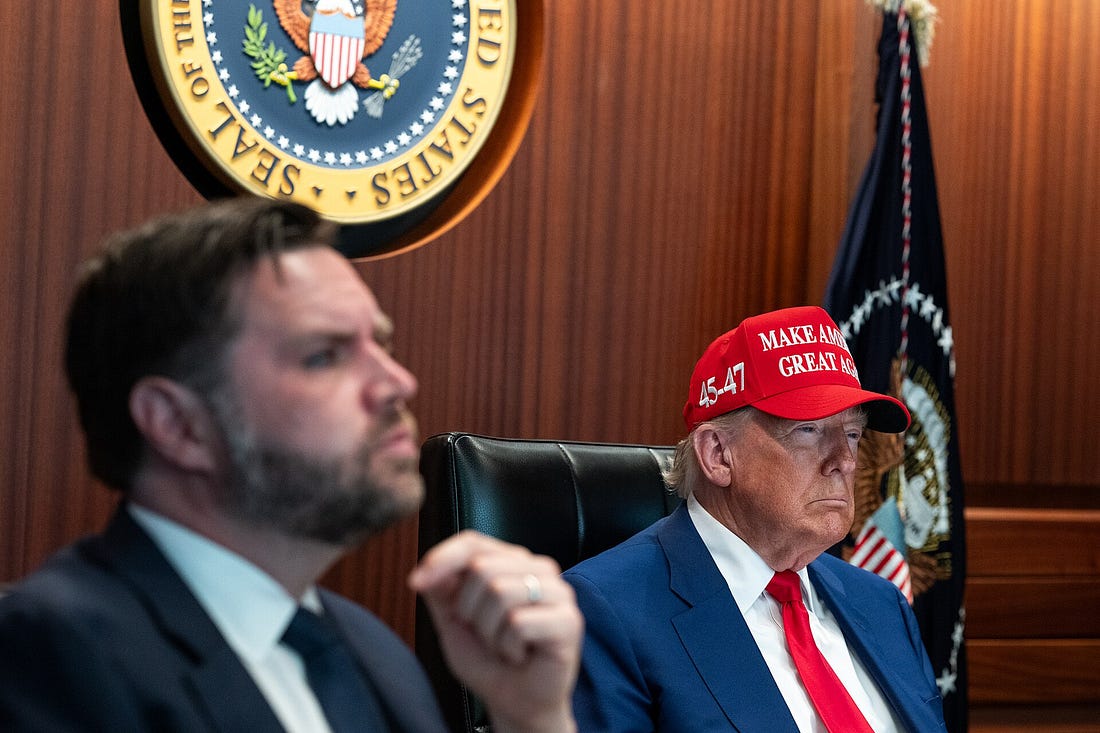
trump and vance sitting in situation room during iran strikes. Vance looks self consciously serious, with one hand raised towards chin. Trump has a MAGA hat and looks like he is decaying.

Last week, vice president J.D. Vance and official administrative healthcare assaulter Mehmet Oz announced that the Trump regime was going to illegally freeze $259 million in Medicaid payments to Minneapolis. They claimed the goal was to force the state government to fight “fraud.” The cuts, yet another assault on a safety net that the federal government has brutally slashed, will be devastating for disabled people, including children, who rely on Medicaid.

Accusations of fraud by immigrants were also the excuse for the massive, brutal attack on the city by ICE agents, which led to widespread chaos and at least two open murders in the street. This is clearly a continuation of the assault on the state—a fact underlined by Vance’s thinly concealed mafioso threats.

“We love [the people of Minnesota],” he insisted. “So much of what is broken in MN is a lack of cooperation”—a not very subtle reference not just to state officials, but to the massive popular uprising against and resistance to the armed federal right-wing militias known as ICE and CBP. “We would encourage everybody in MN to work on the state government a little bit,” Vance added, again not subtly threatening voters to cast ballots for Repblicans in the midterms, or else.

Also last week, Trump launched an unprovoked war of aggression on Iran. American and Israeli forces coordinated bombing strikes, targeting Iranian leaders and other sites. Among those killed were forty people at a girls’ school, including at least five students.

Citing a list of vague grievances with the Iranian regime as justification for the attack, Trump framed his murderous violence as a gift to the Iranian people, urging them to “seize control” of their “destiny.” After the bombings stop, he said, Iranians should “take over your government. It will be yours to take. This will be probably your only chance for generations.”

There are obviously many differences between Trump’s attack on Minnesota and his attack on Iran. But the similarity in tactics and rhetoric from Trump and his apparatchiks is striking. In both cases, Trump targets civilians for pain, injury, and death as a way to force concessions from government officials. In both, he claims he is on the side of the ordinary people he is brutalizing, suggesting that their government, not him is to blame. “Why are you punching yourself?” he asks in the tone of bullies everywhere.

In short, Trump’s tactics are predicated on his belief that his own disregard for human life and well-being is higher than that of the governments he targets, and that the people he immiserates are too foolish to understand who is really attacking them. He believes that he can force regime cooperation, or even regime change, by simply murdering as many people as necessary, whether via neglect or bombs.

“The use of violence against non-combatants to achieve political or ideological aims” is a textbook definition of terrorism. And terror is Trump’s one preferred, constant, predictable strategy when faced with any policy goal, domestic or foreign. Diplomacy, coordination with allies, persuasion, negotiation, investigation—all the myriad lawful, powerful tools that presidents generally use to advance their goals are useless to Trump, mostly because he lacks any interest in understanding them. For him, the best path is always to find some innocent somewhere to torture or murder in the hopes that other people will pity them and knuckle under.

This strategy is very unlikely to work. As pollster Kevin Collins notes of Iran,

ask yourself “How many Americans would Iran have to kill before the Trump administration would decide to step down”? If you answered “There is no upper limit”, congratulations, you have identified the problem.

Nor are the people of Iran—or of Minnesota for that matter—likely to blame their own government for the carnage that Trump is enthusiastically taking credit for. Violent, unprovoked assaults based on incoherent rationale are tailor made to harden resistance, not undermine it. Iran’s own murderous regime will undoubtedly emerge more popular than it has been in years or decades; Republicans are unlikely to do well in Minnesota in the midterms, to put it mildly.

These setbacks aren’t likely to deter Trump though, because the not-so-secret truth is that for him torture and murder are fun, worthwhile goals in themselves. He likes hurting people, especially if they can’t hurt him back; he enjoys watching other suffer and emphasizing that his enemies can do nothing to prevent the suffering he causes. He has, it is relevant to note, been held liable by a jury for a brutal sexual assault, and has been accused of many more. There is just a great deal of evidence that he takes pleasure in violence and pain for their own sake, and that he gathers around him people like himself who do the same.

Though the mainstream media is reluctant to say so directly, none of this is news. Nor will stating it, however clearly, have much effect on Congress or the Supreme Court, both of which are helmed by Trump’s own sadistic cultists. But it does seem important, for our own sake, to acknowledge and name the ongoing fascist terror campaign as the body count mounts, both at home and abroad. There will be no accounting unless we demand one.

Total Pageviews

GOOGLE ANALYTICS

Blog Archive