




THERE ARE PROBABLY 10,000 JOBS IN THE MART ITSELF THAT ARE TECHNOLOGY RELATED.

The Merchandise Mart was an unlikely place to ignite a tech boom.
The massive, art-deco landmark was built in 1930 and became a hub for interior design vendors and other commerce. The 4,000,000 sq. ft. building--the world's second largest building, only to the Pentagon--was built by national retailer Marshall Field & Co. and brings in three million visitors a year for things like furniture trade shows, art shows and antique fairs.
The Mart doesn't exactly scream startup hub.
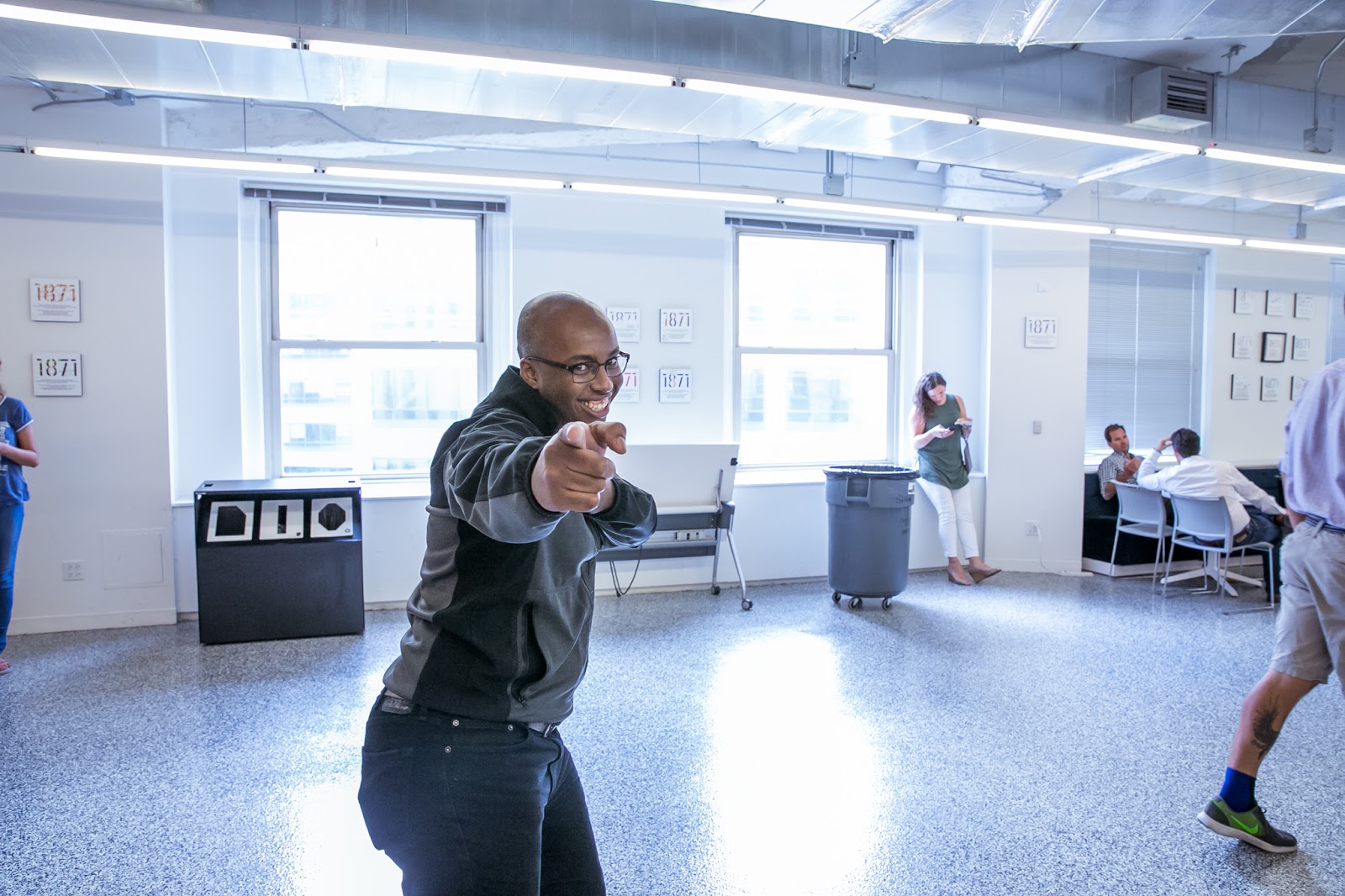
But that all changed in 2012 when tech incubator 1871 officially launched. A great deal of ink has been shed on the impact of 1871 to Chicago's tech growth, but along with changing the city's startup image, 1871 is also changing the image of one of Chicago's most iconic buildings.
1871 CEO Howard Tullman said before 1871's launch, technology businesses only made up about 100,000 square feet of total space in the Mart. Today, there's roughly 1.5 million square feet of office space that's specifically dedicated to technology businesses, Tullman estimates, which accounts for more than a third of the building's square footage.
"There are probably 10,000 jobs in the Mart itself that are technology related," Tullman said. "Huge things around critical mass are going on. The more momentum you get and the more the flywheel spins around, the more people want to be a part of it."
1871 launched a domino effect of tech companies setting up shop in the Merchandise Mart, who one after another have scooped up tens or hundreds of thousands of square feet of space. Motorola Mobility moved more than 2,000 workers from its Libertyville office to the Mart in 2014, and took up a whopping 604,000 square feet (Motorola, amid job cuts, has leased 91,000 square feet if its space to another tech company VelocityEHS, an environmental, health and safety software firm).
Mobile payments company Braintree, which is owned by PayPal, also moved to the Mart in 2014, signing a lease for a 60,000 sq. ft. space on the 8th floor. Braintree, which provides payment solutions to companies like Uber and StubHub and has been called one of the most significant consumer tech acquisitions ever, leased anadditional 20,000 square feet in the Mart last February. And you can't forget digital marketing agency Razorfish, which joined the Merch Mart party even before 1871, opening a 65,000 sq. ft. space after leaving its West Loop office.
Then came Chicago healthtech hub MATTER, business review company Yelp, and health insurance marketplace GoHealth, who all wanted space in Chicago's growing tech center.

Several factors led to 1871 choosing the Mart, including its proximity to the burgeoning tech scene already taking place in River North with companies like Groupon and BrightTag (now Signal), its location to the L train, and the fact that it was a "24/7" building that was good for hosting events, said Kevin Willer, who was 1871's first CEO and is now a partner at Chicago Ventures.
But more importantly, the Mart met 1871's space needs. Willer, JB Pritzker and others traveled the country looking at places like the Cambridge Innovation Center across from MIT and General Assembly in New York, and decided that 1871 needed to be in a space with at least 50,000 square feet, and all on one floor.
The Mart, at the end of the day, met those needs, even if at the time it might have seemed like an unconventional choice.
"At the time, (the Merchandise Mart) was a quiet building," Willer said. "It definitely wasn’t a tech building. A lot of the building was about art shows and wedding dress shows. It was very episodic. There would be something going on, and then nothing."
In fact, the 12th floor--where 1871 is now--used to hold rotating art shows, Willer said.
And as companies like Braintree, Motorola, and Yelp have followed 1871's lead, the Mart's tech growth hasn't slowed down. In March, Allstate announced plans to open an innovation hub in the Merchandise Mart, and it expects to bring nearly 400 tech jobs to Chicago. The positions will primarily work with the company’s Connected Car and Quantitative Research & Analytics teams, and Allstate said it plans to hire "top quantitative scientists and innovation specialists."
"The Merchandise Mart has built a reputation as a location for innovation," Allstate spokesperson Laura Strykowski told Chicago Inno via email. "In addition to the building being iconic, and a draw for creative and technology companies, the building is configured in a way that allows us to occupy the space needed on one floor."
"This new space will provide a creative environment for employees to leverage innovation, data and technology to invent new ways to better serve our customer and differentiate Allstate," she added.
Big corporations are finding that they can't get digital or creative workers to move out to the suburbs, Tullman said, which is why you're seeing suburban businesses like Motorola and Allstate wanting to get closer to the city. And companies like Braintree are proving that you can attract top tech talent at a cost-competitive basis compared to the coasts, and PayPal didn't find the need to move the business to Silicon Valley.
But the tech energy in the Mart feeds off 1871, which began with 50,000 square feet on the 12th floor, but now has grown to 115,000 square feet after opening a space on the 13th floor. Tullman said 1871 is bursting at the seams, and even scooped up 10,000 square feet on the 9th floor.
1871 is eyeing more expansion as well, Tullman said, by adding domain specific incubators around retail and the Internet of Things, which will require more space. But 1871's impact is about a lot more than square footage, he said. Investors, serial entrepreneurs and other mentors provide thousands of hours of free counseling to the hundreds of startups in 1871. Speakers from Bill Clinton to AOL founder Steve Case swing through. And the space is home to a handful of venture funds, accelerators and university groups, who all feed off the entrepreneurial spirit inside 1871.
"People who think this is a real estate story really don’t understand what goes on at 1871," Tullman said. "This doesn't happen anywhere else probably in the country, where you have this constant stream of amazing resources and talents and speakers and presenters."
Tullman noted that there are a couple floors inside the Mart that are in transition, which could be home to additional tech businesses looking for space. And Tullman said 1871 is having discussions with different tenants about relocating to the Mart.
1871 is by no means Chicago's only tech hub. Dozens of incubators and co-working spaces exist throughout the city--from TechNexus to Blue1647 to 2112 and beyond--and Chicago tech has broadened its reach much farther than River North. But there's no denying 1871's impact on Chicago's national and global tech reputation, which has helped attract and retain tech talent to the city.
But as Chicago grows as a tech hub, the Mart could face competition from other real estate hubs in the city like Fulton West, R2 Goose Island, and other spaces recently identified by Colliers International as areas that have already started attracting the attention from the city's burgeoning tech sector.
But Tullman believes that the Mart and River North is still the focal point for Chicago tech, despite the growing interest in other neighborhoods.
"As interesting as the West Loop is--the Fulton Market area--I think it's going to turn out that a bunch of people are going to say maybe that's just about 5 or 6 blocks too far to be the sweet spot that the Merchandise Mart is," he said.


