Showing posts with label Caralynn nowinski. Show all posts

Monday, March 16, 2015

Forbes Summit emphasizes connectivity, Midwest competitiveness


Forbes Summit 


Connectivity will be a key factor in U.S. efforts to lead the global economy in the coming decades. So said business people and entrepreneurs at the Forbes Reinventing America Summit, which took place Thursday in Chicago for the second straight year.

They referred to offline collaborations as well as digital and technological connections. And they urged Chicago, which some attendees called the “capital of the Midwest,” to seek links to neighboring states and their startup communities — a move they said could even draw venture capital to the region. Silicon Valley attracts most of the country’s venture investments.
“I think to really elevate the Midwest, we need to find ways to connect Indy to Chicago, Chicago to Detroit, Detroit to Ann Arbor,” said Scott Dorsey, co-founder of Indianapolis-based ExactTarget, on a “Betting Big on the Heartland” panel. “I think we’ll get a lot stronger if we build more connective tissue throughout the big Midwestern cities where today I feel like we do a lot of things in isolation.”

The official theme of this year’s Summit was “Leading the Next Industrial Revolution.” The 300 attendees heard from makers of 3D printers and those who use 3D printing techniques to create novel items, such as a dress printed all in one piece.
But strengthening the Midwest remained a focus.
Terry Howerton, co-founder and partner at TechNexus, emphasized the importance of companies to embrace the Midwest as a whole. He suggested a connected Midwest could make an attractive home to entrepreneurs.
“Instead of tearing each other down or trying to steal a company across a state border, we have an opportunity to retain talent in the Midwest, to develop research in the Midwest, to build companies in the Midwest that compete against the whole world,” he told Blue Sky.
Howerton appeared on the “Heartland” panel and later introduced Gov. Bruce Rauner, who reiterated his criticism of taxes and regulations in Illinois.
Steve Case, co-founder of America Online, discussed his belief that communities outside of Silicon Valley offer opportunities for innovation. He is behind Rise of the Rest, a multi-city tour that runs pitch contests in cities including St. Louis and Nashville. He said communities in smaller cities should celebrate entrepreneurship and startups.

“Most startups fail, so going in with some degree of skepticism is understandable,” Case said. “I think it’s really important that you lean into the future and at least give the entrepreneurs the benefit of the doubt that maybe this actually could be a big idea.”
Panelists also discussed the idea of transforming — instead of replacing — company staffs through “upskilling,” the practice of teaching an existing employee new skills. Howard Tullman, CEO of the 1871 tech hub, said high-end vocational training could offer digital skills that would keep employees competitive.
Caralynn Nowinski, executive director and COO of UI Labs, said upskilling could fill a need for skilled labor at manufacturing companies. She encouraged companies to consider the variety of skills in their workforces and approach upskilling accordingly. Someone in skilled labor may need a different sort of training than someone in engineering, she said.
She urged employers to remember “that it’s not a one-size-fits-all in how you think about your workforce.” That perspective should help company leaders to establish the right mechanisms and programs, she said.
Panelists throughout the day discussed the value of apprenticeships and internships for workers seeking development.
Lifeway Foods CEO Julie Smolyansky shared her company’s experience with Year Up, a Boston-based non-profit that trains young urban adults through internships and classes. Partnerships with companies give jobs to low-income people, and connections to those workers give companies access to their opinions and insights from their experiences, Smolyansky said.
“They have been operating under really scarce resources, and that’s something that we can learn," Smolyansky said of workers from low-income backgrounds. "We all, every day, operate with scarce resources. So I think they’re looking to us to teach them, and I’m looking to them to teach me.”

Thursday, March 12, 2015

'It's Not About Snacks And Scooters': How To Win The Big Talent Game


LEADERSHIP  1,506 views

'It's Not About Snacks And Scooters': How To Win The Big Talent Game


Forty percent of employers report difficulty in securing talent, according to a recent report by HR consultancy and staffing firm Manpower  Group. There’s a lack of hard skills, there’s a lack of soft skills, there’s a lack of suitable candidates in general.

What’s a hiring manager–or a job seeker–to do?
That was the topic of a discussion about changes in the American workforce and the challenges of finding and retaining the best available talent that took place Thursday afternoon as part of the second annual Forbes Reinventing America Summit in Chicago. 

The panel included Tom Gimbel, CEO of LaSalle Network, Caralynn Nowinski, M.D., Executive Director of UI LABS, Howard Tullman, CEO of 1871, and Kip Wright, Senior Vice President of Manpower North America.
When it comes to seeking quality talent among young professionals, “It’s really not about foosball and snacks and scooters,” said Tullman. “[Young adults] want to work on big problems. They want to work with other talented people. They really want to make a difference—that’s more generational than it’s ever been. They don’t care abut ownership, they care about experiences and managing their work life in different ways.”
Each of the panelists expressed dismay at the lack of skills training that’s currently part of the education system.


“I actually see this getting far worse,” said Wright, referencing the Manpower research that cited a dearth of technical and soft skills among job candidates. “It has as much to do with education and what our education system is putting out—a traditional four-year curricula—instead of more short, targeted bursts of skills that are useful in an immediate capacity.”
Nowinski noted that a new challenge for employers, particularly those seeking manufacturing talent, is to create a workforce that combines the model for a more traditional knowledge worker with specific experience with that of a worker trained with digital skills they can continue to update.


“How do we make sure that we’re thinking about how tech and talent solves those problems?” asked Nowinski. “How do we ensure that the person on the line who now listens for things and smells things and feels the vibration—how do you translate those skills into the next generation of workers? Now we’re talking about using a combination of a knowledge worker and digital technology.”
Gimbel observed that in addition to an education better suited to producing a skilled workforce, job seekers need to be playing an active role in educating themselves.
“Parents pay thousands and thousands for private lessons for the kids,” said Gimbel. “Go back and take a class [yourself.] Go to school. You want your kid to be competitive but you’re not going to invest in yourself?”
GD160972
Further, Tullman noted, job seekers need to be ready to show employers a strong work ethic coupled with a willingness to pay dues and earn independence.
“The talent has to do a good job of convincing prospective employers that they have a longer term horizon and are ready to work,” said Tullman. “It really is about patience. You might have a clear view of where you want to end up but it’s really not a short distance. Everybody’s in a hurry today but we have to teach a couple of these generations that you have to earn the ability to do it your own way.”
Gimbel suggested that it’s society and workers at large–rather than millennials, specifically–that have become entitled, but that active communication with employees can assuage that issue.
“Eighty percent of my company are millennials and they’re the hardest working people out there. I think what they want is more communication and more information–telling them what this is going to lead to.”
Ultimately, Wright recommended, companies need to begin to look at their talent horizon the way they would their financial outlook.
“How many of you spend months looking at your talent plan? Do you, every month, look at your financial plan? Of course. We’ve got to fundamentally think very selfishly and aggressively about how we manage our talent.”

Monday, February 16, 2015

Forbes Reinventing America Summit returning to Chicago in March


Entrepreneurs, investors and policy-makers will meet in Chicago on March 11-12 for Forbes Media’s second Reinventing America Summit.
The two-day invitation-only event, at JW Marriott Chicago, will focus on heartland innovation and regional economic growth. The inaugural event took place last March in Chicago.
Scheduled speakers include Mayor Rahm Emanuel, Illinois Gov. Bruce Rauner and AOL co-founder Steve Case. Steve Forbes, chairman and editor-in-chief of Forbes Media, also is scheduled to speak.


“Chicago serves as an economic resource for the Midwest and we are pleased that Forbes will once again bring its Reinventing America Summit to the city for this critical discussion about innovation and the economy,” Emanuel said in a statement.
Caralynn Nowinski, executive director of research collaborative UI Labs, and Howard Tullman, CEO of tech hub 1871, will share tips for recruiting and retaining the best technology talent. Forbes also plans to demo a 3D printed dress.
Partner sponsors include GE Ventures, Horatio Alger, JobsOhio and TechNexus. 1871 is a participation partner.

Sunday, December 15, 2013

Caralynn Nowinski on UI Labs and 1871

How UI Labs aims to link university, corporate and startup DNA

Caralynn Nowinski is the Associate Vice President for Innovation & Economic Development at the University of Illinois. (L. Brian Stauffer / University of Illinois )

As Caralynn Nowinski helps flesh out plans for the University of Illinois’ Chicago-based UI Labs to team academia with industry, she taps all of her earlier experiences as a U of I student, entrepreneur and investor.

While earning her M.D., Nowinski co-founded and was CEO of SanoGene Therapeutics, an early stage biotechnology company that she spun out from the university. She later worked at venture capital firms Sikich Investment Banking, ARCH Development Partners and Midwest Venture Partners. Today, Nowinski is interim executive director and chief operating officer for the forthcoming research lab, along with her main role as the university’s associate vice president for innovation and economic development.

There, she helps find ways for U of I research, students and technology to contribute to the local economy. She shares her education as a company founder and her vision for Illinois’ startup environment.

Q. What did you learn most from starting SanoGene?

A. We ultimately shut down the company, but it was one of best experiences of my life. It led me to realize how much failure can impact one’s career, and ultimately it made me a stronger operator and businessperson. There were very basic business principles that the first time you don’t know. They could be as simple as how you set up by-laws or board governments or which accounting software to use. But until you go through that experience of having to figure things out, you don’t know what you don’t know.

The second time, you may not know the answers, but at least you know which questions to ask. That was the biggest lesson. Another lesson taught me the importance of the relationships among co-founders and the relationships between the business side and the technology side.

Q. What can you tell us about UI Labs?

A. We officially incorporated in March, and the University of Illinois drove it in close collaboration with the City of Chicago and also with support from the State of Illinois. We are developing our first programs. These are programs that bring together research, training and commercialization. Our first programs are in advanced manufacturing in the U.S. We’ve had some wonderful collaborations with other universities in Illinois and the greater Midwest as well as with leading companies, startups and mid-sized companies.

Q. What is your hope for Illinois’ startup environment?

A. UI Labs is about university-industry partnerships. This means big and small companies working together, but also working with university talent and technologies. We have a very firm belief that there’s opportunity for corporate support of startups, and it’s bi-directional. There is a lot of opportunity for employees of large companies to learn from their interactions with startups. They get the experience of working with companies that work so much faster. Things change so quickly with startups. Exposing corporate folks to that culture can ultimately lead to more “intrapreneurship” and innovation.

Q. What are some other advantages of collaboration?

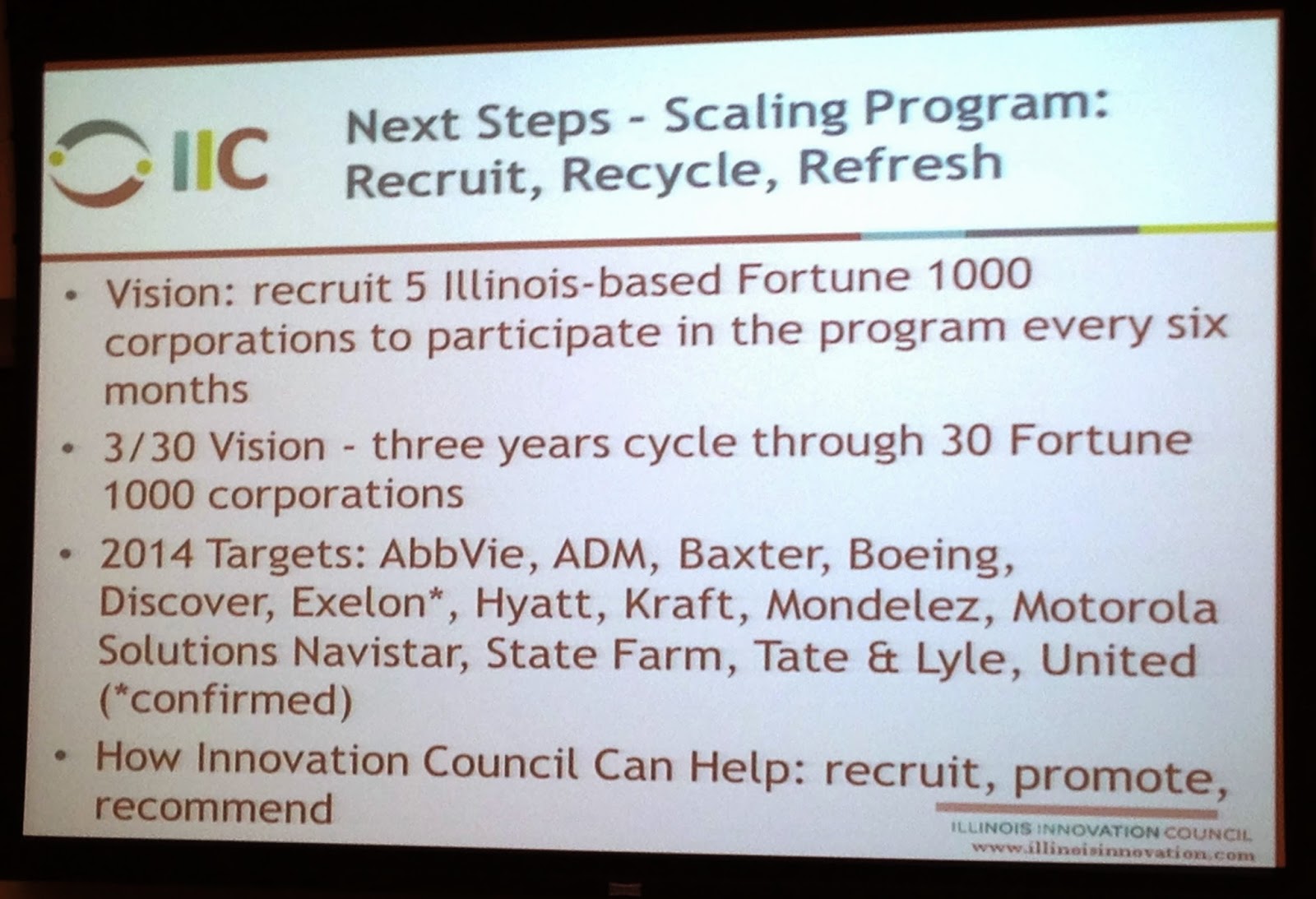
A. There is increasing opportunity for large companies to look to startups as sources of their innovation from a technology and people perspective. You can develop relationships with teams within startup companies where you’re getting more than just products. You’re getting that DNA of the startup the opportunity to infuse with a larger company. The Illinois Innovation Council has launched an initiative ordered by Gov. Quinn to link large corporations to give startup companies simply the opportunity to tell their story to the big companies. There are a lot of roadblocks to let that happen. That particular initiative is just one of several kicking off within Chicagoland to better make those connections.

Q. Howard Tullman, the new head of 1871, has said he wants more serious entrepreneurs and more rigor for startups there. What do you think?

A. I really like Howard’s perspective, and I think it will go a long way. When I was on the investor side, I expected the CEOs of the companies that we were investing in that they would live and die by their company. They were all in. I think that’s what we and they have got to be looking for, and we’ve got to help build companies that are constantly testing their business models and their markets and revenue streams in a really disciplined manner.
 
Often that second-time or third-time entrepreneur gets to build on experiences of failure that ultimately lead to success in their next one. Howard can help apply that culture and discipline to the earliest-stage companies.

Total Pageviews

GOOGLE ANALYTICS

Blog Archive