HINDSIGHT - WRITE SOMETHING WORTH READING ABOUT OR DO SOMETHING WORTH WRITING ABOUT
Marriage and Dementia
I
forgot my point.
Apr 21, 2025
Before you read this article, please take the following
brief quiz:
1. Are you married?
HOW TO SCORE:
If you answered "No," you do not need to read
this article. If you answered "Yes," or if you don't remember taking
a quiz, I have some disturbing news for you.
I refer to a study by researchers at Florida State
University, who studied the relationship between marriage and dementia. Their
study produced a surprising finding, which is summarized by this headline from the Independent:
Twist as marriage now linked to an increased risk of
dementia
That's right: According to this study, if you're
married, you're more likely to develop dementia than if you're single.
As the Independent article states: "This study challenges the idea that
marriage is automatically good for brain health."
Does this mean that if we're married and we don't want to
become demented, we should immediately get a divorce? Yes.
NO! I mean, no. Of course not. It means that we should try
to understand what it is about marriage that might cause a person's mental
capacity to decline.
I personally have been married for over 600 years, so I
feel qualified to weigh in on this. My theory is that after you've been married
for a while, you outsource certain tasks from your brain to your spouse's
brain, and the part of your brain that used to perform those tasks develops
what brain scientists refer to as "brain rust."
For example, let's say Michelle and I want to watch a
certain TV show that we've heard is good. First we have to figure out where it
is. In the olden days, of course, we'd know exactly where it was: It was on
television. But now it could be virtually anywhere — Netflix, Hulu, Apple,
Tubi, Fubo, Max, Peacock, Feeboo, Skeeter, Emu, Fafo, Bazooty, Skeeter Prime or
any of the dozens of other streaming services that we may or may not be paying
for — there is no way to tell — and almost certainly do not remember the login
name or password for.
Once we've figured out where the show is — this can take
several days — I go to The Basket. This is a basket on our coffee table that,
from the outside, appears rustic and harmless.
But lurking inside The Basket is our scarily large
collection of remote controls, some of them dating back to the Spanish-American
War.
It's my job to determine which remote controls we need — it
can take more than one — and manipulate them in such a way that we are able to
watch the show. Michelle never does this. At this point I don't think she could do
it. A couple of times I've tried to explain my procedure to her. ("OK, you
see this button here? Do NOT press it.") But it's hopeless. The part of
her brain that in an unmarried human would handle remote controls is rusted
solid from lack of use.
Another aspect of our lives that I'm responsible for is
plumbing. When one of our toilets goes awry, it is my job, and mine alone, to
point out that "Toilets Gone Awry" would be a good name for a rock
band. But it's also my job to repair the toilet. And by "repair the
toilet," I of course mean "call the plumber."
Michelle almost never talks to the plumber. The plumbing
sector of her brain is now a nonfunctional rust glob. Whereas I talk to the
plumber a lot, especially lately, because we're installing a new septic system.
This is something that, like many couples, we've always dreamed of doing, and
we finally decided, what the heck, we're not going to live forever, let's just
DO it. As the plumbing specialist in our marriage, I am deeply involved in this
project, not in the sense of doing any of the actual work, but in the sense of
taking pride in our new septic tank, which is larger than many New York City
apartments.
So in two crucial areas of our married life — plumbing and
remote controls — my brain handles the thinking for both of us. I also am in
charge of some other areas, including:
— Turning off every single light in the house at least six
times a day.
-- Opening any mail we receive from financial institutions
and, after frowning thoughtfully at the contents for 8 to 10 seconds, putting
them in a "file."
-- Spiders.
-- Making sure we arrive at the airport at least four hours
before the scheduled departure time of our flight because You Never Know.
But there are other areas that my brain does not concern
itself with, because I have come to rely on Michelle to think about them. One
example is pillows. I never have to think about pillows, because Michelle
apparently thinks about them 24/7, the result being that we have acquired
enough pillows to blockade the Canadian border. Michelle is also extremely good
at detecting odors, so I don't have to. Here's a conversation we have often:
MICHELLE: Do you smell that?
ME: Smell what?
MICHELLE: You can't smell that?
But Michelle's biggest mental responsibility is thinking
for both of us about other people. I used to be involved with other people, but
over time I outsourced pretty much all social interactions to Michelle, to the
point where my only regular human contact, aside from Michelle, is the plumber.
As a result, the social part of my brain now has the same level of neural
activity as a rutabaga. This means that whenever we encounter another person, I
depend on Michelle to supply me with critical information such as:
-- Who is this person?
-- Do I know this person?
-- Am I related to this person?
-- Do I have to talk to this person?
-- If so, what should I say?
Because I never know who anybody is, I try to avoid people
altogether. If Michelle and I are walking in our neighborhood, and we see
somebody approaching, my immediate instinct is to hide behind something — a
mailbox if necessary — whereas hers is to engage the person in conversation. As
they converse, it quickly becomes obvious to me that we know this person, by
which I mean that Michelle knows this person and I should know
this person. But I can't just say to Michelle, in front of the person,
"Who IS this person?"
So what happens is, Michelle and the person start chatting,
while I remain mute, smiling brightly in an effort to appear delighted to be
part of this social interaction. After about a minute I start casually sidling
away so as to indicate to Michelle that we need to move along. Michelle is a
talker, so sometimes I will sidle a full 30 feet — enough for a first down —
before she notices that I'm gone. Then she'll say goodbye to the person, catch
up with me and reveal the person's name, which will go into my ears but
immediately bounce off my brain without penetrating.
Anyway, if my theory is correct, it explains the results of
the Florida State University study. Essentially, married couples have just one
fully functioning brain between them. If you test married people's brains
individually, you're going to see a mental dropoff, because of the outsourcing.
I suspect another contributing factor is children, which
many married people have. Children take a serious toll on the adult human
brain. Every time you start to read "The Cat in the Hat Comes Back,"
two million of your brain cells elect to commit suicide rather than go
through that again.
So to summarize what we know:
1. The institution of marriage is vital for the survival of
human society.
2. But marriage makes us stupid.
3. Therefore, some kind of helpful conclusion should go
here.

But His Emils
Emil
Bove III, Trump’s hatchet-man in the Justice Department, is now an appellate
court judge of the Third Circuit.
Jul 30, 2025
Emil
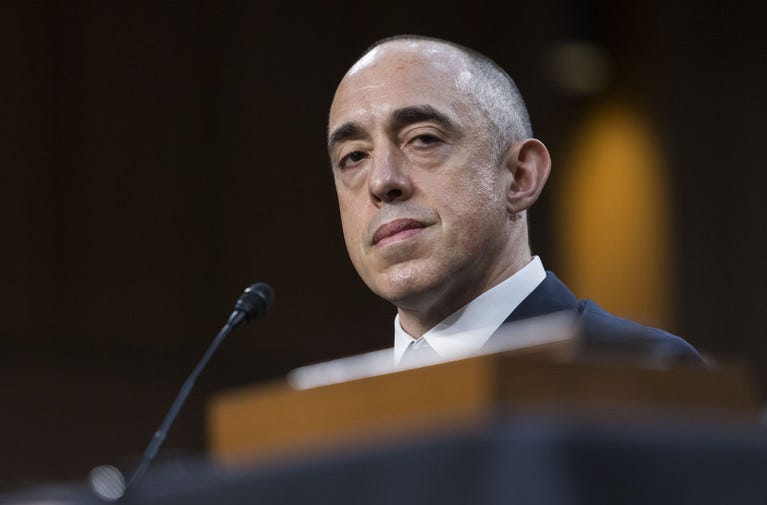
Bove III is confirmed as a judge on the Third Circuit. Photo: Diego M.
Radzinschi/ALM.
The GOP-controlled Senate demonstrated once again that they
are willing to abdicate their constitutional duty by ramming through and rubber
stamping one of the worst—if not the worst—judicial appointment in
our nation’s history: Trump’s erstwhile personal criminal attorney, Emil Bove
III.
The vote was 50-49, with one GOP absence and only two GOP
defectors (Sens. Collins (R-ME) and Murkowski (R-AK)), despite everything we
know about Bove and how damaging to the basic rule of law he has already been.
It’s important to be clear-eyed about the lackey the Senate
actually just approved, just as it was important to understand the deplorable
nature of Trump’s other successful nominees. Pete Hegseth and RFK Jr., for
example, are turning out as bad or worse than Democrats had warned, leading GOP
senators to admit they were wrong to confirm them.
For the sake of demonstrating later that we were correct to
warn everyone today, let’s sift through the destructive rubble Emil Bove III
has already created as he took a sledgehammer to the pillars of our
constitutional governance. Then let’s assess what his lifetime appointment to
the Third Circuit Court of Appeals could mean. Spoiler: There’s a bit of a
silver lining here.
Prosecuting the January 6 prosecutors
At the beginning of Trump’s second term, Bove served as the
acting head of the Justice Department before Pam Bondi was confirmed as the new
Attorney General. Bove used that temporary position to begin to insert raw
partisan politics into what should have been non-political law enforcement. As
the Los Angeles Times noted,
Before this year, the
Justice Department held to a tradition of keeping politics out of law
enforcement. But Bove and Atty. Gen. Pam Bondi saw their missions as carrying
out the wishes of President Trump.
One of Bove’s most outrageous moves was to go after, on
Trump’s behalf, the FBI prosecutors and agents who had anything to do with the
January 6 criminal investigations and prosecutions. These even included cases
against dangerous criminal insurrectionists and rioters. As the LA Times
reported, Bove laid out
plans for retribution
against the prosecutors and investigators who brought charges against him or
the 1,500 Trump allies who stormed the Capitol and fought with police.
Specifically, as CBS reported in February, Bove ordered the
FBI to compile a list of all current and former employees who were assigned “at
any time” to a January 6 investigation. The purpose was “to determine whether
any additional personnel actions are necessary,” according to an internal
department memo. Agents across the country were asked to complete
questionnaires about their involvement in the January 6 and Trump probes as
part of a department-wide “evaluation” of the workforce.
This was manifestly unfair and improper. Whatever your
“politics” around January 6, punishing FBI employees who were simply assigned
to work on these cases amounted to gross political retribution. Bove
intentionally targeted civil servants who were properly seeking to hold Trump
and others accountable for their crimes.
It cannot be understated what kind of immediate and
long-lasting chill this placed on the Justice Department and FBI. Bove’s
message was clear: If you work on any case against Trump or his supporters,
your job will be on the line whenever the GOP next returns to power. This
policy was designed to undercut federal law enforcement’s ability to hold
future criminal politicians accountable. Along with the blessing from the
Supreme Court that presidents have immunity from prosecution for all official
actions, Bove’s attack on the frontline prosecutors and agents has encouraged
violations of the law today and empowered those who choose to do it.
Per the same reporting in the LA Times, Sen. Adam Schiff
(D-CA), who opposed Bove’s nomination along with every other Senate Democrat,
drew attention to how this move also ratified the violent mob’s behavior and
attack on police officers on January 6:
“When Trump wanted to
purge the department of prosecutors who had proved to juries beyond a
reasonable doubt that the violent offenders who attacked police officers that
day did so to interfere with the peaceful transfer of power, Emil Bove was
there to punish not the criminals, but the prosecutors.”
Together with Trump’s mass pardon of the January 6
defendants, undoing years of arduous investigative work and lengthy court
trials with tens of thousands of work and jury hours, Bove helped drive the
point home: The Justice Department is now nothing more than a tool for Trump to
use against his political enemies.
Brokering the corrupt Eric Adams deal
Bove remained Trump’s No. 3 at the Justice Department after
Bondi was confirmed. In that position, he continued to train his sights not on
criminal defendants but on the prosecutors who had obtained indictments against
them. Nowhere was this more apparent than in the case of New York City Mayor
Eric Adams.
As I wrote about back in February, federal
prosecutors indicted Adams in 2024 for conspiracy to commit wire fraud and
bribery and for soliciting and accepting illegal campaign contributions and
bribes from wealthy Turkish nationals.
Desperate to get out from under the federal charges, Adams
went to Trump and claimed that he, too, was a “victim” of overzealous
prosecutors and the Biden administration. Adams “praised parts of Trump’s
agenda, visited him near his Mar-a-Lago compound and attended his inauguration
a few days later,” according to the New York Times.
Adams’s shameless obsequiousness was rewarded not long
after. In a memo, Bove directed the lead prosecutor on the Adams case, Acting
U.S. Attorney for the Southern District of New York Danielle Sassoon, to cease
all further investigations of Adams until her successor was confirmed by the
Senate.
Bove’s rationale? The charges “unduly restricted Mayor
Adams’s ability to devote full attention and resources” to Trump’s efforts to
crack down on migrants” and had “improperly interfered” with Adams’s
re-election campaign. In short, Bove provided political justifications
for dropping the charges, with no rationales related to the actual facts,
evidence or law of the case.
Sassoon, who is herself a conservative Federalist Society
member, bravely and famously pushed back in an eight-page letter for the ages
to Attorney General Pam Bondi, methodically demolishing Bove’s assertions in
the memo. And she inserted what has become known simply as Footnote 1, which
law students one day will study in ethics courses:
I attended a meeting on
January 31, 2025, with Mr. Bove, Adams’s counsel, and members of my office.
Adams’s attorneys repeatedly urged what amounted to a quid pro quo, indicating
that Adams would be in a position to assist with the Department’s enforcement
priorities only if the indictment were dismissed. Mr. Bove admonished a member
of my team who took notes during that meeting and directed the collection of
those notes at the meeting’s conclusion.
Bove took this badly. He not only fired back at Sassoon on
Bondi’s behalf, blasting her handling of the case and her decision to disobey a
direct order, he also put other prosecutors who had worked with her on leave.
He threatened her whole team with investigations—once more creating a chill
across the Department after one had already washed over it with the January 6
internal department witch-hunts.
In his response, Bove managed to fit in a wince-inducing
pledge of fealty to Trump that gets the oath of office completely backwards:
“In no valid sense do you uphold the Constitution by disobeying direct orders
implementing the policy of a duly elected President,” he wrote, “and anyone
romanticizing that behavior does a disservice to the nature of this work and
the public’s perception of our efforts.”
With Sassoon and her team off the case, Bove tried to send
the matter to the Public Integrity Section of the Justice Department in D.C.,
but the two heads of that section quit. Bove then went down the chain of
command, and it was quit, quit, quit. This became the “Thursday Afternoon
Massacre” resulting in six public resignations, including Sassoon’s.
Pressuring DOJ to defy court orders
The most recent “Bove trove” comprises whistle-blower
complaints and exhibits from within the Justice Department. The most
comprehensive of these was filed by Erez Reuveni, a respected career attorney
with 15 years of experience in the department. He alleged that Bove was one of
the principal proponents of a plan within the Department to defy the courts.
As I wrote about back in June, Reuveni filed a
35-page complaint after being terminated for
refusing to sign his name to a brief that contained untrue allegations about
Kilmar Abrego García, who was finally returned to the U.S. from illegal
rendition to and imprisonment in El Salvador.
In a meeting on March 14, Bove informed his subordinates
that Trump was going to invoke the Alien Enemies Act to fly a group of
immigrants out of the country. Bove told them that the planes needed to take
off no matter what. Reuveni’s complaint then dropped this bombshell:
“Bove stated that D.O.J.
would need to consider telling the courts ‘fuck you’ and ignore any such order.
Mr. Reuveni perceived that others in the room looked stunned, and he observed
awkward, nervous glances among people in the room. Silence overtook the room.”
The White House dismissed these allegations as the rantings
of a disgruntled employee, but Reuveni produced email and text receipts to back
up his claims.
A second person then came forward with information just
before the Senate vote to confirm Bove. As The Hill reported,
A second whistleblower
has now stepped forward to back Reuveni’s claims, saying Bove and other senior
DOJ officials were “actively and deliberately undermining the rule of law.”
“Our client, whose
identity we are protecting, has provided substantive, internal DOJ documents to
the Inspector General, supporting former senior DOJ attorney-turned
whistleblower Erez Reuveni’s allegations,” Whistleblower Aid, the group
representing the second whistleblower, said in a press release.
“Reuveni’s whistleblower
complaint exposes ‘high-level governmental personnel [at the DOJ who] knowingly
and willfully defied court orders, directed their subordinate attorneys to make
misrepresentations to courts, and engaged in a scheme to withhold relevant
information from the court to advance the Administration’s priority of
deporting noncitizens.’”
As an official near the top of the chain of command within
the Department of Justice, Bove could be found in contempt for defying Judge
James Boasberg’s direct order to turn planes bearing migrants around before
they landed in El Salvador. That investigation is still pending.
From corrupt Justice Department to compromised judiciary
The twist in the plot is this: Now that he is a federal
judge with a lifetime appointment, Bove may eventually have to face a federal
contempt of court investigation and possible charges as a member of the
judiciary. And Trump may have to consider pulling out his pardon autopen for
his former personal criminal attorney. Given whom else Trump has pardoned or is
considering pardoning (including convicted sex trafficker and Epstein
accomplice Ghislaine Maxwell), we shouldn’t think for a moment that Trump wouldn’t
do it for his own attorney.
Apart from possible criminal contempt charges, a stronger
case for a House impeachment of a member of the federal judiciary hardly
exists, and that’s with Justice Clarence Thomas vying for the top spot. While
this Senate would almost certainly never convict and remove Bove given the need
for 67 votes, for the sake of the rule of law the House Judiciary Committee
should open investigations into Bove if the Democrats regain control of that
chamber after the 2026 midterms.
But at least he can do less harm…?
I promised you a silver lining to this depressing tale, and
it is this: As a Trump appointee on the Third Circuit Court of Appeals, which
covers New Jersey, Pennsylvania, Delaware and the U.S. Virgin Islands (ahem),
the ability of Bove to do real damage will be more constrained than it was
while he held No. 3 stop at the Justice Department. Going forward, Bove’s will
be one voice among many, and he can still be outvoted 2-1 on any panel.
We should be on the lookout, however, for any plans to
elevate Bove to a justice on the Supreme Court at the next retirement. He would
be a more reliably fascist and anti-Constitutional vote than even Justices
Alito or Thomas.
As he
made clear in his letter to Sassoon, there is no daylight in Bove’s mind
between the Constitution and the Presidency. The former is there to serve the
latter, end of story, assuming of course the latter is Trump or another MAGA
Republican. And that’s about as upside down a view of constitutional law as you
can arrive at, whether you’re inside the Justice Department or on the bench in
the Third Circuit.
Trump’s Texas Gerrymander Is
Supercharging a New War on Democracy
Texas Republicans just unveiled a
shocking plan to give their party five new House seats.
National Voting Rights Correspondent
Donald Trump’s plan to rig the 2026
midterms became crystal clear on Wednesday, as Texas
Republicans introduced a new congressional redistricting map that would give
their party five new seats in
the US House, making it much more difficult for Democrats to retake the chamber
next November.
The map is designed to give
Republicans control of nearly 80 percent of
the state’s House delegation, though Trump only won 56 percent of the vote
there in 2024. The plan creates 30 districts that Trump would have carried by
10 points or more, up from 25 seats in the current map.
Republicans accomplished this feat by
drawing more Republicans into the seats of two vulnerable Democrats in South
Texas, Reps. Henry Cuellar and Vicente Gonzales Jr., and eliminating
Democratic-held seats in Austin, Houston, and Dallas-Fort Worth. No Republican-held
seats became significantly more competitive as a result.
“This
map is racist, it’s illegal, and it’s part of a long, ugly tradition of trying
to keep Black and Brown Texas from having a voice,” said Democratic Rep. Marc
Veasey.
New districts are typically redrawn
following the decennial census, and it’s highly unusual to redraw them
mid-decade, absent a court order. Texas did it once before in 2003, under the
orders of then-House Majority Leader Tom DeLay, but the legislature at that
time redrew districts that had been drawn by a court. This time, the
GOP-controlled legislature is redrawing maps that were drawn by that very
legislature, which is virtually unprecedented.
“The maps are already bad,” said Emily
Eby French, policy director at Common Cause Texas. “Now they’re getting worse.”
Texas State Sen. Phil King, chair of
the senate’s special committee on redistricting, said the new map was drawn by
GOP redistricting operative Adam Kincaid,
who authored the 2021 Texas redistricting maps that civil rights groups are
challenging as racially
discriminatory and is executive director of the National
Republican Redistricting Trust, which was founded after the 2020 census to
“coordinate the GOP’s 50-state redistricting effort.”
The brazenly partisan nature of the
re-gerrymandering of the state undercuts the stated rationale for the special
session provided by the Justice Department, which claimed earlier this month in
a letter to Texas that four congressional districts, all represented by Black
or Hispanic Democrats, constituted “unconstitutional
racial gerrymanders.”
Voting rights experts, Democrats, and
even Texas Republicans have since debunked that argument. Justin Levitt, a
high-ranking official in the Obama Justice Department, called the letter “a fig
leaf, if you think one is necessary, to give the governor an excuse to
redistrict.”
The DOJ letter claimed that coalition
districts, in which different minority groups form a combined majority of the
voting population, violate the Voting Rights Act, citing a 2023 opinion by
the Fifth Circuit Court of Appeals, the most conservative appellate court in
the country. But the Fifth Circuit’s decision, while holding that states like
Texas are not required to draw coalition districts under the Voting Rights Act,
did not say that existing coalition districts must be dismantled, as the
DOJ letter claims. Nor has the Supreme Court weighed in yet on that decision.
Nina Perales, vice president of
litigation at Mexican American Legal Defense and Educational Fund, testified
before the Texas Senate that the Justice Department’s argument was “factually
wrong” and “littered with errors.”
And Texas Republicans have repeatedly
asserted that they drew the current redistricting maps “race-blind,”
contradicting the DOJ’s claims. “I’ve certainly never seen any indication that
any map that has been passed out of this legislature, anytime I’ve been in the
legislature, would violate in any way the Voting Rights Act,” said State Rep.
Cody Visut, the Republican chair of the House special redistricting committee.
Democrats in the Texas legislature
have sought to subpoena the
head of the Justice Department’s civil rights division, Harmeet Dhillon, a
close Trump ally who authored the DOJ letter, to compel her to testify.
If anything, the 2021 maps give too little
representation to communities of color, argue civil rights
groups who are challenging it in court. Ninety-five percent of the state’s
population growth over the past decade came from people of color, but the state
drew two new seats in areas with white majorities instead.
Trump’s new plan makes that problem
worse, by targeting districts held by minority representatives, including
Representatives Al Green in Houston and Greg Cesar in Austin.
“This map is racist, it’s illegal, and
it’s part of a long, ugly tradition of trying to keep Black and Brown Texas
from having a voice,” said Democratic Rep. Marc Veasey.
Blue states could retaliate in
response to Texas’ new map but their options are more limited.
California and New York, where Democrats could pick up the greatest number of
new seats, have independent redistricting commissions and prohibitions on
partisan gerrymandering that make any mid-decade redistricting effort more
complex. And Democrats have already come close to maximizing the number of
representatives in other blue states, such as Illinois, Massachusetts, and
Maryland.
Meanwhile, Republicans are pushing
forward with mid-decade
redistricting in Ohio and floating similar schemes in states
including Florida, Indiana, and Missouri.
Trump, with the help of the conservative
majority on the Supreme Court, is supercharging a new race to
the bottom, using re-redistricting as the latest tool in his ever-growing war
on democracy. As his popularity sinks and
a majority of the public disapproves of his handling of every major issue, the
president seems to believe that the only way his party can win is if election
outcomes are predetermined in their favor.
“The president and his party are
afraid of the voters,” former Attorney General Eric Holder testified before
Senate Democrats on Wednesday, “and they’re trying to manipulate the maps in
Texas so that they can rig the elections in 2026.”
Trump’s Epstein Fiasco Worsens as
Dems Suddenly Find Big New Weapon
Senate Democrats are using a 1928 law
to pressure Trump to release the Epstein files. The White House will ignore
them. Here’s what could happen next.
Desperate
times may call for desperate measures, but they also call for creative ones.
Faced with a criminal president and a GOP congressional majority that’s wholly
devoted to shutting down any and all transparency and accountability for him,
Democrats will have to get increasingly resourceful in their efforts to crack
through that facade. The very tentative good news is: They actually have
options to do just that.
This
is why you should pay attention to the news that Senate
Democrats are now exercising an obscure, rarely used law to try to force
transparency on the so-called Epstein files.
The
New York Times reports that seven
Democrats on the upper chamber’s Homeland Security and Governmental Affairs
Committee just sent a letter to DOJ demanding that it turn over the information
it has compiled related to the investigation pursuant to the 2019 arrest of
Jeffrey Epstein on sex-trafficking charges, using a decades-old statute:
Under a section of federal law commonly referred to in the
Senate as the “rule of five,” government agencies are required to provide
relevant information if any five members of that committee, which is the
chamber’s chief oversight panel, request it.
The letter spells out
exactly what Democrats are demanding, calling for the release of “all
documents, files, evidence, or other materials in the possession of DOJ or FBI
related to” Epstein’s prosecution, including “audio and video recordings” and
much more.
This
is a good move. Let’s start with the law in question: It states that if “any five members” of that
Senate committee request “any information” that is “related to any matter
within the jurisdiction of that committee,” the relevant executive agency
“shall” submit it. There’s a companion provision for the House.
A
historical parallel here is worth noting. This 1928 law was passed in the wake
of the Teapot Dome scandal, according to David Vladeck, a professor of government at
Georgetown. That scandal, which involved a corrupt Cabinet member under
President Warren Harding taking bribes in exchange for oil leases, resulted in
higher public awareness of governmental corruption and the need for better
congressional oversight to ensure transparency.
Critically,
though, the statute that Senate Democrats are now invoking, Vladeck says, was
originally designed to “ensure that the minority” in Congress “has real access
to what executive agencies are doing.” As you may have noticed, this is a
particularly urgent need right now: Democratic efforts at oversight have been
entirely blocked by the GOP majority, which is devoted to protecting Trump at
all costs.
House
GOP leaders literally shut down a vote on
whether to release the Epstein materials. And while there are scattered indications that
some Republicans do want to force more transparency on the White House this
fall, after congressional recess ends, it’s easy to imagine nothing coming of
that, especially if and when Trump commands them to stand down.
Enter
this new effort by Senate Democrats. There are reasons to think it might do
some good.
Obviously
the Justice Department will ignore the demand. But Senate Democrats can then
try to take the administration to court. “The Justice Department has to
comply,” congressional scholar Norman Ornstein told me. “If they refuse, Senate
Democrats need to sue the attorney general and the Justice Department for
failure to comply with the law.”
Democrats
seem to agree, as Democratic leader Chuck Schumer appeared to confirm at a
press conference on Wednesday. “This is the law,” Schumer said. “This can be
challenged in the courts.”
Congressional
procedure expert Sarah Binder says the whole matter will then turn on what the
courts say. “The statute is very clear—agencies shall provide
these documents,” Binder told me. “The question is whether the courts would
agree that a group of senators, as opposed to the whole chamber, has standing
to sue.”
Here
there’s reason for (very) cautious optimism. House Democrats got pretty far the
last time this was attempted. They invoked the statute in 2017 to try to force
the first Trump administration to divulge information related to the Trump
International Hotel in Washington, D.C., which raised many ethical issues.
Importantly,
an appeals court ruled that House Democrats did have standing to bring this
lawsuit. And the Supreme Court even agreed to hear the
case in 2023. But that never happened because the Democrats ended the lawsuit
after they received the documents they’d sought.
Now
this same question could be considered by the high court, only this time on the
Epstein case. Vladeck, who was involved in the previous litigation, says he
thinks this is likely, precisely because the courts already tilled so much
relevant ground in that litigation. Appeals courts will rule the same way this
time, Vladeck predicted, with the result that “this case” or one like it “will
have to get to the Supreme Court.”
Obviously,
it’s anybody’s guess how the high court would then rule. But sustained legal
efforts like these will keep the media focus on what the administration
is refusing to do in the face of overwhelming public interest
in getting to the bottom of this scandal. And it will keep the focus on what
the courts are doing.
“The
courts can screw around with this, but it would clearly be saying, ‘We don’t
care about the law,’” Ornstein told me. “Every time we can shed light on the
unwillingness of John Roberts and the Supreme Court to do anything about
Trump’s lawlessness, the better off we are, even if it’s far from ideal.”
I’ve argued that
there’s real value in efforts like this from the minority. They can be
constructive if they impart new information to the public or shine a glaring
light on the failure of others in power to impose accountability. As Marcy Wheeler notes, it
can also help break through the clutter.
The
failure of accountability is everywhere in the Epstein matter. After
campaigning on a promise of transparency, the president—with the active
assistance of most of the GOP—is thwarting disclosure of untold damning
information involving a ring of child predators, information that quite
possibly involves some of the richest and most powerful people in the world,
including the president himself.
It’s
easy to give up on congressional oversight. But Democrats have options for
getting very creative. No matter how hopeless it might seem at times, we
shouldn’t lose sight of that, lest we do Trump’s (very) dirty work for him.
Democrats: Stay on this, and don’t let up.
Greg Sargent is a staff
writer at The New Republic and the host of the podcast The Daily Blast. A seasoned political
commentator with over two decades of experience, he was a prominent columnist
and blogger at The Washington Post from 2010 to 2023 and has
worked at Talking Points Memo, New York magazine, and
the New York Observer. Greg is also the author of the critically acclaimed book An
Uncivil War: Taking Back Our Democracy in an Age of Disinformation and
Thunderdome Politics.


.JPG)