

HINDSIGHT - WRITE SOMETHING WORTH READING ABOUT OR DO SOMETHING WORTH WRITING ABOUT
Tuesday, January 23, 2007
Sunday, January 14, 2007
New Catalogue from Gdansk Museum Show Curated by Donald Kuspit
The New Catalogue from the Gdansk show is HUGE and really exceptional with substantial coverage of each of the featured artists including collection artists Steven Assael, F. Scott Hess and Jerome Witkin. The section on Scott Hess is reproduced below.


Saturday, January 13, 2007
New Art from Galerie Adler in Frankfurt

Klaus Wanker painting entitled: "Can you feel the disgusting, rotten smell of flatness and loneliness?" 2006
ARTIST STATEMENT:
On January 19, 2007, Galerie Adler, in its gallery space in Frankfurt am Main, will open the exhibition Illusion Unlimited with the Austrian artist Klaus Wanker (*1969, Graz).
In his early works, it is usually anonymous young people, whom Klaus Wanker represents in the poses familiar from the models of an advertising industry that operates worldwide. He portrays young people in wicked gear, whose appearance is oriented towards those media models who symbolise the dream of a beautiful and successful life in the glossy magazines. The desire to be a star is fulfilled in his pictures.
In these works, the artist focused on the persons and their faces, with the environment downgraded to second-rate status and usually at best imprecisely defined. The yearnings and dreams of his youthful ‘stars’ were detached from time and location.
In the more recent paintings, not any more anonymous people but professional models are shown, as the representatives of the young. Their personality is being formed by the advertising industry. In order to demonstrate this manipulation, advertising elements are, like in collages, composed and interpreted anew. The works are overlaid with barely legible scripts (representing the titles of the works). Wanker is using an approach similar to that of the subliminal advertising messages aimed at reaching the viewer’s subconscious without being obtrusive.
In his current work, the models are positioned in front of urban scenery. High-rise façades, underground rail stations and bleak urban landscapes are the scenarios in which they pose for the viewer. They look blasé, detached yet tinged with sadness. The beautiful world of appearances has left them behind all on their lonesome. Many of the new paintings are in monochrome colours, they recall the bleak ambience of the Film Noir, in which the city embodies the root of all evil.
In addition to the images of human beings, it is the requisites of the consumer and media worlds, the brand-name articles that are part of Wanker’s œuvre. Individual sneakers are blown up to the monstrous size of two by three metres and stylised into fetish ware, consumer icons out of all proportion. In contrast to the ethereal-looking images of his imaginary stars, his sneakers are bursting with colourful reality. Praying benches, real ones, installed in front of them exaggerate the products, support the message of the artist.
Thursday, January 04, 2007
Review of David Hevel Show in KC at Byron Cohen
FIRST FRIDAYS, JANUARY | Visual arts
First Fridays: The art bizarre
Dogs meld with celebrity, and dubious medicine is brought to light.
By ALEX SCHUBERT
Special to The Star
Byron C. Cohen Gallery
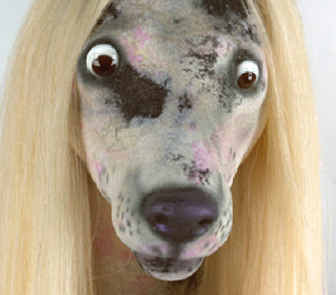
I’m making a hairless Chinese dog that’s supposed to be Barry Manilow,” artist David Hevel says.
Hevel is soft-spoken, but even over the phone there’s no mistaking his enthusiasm for the idea.
“That’s just funny,” he adds.
Hevel, who left Missouri for California and a masters in fine arts in 2000, usually begins his sculptures with an exotic animal, a taxidermy form, which he then matches to a celebrity’s personality. He has made Tyra Banks into a giraffe, Britney Spears into a baboon and Mariah Carey into a goat. Hevel’s offbeat works at Byron C. Cohen Gallery include a decapitated Missy Elliott.
For his presentation at the Cohen Gallery this month, which debuts as part of January’s First Fridays event, he’s taking a simpler approach. It’s called “Diva Hound Smack Down at the Grammys.”
“The whole show is dogs, except for Paris Hilton. She’s a blind monkey,” Hevel said.
The inspiration is this year’s Grammy Awards ceremony, and Hevel uses the occasion to underscore the subtle motives of his ingénues. Beyoncé, Carrie Underwood and Paula Abdul devour a headless Missy Elliott in one particularly weird, gory piece.
His sculptures combine craft-store finds with a florist’s approach to composition, and he seems to be skewering both tabloid culture and home décor.
“David’s work is risky, because it’s so decadent, and so showy, and so over-the-top,” Byron Cohen’s assistant director, Toma Wolff, said. “I’m really curious to see how Kansas City reacts to it.”
If the enthusiastic response to the H&R Block Artspace’s “Cryptozoology” exhibition, which featured an assortment of imaginative animal sculptures, is any indication, Kansas City may be ready for Hevel’s doggie divas.
First Fridays: The art bizarre
Dogs meld with celebrity, and dubious medicine is brought to light.
By ALEX SCHUBERT
Special to The Star
Byron C. Cohen Gallery

I’m making a hairless Chinese dog that’s supposed to be Barry Manilow,” artist David Hevel says.
Hevel is soft-spoken, but even over the phone there’s no mistaking his enthusiasm for the idea.
“That’s just funny,” he adds.
Hevel, who left Missouri for California and a masters in fine arts in 2000, usually begins his sculptures with an exotic animal, a taxidermy form, which he then matches to a celebrity’s personality. He has made Tyra Banks into a giraffe, Britney Spears into a baboon and Mariah Carey into a goat. Hevel’s offbeat works at Byron C. Cohen Gallery include a decapitated Missy Elliott.
For his presentation at the Cohen Gallery this month, which debuts as part of January’s First Fridays event, he’s taking a simpler approach. It’s called “Diva Hound Smack Down at the Grammys.”
“The whole show is dogs, except for Paris Hilton. She’s a blind monkey,” Hevel said.
The inspiration is this year’s Grammy Awards ceremony, and Hevel uses the occasion to underscore the subtle motives of his ingénues. Beyoncé, Carrie Underwood and Paula Abdul devour a headless Missy Elliott in one particularly weird, gory piece.
His sculptures combine craft-store finds with a florist’s approach to composition, and he seems to be skewering both tabloid culture and home décor.
“David’s work is risky, because it’s so decadent, and so showy, and so over-the-top,” Byron Cohen’s assistant director, Toma Wolff, said. “I’m really curious to see how Kansas City reacts to it.”
If the enthusiastic response to the H&R Block Artspace’s “Cryptozoology” exhibition, which featured an assortment of imaginative animal sculptures, is any indication, Kansas City may be ready for Hevel’s doggie divas.
Tuesday, January 02, 2007
Comments on Intro to Barry Moltz Book
A while ago I wrote a short Preface to a new book by a friend named Barry Moltz about entrepreneurs called You Have to be A Little Crazy. Recently he sent me a link to a blog that had commented on the Preface and reprinted a section of it. I thought I'd share it again since it's not clear how many folks ever actually read the book although it continues to sell and race up the Amazon list. And it's worth reading.
You Need to Be a Little Crazy
December 27th, 2006 Sean Murphy
Theresa heard a radio interview with Barry Moltz in 2003 and suggested that I get his book. In December 2003 I purchased a copy of You Need to Be a Little Crazy and when it arrived from Amazon I put it on my to-be-read pile where it languished until early this morning when I read it in one setting, making notes in the margin and jotting down page numbers for quotes I was going to harvest for later re-use on a 3×5 card as I read.
This is a great book that I now wish that I had read the week that I got it. It’s only 208 pages but packed with some very powerful insights into entrepreneurship.
I want to quote a long passage from the Preface by Howard Tullman that offers a nice overview of the book and explains why Barry Moltz’s perspective on entrepreneurship is focused on the real issues: Identity, Family, and Failure. The passage was originally all in plaintext, I have added bolding to highlight what I consider key points.
When I first met Barry Moltz, I was struck by his unique perspective on the trials and tribulations of entrepreneurship. He took as a given all of the typical questions and concerns (about deal making, valuation issues, control issues, etc…) and turned instead to much more interesting and harder personal issues. Identity. Family. Failure. These aren’t soft subjects and it’s not easy talking about what no one wants to hear. But that doesn’t make them any less important.
Identity is important because entrepreneurs constantly confuse what they do with who they are. We’re all certainly responsible for what we do but failing doesn’t make us bad people and succeeding doesn’t make us omniscient.
Family is important because it’s a much more important extension of ourselves than any work we’ll ever do. There’s always more work but you’ve only got one family.
Failure is important because the first time you win (or lose), it could be luck, it could be timing, or it could be talent. It’s only after you fail once or twice and learn to rely equally on thought, analysis, and anticipation–in addition to speed, talent, and execution–that you can really call yourself an entrepreneur. […] In the long run, it’s mind over muscle, strategy over strength, and a healthy perspective–not just a lot of perspiration–that make someone a real success in his or her business and in the equally important rest of his or her life.
And one final (abridged) quote from Moltz himself in the Introduction makes a point I have made to a number of folks who are not entrepreneurs (sometimes even to their spouses or others they have invited to be “a passenger in the race car”).
Entrepreneurs start businesses because..they have no choice. Passion and energy drive them on good days and sustain them on bad days.
I even remind myself of this from time to time. Some mornings when I am in the shower and contemplating the day ahead, I will remind myself that ”This is the life that I have chosen” because it’s never easy and it’s never dull.
Entry Filed under: quotes, startups, rule of thumb
You Need to Be a Little Crazy
December 27th, 2006 Sean Murphy
Theresa heard a radio interview with Barry Moltz in 2003 and suggested that I get his book. In December 2003 I purchased a copy of You Need to Be a Little Crazy and when it arrived from Amazon I put it on my to-be-read pile where it languished until early this morning when I read it in one setting, making notes in the margin and jotting down page numbers for quotes I was going to harvest for later re-use on a 3×5 card as I read.
This is a great book that I now wish that I had read the week that I got it. It’s only 208 pages but packed with some very powerful insights into entrepreneurship.
I want to quote a long passage from the Preface by Howard Tullman that offers a nice overview of the book and explains why Barry Moltz’s perspective on entrepreneurship is focused on the real issues: Identity, Family, and Failure. The passage was originally all in plaintext, I have added bolding to highlight what I consider key points.
When I first met Barry Moltz, I was struck by his unique perspective on the trials and tribulations of entrepreneurship. He took as a given all of the typical questions and concerns (about deal making, valuation issues, control issues, etc…) and turned instead to much more interesting and harder personal issues. Identity. Family. Failure. These aren’t soft subjects and it’s not easy talking about what no one wants to hear. But that doesn’t make them any less important.
Identity is important because entrepreneurs constantly confuse what they do with who they are. We’re all certainly responsible for what we do but failing doesn’t make us bad people and succeeding doesn’t make us omniscient.
Family is important because it’s a much more important extension of ourselves than any work we’ll ever do. There’s always more work but you’ve only got one family.
Failure is important because the first time you win (or lose), it could be luck, it could be timing, or it could be talent. It’s only after you fail once or twice and learn to rely equally on thought, analysis, and anticipation–in addition to speed, talent, and execution–that you can really call yourself an entrepreneur. […] In the long run, it’s mind over muscle, strategy over strength, and a healthy perspective–not just a lot of perspiration–that make someone a real success in his or her business and in the equally important rest of his or her life.
And one final (abridged) quote from Moltz himself in the Introduction makes a point I have made to a number of folks who are not entrepreneurs (sometimes even to their spouses or others they have invited to be “a passenger in the race car”).
Entrepreneurs start businesses because..they have no choice. Passion and energy drive them on good days and sustain them on bad days.
I even remind myself of this from time to time. Some mornings when I am in the shower and contemplating the day ahead, I will remind myself that ”This is the life that I have chosen” because it’s never easy and it’s never dull.
Entry Filed under: quotes, startups, rule of thumb
Saturday, December 23, 2006
NEW ART FROM PACINI LUBEL GALLERY IN SEATTLE
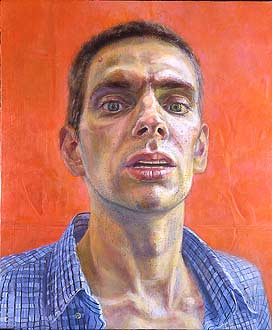
New Art from PACINI LUBEL Gallery in Seattle.
BRENT HOLLAND
"Self Portrait - Orange Background"
BRENT HOLLAND
"Self Portrait - Orange Background"

Friday, December 22, 2006
Another Review of the Mobile Art Show
The sky was grey, the wind chilling but what was found inside was enough to color the most dismal of early winter days and warm the soul.
As has become customary since the arrival of director Tommy McPherson, the Mobile Museum of Art in Langan Park is presently treating the local populace to first-rate exhibits that are raising the bar for this sleepy Southern town. McPherson appears to be the perfect complement to a revamped museum eager to match its modern environs with shows as dynamic.
The current slate of exhibitions is proof enough.
Ed McGowin’s elaborate and stimulating "Name Change Project" is both amusing and entrancing with a depth of thought that certainly induces reflection. In the course of the project, the artist changed his name a series of times, accompanying each different moniker with a completely manufactured biography and new style. The body of work underlines the multi-faceted aspect of not only artists but also the average human heart in a truly gifted concept.
The Dusti Bongé exhibition on loan from Biloxi underscores the work of oft-overlooked artists from a region which, at times, seems content to ignore the more adventurous in favor of watercolor boats and wildlife. Though the Mississippi-born artist’s surrealism is clearly part and parcel of her Twentieth Century roots, it belies a sensibility still refreshing without being too dated, especially in a land of over-mythologized moonlight and magnolias.
The Southeastern Juried Exhibition is also tantalizing, but the meat of the present shows is undoubtedly the Howard A. and Judith Tullman Collection entitled "Creative Imaginings." A list of superlatives spring to mind when contemplating the collection, but none do justice to the actual emotional gamut viewing elicits.
In fact, the first left hand turn into the gallery met one work so forceful, the first glance greeted a wave of intensity that passed through the observer’s core and stirred an almost visceral reaction. Superficially, Mary Borgman’s "Portrait of Jody Carter" (2002) seems another monochromatic likeness, however something seemed poised to leap from its subject’s gaze. Neither the technique nor the subject matter is uncommon, but whether it was the sheer size of the piece or the viewer’s receptiveness, its impact was tangible.
And that was only the first taste.
Work after work in this panoply of contemporary art was as vibrant as anything Artifice has seen in Mobile in years. Whether it was the haunting visage within Peter Drake’s "Out of Place" (2004), the schizoid religiosity of Norbert Cox’s works or the palpable explosiveness of Leonard Koscianski’s "Clash" (1988), every turn elicited inner action and reaction.
And is the case with contemporary art, much of it met subjects and emotions that are often avoided in our area for the uncomfortable ground they tread. Caleb Weintraub’s "Party Favors" (2005) in particular carried an overt violence that, while effective, would likely have been turned away from the museum in years past.
And Mobile’s seemingly most taboo of subjects was present in full force. The nudity that was the subject of a somewhat controversial installment of Artifice in the last year was everywhere. A full frontal female nude standing in longing over a prostrate and bare man, a distinctly unnerving male nude reclining amongst archetypes of the mythological South, or the open embrace of a naked couple protected by a distracted Rottweiler, there were more than enough human forms to shock the more puritanical quarters of our town.
But a glance through the comments in the guest book showed a refreshingly mature reaction to the exhibit. The skies didn’t fall, the earth didn’t open to swallow anyone. People took it for what it’s worth and evaluated it as such, as one would hope functioning human beings could do.
How this stands in stark comparison to other local venues that bill themselves as havens for contemporary work is inescapable, especially in light of the way the struggles of those venues’ artist advisory boards are sometimes negated, the political maneuverings within those institutions and the eradication of those who dare to try and hold their ideals above the inane and pedestrian backroom schemes.
Ideals? In an arthouse? Why who ever heard of such a thing?
Kudos to McPherson and company for retrieving the fallen standard and leading Mobile’s artistic charge into a new realm.
Maybe they can dash eastward down The Hill soon.
Kevin Lee is Lagniappe associate editor. Contact him at klee@lagniappemobile.com.
As has become customary since the arrival of director Tommy McPherson, the Mobile Museum of Art in Langan Park is presently treating the local populace to first-rate exhibits that are raising the bar for this sleepy Southern town. McPherson appears to be the perfect complement to a revamped museum eager to match its modern environs with shows as dynamic.
The current slate of exhibitions is proof enough.
Ed McGowin’s elaborate and stimulating "Name Change Project" is both amusing and entrancing with a depth of thought that certainly induces reflection. In the course of the project, the artist changed his name a series of times, accompanying each different moniker with a completely manufactured biography and new style. The body of work underlines the multi-faceted aspect of not only artists but also the average human heart in a truly gifted concept.
The Dusti Bongé exhibition on loan from Biloxi underscores the work of oft-overlooked artists from a region which, at times, seems content to ignore the more adventurous in favor of watercolor boats and wildlife. Though the Mississippi-born artist’s surrealism is clearly part and parcel of her Twentieth Century roots, it belies a sensibility still refreshing without being too dated, especially in a land of over-mythologized moonlight and magnolias.
The Southeastern Juried Exhibition is also tantalizing, but the meat of the present shows is undoubtedly the Howard A. and Judith Tullman Collection entitled "Creative Imaginings." A list of superlatives spring to mind when contemplating the collection, but none do justice to the actual emotional gamut viewing elicits.
In fact, the first left hand turn into the gallery met one work so forceful, the first glance greeted a wave of intensity that passed through the observer’s core and stirred an almost visceral reaction. Superficially, Mary Borgman’s "Portrait of Jody Carter" (2002) seems another monochromatic likeness, however something seemed poised to leap from its subject’s gaze. Neither the technique nor the subject matter is uncommon, but whether it was the sheer size of the piece or the viewer’s receptiveness, its impact was tangible.
And that was only the first taste.
Work after work in this panoply of contemporary art was as vibrant as anything Artifice has seen in Mobile in years. Whether it was the haunting visage within Peter Drake’s "Out of Place" (2004), the schizoid religiosity of Norbert Cox’s works or the palpable explosiveness of Leonard Koscianski’s "Clash" (1988), every turn elicited inner action and reaction.
And is the case with contemporary art, much of it met subjects and emotions that are often avoided in our area for the uncomfortable ground they tread. Caleb Weintraub’s "Party Favors" (2005) in particular carried an overt violence that, while effective, would likely have been turned away from the museum in years past.
And Mobile’s seemingly most taboo of subjects was present in full force. The nudity that was the subject of a somewhat controversial installment of Artifice in the last year was everywhere. A full frontal female nude standing in longing over a prostrate and bare man, a distinctly unnerving male nude reclining amongst archetypes of the mythological South, or the open embrace of a naked couple protected by a distracted Rottweiler, there were more than enough human forms to shock the more puritanical quarters of our town.
But a glance through the comments in the guest book showed a refreshingly mature reaction to the exhibit. The skies didn’t fall, the earth didn’t open to swallow anyone. People took it for what it’s worth and evaluated it as such, as one would hope functioning human beings could do.
How this stands in stark comparison to other local venues that bill themselves as havens for contemporary work is inescapable, especially in light of the way the struggles of those venues’ artist advisory boards are sometimes negated, the political maneuverings within those institutions and the eradication of those who dare to try and hold their ideals above the inane and pedestrian backroom schemes.
Ideals? In an arthouse? Why who ever heard of such a thing?
Kudos to McPherson and company for retrieving the fallen standard and leading Mobile’s artistic charge into a new realm.
Maybe they can dash eastward down The Hill soon.
Kevin Lee is Lagniappe associate editor. Contact him at klee@lagniappemobile.com.
Monday, December 18, 2006
A Brief Note on New Financing for Experiencia
Week in Midwest Business: Origin of Howard Tullman's Experiencia
CHICAGO -- This week in Midwest business, we take a peak at Howard Tullman's latest venture that recently received $2.575 million in VC financing.
Are You Experienciad?
Serial entrepreneur Howard Tullman very well may have founded or directed more companies than the Chicago Bears currently have wins.
The guy who brought us companies including insurance automation specialist CCC Information Systems, music site Tunes.com and digital strategy shop Xceed Group has jumped back on the entrepreneurial horse after a stint turning around Chicago-based culinary school Kendall College.
Tullman is the chairman of for-profit educational company Experiencia. Founded in 2001 and located near the intersection of Chicago Avenue and the Chicago River (old stomping grounds for divine InterVentures and Sears), Experiencia recently closed on a $2.575 round of institutional financing led by Origin Ventures.
Founded by former Quill director of business development Steve Miller in 1999, Origin invests in Midwest-based seed and early stage technology companies. The firm has also backed insurance automation company Claimforce and iNest. iNest is a new-home builder referral network that was sold to Lending Tree in 2004.
Experiencia also raised money from private investors. The firm partners with grammar schools to offer "immersive leaning" programs for students grades three through six. To date, more than 1 million students have experienced the service. Investment proceeds will be allocated toward national expansion.
CHICAGO -- This week in Midwest business, we take a peak at Howard Tullman's latest venture that recently received $2.575 million in VC financing.
Are You Experienciad?
Serial entrepreneur Howard Tullman very well may have founded or directed more companies than the Chicago Bears currently have wins.
The guy who brought us companies including insurance automation specialist CCC Information Systems, music site Tunes.com and digital strategy shop Xceed Group has jumped back on the entrepreneurial horse after a stint turning around Chicago-based culinary school Kendall College.
Tullman is the chairman of for-profit educational company Experiencia. Founded in 2001 and located near the intersection of Chicago Avenue and the Chicago River (old stomping grounds for divine InterVentures and Sears), Experiencia recently closed on a $2.575 round of institutional financing led by Origin Ventures.
Founded by former Quill director of business development Steve Miller in 1999, Origin invests in Midwest-based seed and early stage technology companies. The firm has also backed insurance automation company Claimforce and iNest. iNest is a new-home builder referral network that was sold to Lending Tree in 2004.
Experiencia also raised money from private investors. The firm partners with grammar schools to offer "immersive leaning" programs for students grades three through six. To date, more than 1 million students have experienced the service. Investment proceeds will be allocated toward national expansion.
Another Review of the Mobile Show
Fine Arts
Review: 'Creative Imaginings: The Howard A. and Judith Tullman Collection'
Heather Duffy
Contributing Writer
hnd301@jaguar1.usouthal.edu
November 20, 2006
The Mobile Museum of Art is currently displaying "Creative Imaginings: The Howard A. and Judith Tullman Collection," an exhibition comprised from the Chicago couple's private collection.
The show is made up of representational paintings and drawings, primarily in the mediums of oil, acryic and charcoal. Largely figurative, this exhibition is one of the best examples of contemporary realism to arrive in Mobile in recent years.
Upon entering the gallery, one first notices the vast diversity of narrative subject matter and the large scale of most of the images. Massive canvases line the walls, interspersed with the occasional four-foot-tall drawing.
Aspects of Baroque and Renaissance painting can even be seen, of course, with contemporary twists. Bruno Sardo's "So What Do You Think?" takes an amalgamation of modern day characters (the businessman, the construction worker, etc.) and positions them into a composition reminiscent of Caravaggio's "The Taking of Christ."
Brooklyn-based artist, Sarah Bereza, even shows us a modernized look at a triptych altar piece. The three-paneled painting is adorned with an intricately carved border and wooden pinnacles that point towards the gallery ceiling. Each panel subsequently gives us the view of looking in from the other side of the mirror. Bereza shows the prominance that vanity is given in our time by holding it in the same esteem as that of religion in the Middle Ages. In each panel we see a different young girl, putting on lipstick, pushing her breasts together, putting on eye shadow; each staring into the mirror as devoutly as a monk would observe mass.
While many of the paintings are well-executed, Jennifer Presant's oil painting "Projection, Memory, Desire" surpasses the other works in beauty and technical skill. A nude woman stands in the center of a room, walking forward amidst a floor of scattered magazines. The background converges into a corner behind her as the walls come together. These walls, however, show a different image projected on either one. To the left we see a bedroom in complete disarray. The perspective is skewed; cluttered pillows and sheets fall from the bed, fading together into darkness. To the right, the same woman stands naked, looking away from a man lying on the bed, his forearm almost covering his face. One is immediately overwhelmed with a feeling of loss. These projections are images of a shattered past relationship. The woman in the center is utterly alone with only these fragments of memories. The projections create such a great depth of space that the confines of this small room are stretched out infinitely far.Her subtle caucasian skin tones glow in contrast to the rest of the painting. Painted over an acidic green underpainting, her flesh reads as luminous and soft. The brushstrokes on her body are non-existent. The underpainting shows through in many places, creating a sense of process, and a look at the foundation on which this painting was built. Burnt sienna and Indian red hues play well against the bright green. The background is brushy and soft, with many of the large shapes fading in and out of each other. Value contrast decreases and darkens everything but the central figure, pulling her forward and setting her apart from the loss and sorrow of these projected memories.
This show, of course, is not without its shortcomings. Some of the paintings lack any sort of complexity, and many read as if they are so photo-realistic that they may as well not even be paintings. Some even come off as the tasteless purchasing of an eccentric collector.
Despite these facts, the good aspects of this exhibition completely out-number the bad. This is a fine collection of what is currently happening with figurative realism. Ranging from the elegant and the lovely to the garish and offensive, this show is definitely worth seeing.
Where and When
"Creative Imaginings"
Mobile Museum of Art
Through Jan. 7, 2007
Tickets: $10 for adults; $6 for students
Gallery hours: Monday through Saturday 10 a.m. until 5 p.m.
Sunday 1 p.m. to 5 p.m.
More information: 208-5200
Review: 'Creative Imaginings: The Howard A. and Judith Tullman Collection'
Heather Duffy
Contributing Writer
hnd301@jaguar1.usouthal.edu
November 20, 2006
The Mobile Museum of Art is currently displaying "Creative Imaginings: The Howard A. and Judith Tullman Collection," an exhibition comprised from the Chicago couple's private collection.
The show is made up of representational paintings and drawings, primarily in the mediums of oil, acryic and charcoal. Largely figurative, this exhibition is one of the best examples of contemporary realism to arrive in Mobile in recent years.
Upon entering the gallery, one first notices the vast diversity of narrative subject matter and the large scale of most of the images. Massive canvases line the walls, interspersed with the occasional four-foot-tall drawing.
Aspects of Baroque and Renaissance painting can even be seen, of course, with contemporary twists. Bruno Sardo's "So What Do You Think?" takes an amalgamation of modern day characters (the businessman, the construction worker, etc.) and positions them into a composition reminiscent of Caravaggio's "The Taking of Christ."
Brooklyn-based artist, Sarah Bereza, even shows us a modernized look at a triptych altar piece. The three-paneled painting is adorned with an intricately carved border and wooden pinnacles that point towards the gallery ceiling. Each panel subsequently gives us the view of looking in from the other side of the mirror. Bereza shows the prominance that vanity is given in our time by holding it in the same esteem as that of religion in the Middle Ages. In each panel we see a different young girl, putting on lipstick, pushing her breasts together, putting on eye shadow; each staring into the mirror as devoutly as a monk would observe mass.
While many of the paintings are well-executed, Jennifer Presant's oil painting "Projection, Memory, Desire" surpasses the other works in beauty and technical skill. A nude woman stands in the center of a room, walking forward amidst a floor of scattered magazines. The background converges into a corner behind her as the walls come together. These walls, however, show a different image projected on either one. To the left we see a bedroom in complete disarray. The perspective is skewed; cluttered pillows and sheets fall from the bed, fading together into darkness. To the right, the same woman stands naked, looking away from a man lying on the bed, his forearm almost covering his face. One is immediately overwhelmed with a feeling of loss. These projections are images of a shattered past relationship. The woman in the center is utterly alone with only these fragments of memories. The projections create such a great depth of space that the confines of this small room are stretched out infinitely far.Her subtle caucasian skin tones glow in contrast to the rest of the painting. Painted over an acidic green underpainting, her flesh reads as luminous and soft. The brushstrokes on her body are non-existent. The underpainting shows through in many places, creating a sense of process, and a look at the foundation on which this painting was built. Burnt sienna and Indian red hues play well against the bright green. The background is brushy and soft, with many of the large shapes fading in and out of each other. Value contrast decreases and darkens everything but the central figure, pulling her forward and setting her apart from the loss and sorrow of these projected memories.
This show, of course, is not without its shortcomings. Some of the paintings lack any sort of complexity, and many read as if they are so photo-realistic that they may as well not even be paintings. Some even come off as the tasteless purchasing of an eccentric collector.
Despite these facts, the good aspects of this exhibition completely out-number the bad. This is a fine collection of what is currently happening with figurative realism. Ranging from the elegant and the lovely to the garish and offensive, this show is definitely worth seeing.
Where and When
"Creative Imaginings"
Mobile Museum of Art
Through Jan. 7, 2007
Tickets: $10 for adults; $6 for students
Gallery hours: Monday through Saturday 10 a.m. until 5 p.m.
Sunday 1 p.m. to 5 p.m.
More information: 208-5200
Subscribe to:
Posts (Atom)