
New
York Times bombshell exposé traces Court's shadow docket to its dubious origin.
Apr 22, 2026
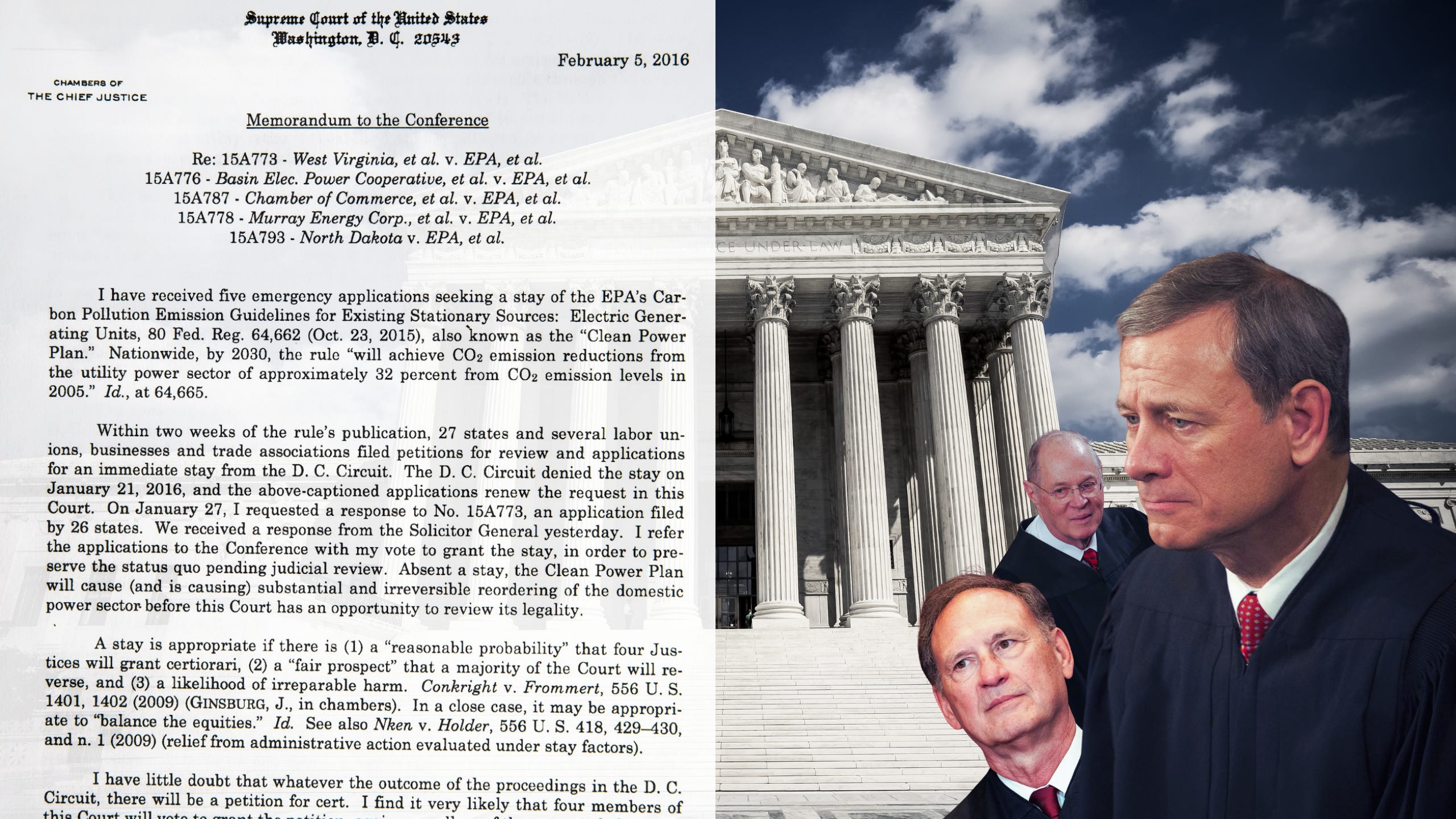
Ten years ago, over a long February weekend, five
Supreme Court justices quietly inaugurated a practice that would reshape
American law and policy for the next decade. Last Saturday, the New
York Times took us inside the room where it
happened.
The Times published a package of leaked internal memos from
the Supreme Court justices, sixteen pages of correspondence exchanged over five
days in February 2016, that traced the birth of the so-called shadow docket.
The memos had never been seen before. They show the justices writing to one
another on formal letterhead, addressing each other by first name, signing off
with their initials, debating in real time whether to do something the court
had never done: freeze an entire federal regulatory program while the courts
considered its legality.
Some commentators, mostly on the right, quickly moved
to dismiss the exposé: nothing to see here, everyone already knew the court was
using its emergency docket more aggressively. Move along.
They are wrong. It is a big story. Not primarily
because of the memos themselves (remarkable as they are), but because of what
they reveal: the founding moment of a procedural mechanism that has reshaped
American law and policy over the last decade. And more than tracing the birth
of the doctrine, the memos provide an origin story that is difficult to square
with the ideal of a modest, impartial, and deliberative High Court.
They also shine a harsh light on Chief Justice John
Roberts, who has long cultivated a public image as the neutral umpire of
American law. The memos show him pushing the court hard to take aggressive
action that was unprecedented, tenuous, and consequential.
The shadow docket refers to cases in which the Court
grants emergency relief without the normal process of briefing, oral argument,
and written opinions – in the shadows, as it were. Since the whole point of a
Court is to rationalize and explain its decisions, the approach is supposed to
be reserved for an extremely small slice of cases in which there is an
unavoidable need for exigency.
So in a death penalty case with a scheduled execution,
or an election case with a looming deadline to certify a candidate, the court
might need to take immediate provisional action, for example, staying the
execution, before it’s able to consider the case in its normal extended course.
In fact, the memos show that the Court adapted its
existing emergency procedure for capital cases—the same quick round-the-horn
canvassing used for last-minute death penalty stays—in the 2016 case at the
heart of the Times story. But it put that procedure to very
different ends. For the first time, it became a tool for making major decisions
about nationwide federal policy, quickly, secretly, and without accountability
to anyone.
The case was West Virginia v. EPA,
involving the Obama administration’s Clean Power Plan, an ambitious EPA
regulation aimed at shifting the nation’s power sector away from coal. A group
of states challenged it. The D.C. Circuit refused to freeze the plan while it
considered the challenge. The states went straight to the Supreme Court to
renew that motion for a stay, even as the case remained in the court of
appeals.
As even West Virginia’s own solicitor general later
acknowledged, this had never been done before. The court had granted emergency
relief before, in death penalty cases, election disputes, and the occasional
challenge to a state law. But the court had never intervened to freeze an
entire nationwide federal regulatory program, initiated by an executive branch
agency, before any lower court had ruled on its legality. That was new. The
EPA’s general counsel called it a Hail Mary. They were not especially worried.
They should have been.
Roberts, as Circuit Justice for the D.C. Circuit,
received the emergency application first and drafted a memo to the full court
with his own analysis. Nothing unusual about that. But the memo he circulated
was far from routine. Rather than the standard canvassing of arguments on both
sides, Roberts’s memo was a piece of forceful advocacy. He predicted the court
would take the case, predicted it would reverse, and insisted immediate action
was required because the energy industry “must make changes to business plans
today.”
The memo relied not on a factual record—there was as
yet no record—but on public sources such as a BBC television
interview with the EPA administrator and a blog post. Roberts used these
sources to support two core claims: that the plan would become functionally
irreversible if the court did not act immediately, and that the costs of
compliance would run into the hundreds of billions of dollars, figures he
himself acknowledged were likely inflated.
Justice Breyer offered a diplomatic compromise. He
proposed the Court tell the D.C. Circuit to move quickly, and tell the states
they could apply to the EPA for two-year extensions of the compliance deadline.
If extensions were denied, the states could return to the Supreme Court at that
point. Under that framework, no state had to do anything immediately. No
industry player faced imminent disruption. Implicit in Breyer’s memo was a
direct criticism of Roberts’s irreparable harm analysis: there was no irreparable
harm as of yet, not when the states could put off compliance for two years.
But Roberts doubled down. The states would still have
to “engage their regulatory apparatus,” he wrote. That amorphous prospect was
enough in his view to constitute “irreparable harm.”
Justice Kagan pushed back directly: “As far as I can
tell, it would be unprecedented for us to second-guess the D.C. Circuit’s
decision that a stay is not warranted, without the benefit of full briefing or
a prior judicial decision.” She also directly challenged the irreparable harm
claim, calling the industry’s predictions of immediate disruption “entirely
speculative and highly doubtful.” The rule imposed no direct obligations on
private parties, only on states, which could seek extensions and buy themselves
two years. There was, she argued, simply nothing that could not wait.
Remarkably, neither Roberts nor any other justice ever
directly answered her. Roberts conceded only that “the posture of this stay
request is not typical,” and moved on.
Justice Alito weighed in the same day, taking the
opposite view with characteristic bluntness: failing to act, he wrote, would
render the court’s institutional legitimacy “a nullity.”
Anthony Kennedy (for whom I clerked) settled the matter
with a three-sentence note: the court would probably grant a stay in four to
six months anyway, so it might as well do it now.
That reasoning, of course, in effect acknowledged that
there was no immediate need for the stay. That the court “probably” would grant
it, and not immediately but months later (during which the states could seek an
extension), suggests doubt as to both the need and the urgency for immediate
intervention.
But that vote broke the stalemate. The order issued at
6:20 p.m. on Tuesday, February 9, 2026.
One might assume, or hope, that even though the court’s
decisions in shadow docket cases are themselves curt, a rich deliberative
process occurs behind the unexplained public orders. The Times story
lays that assumption to rest. The Court’s entire deliberations consist of a
series of hastily sketched thoughts that are not remotely a stand-in for the
normal briefing, argument, and deliberation of a merits case. ** katie to place
As Steve Vladeck, the foremost scholar of the shadow
docket, put it when we discussed the story: “This is a bit of
the emperor really not having much clothing”. Those memos, in all likelihood,
were the process. There was nothing more happening behind the curtain.
At the core of shadow docket outcomes sits a concept of
irreparable harm that has become all too malleable in the justices’ hands. The
Court has applied it casually and inconsistently, accepting harm that is
neither immediate nor unavoidable.
In the Clean Power Plan case, the harm Roberts invoked
was that states might have to start thinking about regulatory compliance.
Industry might voluntarily begin adjusting. That is not irreparable harm by any
serious measure. Voluntary compliance with a rule that has not yet been struck
down is not a constitutional injury. Engaging a regulatory apparatus is not
irreparable. And Breyer’s compromise, which Roberts rejected, would have mooted
even those attenuated concerns.
Roberts never even mentioned the harm on the other
side: to the government trying to implement its climate policy, to the
environment, or to anyone outside the power industry.
The contrast with the Court’s treatment of the shadow
docket during the Trump administration is glaring. In case after case, the
Trump administration has claimed, with remarkable success, that any court order
blocking any executive policy constitutes irreparable harm to the government.
The mere inability to enforce whatever it wants, right now, counts as injury
enough.
The standard Roberts refused to apply to the Obama
administration has become the automatic, unquestioned assumption when the
program belongs to Trump. Roberts himself, in a 2012 in-chambers opinion,
established the principle that the government suffers irreparable harm when
courts enjoin its policies. He simply declined to apply it in February 2016.
The standard did not change. The party in power did.
The practice the EPA order inaugurated has dramatically
affected the entire country in the ten years since, often without the public
fully appreciating the stakes. In the entirety of the Obama administration, the
government filed three emergency applications with the Supreme Court. In the
first fifteen months of Trump’s second term alone, the number is thirty-four.
Far more troubling is the pattern of how the Court’s
conservative supermajority has ruled in these cases. The shadow docket has
assumed an outsize importance in enabling Trump’s agenda, granting him
emergency victories on immigration, agency power, and personnel. The court used
the shadow docket to allow the firing of 16,000 federal workers, to strip legal
status from more than 500,000 immigrants, to terminate research grants
mid-project, and to permit deportations to third countries without basic due process
protections. And every one of those decisions arrived in unsigned, unexplained
orders, without a word of reasoning to the public that lives with the
consequences.
One might assume, or hope, that even though the court’s
decisions in shadow docket cases are themselves curt, a rich deliberative
process occurs behind the unexplained public orders. The Times story
lays that assumption to rest. The Court’s entire deliberations consist of a
series of hastily sketched thoughts that are not remotely a stand-in for the
normal briefing, argument, and deliberation of a merits case.
The Supreme Court’s authority rests entirely on the
persuasiveness of its reasoning. The political branches can draw arbitrary
lines; the Court must justify and persuade. As Professor Vladeck put it: “What makes the Supreme Court
different from the other branches of government is that its power comes from
its explanations. If it’s not explaining itself, all it’s doing is fiat.”
The shadow docket has become a fiat machine, one of
enormous and often unappreciated import in the lives of Americans. At his
confirmation hearing, Roberts famously promised “to call balls and strikes, and
not to pitch or bat.” The memos show something different: a justice with a
rooting interest, and a strike zone that shifts depending on who’s up.
Talk to you later.
