
Justice According To
Trump
Apr 18, 2026
The Justice Department has moved to
drop the last remaining January 6 insurrection criminal matters: the Oath
Keepers and Proud Boys seditious conspiracy cases. It’s a gratuitous move. On
the first day of his second term, Trump issued full pardons to more than 1500
people who overran the Capitol on January 6. Then he commuted the sentences of
14 of the Proud Boys and Oath Keepers defendants, the people convicted of the
most serious January 6-related offense, seditious conspiracy. Getting clemency
got them out of prison, but it didn’t erase their convictions.
So earlier this week, Trump’s U.S.
Attorney for the District of Columbia, Jeanine Pirro, moved to vacate the convictions of
prominent insurrectionists including Stewart Rhodes and Ethan Nordean. She
wrote that doing so was “in the interests of justice.”
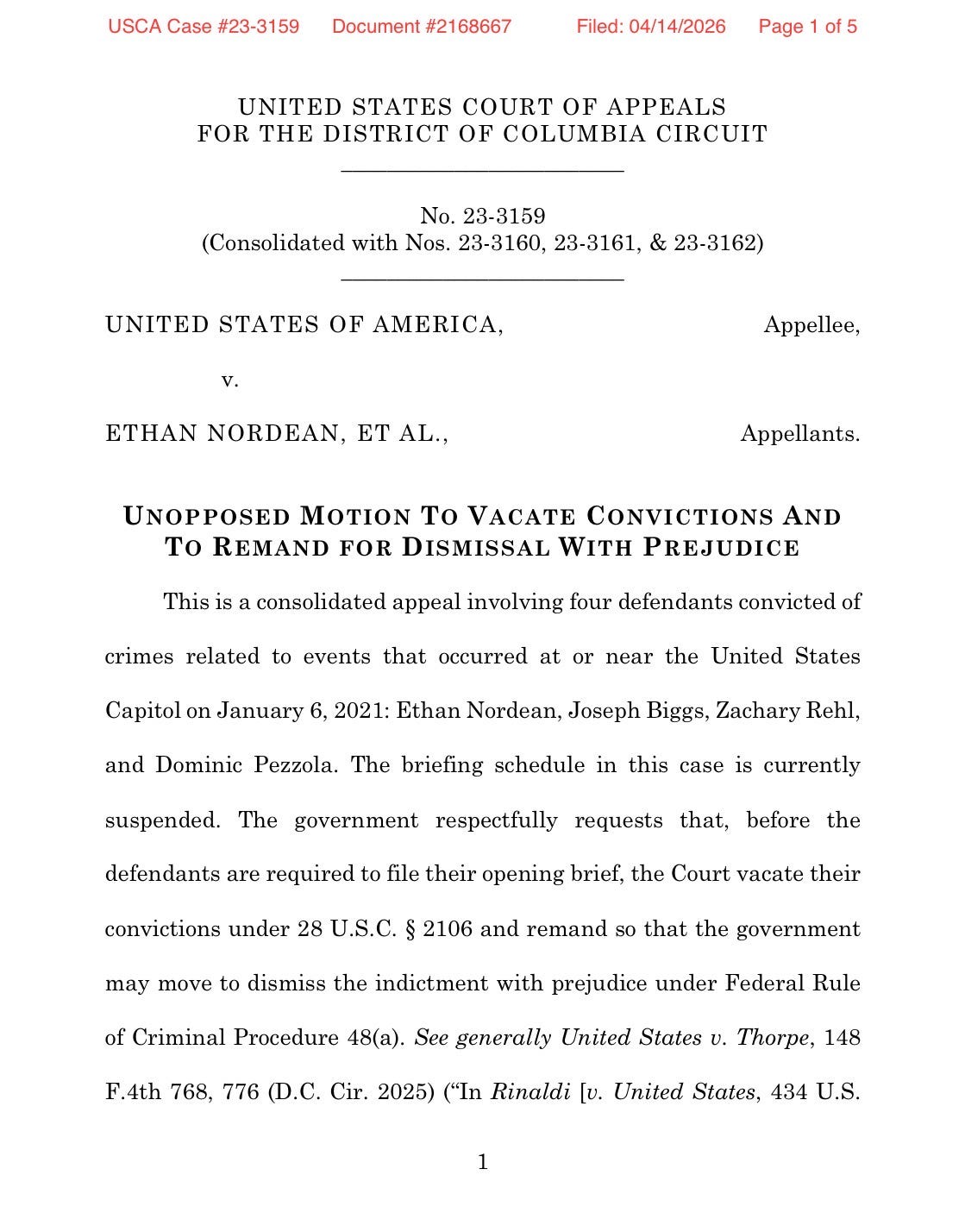
Here’s what that means: The government
wants to pretend the indictments didn’t occur and juries never convicted these
defendants on some of the most serious charges that can be leveled against
people in a democracy. Vacating a conviction means it never happened.
Prosecutors need a judge’s permission
to dismiss a case after it has been indicted. These cases are on appeal, and
the government filed its request to vacate before the defendant/appellants’
first briefs are due. Pirro explained “The government respectfully requests
that, before the defendants are required to file their opening brief, the Court
vacate their convictions under 28 U.S.C. § 2106 and remand so that the
government may move to dismiss the indictment with prejudice.” A defendant’s
conviction isn’t final until it has been affirmed on appeal, and these
convictions haven’t been, so it’s still possible to do away with them. The
government argues that judges “routinely” grant these types of motions.
One might hope that the judges here
will inquire further into precisely how fulfilling the government’s requests
serves “the interests of justice.” But rejecting them could easily result in
mandamus orders from a higher court requiring the judges to do so. It’s likely
Trump will get his way.
This is what Donald Trump does for his
friends—the people willing to plot a violent insurrection in hopes he could
hold onto power after losing the 2020 election. He treats the people he thinks
of as enemies very differently, but the stench of corruption is the same.
The current example is former CIA
Director John Brennan—one of the ultimate catches on Trump’s revenge
prosecution list. Trump became convinced during his first term in office that
Brennan had been involved in some shadowy plot against him, and although nothing
in the extensive “Crossfire Hurricane” investigation carried out by then AG
Bill Barr and Special Counsel John Durham bore that out, Trump apparently still
holds a grudge. Trump has always been sensitive to the 2017 intelligence
assessment that found Russia interfered in the
2016 presidential election in order to help him, and since Brennan was at the
CIA when that happened, Trump seems to hold him responsible. The intelligence
assessment appears to have been accurate; both the FBI and a bipartisan Senate Committee agreed.
Brennan is now the target of an
investigation in the Southern District of Florida, which appears to be amping up, despite the fact
that the career prosecutor who has been running that investigation had been
resisting “pressure to quickly bring charges against the former CIA director
and prominent critic of President Donald Trump,” according to CNN. She reportedly questioned
the strength of the evidence and was subsequently removed from the case.
She will be replaced by Joseph diGenova, a
former U.S. Attorney during the Reagan administration. diGenova is one of the
lawyers who helped with Trump’s effort to overturn the 2020 election.
CNN went on to report that the Justice
Department said in a statement that it is a routine practice to move attorneys
around on cases “so offices can most effectively allocate resources.” The
statement continued, “It is completely healthy and normal to change members of
legal teams.” That’s unlikely to fool anyone. It’s counterproductive and
wasteful of time and deep knowledge about the evidence in a case to make a move
like this, and it doesn’t happen in the absence of solid reason. Here, it
appears to be happening, as we saw in the Eric Adam’s case in New York, and the
cases involving Jim Comey and Letitia James in the Eastern District of
Virginia, to remove an unwilling prosecutor and replace her with a more
compliant one. We don’t yet know what the potential charges might look like
here, and the government seems confident, with the matter proceeding in Judge
Aileen Cannon’s district. But it’s hard to imagine there’s anything of
substance here.
The polar opposite treatment of these
two cases clarifies just how defunct the Justice Department is. During Trump’s
first term in office and his bid for reelection, I repeatedly spoke of the
danger he posed to our criminal justice system and hence to our democracy, the
risk he would turn us into a banana republic where an authoritarian leader uses
the criminal justice system to reward his friends and punish his enemies. And
here we are. This is what the stakes are in the midterm elections. Because a president
who is willing to do all of this—and has a party behind him that is willing to
be complicit—will try to do whatever it takes to hold onto power. It’s a moment
where no one can afford to stay on the sidelines.
This isn’t about one case or a handful
of defendants. It’s about whether the rule of law still has meaning, whether
Trump will succeed in eroding it into yet another political tool; applying it
differently to people depending on who they are—and whose side they’re on. When
a president can make convictions disappear for his allies while leaning on
prosecutors to go after his critics, the damage isn’t just theoretical, it’s
already happening in front of our eyes. And once that line is crossed, it
doesn’t easily uncross itself. It’s on all of us to see it clearly and refuse
to look away.
Thanks for being here with me at Civil
Discourse and making it possible, through you subscriptions, for me to write
the newsletter.
We’re in this together,
Joyce
