Showing posts with label cameo. Show all posts

Monday, May 25, 2026

NEW INC. MAGAZINE COLUMN FROM HOWARD TULLMAN


The Brilliant Strategy Top Creators Use to Bypass Platforms and Keep 100 Percent of Revenue

A business that depends on resources it doesn’t control isn’t really a business; it’s a hostage to the whims and vagaries of others.

EXPERT OPINION BY HOWARD TULLMAN, GENERAL MANAGING PARTNER, G2T3V AND CHICAGO HIGH TECH INVESTORS @TULLMAN

Photo: Getty Images

A decade ago, when Cameo first started in Chicago and was working out of 1871, the tech incubator which I ran there at the time, only a few of us understood what the company’s long-term roadmap looked like and how utterly disruptive this little firm (with ugly videos from jocks in their cars and “D” level celebrities holding forth in their basements) was going to be for the entire entertainment industry.

One of the great ironies at the time was that the most cogent observation came from no less an authority than Snoop Dogg, now a noted Olympic commentator, who said: “There is no platform or middleman filtering my message anymore.” The idea that artists and musicians could bypass many expensive and controlling layers of agents and managers and directly reach out to and connect with their fans wasn’t exactly revolutionary, but Cameo and others were the earliest players to provide painless technology solutions and easy access to anyone and everyone who thought they had something important to say. However, the economic problem for the creators and content providers was still a sizable concern because Cameo as the platform provider took a healthy cut of the revenue earned in each transaction. It was a better deal, but not the right deal.

A business that depends on resources it doesn’t control isn’t really a business; it’s a hostage to the whims and vagaries of others. Even Steven Galanis, one of the co-founders of Cameo, advises creators to own their audience rather than rent it, which he defines as building monetization that does not depend on any single platform’s algorithm or content policies remaining consistent.

So, a few years later, along came bemyfriends, riding on the huge success of its first major customer, the South Korean pop group BTS, and offered musicians and other creators their own platform with all the basic features required to build direct and lasting connections to their own fans without any intermediaries. This platform enabled special fan events, merchandise sales, access to the performers themselves, data analytics, advertising opportunities, fan voting mechanisms and numerous other tools which permitted the platform owner to focus on their principal activity while all the commerce and other business concerns were handled by the b.stage and b.stage+ platforms provided by bemyfriends. Most importantly, all the fan contacts and other proprietary data were owned exclusively by the artists and not by the platform operators. But the glaring omission in their offerings was the very critical area of ticketing which was controlled for almost all of the major U.S. concert venues by Ticketmaster and Live Nation Entertainment. 

The recent Ticketmaster and Live Nation litigation, where the suing states secured an initial determination that these two industry overlords were engaged in illegal monopolistic behavior (and notwithstanding the sad fact that they took the Trumpian payment path to bail themselves out of the federal proceedings), has energized talented musicians to be more entrepreneurial and aggressive in addressing the whole ticketing swamp. Here again, for artists with substantial fan bases and international followings, the attraction of building their own ticketing app and controlling their own interactions with their fans is very attractive and potentially quite lucrative.

One very significant example of direct-to-fan ticketing is the recent successful sold-out tour of Australia by GiaNina Paolantonio which employed a new free iPhone app that allows her to sell tickets worldwide to her fans without any service fees. She can sell tickets through the Headquarters app (which also works on Android phones) for dance classes, performances and concerts to her followers which number over 4 million on TikTok alone. Add another 2 million fans for Snap, Insta, and YouTube and you can begin to understand the reach and power of what she’s doing.

These are not thin or casual connections but rather relationships she’s been building since her work on Dance Moms first gave her a persistent global audience. She’s choreographed viral dance moves for Jennifer Lopez, Billie Eilish and Sombr, among others, and is now recording her music with Atlantic Records. The global app was built by GiaNina and her partners at a development firm named Clique Apps. GiaNina’s also got her own Selfie, an online digital twin that fans and followers can ask questions and get instant responses about everything GiaNina.

I wrote a piece quite a while ago noting that we’d probably all reached peak apps and that no one was looking to add more applications to their phones, but it’s a whole different story and a dream marketing scenario when an app developer is an artist who can speak directly to 6 million fans and tell them to get with the program and install her app to keep up with everything she’s doing – new music drops, hosting dance classes, extending her tours and, of course, other merch opportunities. And that’s only half of the really bad news for the twin ticket ogres.

The viral flywheel aspect of her launch goes like this. Once a fan sees how easy, cheap (actually free) and speedy this app is, they’re never going back. All consumers’ expectations are perpetually progressive and—just as Amazon set a brand-new curve and standard for delivery times and goosed the world’s expectations—every one of GiaNina’s fans will be asking her to add other artists, acts, creators and tours to her app. And every one of those fans will also be asking every other act, musician and performer why they’re still doing things the old, slow and costly way. It’s only a matter of time with millions of consumers waiting worldwide at the end of the channel that GiaNina’s building until every artist will be speeding their way to GiaNina’s door. You can never go wrong counting on smart people to act in their own self-interest.

Tuesday, July 15, 2025

NEW INC. MAGAZINE COLUMN FROM HOWARD TULLMAN


The 1 Crucial Innovation Lesson Every Business Owner Should Learn From eBay

The company I first encountered as a Pez dispenser trading post serves as a fascinating case study for what businesses need to do to retain users.   

EXPERT OPINION BY HOWARD TULLMAN, GENERAL MANAGING PARTNER, G2T3V AND CHICAGO HIGH TECH INVESTORS @HOWARDTULLMAN1

Jul 15, 2025


Having collected Pez dispensers since I was a kid and having an embarrassingly large collection at the age of 50 (which my daughters and granddaughters had no interest in), I was excited to learn in 1995 about what came to be called eBay—an online auction platform where you could buy, sell, and swap Pez dispensers relatively securely with total strangers from anywhere in the country. I became one of its earliest and most enthusiastic participants, bought and sold plenty of Pez, and made some new friends along the way. I also had dozens of classic lunchboxes, but that’s another story.  

The eBay founders thought they were building a marketplace for their friends and family. What they also created was an amazing discovery tool whereby passionate collectors could find similar souls who were just as crazy about these little plastic devices (and zillions of other collectibles) as they were. Entrepreneurs are constantly trying to develop new businesses and to create, exploit, and sustain demand and desires for their products and services. The beauty of dealing with collectors of any kind is that there’s already a built-in passion for the objects which the exchange experience merely needs to facilitate, channel, and monetize. It’s always easier to ride the horse in the direction it’s already headed.

Most people know some version of the eBay origin story—founded by Pierre Omidyar as a side project to help his girlfriend trade Pez dispensers online—and everyone knows that it grew rapidly from an auction site into a global e-commerce marketplace because it tapped into an underserved analog population and pulled those folks into the digital age. The speed and scale of the immediate nationwide adoption was amazing. 

What far fewer people appreciate is that eBay is yesterday’s news—cluttered, dated, and slow. It’s afflicted with the same disease as one of Yogi Berra’s favorite restaurants: It’s “so crowded that nobody goes there.” In an age where time is everything and patience is scarce, eBay looks, operates, and feels like molasses. It turns out that trying to be all things to everybody, fulfilling at best by FedEx, and making its connections to its users a mile wide and an inch deep might have been a great formula for volume and growth metrics, but over time, it made the site cumbersome and unfocused. 

These days, everyone wants just what they’re looking for, right when they want it, and instantly deliverable. EBay opted to go wide instead of deep and never really owned its customers in a world where alternatives were only a click away. Without constant change, innovation, and site improvements, eBay was never going to build lasting connections, a committed community, or loyal long-term users.   

EBay opened the digital marketplace but didn’t keep pace with the nature and needs of the new breed of collectors—especially passionate sports fans who were searching for community and interactivity as avidly as they were for commerce, and just as interested in buying something scarce and brand new as they were in owning decades-old hats, helmets, jerseys, shoes, and uniforms. It turns out that nostalgia is totally pliable—collectors can long for products created in their youth just as fervently as for goods unpacked and shipped yesterday.   

These newbies weren’t the hermits, housewives, cat ladies, and hoarders of old. They were millions of solitary kids, DIY techies, and fanatical sports fans (often all three rolled into one) who were looking to be a part of something that played to their passions, connected them to their peers, and encouraged them to engage and participate. Not surprisingly, the opportunity to create new venues and marketplaces to serve today’s hordes of hyped-up young collectors and dramatically speed up and streamline the buy-sell process was far too good a prospect to be overlooked for long. 

First eBay, then e-sports

An early instance of the demand for new experiences was the explosion of e-sports as a spectator event. Although I never understood why watching others play a video game could be a contagious and addictive experience, it’s clear that the next several generations don’t agree. Starting in 2017, we saw whole stadiums like the Bird’s Nest in China or the Barclay’s Center in Brooklyn converted into viewing venues where players sat on a stage in front of computers while the gameplay was projected on huge video screens throughout the entire space. Fans bought tickets, merchandise, and gaming equipment, while millions of additional fans watched the competitions at home online through Twitch or YouTube. These players and viewers were ripe for the digitization and gamification of collecting and online retail.  

EBay created static stores, but not stirring streams; illustrative images, but not live videos; and collector interest, but not real-time excitement and interactivity. Text-based auctions simply made no sense for the Twitch generation. The need for speed, sound, and action was clear, so into the void stepped Fanatics Live, a dedicated, live-streamed collectibles and trading card platform which moved online retail to the next level and made it a gamified, community-based, compelling experience. In some ways, Fanatics Live is just the newest instance of the web’s ability to smash together context, connection, community, and commerce.  

Cameo was an early case of connecting fans and followers (especially in sports) with their favorite athletes, performers, and celebrities and monetizing the experience. Bemyfriends was a platform provider offering bands and other acts the ability to build, own, and control their own platforms, finances, and destiny by owning the IP and also directly connecting with their fans. 

And now, Fanatics Live will enable the most entrepreneurial fans and fanatics alike to build their own online mini businesses. The formula is simple—virtually no barriers to entry, modest production costs, all underlying technology provided by third-party platforms, immediate action and gratification, and a chance to make a decent living on their own as well. 

Fanatics Live reports that there are already mini-merchants like Stephanie from MamaBreaks and Joel from Soccercrds who are allegedly making six-figure incomes while working from home. This is one impressive side of their multi-channel marketplace. And to be very clear, the success of the overall Fanatics Live venture will have a lot to do with the performance, professionalism, integrity, and customer service provided by these micro-merchants.  

But the most critical metric—and the real path to the long-term success of this venture—is the degree, depth, and scale of the engagement of the participants. Connecting passionate peers to other peers thru real-time video events like card reveals and pack openings; enabling direct chats between and among buyers, sellers and traders; and facilitating swift and easy transactions create exceptional levels of cost-effective engagement.

On a global basis, Fanatics Live users spend more than an hour a day on the site, which is 25-30 percent longer than Instagram’s comparable numbers. More than 70 percent of the Fanatics Live users take advantage of the chat feature, and this consistently leads to sales. On a monthly basis, loyal and committed users make an average of more than 15 transactions a month.  

Letting the fans drive the majority of the action and the transactions, relying on substantial amounts of user generated content, turning motivated users into platform advocates, and building positive word-of-mouth are all critical to inexpensive global expansion and to consistent user retention. But all of this activity and goodwill is predicated on a foundation of authenticity and trust which, like it or not, the team at Fanatics Live will need to assure, adjudicate, and otherwise backstop, just like Amazon regulates and manages its third-party vendors. It’s not an easy undertaking, and I’m not sure that the guys running the Fanatics Live shop understand that becoming referees is an inevitable part of the deal. 

They’re focused at the moment on generating buzz, growth, excitement, and millions of happy fans. But in the long run, to stay in business, it’s far more important to be trusted than to be loved—and much harder.

Monday, January 23, 2023

NEW INC. MAGAZINE COLUMN BY HOWARD TULLMAN


Do You Have the Right Influencers?

Companies such as Cameo have shown the value of making genuine connections with people through its platform. But now that everyone wants to sell via social media, you've got to up your game.  

BY HOWARD TULLMAN, GENERAL MANAGING PARTNER, G2T3V AND CHICAGO HIGH TECH INVESTORS@TULLMAN


When Cameo was started at the 1871 tech incubator in Chicago, the two founders had to overcome a staggering amount of skepticism about the whole premise -- that anyone would pay any amount of money for short, customized, video messages, wishes and greetings created for their friends and family by C- and D-level celebrities and other has-beens and "never wases." It didn't happen overnight, but eventually, and with a huge boost from the pandemic lockdowns, Cameo killed it. Cameo's 2020 gross revenues were about $100 million -- four times the 2019 results -- and the company soon grew to be one of Chicago's brightest unicorns.

As with so many firms which raced to bulk up in order to meet the Covid-19 craziness, Cameo overbuilt its team and the 2021-2022 season was spent dealing with slower growth and right-sizing the business's headcount. More importantly, management was able to apply the product-market fit lessons learned to build a stronger set of offerings for the future.

As you might expect, there are many explanations of what ultimately helped Cameo turn the corner early on, and plenty of their "creators" are happy to take credit. Yet it's pretty clear that the real hook wasn't the celebrity, skill or talent of the various amateur or professional participants that the customers connected with; it was something much more basic and too often overlooked.  Interestingly enough, the fact that the first few thousand cameos were fairly crappy, done on iPhones on the fly in bad locations and circumstances and, as often as not, with only a rough approximation of the actual "script" that the customer was seeking, turned out to be not a flaw, but a compelling feature. These weren't slick Hollywood shorts (dare I say Quibies) or painstakingly produced IG user-generated fantasy flicks; they were down-to-earth, simple videos which felt like they were made by friends.

The key to these critical connections with the customers was that, even though everyone knew these weren't technically authentic, everyone was also in on the game.  Above all, what came through was the fact that the creators were sincere. The videos may have been clumsy or hokey, the performers might have stumbled along the way but what was obvious was that they were trying their best and actually putting themselves into the moment. Strangely enough, you might say that, even as they were using a cellphone to create the end product, they weren't phoning it in. Sincerity reads on the little screen just as effectively as does on the big screen at the theater. The immediacy, the simplicity, the directness, and the informality of the process combined to create a touching and convincing result that no one really anticipated.

Now, as we see the shift from the attention economy, where clicks counted most, to the influencer economy, which started as looks, but is increasingly about lucre, Cameo and others in the game are shifting their offerings from entertainment to information and economics. Cameo's "partners" are now happy to make brand and product endorsement videos for all kinds of companies.  

In the past, social didn't need to sell stuff to make ends meet - selling slices of your mindshare and attention to advertisers was enough.  Today, the business is all about ROI and every player needs to pay their own way. Social is no longer simply about seeing, it's all about shopping. Context trumps content. The central context now is less about community and far more about commerce. Novelty, notoriety, and noise are no longer enough. And not every influencer is a smart choice.

Cameo's initial experience provides some important lessons for brands and advertisers who want to use the omnipresent influencers effectively. The issue now is whether Cameo's latest attempts to translate and transfer their creators' credibility and connection to the commercial world will work or whether it will undermine the very reasons these people were accepted and appreciated in the first place. Too often, the medium gets in the way of actual communication.

There are three important ideas to keep in mind as you decide whether the risks and costs associated with employing influencers make sense and will provide a real return on your investment - not simply in terms of buzz, but in terms of bottom-line bucks. Brands and businesses need to build trust, authenticity, and benefit into their stories and the right influencers can help them do that.

(1)  Make Sure Your Influencers Know What They're Talking About

You need to take great care to ensure that the particular talent talking the talk is actually someone who consumers believe walks the walk as well. Snoop Dogg can sell Corona by the case and cannabis products all day long, but I wouldn't ask him (or Matt Damon) about crypto. Cred is extensible, just as brands can expand their coverage, but the capacity and qualifications of the endorser need to be known not simply to the industry or insiders but to the target consuming population as well. They don't have to be in the business - Snoop doesn't make the beer - but they need to know the business they're talking about. The Manning family may look silly hawking gambling apps for Caesars, but everybody truly believes that they love Lays potato chips.

(2)  Talk to Me about Me or Have a Friend Do It

Don't waste the time I don't have talking to me about you and your products or services; tell me simply and succinctly what you can do for me. How will you save me time, money, increase my productivity, or help me make better, smarter decisions about the things that matter in my life? People listen mainly to other people these days, most often at work, and the best paths are always the byways. These are lateral conversations in proper contexts from close and trusted sources -- not blasts or blatant attempts to beat me into submission. Subtle sharing sells. To be effective, influencers need to connect their own experiences to those circumstances and situations that the customers would empathize with and understand.

(3)  Make Sure the Influencers are Properly Positioned

The only content that really reaches the right audiences and effectively communicates your pitch is content that is authentically shared and passed on from trusted peers, friends, and families at the right time and place. If I'm not listening, it doesn't matter who is speaking or what you're selling. If the time's not right, even the most effective communicator will not get the job done. It's all about sharing, not selling. Given the growing swamp of competing and commoditized product offerings and the glut of ads about them, no one is looking for more choices. We want simple answers from people we trust. A finite and carefully cultivated number of credible influencers can provide those responses and directions if they're presented properly and in the right context.

Reverse mortgages may be sketchy -- and there are known scams associated with them -- but there's no better man to sell them to senior citizens than Tom Selleck. He's the right guy, right age, right persona, and a simple story. Trust me, I'm a TV Police Commissioner, a family man, and here to help.

Tuesday, May 11, 2021

LOOP NORTH NEWS How Cameo became a star


Loop North News

Howard Tullman


(Above) Some of the 40,000+ actors, athletes, musicians, comedians, and other celebrities that can be booked for a short, personalized video message through Cameo.

How Cameo became a star

The company, which connects celebrities with fans via paid videos, just reached unicorn status. Cameo is a great example of how a slow-burn strategy can catch fire and scorch unsuspecting competitors.

11-May-21 – Chicago is all abuzz about the new unicorn in town. Cameo, a four-year-old startup that allows users to buy short video shout-outs from celebrities, just completed a new $100 million round of financing at a valuation of more than a billion dollars. The list of new strategic and growth investors led by e.ventures reads like a tech Who’s Who – Amazon, Google, SoftBank, etc. – and the newbies join an existing A-list VC roster headed by Kleiner Perkins and Lightspeed Venture Partners.

The irony is that when the business was started a few years ago as two young guys trying to talk B- and C-list has-beens and never-wases (plus some new and old jocks) into making a few bucks recording videos on their phones for complete strangers, pretty much everyone thought it was a joke. Who would agree to do it? Who would care about the people doing it? And, of course, who would pay for it? While maybe everyone has their 15 minutes of fame, Cameo was chasing people who had burnt out long ago or missed their moment completely.

Cameo

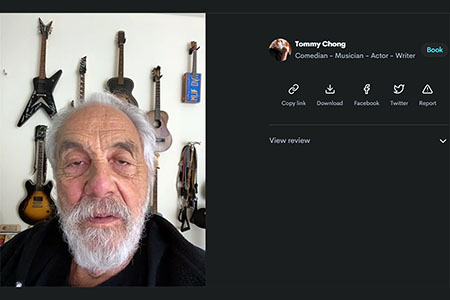
(Left) Cameo page of actor/comedian Tommy Chong.

What no one realized in the beginning – when the entire Cameo team shared a modest glass-walled office at 1871, Chicago’s premiere tech incubator – is that this is a near-perfect example of how new competitors can enter a market at the very bottom – and get ignored or ridiculed by all the existing players – while slowly and steadily improving their offerings. Cameo moved continually upstream, grew its presence and share, and is now poised to pounce.

This is exactly what China did to sectors of the American steel industry. They started by producing and delivering cheap, dirty, and low-grade rebar (those rusty stakes you see sticking out of concrete at every construction site with the little orange caps), which no one else in the United States wanted to produce because of the low margins and associated workplace pollution problems. And then, in just over a decade, the new entrants developed clean mini-mills and came to be a significant player in the production of most specialty steel in this country. Change China to Japan and you’ve got the same basic story with film and copying machines.

If this process sounds somewhat familiar, it’s the core concept behind Clay Christensen’s theory of disruptive innovation. Start small and moderately priced in potentially large and under-appreciated markets, or in markets that were largely monopolized and taken for granted. Serve your customers’ most basic needs, innovate and iterate constantly, and move so quickly that the incumbents can’t keep up with the pace.

Cameo never worried about the quality of the videos on their folks’ phones – although the quality and smarts of those phones exploded, which didn’t hurt. Smooth, polished, and slick was out. In fact, the more informal, the more ad hoc, the goofier some of the early offerings were, the more authentic and real they seemed to the end users in an age of fake, plastic, and manufactured everything. In a way, everyone was in on the joke and the hokier the performance, the bigger the bang.

(Right) Actress Fran Drescher wishes a happy anniversary to two Cameo customers.

Cameo

These days, some 1,300,000 videos later, there are more than 40,000 celebs and other personalities of all sizes, shapes, ages, and histories competing every day on the Cameo site to make videos and make someone’s occasion instantly memorable, for a fee. The talent sets the price for their own videos and Cameo takes a cut of each transaction. Last year’s revenues look to have been around $100 million.

And, as sad as it is to say, the COVID-19 pandemic couldn’t have come at a better time for Cameo since everyone who was anyone was stuck at home, along with the rest of the world, looking for something to do in the way of work. At the same time, digital gifts are safe and easy to deliver. As the business and the transaction volumes took off, it turned out that these celebs could actually make some real money in their spare time. The company says that more than 150 of their best “creators” earned more than $100,000 each last year.

All good, you say, but who’s really being disrupted? That’s what the world doesn’t really know yet about Cameo, even though Steven Galanis, the CEO, talks about it all the time. He says that Cameo isn’t really about the videos – those are mini-Trojan horses for the real score. It’s about building a two-way marketplace between celebrities and their fans where just about anything – any task, any request – can be accommodated and bought or sold.

1871

(Left) Cameo CEO Steven Galanis.

And who is really being disrupted and about to be blown up? Some of the worst people in the world – talent agents, music label heads, and managers. As Hunter Thompson used to say: “The music business is a cruel and shallow money trench, a long plastic hallway where thieves and pimps run free, and good men die like dogs. There’s also a negative side.”

Once you (and millions of others) can use Cameo’s channels to ask Snoop Dogg to do whatever, it won’t take him too long to wonder why he needs any intermediary to take care of business. He’s already killing it on Cameo, and now non-fungible tokens (NFTs) provide another whole channel for musicians and others to directly connect with fans. Snoop recently observed: “There is no platform or middleman filtering my message anymore.”

The fat cats in the entertainment business may not know it yet, but their days are numbered. Every day, it seems, the world turns upside down on someone who thought they were sitting on top of it.

Cameo is coming for all of them. The one thing we know for sure in the startup world is that the wolf climbing the hill is always hungrier than the wolf on top of the hill.

You Can’t Win a Race With Your MouthHoward Tullman is General Managing Partner for G2T3V, LLC – Investors in Disruptive Innovators, and for Chicago High Tech Investors, LLC. He is also the author of You Can’t Win a Race With Your Mouth: And 299 Other Expert Tips from a Lifelong Entrepreneur.

By Howard Tullman | Loop North News | h@g2t3v.com

Tuesday, April 13, 2021

NEW INC. MAGAZINE COLUMN BY HOWARD TULLMAN


How Cameo Became a Star

The company, which connects celebrities with fans via paid videos, just reached unicorn status. Cameo is a great example of how a slow-burn strategy can catch fire and scorch unsuspecting competitors. 

BY HOWARD TULLMAN@TULLMAN 


Chicago is all abuzz about the new unicorn in town. Cameo, a 4-year-old startup that allows users to buy short, video shout-outs from celebrities, just completed a new $100 million round of financing at a valuation of more than a billion dollars. The list of new strategic and growth investors led by e.ventures reads like a tech Who's Who (Amazon, Google, SoftBank, etc.) and the newbies join an existing A-list VC roster headed by Kleiner Perkins, and Lightspeed Venture Partners.

The irony is that when the business was started a few years ago as two young guys trying to talk B- and C-list has-beens and never-wases (plus some new and old jocks) into making a few bucks recording videos on their phones for complete strangers, pretty much everyone thought it was a joke. Who would agree to do it? Who would care about the people doing it? And, of course, who would pay for it? While maybe everyone has their 15 minutes of fame, Cameo was chasing people who had burnt out long ago or missed their moment completely.

What no one realized in the beginning (when the entire Cameo team shared a modest glass-walled office at 1871, Chicago's premiere tech incubator) is that this is a near-perfect example of how new competitors can enter a market at the very bottom - and get ignored or ridiculed by all the existing players -- while slowly and steadily improving their offerings. Cameo moved continually upstream, grew its presence and share, and is now poised to pounce.

This is exactly what China did to sectors of the American steel industry. They started by producing and delivering cheap, dirty and low-grade rebar (those rusty stakes you see sticking out of concrete at every construction site with the little orange caps), which no one else in the U. S. wanted to produce because of the low margins and associated workplace pollution problems. And then, in just over a decade, the new entrants developed clean mini-mills and came to be a significant player in the production of most specialty steel in this country. Change China to Japan and you've got the same basic story with film and copying machines. If this process sounds somewhat familiar, it's the core concept behind Clay Christensen's theory of disruptive innovation. Start small and moderately priced in potentially large and under-appreciated markets, or in markets that were largely monopolized and taken for granted. Serve your customers most basic needs, innovate and iterate constantly, and move so quickly that the incumbents can't keep up with the pace.

Cameo never worried about the quality of the videos on their folks' phones -- although the quality and smarts of those phones exploded, which didn't hurt. Smooth, polished and slick was out. In fact, the more informal, the more ad hoc, the goofier some of the early offerings were, the more authentic and real they seemed to the end users in an age of fake, plastic and manufactured everything. In a way, everyone was in on the joke and the hokier the performance, the bigger the bang.

These days, some 1,300,000 videos later, there are more than 40,000 celebs and other personalities of all sizes, shapes, ages and histories competing every day on the Cameo site to make videos and make someone's occasion instantly memorable, for a fee. The talent sets the price for their own videos and Cameo takes a cut of each transaction. Last year's revenues look to have been around $100 million.

And, as sad as it is to say, the COVID-19 pandemic couldn't have come at a better time for Cameo since everyone who was anyone was stuck at home along with the rest of the world looking for something to do in the way of work.  At the same time, digital gifts are safe and easy to deliver. As the business and the transaction volumes took off, it turned out that these celebs could actually make some real money in their spare time. The company says that more than 150 of their best "creators" earned more than $100,000 each last year.

All good, you say, but who's really being disrupted? That's what the world doesn't really know yet about Cameo, even though Steven Galanis, the CEO, talks about it all the time. He says that Cameo isn't really about the videos -- those are mini-Trojan horses for the real score. It's about building a two-way marketplace between celebrities and their fans where just about anything - any task, any request - can be accommodated and bought or sold.

And who is really being disrupted and about to be blown up? Some of the worst people in the world -- talent agents, music label heads and managers. As Hunter Thompson used to say: "The music business is a cruel and shallow money trench, a long plastic hallway where thieves and pimps run free, and good men die like dogs. There's also a negative side."  

Once you (and millions of others) can use Cameo's channels to ask Snoop Dogg to do whatever, it won't take him too long to wonder why he needs any intermediary to take care of business. He's already killing it on Cameo, and now non-fungible tokens, NFTs, provide another whole channel for musicians and others to directly connect with fans. Snoop recently observed: "There is no platform or middleman filtering my message anymore." The fat cats in the entertainment business may not know it yet, but their days are numbered. Every day, it seems, the world turns upside down on someone who thought they were sitting on top of it.

Cameo is coming for all of them. The one thing we know for sure in the startup world is that the wolf climbing the hill is always hungrier than the wolf on top of the hill.

Total Pageviews

GOOGLE ANALYTICS

Blog Archive