Showing posts with label SPOT HERO. Show all posts

Thursday, June 12, 2014

SPOT HERO - How this company landed $4.5M to help you find a parking spot

By | Get In Touch: @sandraguy | sguy@suntimes.com  By Business, Grid - June 11, 2014 7:00 am

How this company landed $4.5M to help you find a parking spot

SpotHeroTeam

Team SpotHero: Alex Kruger (from left), Elan Mosbacher, Mark Lawrence, Jeremy Smith and Larry Kiss.


SpotHero

SpotHero, an on-demand parking-spot-finder website and mobile app, said Wednesday it has raised $4.5 million — its biggest funding round to date — and plans to hire more employees, improve its product and expand its presence locally and in the Western and Southwestern United States.

The company will also get a new board member: Mike Gamson, a senior vice president of sales at LinkedIn.

It’s an example of Chicago-area natives made good: Co-founders Jeremy Smith, 27, and Mark Lawrence, 28, grew up in Skokie and Winnetka, respectively, and got their first taste of success by winning the Apps for Metro Chicago competition three years ago.

The company, which moved into new headquarters June 1 at 720 N. Franklin St., takes a cut of each parking spot it sells. Smith, the chief operating officer, said the company works with more than 700 parking lots, garages and valets nationwide, and has “hundreds of thousands of paying customers” in seven markets, including Chicago. In Chicago, SpotHero works with 260 parking lots, garages and valet-parked sites.
The other markets are Baltimore, Boston, Newark, New York, Milwaukee and Washington.

Owners of parking spaces post their listings of available spaces for free with SpotHero, and set the prices. Motorists use the website and mobile app for free, and pay the going rate for an available parking space, which Smith said can result in as much as 35 percent savings from a full-price parking spot. The average daily full-price parking spot in Chicago is $32, Smith said.

Smith said SpotHero generates more than $500,000 yearly in incremental revenue for its parking-spot-owner partners, including four of the largest in the country — ABM Parking Services, Impark, LAZ Parking and Chicago-based Standard Parking.

SpotHero, which employs 19 in Chicago and 22 total, aims to expand to new markets such as Dallas, Houston, San Diego, San Francisco and Los Angeles, Smith said.

The company intends to hire an undetermined number of new employees for jobs such as operations, marketing and account managers, and software engineers and mobile app developers.

SpotHero’s new funding brings the 2-year-old company’s total venture capital to $7 million. The latest backers include new investors Chicago Ventures, an early-stage fund headed by Kevin Willer and Stuart Larkins; Bullpen Capital; Draper Associates and 1871 CEO Howard Tullman’s G2T3V venture capital fund.


Chicago Ventures’ Larkins said Tuesday he and Willer were won over to invest in SpotHero because the company has improved its process so that motorists can scan a QR code from their smartphones at parking sites or give an attendant their confirmation number, all without having to use a paper receipt or paper reservation.

Larkins uses SpotHero about twice a week when he drives from his home in Winnetka to the office downtown.

“It’s so convenient,” he said. “I just pop into a location and choose where I want to park. I have my spots picked out at two or three locations near the office.”

Wednesday, January 15, 2014

1871 publicly salutes 26 companies as new era firmly begins

1871 publicly salutes 26 companies as new era firmly begins


For 27-year-old Jeremy Smith, cofounder of SpotHero and product of the 1871 coworking center, the turnaround moment for his young company came when fellow Niles North alumni realized he was behind the parking spot-finding app and emailed him to praise it.
But he said he didn't feel like his company had grown up until its members moved out of 1871, hired more employees and struck out on their own last spring.
"It forced us to define 'Who are we?'" Smith said. "It was like moving out of mom and dad's house."
At 1871, officials point to former tenants like Smith and increasingly assert that the startup for startups proves its worth only when graduates move on. They put SpotHero on stage early Tuesday with 25 other companies that had outgrown the tech incubator. At an event featuring entrepreneurs and elected officials, Chicago's most-recognized hub for the digital entrepreneur ethos pivoted from its signature startup energy to a message about showing results – honoring the companies that have moved on.
"Graduates, we’re really proud of you, creating employment, growth opportunities, jobs for everyday people," said Illinois Gov. Pat Quinn. "But also, when you continue to grow your company, please remember there are other people starting their companies. It's important on this that we acknowledge that we have more work to do."
Listed alphabetically from AdYapper to Whittl, the alumni startups offer creative solutions and creative spellings and boast products and services that include real-time mobile ad analytics, a purse that recharges smartphones – and a combined $10 million in revenue, $32 million in outside investment, and 325 jobs.
"It's fantastic," said outgoing interim CEO of 1871 Jim O'Connor, a private equity investor and a founder of the Chicagoland Entrepreneurial Center that established 1871. "No one on the founding team would have envisioned this level of success, 18 months into it. It's a product of the community and the Chicago-ness of this entity. It's the mentorship that people give for free."
The announcement took place during a handoff in executive leadership at the high-profile entrepreneurial hub, and also at a time when the organization has taken to stressing its accomplishments during "the first 18 months of 1871."
"To me, the real operative metric is how many jobs have been created and the revenue they're generating," said incoming CEO Howard Tullman. "We have real concrete results to brag about. I want to be known not as a community center, but as a place where people think of it as startup factory for building businesses."
The Merchandise Mart incubator has gotten credit from politicians, business leaders, investors and the digital-savvy public as a place of innovation. But it is also a place where generally younger entrepreneurs are found learning the rules in some corners of business even as they seek to disrupt it elsewhere. Workers and young companies can be either focused or frenetic at 1871, though the atmosphere is always earnest.
Tullman, the retired insurance executive and serial entrepreneur behind Tribeca Flashpoint Academy, a turnaround at Kendall College and a Chicago venture capital fund, has said 2014 would be the year that entrepreneurs would face regular progress reviews in an "up-or-out" turnover strategy. Tuesday was about up.


The 26 companies include:
  • AdYapper, which offers analytics for display and mobile ads
  • Branchbird, offering big data services and solutions for business intelligence
  • Caremerge, a set of apps improving communication and care coordination for senior living communities
  • Civis Analytics, a technology and analytics firm
  • Cheeky Chicago, a digital hub for women in Chicago
  • Dashfire, which partners with entrepreneurs to convert PowerPoint presentations into products through software development
  • Digital H2O Inc., a big data startup offering online water-management analytics
  • Everpurse, a purse with a wireless phone charger
  • Food Genius, which delivers data and insight to the food industry
  • MarkITx, an online marketplace for secondary IT equipment
  • Moxie Jean upscale resale, making it easy to buy and sell like-new kids' clothes online
  • KBooM! Games and Apps, which designs and builds custom games and apps for businesses
  • Piece & Co., which connects brands and retailers with artisans in the developing world
  • ProOnGo, expense management for small businesses accessible from any device
  • PrettyQuick, a reservation system for the salon and spa industry
  • Rapleaf, an engagement platform for digital marketers
  • Rocketmiles, hotel-booking site for travelers who stockpile miles for dream vacations
  • Risk I/O, which monitors, measures and prioritizes enterprise vulnerabilities
  • SimpleRelevance, a provider of personalized marketing communication
  • SpotHero, which works with the largest parking companies to help drivers find and reserve parking spots
  • StageBloc, an audience engagement tool
  • Tempesta Media, a managed services provider for digital content for businesses
  • ThinkCERCA, an online literacy program with tools and content so teachers can help students learn to read, think and develop arguments
  • Toodalu, which offers a mobile loyalty program for stores and restaurants, and which was acquired by Spring early in 2013
  • WeDeliver, which offers on-demand delivery for any neighborhood business
  • Whittl, which provides a price menu of neighborhood services
Finding mentorship and like-minded entrepreneurs at 1871 often made all the difference for early success, several founders said.
"It's much more than serendipity," said PrettyQuick founder Coco Meers, whose company relocated to Industrious in September. "To increase the probability of success, you need every single one of a variety of factors, and 1871 provided them all. It was not at all serendipity – 1871 was set up to create that."
The ready supply of startup-ready tech entrepreneurs was the most useful for Phil Davis, CEO of RapLeaf – even if the 47-year-old serial entrepreneur didn't look like anyone else in the room.
"I think I was the oldest guy in there. They heard my age and thought I was a banker or a lawyer," he said with a laugh before the company was recognized Tuesday.
His three employees moved out in September to offices in Evanston.
"For us it worked out great," he said.
But as much as alumni held positive reflections of their time at 1871, they said the sense of accomplishment that came from moving on might feel even better.
"I remember when it was just two guys who worked out of our homes and would sneak into DePaul for a fresh place to get ideas," said Smith, of SpotHero. "The feeling that we have is that it – it's fantastic."

Tuesday, September 24, 2013

How Do Startups Disrupt Old School Industries?


Chicago Startups Learn How to Disrupt Old School Industries

BY: | September 25, 2013


(Photo courtesy: Michael Courier/michaelcourier.com)

Disruption isn’t easy, as things that are new are not always welcome. This is the perennial problem for entrepreneurs. Startups heard from seasoned entrepreneurs in Chicago Tuesday night on how to influence real change and break into new markets.

“Disruption is a big word… we had to do a lot of things to do what we got through today,” said Mark Lawrence, CEO of SpotHero.

Speakers proved disruption is a process with persistent and persuasive means of  convincing people to accept new products into their daily lives. This often happens by meeting your customer halfway and introducing new products slowly.

“Disruption is something that defines a startup so we wanted to hear from people in different industries about what makes them successful,” said Stella Fayman, co-founder of Entrepreneurs Unpluggd, the company hosting the event. “We purposely chose people in different stages in what they’re doing.”

The speakers proved that despite their different stages in company growth, there are basic elements that facilitate disruption, and it has a lot to do with the consumer.

Many entrepreneurs are told “understanding why your consumers are doing what they’re doing,” will help you build a unique product and gain entrance into new markets,” said Kevin O’Reilly, founder of Chicago-based startup Buildings on Demand.

But they saw Tuesday that “assuming you know your market, then finding out something new can change the way you pivot” but can also entirely change your business, said Jerry Freeman, founder of Chicago-based startup, paletteapp.

Speakers proved disruption isn’t just about understanding consumers.  Often, it’s also understanding other businesses first that would lead you to your consumer.


Photo Courtesy: Michael Courier/michaelcourier.com

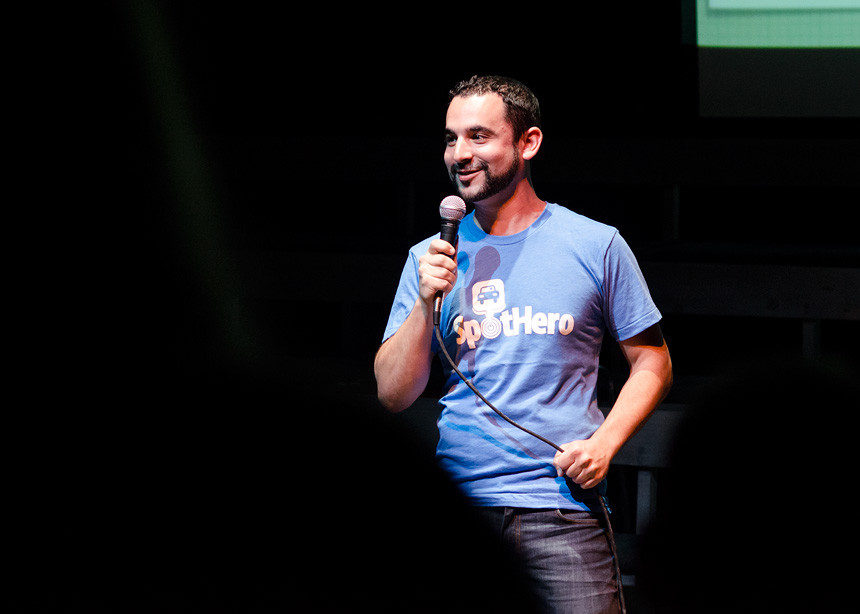
Mark Lawrence, disrupting parking

The parking industry was extremely slow to welcome change, Lawrence said. His app SpotHero, helps you find and reserve parking online for discounted rates through your phone. But figuring out how to make this possible took a bit of negotiation.

Making payments can be so easy nowadays. You can order food or airplane tickets through your phone, he said. But for some reason, the parking industry still needs paper slips to make transactions possible.

“When you talk to these industries, paper is king,” he said. “And this was really difficult for me because we wanted to make parking easier… and paper still plagues me.”

How did Lawrence jump the hurdle in dealing with an industry averse to mobile transactions? He gave them what they wanted – paper “SpotHero” receipts to staple to the parking slips so parking managers could continue business the way they wanted, however antiquated.

But everyone is happier for it – consumers can use their mobile devices to pay, and parking lots can keep their paper. He disrupted the industry by meeting all participants halfway.


Photo Courtesy: Michael Courier/ michaelcourier.com

Aleksandra Efimova, disrupting dance

Efimova began her company Russian Pointe, by bringing ballet shoes from Russia to America when she moved in 1993. The name of her company came to mind with no big market research and no experience, she said. She sold it by telling her clients: “Shoes from Russia, Russian ballet is good and you should buy them.”

It is now a multi-national, multi-multimillion dollar company. And Efimova said her marketing strategy had grown far more complex.

But the way she did it was not just by looking to her consumers or looking to other businesses. She first looked inside herself for a “vision of something that’s very unattainable” but motivates her in the morning, she said. It’s the vision of seeing every girl participate in the arts. And that’s how she sold the shoes: With the dream to bring culture to little girls through high quality dance apparel.

She’s formed a connection with her customers. She presents a stern value proposition to stores, and addresses the quality, safety and beauty of the shoes to professional dancers and how it will help their craft. But to parents she addresses how their kids can achieve their dreams on the dance floor and what skills their kids would need to succeed.

Like Lawrence, disrupting dance has come slow and steady with a strong company values and attention to quality. But it also came from understanding how to balance steady growth.

“You want to have time to do fun things but at the same time you want to make money. How do you find this balance?” she asked. By making “as little as possible but as much as necessary.”


Photo courtesy: Michael Courier/michaelcourier.com

Howard Tullman, disrupting disruption

Tullman is the chairman of Tribeca Flashpoint Media Arts Academy and a serial entrepreneur. He is also now the managing director of a new venture fund named G2T3V. He gave examples of companies that he’s built that are still here, still working and still creating jobs and building additional value.

“Technology once adopted is sticky, he said. “It turns out people are perfectly willing to go back” to the old way of doing things. He found, just as Lawrence showed, business sometimes has nothing to do with efficiency or rationality, “it has to do with politics,” he said.

“You discover nothing works top down, you have to sell in at the local and regional levels and work your way up.”

What is dangerous about trying to building a product to scale nationally is that it always takes a long time, he said. “A mom and pop almost anywhere can beat your head in, because they can live with the customer.”

He advised businesses to be useful in ways that defeat this advantage by providing greater economic value, better research and the ability to scale and standardize across multiple locations.

He gave eight pieces of advice to keep the ball rolling to build not just a new product, but products that will disrupt entire industries:
  • Tell a simple story: Who, what and why. Know who are you and why are you doing whatever it is you’re doing.
  • Keep raising the bar for your expectations and remember “everything can be better. Everything can be done faster.”
  • Get started and then build, don’t wait for a perfect anything.
  • Make cheap mistakes. Fail fast.
  • Don’t reinvent the wheel. Figure out your competitive advantage — what sets your business apart. But don’t try to do everything.
  • Do your customers’ homework for them. The first sale can happen easily but the second sale — when you’re not in the room and if you haven’t provided your advocate in the business with ammunition to sell the product, you’re toast.
  • Business plans are great but don’t stick to the ‘plan’ too long. Stick to your guns.
  • Make room for all kinds of people. “The biggest mistake entrepreneurs make in hiring is hiring people just like them.”
Sonali Basak

Sonali Basak

Sonali Basak fell in love with the start-up world during her short time in Chicago. She believes small businesses and start-ups are the heart of the American economy. She is a broadcast and business reporter at Medill News Service, pursuing her masters at Northwestern University. She got her Bachelor of Arts from Bucknell University in English and Econ. She loves food and sports, and when she’s not writing, she’s running. Find some of her writing here: BasakWrites and fun stuff here: Sonali Basak

Monday, September 09, 2013

ENTREPRENEURS UNPLUGGED How Do Startups Disrupt Old School Industries?


How Do Startups Disrupt Old School Industries?

September 24, 2013
6pm - 9pm
  • Chopin Theatre
  • 1543 W Division St
  • Chicago, IL 60622


Startups are by nature disruptive, but how do you build a successful company that totally breaks the rules in a given industry? How can you have both exponential growth and keep the same disruptive edge? This Entrepreneurs Unpluggd features 3 founders who are either blazing new trails in rusty industries or who have successfully built a company that caused a paradigm shift.
Featuring: 
Howard Tullman - Chairman of Tribec Flashpoint Media Arts Academy, and Managing Partner of G2T3V, LLC
Mark Lawrence - CEO and Co-Founder of SpotHero
Aleksandra Efimova – President, Russian Pointe, Inc.
These three founders will talk about how they dealt with resistance to new ideas from customers, businesses, and investors. As usual at Entrepreneurs Unpluggd, you’ll hear the inside story with candid details about how these founders came up with their ideas, how they built initial products, and how they truly disrupted a market.
Schedule:
6:00 – 6:30
Networking
6:30 – 8:00
Speaker presentations
8:00 – 9:00
Networking


Speakers


Howard Tullman


Chairman of Tribec Flashpoint Media Arts Academy, and Managing Partner of G2T3V, LLC
Howard’s entrepreneurial career spans four decades and a broad range of industries. He has started 12 companies, including Tribeca Flashpoint Media Arts Academy, CCC Information Services, Original Research II, Tunes.com, the Rolling Stone Network, Imagination Pilots and Experiencia. In addition, he has been hired to manage and has served as CEO in several large-scale and highly-successful turnarounds including COIN Management Systems (Atlanta), Xceed, Inc. (NYC) and Kendall College in Evanston, Illinois.

Mark Lawerence


CEO and Co-Founder of SpotHero
Mark Lawerence, CEO and Co-Founder of SpotHero was bitten by the entrepreneurial bug early, having started his first business in second grade. Through his career, he quickly realized his passion for innovation, both in technology and in everyday living. This drive ultimately led Mark to the Chicago parking industry, where he found an entire industry ripe for innovation. Prior to his professional experience, Mark graduated with BS in Finance from Bradley University.

Aleksandra Efimova


President, Russian Pointe, Inc.
Aleksandra Efimova is a Russian-American entrepreneur and leader in the arts, business, and Russian-American communities in Chicago. As president of Aleksandra Enterprises, Ms. Efimova is dedicated to spreading access to and enjoyment of the arts, and to forging cross-cultural bridges, particularly in the education, arts, and business sectors.

Friday, February 22, 2013

TRIBECA FLASHPOINT ACADEMY CEO HOWARD TULLMAN INTERVIEWED BY SPOTHERO CEO JEREMY SMITH FOR GRID CHICAGO


WATCH THE VIDEO HERE: http://www.chicagogrid.com/people/flashpoint-howard-tullman-shares-his-wisdom-with-spothero-cofounder-jeremy-smith/

Deemed “The Most Accomplished, Best-Connected Entrepreneur You’ve Never Heard Of” by Inc. Magazine, Howard Tullman has founded more than a dozen high-tech companies and Chicago’s Tribeca Flashpoint Media Arts Academy. Jeremy Smith is the cofounder of online parking spot rental marketplace SpotHero, founded in 2010.

JS: Wanted to talk to you about hiring. At what point do you determine it’s right to start bringing somebody in?

HAT: I always say that the CEO is the last person who should do any hiring at all. Because CEOs are a) really busy, b) always focused on selling, not great listeners. And then, if that wasn’t bad enough, CEOs by and large believe that if it’s a great person, they can find a job for them. And that is a not a good strategy for a startup.

The issue with [hiring] more experienced people is they have a different approach to everything. Everything isn’t a fire drill [to them], which isn’t necessarily startup culture. You’re bringing them in because they’re middle management and they’re a little more mature. But that culture clash with the young people who have been doing everything and running around is something that’s really complicated to manage.

JS: So let’s say it is a senior position. You can tell in interviews that this is somebody who’s very intelligent, but keeping them challenged is going to be difficult. How do you go about that?

HAT: If you’re worried about how to keep somebody busy, they’re probably the wrong person. You’ve got to find somebody, whether they’re senior or not, who’s excited about the opportunities. It’s almost impossible to think that anybody would be bored or wouldn’t be challenged if they were the right person. Smarts is really important. Attitude, way more important. Energy, probably even more important than that.

JS: My company is dealing with major parking companies. We’re the small fish in the sea right now. We’re not in a position of leverage over them. What gives you tipoffs that, OK, now we have some real bargaining power?

HAT: When we were building one of our businesses that serves insurance companies, which are monsters, there [was] what I called FOMO — fear of missing out. If you convinced them that the other big players were doing it, and they were going to be left behind, then lo and behold, they got on the program.

JS: What sets great entrepreneurs apart from your average business owners?

HAT: It’s like we say about movies: If you’re in the movie business to make movies, you’re going to be really happy. If you’re in it to make money, you’re in the wrong business. I think that’s absolutely true of great entrepreneurs. The money is nice. But they’re in it because they want to change things. They want to do important work.

JS: If you sit back and see somebody that’s in my shoes, what would be the best piece of advice about growing and continuing to be an entrepreneur?

HAT: First of all, I almost never sit back. No. 2, I would say, learn to sleep really fast. Then, I would say, understand that we’re not umbilically connected to any business — it’s not your family, it’s not your life, it doesn’t define you. The minute you take venture capital money, you have to understand that one of the [potential] outcomes is that the company could go on without you, [it] could be sold whether you like it or not. So you have to have this attitude that if this is the way I want to spend my life, it also may be in a different business. The question is always the same, and that is, is this something I want to be doing? Is it important work? Is it something I can get excited about?

Total Pageviews

GOOGLE ANALYTICS

Blog Archive