Before I start, I just want to say
that all of our thoughts and prayers go out to Martha Lavey for a speedy and
full recovery. No one in the City has been a greater advocate for the arts and
for the humanities.
I want to begin by thanking the
Illinois Humanities Council for this great honor and the leadership and staff
of the IHC for doing all of the hard work that it takes to pull off something
as challenging as this program. I’m also thankful for the work the IHC does
every day because - in my life - art isn’t optional or nice to have – it’s
essential. A culture is measured by its aspirations and its dreams and those
dreams are dreamed by its artists.
I also want
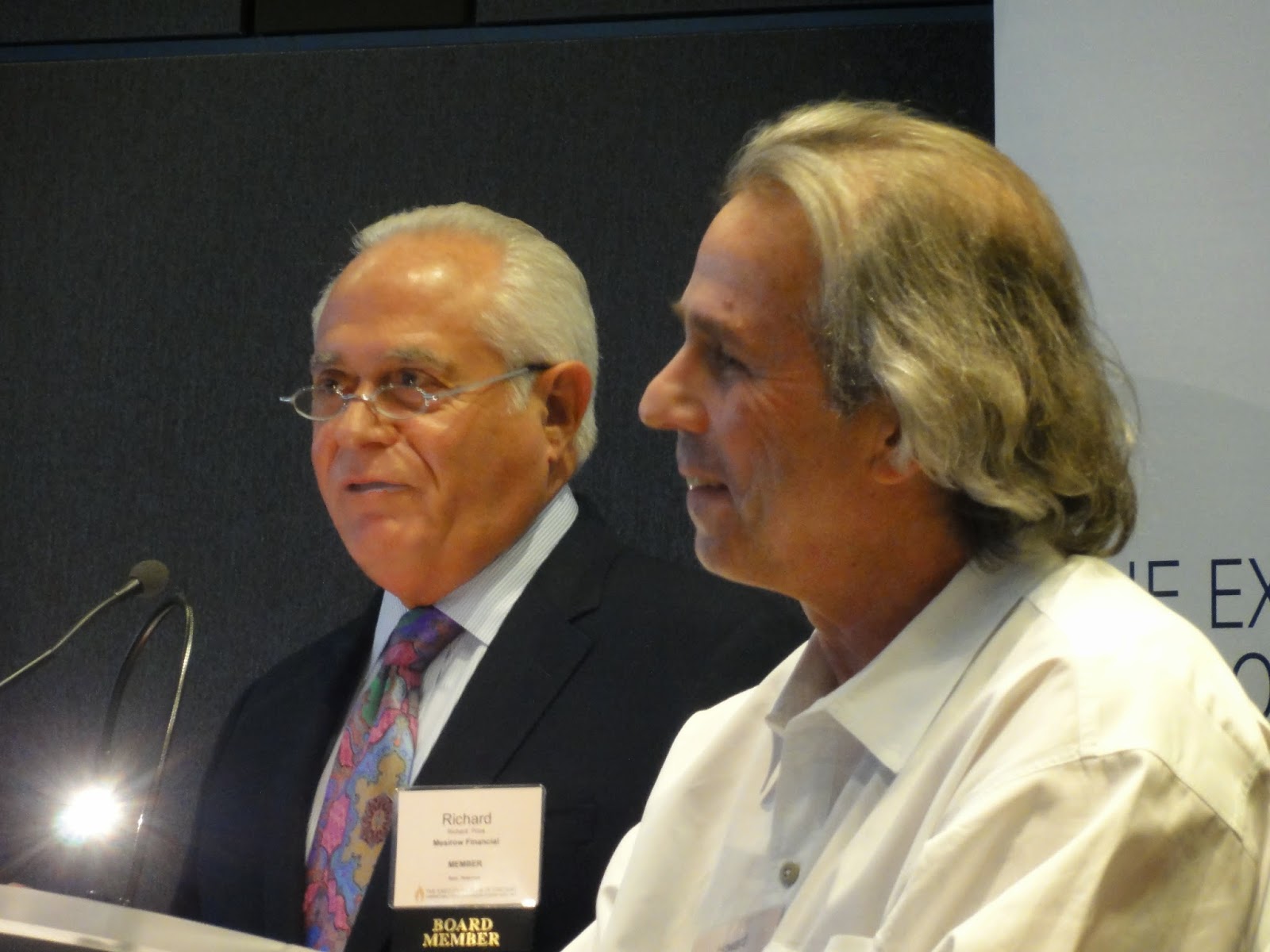
to say how grateful I am to the 3 co-chairmen for today’s event – Joel Henning,
Murray Peretz and Richard Price – whose support, commitment and generosity are
unparalleled and who ALWAYS answer the call whenever I ask for their help. They
are good and steadfast friends and great humanitarians as well as consistent
supporters of the arts in their own right.
I also want to thank Marie Tillman and Joe Shenton for all their help
with today’s luncheon and especially Marie for agreeing to give a few closing
remarks on the program today.
I want to
thank my wife Judy for all her support, encouragement, patience and
understanding for many decades now and for only occasionally saying: “Are you
really going to buy THAT painting?” and only rarely saying: “Oh, no, not
another business.”
I want to
thank Kevin Coval and the crew from Louder than A Bomb for their participation
in today’s event. We’ve been friends and supporters of Kevin’s work for many,
many years and I continue to be amazed at the growth and the depth of his work
and its impact on our city and on all of our citizens.
And finally,
for our meals, my many friends at Lettuce (and especially our guest chef Andrew
Shedden from Mon Ami Gabi) as well as my long-time pal Marc Schulman from
Eli’s. Marc and I have worked together on many different things over the years
starting when I moved Kendall College from Evanston to its new home on Goose
Island.
I was
reminded of that particular adventure most recently when I was proud to see (in
connection with the recent hoopla here in the city) that more than a dozen of
my chefs from Kendall have been honored over the years by the James Beard
Foundation. I didn’t season the soup, but I like to think that I helped to set
the table. And I didn’t do it alone – Barb Pollack who’s here with us today was
an important partner in the creation and development of the “new” Kendall
College and in all our major projects since then.
I had a
similar flashback a few years ago when Christo’s wife, Jean-Claude passed away.
We had worked together more than 40 years ago on a series of multiples for the
Men’s Council of the Museum of Contemporary Art. I was also lucky enough to
support and see the realization of their Central Park Gates project in 2005
(which was only 26 years in the making) and it was truly a dream come true.
In fact, Christo
taught me a number of valuable lessons about passion, patience, persistence and
perseverance that I reference and rely on every day in my writings and in my work
with hundreds of entrepreneurs who are every bit as much dreamers as Christo.
He taught me
three things in particular that I would share with you:
(1) that you
should never agree to knowingly surrender your dreams;
(2) that
it’s a good plan to always have more dreams than memories; and
(3) that a
man isn’t really old until his regrets take the place of his dreams
I’m happy to
report that I’m still dreaming every day. And that I’ve learned over the years
that the development of dreams and their transition into concrete realities
always follows the same path:
(a)
initially, they seem impossible;
(b)
eventually, they seem improbable; and then
(c)
ultimately, they seem inevitable.
The most
important trick - while you’re waiting for the world to catch up - is to always
be drawn by your dreams rather than being pushed by your problems. The second
crucial element is to have the support of talented people beside you because
today no one accomplishes anything important all by themselves. Being an artist
or an entrepreneur may seem lonely at times, but you’re never really alone.
One other important
difference at 1871 is that our dreams come with deadlines and even the grandest
ideas are soon obliged to generate invoices. Great companies start with art and
end up with science. But actually I’ve found that there’s very little
difference between artists and entrepreneurs which is what makes my present work
so exciting.
Whether at
Kendall, Experiencia, Flashpoint or 1871, it turns out that the demands that
true art makes are really no different from what it takes to be a successful
entrepreneur. Three basic things: sacrifice; discipline and integrity. While
there are few things more intimidating than sitting before a blank canvas or an
empty sheet of paper and waiting for the light bulb and the inspiration to
strike; the truth is that the process of building a new business from scratch
really isn’t that much different. Mostly it’s about getting started and putting
one foot in front of the other. It’s a lot less about inspiration and a lot
more about perspiration.
In fact, the
most important thing that any good artist or entrepreneur will tell you is that
ultimately it’s not even about creativity. Creativity is often necessary for
great works, but it’s not sufficient. What ultimately gets the great work done
is a great deal of work.
You’ve got
to show up.
You’ve got
to sit down and get started.
And you’ve
got to have the strength to do that each and every day.
That’s the process. It never changes. You do what you have to
do. You do it the best you can. You do it that way every time. And it’s funny
how often things work out pretty well.
Because in
the end, it all comes down to a simple truth:
YOU DON’T GET WHAT YOU
WISH FOR,
YOU GET WHAT YOU WORK
FOR.
Thank you again for this honor and for honoring me with your
presence here today.