Friday, March 27, 2026

MARCH 26 - HEATHER


March 26, 2026

Heather Cox Richardson

Mar 27


In an interview with Reuters on Monday, Singapore’s minister for foreign affairs, Dr. Vivian Balakrishnan, put in bald language the change in the world order instigated by President Donald J. Trump.

“For 80 years,” Balakrishnan explained, “the US was the underwriter for a system of globalisation based on UN Charter principles, multilateralism, territorial integrity, sovereign equality.” That system “heralded an unprecedented and unique period of global prosperity and peace. Of course there were exceptions. And of course, the Cold War was still in effect for at least half of the last 80 years. But generally, for those of us who were non-communists, who ran open economies, who provided first world infrastructure, together with a hardworking disciplined people, we had unprecedented opportunities.

“The story of Singapore, with a per capita GDP of 500 US dollars in 1965. Now, [it is] somewhere between 80,000 to 90,000 US dollars. It would not have happened if it had not been for this unprecedented period, basically Pax Americana and then turbocharged by the reform and opening of China for decades. It has been unprecedented. It has been great for many of us. In fact, I will say, for all of us, if you look back 80 years.

“But now, whether you like it or not, objectively, this period has ended…. Basically, the underwriter of this world order has now become a revisionist power, and some people would even say a disruptor. But the larger point is that the erosion of norms, processes, and institutions that underpinned a remarkable period of peace and prosperity; that foundation has gone.”

In its place, as scholar of authoritarianism Timothy Snyder said to me in a YouTube conversation yesterday, Trump is aligning himself with international oligarchs like Russia’s Vladimir Putin, Hungary’s Viktor Orbán, Saudi Arabia’s Mohammad bin Salman (MBS), and China’s Xi Jinping. Because of his position as the president of the United States of America, this means he is aligning the United States of America with this oligarchical axis as well, abandoning the country’s democratic principles and traditional allies.

On February 28, Michael Birnbaum, John Hudson, Karen DeYoung, Natalie Allison, and Souad Mekhennet of the Washington Post reported that Trump initially launched the strikes on Iran at the urging of MBS and Israel’s prime minister Benjamin Netanyahu, despite the assessment of U.S. intelligence that Iran did not pose an imminent threat to the U.S. and would not for at least a decade. Both countries see Iran as a threat to their power and want it weakened. Netanyahu has been eager to get rid of the Iranian regime for decades and has urged previous U.S. presidents to attack without success.

On Tuesday, March 24, Julian E. Barnes, Tyler Pager, and Eric Schmitt of the New York Times reported that MBS sees a “historic opportunity” to remake the Middle East and so has been pushing Trump to continue his war against Iran. MBS, the journalists report, has urged Trump to use troops to seize Iran’s energy infrastructure and drive the regime out of power. He has assured Trump that the jump in oil prices will be temporary, although most observers disagree.

Judd Legum of Popular Information notes that the Saudi Public Investment Fund (PIF) controlled by MBS invested $2 billion in the private equity firm of Trump’s son-in-law Jared Kushner, one of Trump’s volunteer Iran negotiators, before the war. A report by Democrats on the Senate Finance Committee and House Oversight Committee released on March 19 says that “since 2021, Mr. Kushner has collected more than $110 million from the government of Saudi Arabia for investment management services that have reaped little to no return.”

The fallout from the Iran war has also benefited Russia’s Vladimir Putin. Despite reports that Russia is aiding Iran in the fight, the Trump administration dropped sanctions on Russian oil that was already at sea, giving Russia an injection of up to $10 billion a month into its cash-strapped war effort against Ukraine.

Today Trump reposted Russian propaganda claiming that Ukraine discussed funneling money to Biden’s reelection campaign. Also today, four Russian lawmakers arrived in Washington, D.C., for the first such visit since Russia invaded Ukraine in 2022 to talk with lawmakers and officials, “part of the normalization of relations with the United States of America,” as one of the Russians told the Russian press.

Trump declared he was determined to achieve peace between Russia and Ukraine, but this week, according to Ukraine president Volodymyr Zelensky, administration officials said the U.S. would not guarantee Ukraine’s security unless Ukraine withdraws from its own land in Donbas. Ceding the region to Russia would essentially give Putin what he launched the war to grab. It is the same region that was at stake in 2016, when Russian operatives told Trump’s 2016 campaign manager they would help Trump’s presidential candidacy if he would look the other way as Putin installed a puppet over the region.

This afternoon, Noah Robertson and Ellen Francis of the Washington Post reported that the Pentagon is considering diverting weapons intended for Ukraine to the Middle East. They also noted that on Monday, Pentagon officials told Congress that it was going to divert about $750 million in funding provided by NATO countries for Ukraine to restock military weapons in the U.S. instead. About allocating weapons, Trump told the reporters, “we do that all the time. We have them in other countries, like in Germany and all over Europe. Sometimes we take from one and we use for another.”

Last week, the U.S. eased sanctions on banks in Russia’s ally Belarus, and today Trump announced he would ease further sanctions on Belarus to try to get fertilizer into the U.S. since Iran’s closure of the Strait of Hormuz has stopped the transportation of about 20% of the world’s fertilizer. Also today, Belarus’s president Alexander Lukashenko signed a treaty with another of Putin’s allies, North Korea’s president Kim Jong Un, announcing a “fundamentally new stage” of the relationship between the two countries as they “oppose undue pressure on Belarus from the West.” Both Belarus and North Korea support Russia in its war on Ukraine.

Trump has openly endorsed Orbán for reelection in Hungary’s April 12 elections, posting on social media yesterday: “Relations between Hungary and the United States have reached new heights of cooperation and spectacular achievement under my Administration, thanks largely to Prime Minister Orbán. I look forward to continuing working closely with him so that both of our Countries can further advance this tremendous path to SUCCESS and cooperation.” Urging Hungarians to vote for Orbán, Trump continued: “He is a true friend, fighter, and WINNER, and has my Complete and Total Endorsement.… I AM WITH HIM ALL THE WAY!”

The framers of the Constitution tried to set up a system that would make it impossible for a president to go to war for private interests or the benefit of other countries, establishing that Congress alone can declare war. The framers wanted the American people to weigh in on whether they wanted to dedicate their lives and their fortunes to a war.

But Trump simply began the Iran war without consultation with Congress, and administration officials have refused to appear at hearings, instead briefing Congress behind closed doors. At an annual fundraising dinner for Republican members of Congress, Trump appeared to acknowledge he was violating the Constitution. He spoke of the “tremendous success” of what he called his “military operation” in Iran. He continued: “I won’t use the word war ’cause they say if you use the word war, that’s maybe not a good thing to do. They don’t like the word war because you are supposed to get approval. So I will use the word military operation.”

Now, as the war costs at least $1 billion a day and Trump’s declarations fluctuate wildly from saying the war is over to suggesting he is considering deploying ground troops to posting this morning that Iranian negotiators “better get serious soon, before it is too late, because once that happens, there is NO TURNING BACK, and it won’t be pretty!” even Republicans are starting to have misgivings. The war has pushed Trump’s approval rating down to just 36%, while a new Reuters poll shows that only 25% of Americans approve of how Trump is handling the cost of living. Today the stock market, which has generally trended downward since the invasion, dropped sharply as traders apparently recognized that the cost of oil is not coming down anytime soon.

Yesterday, after a classified briefing, House Armed Services Committee chair Mike Rogers (R-AL), who backed the Iran strikes, told reporters that Congress members “want to know more about what’s going on, what the options are, and why they’re being considered,” adding, “And we’re just not getting enough answers on those questions.” Chair of the Senate Armed Services Committee Roger Wicker (R-MS) commented: “I can see why he might have said that.”

In an in-depth interview with Hunter Walker and Josh Kovensky of Talking Points Memo yesterday, Representative Joe Morelle (D-NY), who sits on the House Appropriations Committee, explained how Trump’s Iran incursion has become a “mess” for the president. The administration has suggested it is going to ask for $200 billion for the war, and Morelle noted that we are already closing in on $30 billion in spending on it and that“when you consider all the things that Trump rejects or the Republicans reject as too costly, the fact that they have now spent $30 billion in effectively the span of a month without even talking to Congress about this expenditure is really somewhat staggering.”

Morelle noted that even if the White House or the Pentagon did start to provide specifics, “I’m not sure it would matter anyway because the president changes his mind so frequently. He might say something and literally without exaggeration, a half hour later say something completely different, or even sometimes within the same press conference, give two wildly different answers.”

Morelle told Walker and Kovensky: “They fight us on things that will help American families be able to pursue dreams, take care of the food, housing, and healthcare needs of millions of families that they can’t afford”—precisely the things that, as Minister Balakrishnan noted, the post–World War II international order enabled people around the world to attain. “But,” Morelle said, “they can go into an ill-conceived military action that has neither the support of Congress nor the support of American families, which has no clear objectives, shifting goals, and has alienated our allies and made us less safe.”


Thursday, March 26, 2026

Exciting Cultural Stadium plan reimagines downtown Chicago - CANDACE JORDAN


Exciting Cultural Stadium plan reimagines downtown Chicago

·         By 'Candid' Candace Jordan, Associate Publisher


Top of Form

Bottom of Form

The Cultural Stadium plan envisions floating farmers' markets. (Rendering courtesy of Chicago Cultural Stadium)

Chicago has never lacked for big ideas, but the Cultural Stadium may be one of the boldest reimaginings of downtown in decades. At its heart, it is not a physical structure but a way of thinking. Conceived by Lou Raizin (President/CEO, Broadway in Chicago), the concept views the city itself, from its theaters and museums to its riverwalk, parks and even its empty spaces, as one connected, living stage. Rather than focusing on a single large-scale development, the idea is to spark hundreds of smaller cultural experiences across downtown, turning everyday places into destinations filled with creativity and connection.


Pop-up artwork throughout the city is part of the Cultural Stadium plan. (Rendering courtesy of Chicago Cultural Stadium)

Imagine performance barges moving along the Chicago River, floating farmers markets docking in neighborhoods along the shoreline, or pop-up art installations tucked into overlooked corners. Picture light festivals transforming familiar buildings, artist residencies bringing energy into vacant offices and striking works of art appearing atop rooftops. The goal is to breathe life into underused spaces and bring a renewed sense of excitement to the city’s core.

Chicago Cultural Stadium panel hosts Millie Rosenbloom, Lou Raizin (the architect of the idea) and Howard Tullman. 


There is also real economic strength behind the idea. Chicago’s cultural sector, which includes hundreds of institutions and public art installations, already generates billions each year. The Cultural Stadium looks to harness and expand that impact, placing arts and culture at the center of tourism, business growth and civic identity.

Alleyways will be turned into inspiring spaces. (Rendering courtesy of Chicago Cultural Stadium)


Support for the concept continues to grow among civic leaders, cultural organizations and business voices who see creativity as a guiding force in downtown’s recovery. With office vacancies still a challenge and foot traffic uneven, the thinking is straightforward. Give people more reasons to come downtown and more reasons to stay.

That vision moved into sharper focus on March 25 during a panel discussion held on the stage of the Cadillac Palace Theatre. Hosted by Howard Tullman (entrepreneur) and Millie Rosenbloom (civic leader), along with Raizin, the gathering brought together about 40 influential guests whose work shapes Chicago’s civic, business and philanthropic communities.

Participants included Tony Karman (former President, EXPO Chicago), Jennifer Farrington (Chicago Children’s Museum), Debra Kerr (Intuit Art Museum), Gary Metzner (Sotheby’s), Lisa Dent (WGN Radio), Jim Terman (Jasculca Terman PR), Carey Cranston (American Writers Museum), Al Friedman (Friedman Properties), Elizabeth Babcock (Adler Planetarium) and Michael Anderson (Chicago History Museum), among others, with this author and her husband Chuck, proud to be part of the conversation. The setting encouraged an open exchange of ideas about how to move the concept forward. 

Turning vision into reality will take coordination across public, private and philanthropic sectors. Funding, policy support and long-term collaboration will all play a role in determining how far and how fast the idea can go.

Chicago has done this before. Projects like Millennium Park and the Chicago Riverwalk reshaped how people experience the city. The Cultural Stadium suggests the next transformation may come not from one landmark, but from many smaller moments woven together. It is a reminder that Chicago has always been a city willing to dream big and then bring those ideas to life. After all, we DO have big shoulders.

HEATHER


What Did the MAGAts Expect?


Jen Rubin's Columns

What Did Republicans Expect?

Republicans privately fret...but they empowered Trump

Jennifer Rubin

Mar 25, 2026


Republicans made a calculated bet that by indulging Donald Trump’s ill-conceived and cruel schemes (e.g., unleashing ICE on cities, tariffs, wars with Venezuela and Iran, slashing healthcare to pay for tax cuts for the rich), the country would somehow stumble through. They figured congressional Republicans would share in any successes but somehow avoid any blame when things (inevitably) went haywire. Politics rarely works out that way.

Through Trump’s Iran War, shutdown of the Department of Homeland Security, futile effort to pass a Jim Crow-style voter suppression act (the so-called SAVE Act), and inflation-aggravating tariff scheme, Republicans are discovering they are tied at the hip with Trump. Refusing to deviate from his dictates, they will bear the brunt of his serial failures.

Whether the Iran War ends this month or months from now, Republicans cannot escape responsibility for the massive expenditure of taxpayer dollars, loss of life, rise in energy costs, regional instability, and damage to alliances Trump has wrought. Congressional Republicans refused to invoke the War Powers Act — or even to conduct meaningful oversight hearings — and applauded a senseless, unconstitutional war. Now they seem prepared to rubber-stamp a preposterous demand for $200B more in war spending. Republicans will have no place to hide come November when voters come looking for politicians to blame.


The latest CBS/You Gov poll has nothing but horrendous news for the Iran war cheerleaders: 90 percent say the war will make gas prices higher in the short term, 58 percent over the long term; 63 percent predict it will weaken the economy (a plurality assume we will be in a recession); a plurality of 49 percent think the war makes us less safe; and 57 percent say the war is going badly. Some 62 percent disapprove of how Trump is handling the war. Perhaps Republicans should have fulfilled their constitutional obligations rather than contenting themselves with sitting on the sidelines.

Meanwhile, Trump’s web of lies about immigrants and voting fraud have entangled him and Republicans in a political knot. Trump’s lie about mass voting fraud drove him to insist on the unpassable voter suppression SAVE Act. He then made that a precondition for any deal to resume DHS funding. Even to Republicans, this made no sense.

When Senator John Thune (R-SD) initially recommended that Trump agree to Democrats’ proposal to pass a DHS funding bill that would pay for TSA, FEMA, and the Coast Guard (leaving ICE funding for later negotiations), Trump rebuffed him. By Monday night, however, Trump was considering a deal to do just that, namely to fund the rest of DHS and handle funding for ICE in reconciliation.

What happened between his refusal to relent on funding and his capitulation? Trump trotted out another senseless and entirely performative maneuver: deploying ICE to airports. ICE agents, untrained for any TSA duties, stood around with virtually nothing to do (reminding one of the National Guard deployed to D.C., who largely loiter around metro stations). This underscores Republicans’ responsibility for bollixing up air travel, Trump’s feebleness in resolving messes of his own making, and the dangerous transformation of ICE into a roving street militia Trump deploys to intimidate and harass Americans.

All the ICE/airport stunt accomplished was to trigger a robust blowback from Democrats and civil society groups, demonstrating once again Trump’s talent in supercharging the Resistance. Deploring Trump’s use of ICE as his “personal dystopian police force,” Public Citizen observed: “The confluence of authoritarian overreach of this moment is striking.” The ACLU likewise condemned using ICE at airports “despite their lack of training for airport security and interactions, and their clear track record of abusing their power, including through using excessive force against citizens and immigrants alike.” (Unsurprisingly, this venture, the ACLU noted, was the first time a president “sent armed ICE agents to airports to replace trained security agents and instill fear in families and other travelers.”)

Trump’s compounding calamities have fractured Republicans internally. Cultists demand perfect fidelity to Trump on the war abroad and bullying at home; others fret that a war betrays their America First ideology and the SAVE Act is a legislative cul-de-sac that now compounds the DHS shutdown disaster. (MAGA provocateur Sen. Mike Lee of Utah has become a chief enabler of Trump’s destructive schemes, “sparking a wave of mostly private animosity from GOP colleagues who believe his plan to push through legislation overhauling how federal elections are conducted is ill-conceived and potentially harmful to the party’s chances in the midterms,” Politico reports.)

Republicans fret privately that the Trump reign of chaos, coupled with the highly unpopular war, spells doom for them in November. One is tempted to ask about the private Republican hand-wringing:

What did Republicans think would happen when they fully empowered a delusional narcissist, one who is so clearly ignorant of government and keen to pursue his own wealth and power, the country be damned?

Some dim-witted MAGA Republicans remain true believers and actually think Trump’s antics will pay off. Others know Trump is nuts and recognize the party is headed for disaster, but lack the courage to say so. They are banking that they will survive the blue wave coming in November to fight another day. Their lack of patriotism may be galling, but their self-preservation strategy looks increasingly daft.

The damage Trump and his flunkies have inflicted on our democracy will reverberate for years to come. American families may take years to recover from the economic hits. It is a small consolation that MAGA lawmakers and right-wing media stooges, who have chosen the route of cowardly compliance over constitutional duty and self-serving propaganda over truth-telling, will shoulder much of the blame. History in the long run and voters in the near term will hold Republicans fully accountable for the blunders they countenanced.

Wednesday, March 25, 2026

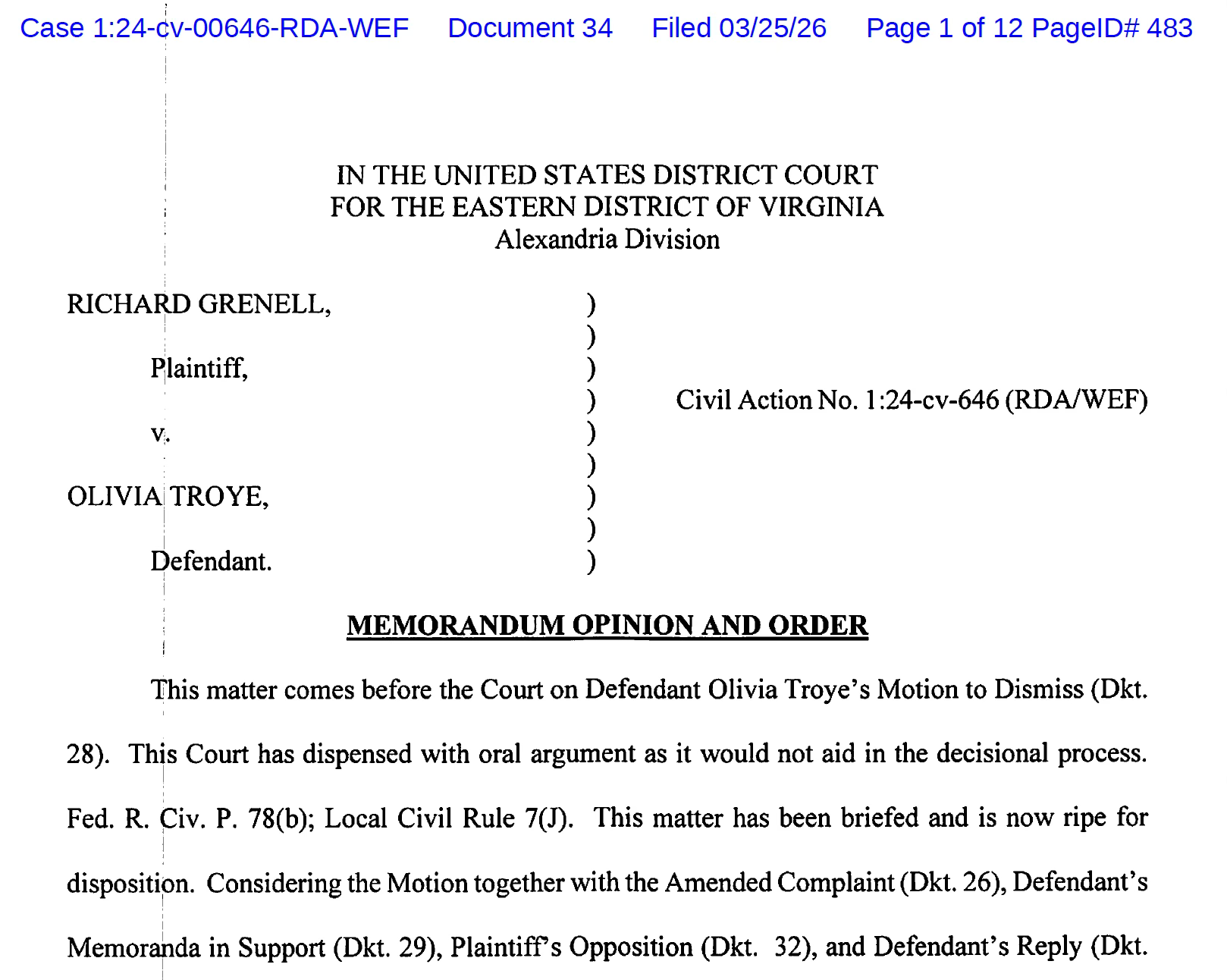
OLIVIA OF TROYE


They Tried to Silence Me. They Failed.

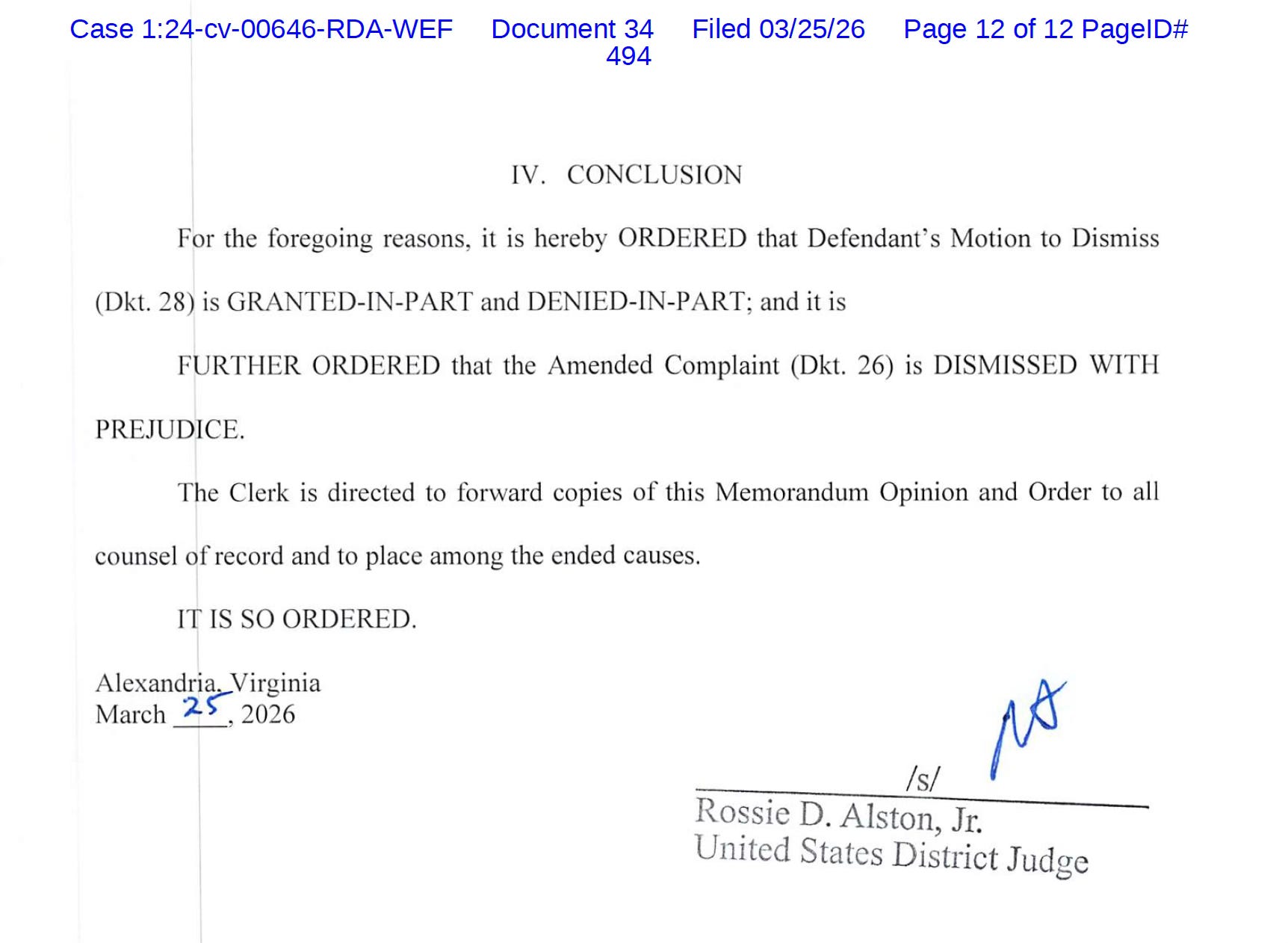
Today, the court dismissed the case against me, with prejudice. The truth held.

⚖️ We Won.

Today, the U.S. District Court for the Eastern District of Virginia dismissed Richard Grenell’s lawsuit against me, with prejudice.

After everything—the amended complaint, the escalation, the pressure, the cost, and years of dealing with this—the case is over.

I want to be very clear about what this was. This lawsuit wasn’t about justice. It wasn’t about truth.

This was about intimidation.
About trying to break me—financially, professionally, and personally. About sending a message: if you speak out, we will come after you.

They wanted me to settle. They wanted me to say I lied. I did not lie. And I refused to say something that wasn’t true just to make it go away.

Today, the court confirmed what I have said all along: there was no viable claim here.

Back in August 2025, when this lawsuit was refiled, I wrote about exactly what this was: an attempt to intimidate, to drag this out, and to make speaking the truth as costly as possible. Nothing about that assessment has changed, except now we have the court’s ruling to prove it. If you want to understand what this fight looked like in real time, you can read that piece HERE.

This fight has been exhausting.
It has been expensive.
And at times, it has been incredibly lonely.

But I stayed in it because I knew the stakes weren’t just about me.

This is what lawfare looks like. It’s not always about winning in court. It’s about dragging someone through the process long enough to wear them down, to isolate them, to make them think it’s not worth it to ever speak again.

That’s why I refuse to stop standing by others who’ve been targeted the same way. Because I know exactly what it feels like, and I know how important it is that we don’t let this tactic work.

I also want to take a moment to thank my attorneys, Mark S. Zaid, P.C., who himself has been targeted by the Trump administration, and Tom Craig, for standing with me, for believing in this case, and for fighting it with integrity and resolve.

To those of you who stood by me—who read, shared, supported, and reached out—thank you. Truly. You made a difference more than you know.

And to anyone watching this, wondering whether it’s worth it to speak up:

They may try to break you.
They may try to silence you.

But the truth still matters.
And today, it held.

I’m still here. And I’m not going anywhere.
We’re in this together, and I will never back down.

In solidarity,
Olivia

Total Pageviews

GOOGLE ANALYTICS

Blog Archive