Entrepreneurs live by their own code
Starter
League co-founders have succeeded by making difficult choices
July 27, 2014
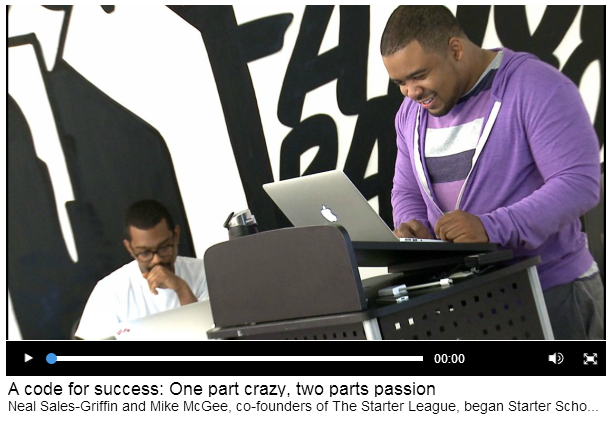
Neal Sales-Griffin and
Mike McGee faced tough choices in spring 2011: They could work for the
president's re-election campaign, split up for different opportunities, or work
on their 3-week-old startup idea.
Ultimately, the two men
chose the last and riskiest option, co-founding Chicago-based coding and
entrepreneurship school The Starter League.
The journey to that
decision involved ignoring advice from business veterans, turning down the
president — and persuading Sales-Griffin's dad to move out of his apartment so
Sales-Griffin and McGee could work together day and night.
"We couldn't stop
this idea," McGee said. "And we went for it."
During the past three
years, graduates of their school have spawned several companies, including one
that raised nearly $1 million in venture capital.
But unlike entrepreneurs
who take their concept national, Sales-Griffin and McGee plan to keep their
business small and local so they can maintain personal relationships with their
students.
"The way we work
well together is, we share the same belief," said Sales-Griffin, 26. That
belief is that the world will be better if people can solve problems with code.
"Neither of us is
that religious or anything, but if we had our own religion, we'd both be very
strong believers in it."
Their startup was
profitable from day one, a "ridiculously rare" accomplishment, said
one of their mentors, Howard Tullman, who also is chief executive of Chicago
tech incubator 1871. Though he questioned the co-founders' lack of desire to
grow, eventually, after a heated argument or two, he finally understood:
"You could see that this was half a business in a way and half sort of a
mission."
The Starter League was
one of the first companies to land space at 1871 when it opened at the
Merchandise Mart in 2012. In March, The Starter League moved into new
headquarters, at 30 N. Racine Ave. The co-founders declined to say just how
profitable their company is, its revenue or its rate of growth.
Sales-Griffin and McGee's
unique relationship — co-founders who work and live together — began in
college. They met at Northwestern University, where McGee was student body
president his senior year.
"I remember
recommending him (for a committee) after all the candidates spoke," said
McGee, 25, though he'd never met Sales-Griffin. "I could really tell that
he cared about the right things."
The two sometimes worked
in their student government offices until 3 or 4 a.m.
"I knew that on a
bad day, Mike could work harder than me," said Sales-Griffin, who, in
addition to attending classes and heading up Northwestern's student government,
also put in three days a week at a venture capital firm.
Amanda Lannert, CEO of
interactive marketing company Jellyvision and on The Starter League board, said
the duo's enthusiasm entices people to want to work with them. Lannert, for
example, said she agreed to teach at their school even though she said she
barely had time for the meeting during which Sales-Griffin asked her to teach.
"(Sales-Griffin is)
kind of a broad guy and his arms are out and he leans into the table … and you
just do it," Lannert said. "All of a sudden you're agreeing to things
you didn't know you would."
The two men could be seen
as interchangeable; they often fill in for one another because of overcommitted
schedules. Yet they have different skill sets. McGee has a knack for design and
Sales-Griffin's forte is business development.
Sales-Griffin is a
homebody and a workhorse, laboring nights and weekends.
"He cares about
nothing except for what he's trying to do," said Jack Mallers, a recent
school graduate. "No score of the football game, he doesn't care if he's
hungry. … Nothing else matters."
McGee is a sports fanatic
and highly competitive. When he makes announcements, he does so with animated,
grand gestures. And he can recall the smallest details of his life with
stunning clarity, as if he were recalling scenes from a movie.
Sales-Griffin clearly is
the restless one of the two. Six months after he graduated in 2009, he landed a
job with Chicago venture firm and startup incubator Sandbox Industries Inc. But
one day he called up McGee: "'Hey, I'm going to quit my job and you should
learn how to code with me so we can build startups.'"
Twenty seconds passed.
"It wasn't a hard
sell," McGee recalled.
At least not to him.
Convincing
Sales-Griffin's parents was another matter. They thought he was crazy.
Sales-Griffin asked his
dad to move out of his apartment so he and McGee could spend the next year,
working 12 hours or more a day, sometimes in their pajamas, teaching themselves
how to build Web applications.
"My dad, he was
like, 'This is stupid. What are you talking about?'" Sales-Griffin said.
"My mom, same thing: 'No, don't do this. You've got a good job.'"
It took three days to
persuade his dad to move out.
"My value
proposition was: We will rent this place from you. You'll be our landlord and
you can go get a nicer place," Sales-Griffin said. With that, he turned
his childhood apartment into their new workspace.
The year turned into a
swirl of frustration. While teaching themselves how to code, and sifting
through about 100 startup ideas, none seemed like a good enough business
concept.
Then, a passive
suggestion from a friend helped crystallize the idea for The Starter League: If
they were struggling so hard to learn code, wouldn't other would-be
entrepreneurs also need help?
"The light bulb went
off," Sales-Griffin recalled. "I thought, 'Yeah, duh! This is a huge
problem. … We need a place to learn this stuff, why isn't there a place for us
to learn how to do this?'"
There were complications,
though. Sales-Griffin had already secured a one-way ticket to Uruguay after a
Web development firm there offered to teach him how to code in exchange for
help managing projects.
A few weeks later, Harper
Reed, chief technology officer for President Barack Obama's 2012 re-election
campaign, came calling. He wanted Sales-Griffin and McGee to be project
managers.
"They spent a lot of
time thinking about it," Reed said.
But ultimately, they said
no to both opportunities.
"I was like … this
is the president," Reed said. "You can't do that … and of course,
Neal didn't (care)."
McGee said it was a tough
decision — he could picture the hundreds of "likes" and
"shares" on Facebook if he went to work for the president.
"But then I was
like, what about six months later?" McGee said. "Is this something
that when you wake up on a random Tuesday that you want to do?"
Reed said McGee's and
Sales-Griffin's willingness to say no is part of why they've been successful.
"It's not just that
they say no," said Reed, who has acted as their mentor and serves on their
board. "It's that they trust themselves. A lot of people say no, and
they're just idiots. But Mike and Neal have this vision, and they're unwilling
to sacrifice that vision."
During spring 2011,
Sales-Griffin drove around Chicago with an iPad trying to convince anybody in
the tech world who would listen that their idea was worth funding. That effort
earned him "a lot of parking tickets," and after a frustrating
runaround with venture capitalists, and watching their bank accounts dwindle to
close to zero, they decided to go it alone, without capital funding. They would
need students to pay tuition upfront to buy needed computers and to pay the
rent.
"We were on State
Street, we were waiting for the bus and we were just like, let's build
this," McGee said. "Let's do it."
Even though they couldn't
prove with "pretty charts and graphs" that there was demand for
learning to code, Sales-Griffin and McGee knew it was there. They'd been to a
lot of tech conventions where they'd heard people say they needed Web
developers. That, they said, underscored the need for a coding school.
The original idea for the
school was a nine-month program. The duo pivoted to a three-month model priced
at $6,000 to test it out.
"We knew we could
get people," McGee said. "We didn't know who they were, we didn't
know what they looked like, but we knew they were out there."
Since The Starter League
opened, dozens of coding schools have followed, along with a promise to churn
out professional developers in as little as 10 to 12 weeks.
"It makes me laugh,
because we really did just make that (stuff) up," McGee said. "Yeah,
three months, quarter system, that could be enough time for someone to learn
something. And now you see all these sites, 'Three months and you'll be a
professional Web developer.'"
Paul Pagel, chief
executive of 8th Light Inc., a software development company, said it's
impossible to become a professional developer in 10 weeks. About one-third of
apprentices who join his company are graduates of either The Starter League or
rival coding school Dev Bootcamp.
McGee and Sales-Griffin
aim to develop self-learners and quickly refocused on their original nine-month
idea. They didn't want to churn out "screwdrivers," who knew how to
code but not how to build businesses. They wanted to foster entrepreneurs.
Their first batch of
students in the $36,000, nine-month Starter School program that teaches
students how to code and design software and ultimately start their own
businesses graduated in June.
Graduate Erinn Barr
started a business called MakeHerSmile, a personalized gift-giving website for
stumped boyfriends and husbands. Pete Albertson created a site to manage season
tickets among friends as an alternative to sites like StubHub. Mallers opted to
go to Starter School rather than traditional college and will continue working
with Sales-Griffin on a Web application side project.
"I've really learned
… that the world we live in was only built by people who are no smarter than you
and I, and that we can build things," Mallers said. "We are the
builders and designers of this world, and that whole point of view comes
completely from Neal and Mike."
The decision to
transition from a financially solid three-month model to a significantly
riskier nine-month model had their mentors screaming about a year ago.
"I'm not sure who
was yelling the most, but the thought was, 'We don't (care) if you don't want
to run (the three-month model) anymore, you should hire people to run it. What
are we missing?'" Tullman said.
"What we were
missing was, that wasn't the business they wanted or intended to build,"
Tullman said.
Focus will be key, their
mentors said.
"Part of the
challenge about having this charisma is, opportunities galore come to them easily,"
Lannert said of the men who have, on several occasions, met with Chicago Mayor
Rahm Emanuel and White House staff to talk about their ideas. "This school
wants them to have a program, the governor wants them to do this, CPS wants
them to do that. … Not doing too much is a challenge."
Sales-Griffin said the
company, which has seven employees and several adjunct lecturers, is in
"investment mode" after a big spike in revenue. He said he and McGee
are using profits to bolster the nine-month Starter School, which
begins its second year of classes in the fall.
Tullman predicts that
Sales-Griffin and McGee will launch a couple of more businesses. "They can
pretty much do whatever they want to pursue. I don't think they'll be going to
work for anybody anytime soon."
McGee and Sales-Griffin agree that they won't
be slowing down.
"I just look out at the world and think
(about) how many people are out there with a far more challenging or difficult
situation," Sales-Griffin said. "I owe it to those people … to
put every last drop of blood, sweat and tears that I have into what I'm doing
all the time."
Twitter @ellenjeanhirst
Mike McGee:
Birthday: Aug.
10, 1988
High school mascot: A
pretzel. "Our motto was, unofficially: 'You can eat us, but you can't beat
us.'"
Favorite superhero: Batman
Ironic fact: One of
the biggest hiccups in his campaign for student vice president at Northwestern
University was the fact that no one knew how to build a website.
Favorite sport to play: Golf.
He used to play an average of 54 holes each day during the summer.
Childhood: He grew
up in Freeport, west of Rockford, but often visited an aunt in Hyde Park, near
where Sales-Griffin grew up.
On getting started
without venture capital funding: "(I'm) not
going totally against capital. There are definitely some startups that need
capital more than most, but the knee-jerk go-for-capital is not the smartest
thing all the time."
Neal Sales-Griffin:
Birthday: July
28, 1987
Childhood: He grew
up in Chicago's Hyde Park and Kenwood neighborhoods.
Favorite sports: He was
on the football and track and field teams in high school.
Ironic fact: He
learned how to type four years ago.
First job: Selling
Christmas trees in grade school.
On work ethic: "I'm
just going, I'm grinding, you can't stop me. … I may not be smarter than you
now, but I will be later, because I'm going to keep working."
On leadership: "It's
ultimately just about bringing together a group of people that can collaborate
and take action to solve a problem. … The rest is jazz."
Copyright © 2014 Chicago Tribune Company, LLC