We Need a Fourth BranchWhy our most vital institutions should be placed in a constitutional vault - beyond the reach of any President.
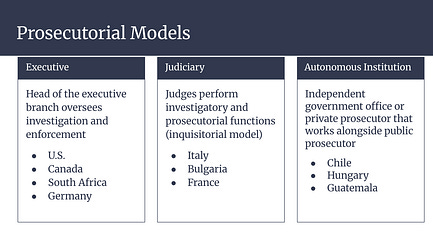
I was on a panel at Princeton a week ago during my reunion called, “Shifting Global Powers: What Comes Next?” It was a good discussion, but primarily focused on the first part of the title. During the Q & A, an audience member called us on it. “So, what comes next?” he asked. “What would each of you want to see moving forward?” I was the last person to answer among the four panelists, and brought the talk to a close with a radical idea that made the audience gasp: I suggested that we needed to amend the Constitution — and create a Fourth Branch. Afterwards, I had a line of people in front of me wanting to know more about this idea. My paid subscribers know that I have been teasing this post for months now. It’s something I have been thinking about for a few years, ever since I gave a talk at McGill University on the structural problems that make it difficult to hold the executive branch criminally accountable (this was before the immunity decision — I have since retired this talk since it is now moot). But part of my argument was that when you look at the United States comparatively, our model — one in which the Justice Department and Attorney General sits under the executive branch — isn’t necessarily the only way to do things, as illustrated by the following slide:
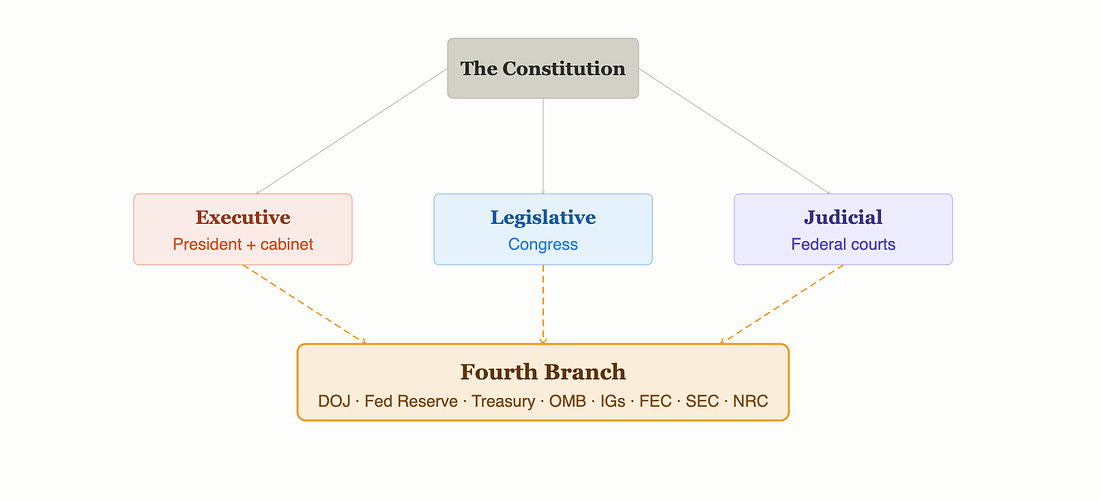
[It’s worth noting that even in the U.S. the Justice Department falling under the executive branch is sort of an accident of history… Professor Steve Vladeck points out in this Substack piece that the Judiciary Act of 1789, which created the office of the attorney general, was “deliberately vague” about where it would fall, or how that person would be appointed. He also observes that at the time, most states had attorneys general chosen independently of the chief executive. Even today, forty three states have attorneys general elected by the people; Maine’s is appointed by the state legislature, and Tennessee’s is chosen by the Supreme Court. The remaining five are appointed by the governor.] Now, as I also pointed out in my talk, the alternative models are not without their problems. Chile, for example, originally had a prosecutorial model that fell under the judicial branch, but Pinochet’s capture of the judiciary led to a move to the “autonomous” model in the years after he stepped down. And as Professor Kim Scheppele noted in our (fantastic) talk two weeks ago about Orbán, even the autonomous model is potentially subject to autocratic capture. And yet, our current structure in the U.S. is simply not sustainable. That has been made crystal clear by <waves hands at everything> but especially with the latest January 6 “slush fund” — the “unitary executive” is, quite simply, incompatible with a theory of checks and balances. A President who is 1) above the law; 2) can hire and fire everyone under him at will; and 3) decide to withhold or spend appropriated funds as he sees fit with no real way to stop him other than impeachment is no longer a “coequal” branch. I mean, if we’re at the point where the President can basically siphon funds directly from the U.S. Treasury (via the Justice Department) into his own pockets, we have to go big or go home. I know many of you are thinking: But that would require a constitutional amendment! GET REAL, ASHA. Look — I’m not saying this is a short-term fix. But the U.S. has amended the Constitution twenty-seven times in 235 years. Three of those, the Reconstruction amendments, were passed in the aftermath of the Civil War, within a five year period. Four amendments — the 16th through the 19th — were passed between 1913 and 1920. And one of them, the 21st amendment, literally undid a prior amendment (the 18th, Prohibition) thirteen years after it was passed because it was so dumb. My point is, let’s not let the fact that something is hard keep us from imagining what would be best. Put on your Tiger Mom pants and let’s go. So what would a fourth branch look like? Well, since my McGill talk, and particularly since Trump 2.0 and the Supreme Court’s expansive embrace of the unitary executive theory, I think a fourth branch would need to include more than just the Justice Department. It would also need to include any institution that must remain independent in order for the republic to continue existing. Professor Tarunabh Khaitan of Oxford University calls these “guarantor institutions” because they provide a “credible and enduring guarantee” of “non self-enforcing constitutional norms” — like, say, the independence of federal law enforcement and the administration of justice. But they could also include, he notes, institutions like “electoral commissions, human rights commissions, central banks, probity bodies such as anti-corruption watchdogs, knowledge institutions such as statistics bureaus and census boards, information commissioners, auditors general,” and so on. Essentially, it’s like putting the institutions most necessary for our democracy to function into a constitutional safe as a way to protect against the risk of the rest of the government going completely off the rails. As ours has now. So which institutions would I place in the fourth branch? Here’s an initial list:
There are more (Claude lists sixteen independent agencies created by Congress whose independence rests with the Supreme Court at the moment) but this is a start. Once you figure out what belongs in the fourth branch, you have to decide how the people within them are selected. Here, again, the comparative models can be useful. For instance, in Colombia (which, like Chile, moved from an inquisitorial to an autonomous prosecutorial model after narcoterrorists intimidated the judiciary), the Attorney General (Fiscal General de la Nación) is chosen by the Colombian Supreme Court from a slate presented by the president. Similarly, Chile’s National Prosecutor (Fiscalia Nacional) is appointed by the president based on a proposal presented by the Supreme Court and approved by two thirds of the Senate. In Hungary, the Prosecutor General is elected with the votes of two-thirds of the members of Parliament. You could do some version of any of these for all of the other appointments, as well, to prevent the executive branch capture we have now. There are obviously many more details that would have to be ironed out but you get the idea. I’m not saying this can happen next year, or even in the next decade. But our current structure has a design flaw based on the way in which Article II power is currently understood by both the President and the Supreme Court (and, apparently, most Republican members of Congress). The unitary executive theory, taken to its logical conclusion, doesn’t produce a coequal branch. It produces a monarch with a term limit. That’s not a Trump problem, it’s a structural problem — and one that people of either party should, under a Rawlsian veil of ignorance, want to fix. Every generation that has faced a structural crisis has eventually asked: what do we actually need to change so this never happens again? That’s the question we should be asking right now. |