
It's the Economy, Stupid
It turns out even SCOTUS has a line.
Big news out with the Supreme Court’s tariffs decision. It is 170-pages long, and I’m still going through it — there’s actually quite a bit of cattiness being tossed around among the justices. Meow!
I wrote up a quick explainer on the tariffs case back in April, if you want to get up to speed on the legal issues. As noted towards the end of the piece, if the Court was going to be consistent, this case appeared to be (more than) analogous to its decision in the loan forgiveness case under Biden — namely, that it seemed to implicate the so-called “major questions doctrine,” which says that if the executive branch is claiming a delegated authority that is so broad that it has “vast political or economic significant” — the statutory text has to be very clear that it is granting that authority. And if the major questions doctrine were applied here, the tariffs wouldn’t fly.
I know that other legal eagles will be breaking down the opinion in detail so I will leave that task to them, but just want to make a few notes. Three justices — Roberts, Gorsuch, and Barett — hung their hats on this reasoning (Barrett barely so), and the three liberal justices said that Trump had no authority to impose tariffs based on the statutory text alone. But despite disagreeing on the why, there were six votes agreeing that Trump could not impose tariffs…under IEEPA. (The other three — Thomas, Alito, and Kavanaugh — thought the tariffs were totally kosher and that this was nothing like the situation in the Biden loan case — surprise!)
This is important because Trump can still impose tariffs under either statutes that explicitly grant this authority — it’s just that all of them include either hurdles to overcome (like factual findings) or have limits on the amount or duration of the tariffs that can be imposed. Here is a helpful chart from the Congressional Research Service:
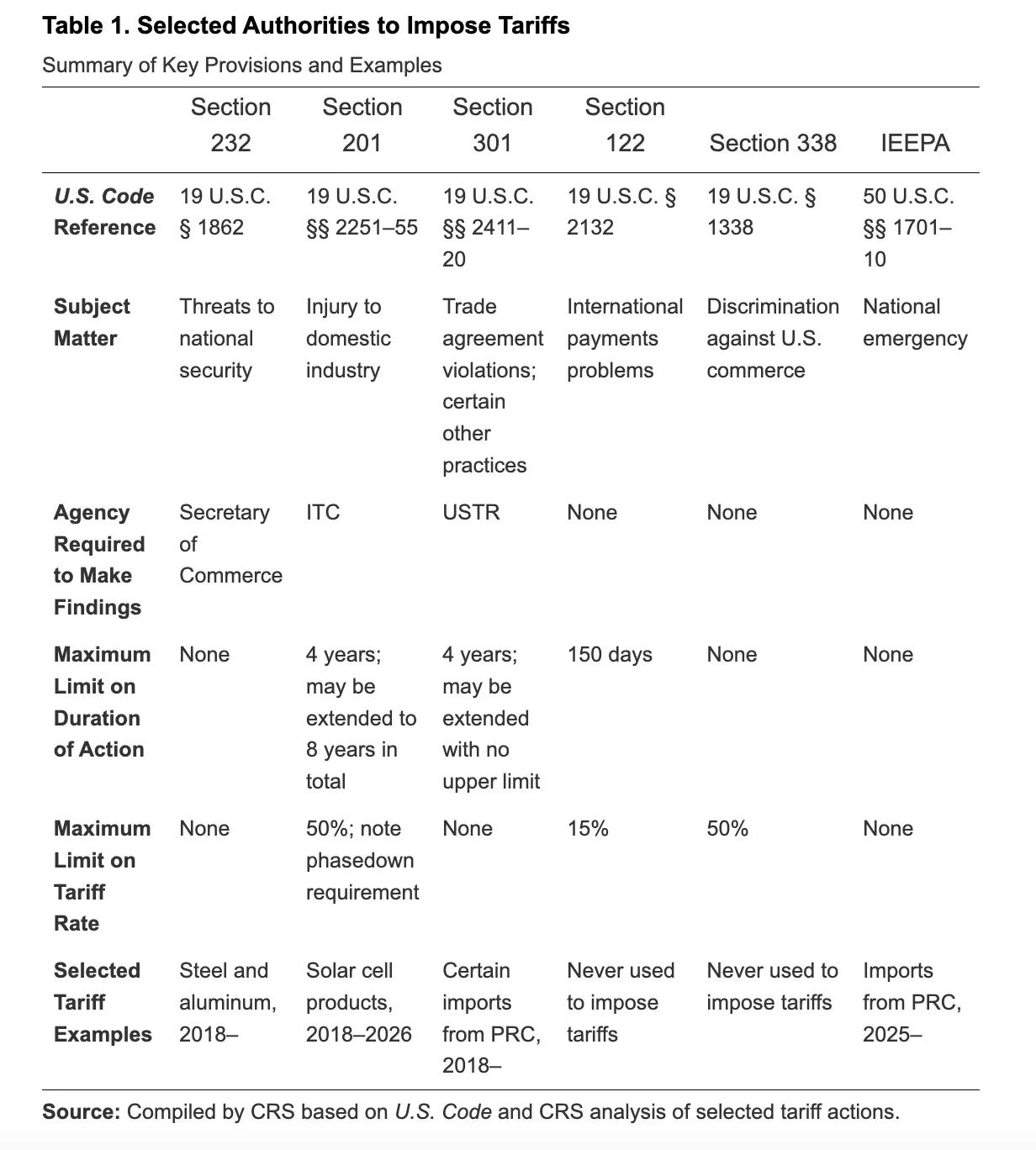
So this is not the end of the tariff saga yet…Trump has already stated that he will be using some of the above authorities to continue or re-impose tariffs (though as you can see, it will be much more constrained — which is why Trump didn’t want to rely on these in the first place).
This was some welcome pushback from the Court, but I am not optimistic that this will translate into meaningful pushback in other contexts — even though almost everything Trump is doing now is through delegated congressional authority in those areas. To wit:
Immigration
Student Visas: delegated authority under the Immigration and Nationality Act (INA) allowing the Secretary of State to deport anyone whose presence he deems has “adverse foreign policy consequences”
Temporary Protected Status: delegated authority under the INA to the Secretary of Homeland Security to grant or revoke TPS
Removal
Terrorists: delegated authority under the INA to remove people belonging to designated Foreign Terrorist Organizations
Alien Enemies: delegated authority to the President to remove foreign nationals of a country with which we are at war
Domestic Military Deployment
National Guard: delegated authority to federalize the National Guard
Regular Military: delegated authority to use military for domestic law enforcement by invoking the Insurrection Act
One thing that the tariffs case has in common with some of the delegated authorities listed above is that it’s triggered by a declaration of a national emergency or a proclamation. The Court seemed circumspect on using that to expand presidential power:
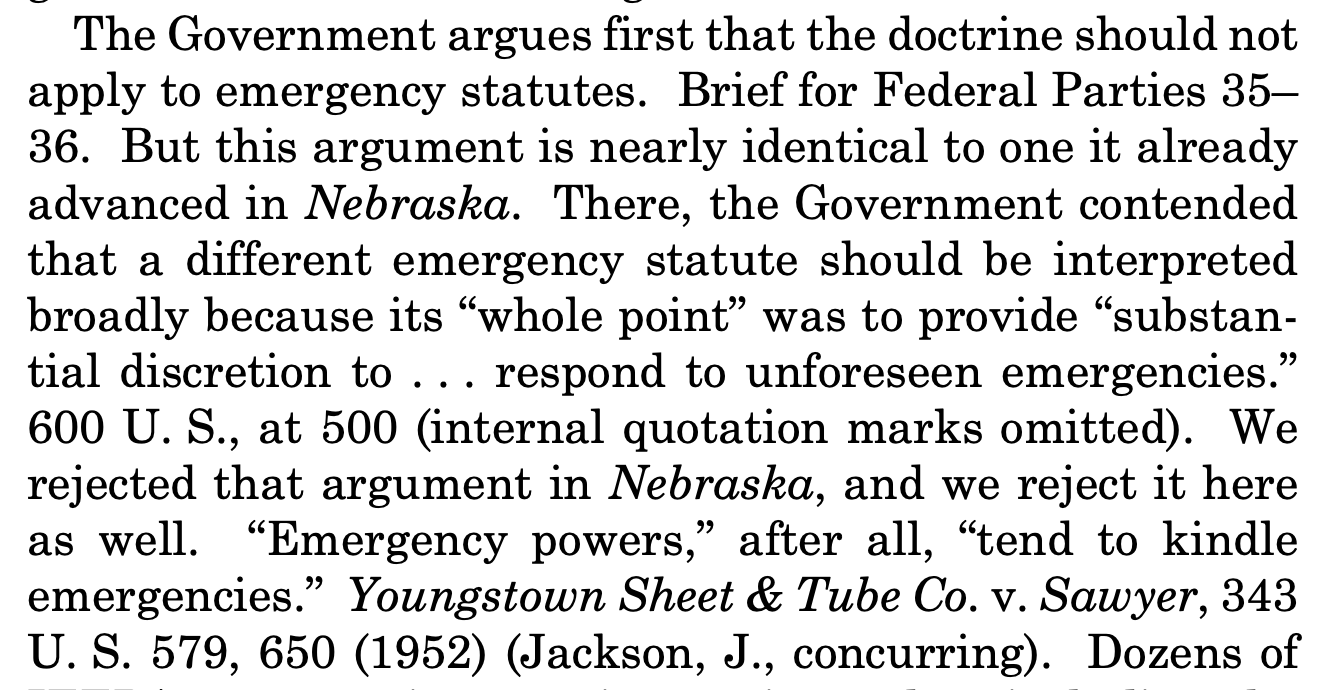
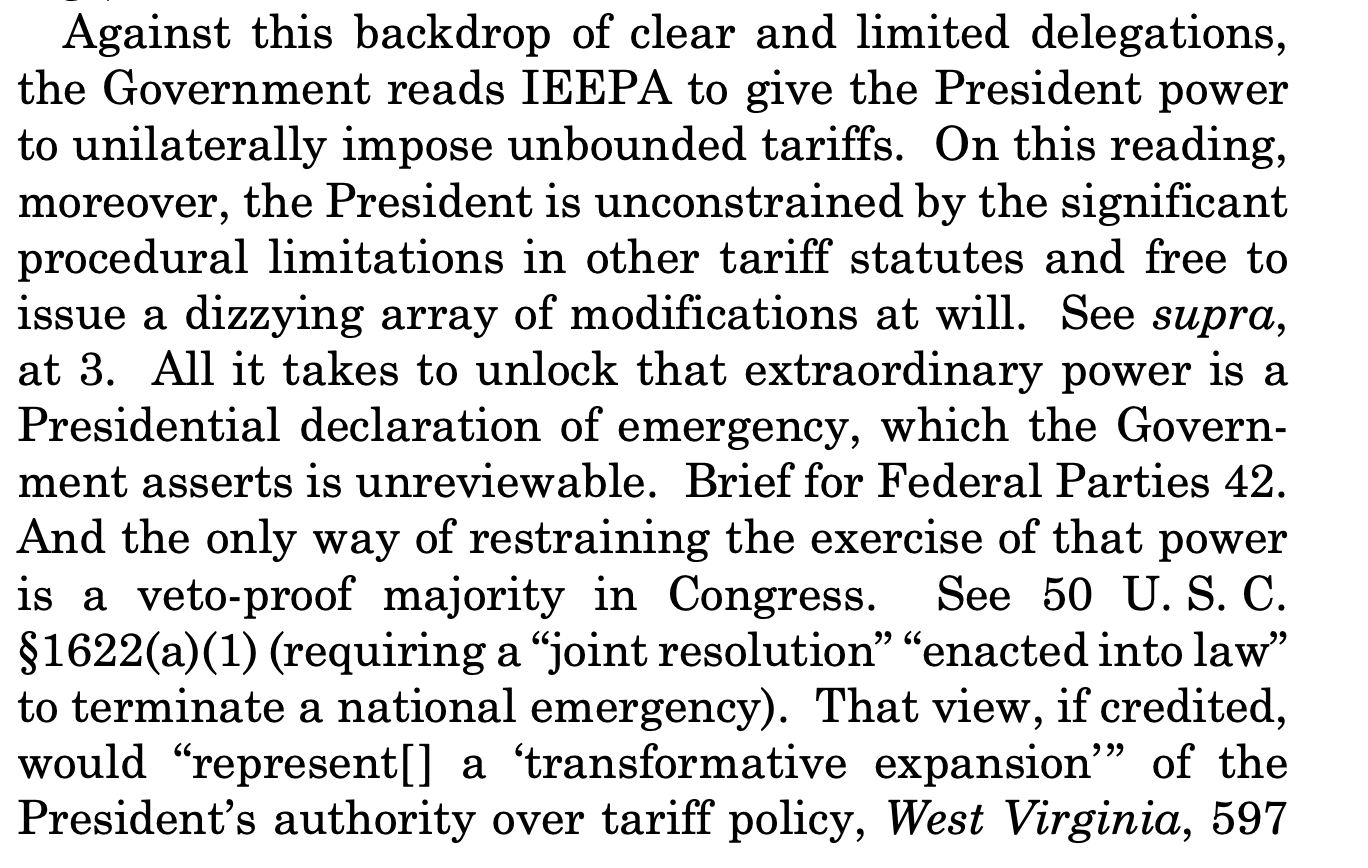
This sounds promising, except that in the end, the Court never second-guesses Trump’s purported “emergency” in the tariffs case. It grounds its decision in the text of the statute, saying that based on the text, Congress just didn’t delegate this power — noting, for example, IEEPA doesn’t even mention tariffs, and no president has ever used it to impose tariffs. But they don’t go so far as to say that Trump’s claim that our trade deficit is an “unforeseen and extraordinary threat” is wrong. And they are unlikely to second guess those determinations when it comes to drugs, illegal immigrants, or the military.
Nor do any of these other delegations seem likely to invoke the major questions doctrine, which in this case “overrode” the emergency declaration. Unlike the tariff case, they 1) involve pretty specific delegations; 2) that have been exercised before by other presidents; and 3) don’t have the kind of “political and economic significance” that directly encroaches on core congressional autorities (with perhaps the exception of the arbirtary revocation of student visas). In fact, all of the above authorities fall into the arena of foreign affairs and national security, which are shared powers between Congress and the President and where the President has some significant exclusive authorities, as well. This is precisely where courts — and the conservative majority on this Court, in particular — are inclined to give the President a lot of deference.
All of this is to say, I don’t think this decision portends anything coming in all of the other ways that Trump is abusing his power. I could be wrong (and will be glad if I am!), but I think in this case, the three conservative justices were as concerned with their own financial portfolios as they were with the law…and that made all the difference.
