
Double-Tap Gate: A Case Study in Gaslighting
We’re all trapped in Trump’s fabricated world and need to pull ourselves up out of it.
 |
“Double-Tap Gate” is now consuming the White House and the Pentagon, and things are about to get even hotter. But if we’re not clear about the larger picture, we could miss an important opportunity to reframe what’s really going on.
Let’s set the scene. A damning report from the Washington Post on Friday suggested Defense Secretary Pete Hegseth was responsible for an illegal “double tap,” or second strike, that killed two survivors of a U.S. military attack on their vessel. Sources with knowledge of Hegseth’s orders told the Post that Hegseth had given an order to “kill everybody,” referring to all persons on board an alleged drug smuggling vessel off the coast of Trinidad.
After an initial strike destroyed the vessel and killed 9 of the 11 passengers, the U.S. military, reportedly on orders from Admiral Frank “Mitch” Bradley, “double-tapped” by firing upon two survivors who were still clinging to the wreckage. This was all done, reportedly, to fulfill Hegseth’s initial command.
As I wrote yesterday, this double-tap was either a war crime (if we indeed are at war) or extrajudicial murder. The prohibition on firing upon shipwrecked crew is clear; it is even spelled out as an example of an illegal act in the Defense Department’s own Law of War Manual.
That means everyone in the chain of command is now a potential criminal defendant, and the careers, and maybe the very lives, of those involved are on the line. Such an illegal kill order is indeed a capital offense, should the perpetrators be convicted.
In response, the Trump White House has gone into full spin mode with rapidly shifting positions. Pentagon spokesperson Sean Parnell initially declared in a statement to the Post, “This entire narrative is completely false.” Then yesterday, White House spokesperson Karoline Leavitt admitted the second strike occurred after all, even while declaring it was legal when it was clearly not. Now Hegseth is attempting in a rather disgraceful way to shift blame away from himself and onto Bradley, as if the admiral somehow acted on his own in making the double-tap call, even as prior interviews have now surfaced in which Hegseth boasted that he “watched it all live.”
Congressional committees are calling for investigations and hearings. Trump is distancing himself and preparing to throw Hegseth under the bus. And Hegseth is, well, shit-posting memes of Franklin the Turtle attacking drug smugglers.
When things heat up as they have in this matter, it’s easy to get mired in the details and the back-and-forth fingerpointing. To prevent this, it’s useful to climb out of the zone they are flooding with vitriol, incomplete denials and misinformation and see a larger pattern at work. We can identify that clearly by treating Double-Tap Gate as a case study in gaslighting.
The very reason we are here at all is a false construct
If you feel a disquieting revulsion witnessing Karoline Leavitt spout talking points about killing “narco-terrorists,” your sensibilities don’t need adjusting. Anyone paying attention understands that the whole idea is nothing more than a cynical framing designed to create a false pretext for U.S. military action.
To see why, we need to deconstruct “narco-terrorism” as a concept. When we think of “terrorism,” it’s typically some kind of public act of violence, often in pursuit of a political or religious ideology, that is designed to sow fear in order to topple a state or change its behavior.
But “narco” drug traffickers aren’t trying to achieve anything except to maximize their own profits. They may deploy terror and violence against rival groups or local law enforcement to further this goal, but the cartels are not trying to topple the U.S. government or fundamentally change our society.
That’s why the idea that we need the full weight of the U.S. military to strike and kill “terrorists” who are allegedly smuggling drugs to our shores doesn’t sit right. What’s more, we are somehow actively targeting Venezuela, which isn’t even a significant source of truly dangerous drugs such as fentanyl to the U.S.
The real goal of this military build-up and imminent attack is something different. It could be to secure Venezuela’s vast oil reserves. It could be an attempt to flex our military power as a show of strength. Or it could be that the White House needs a scapegoat and a distraction from its many problems, including the Epstein files and rising consumer prices. Perhaps it’s a combination of multiple factors.
What our military build-up isn’t about is actually interdicting dangerous drugs in any meaningful way. Every time we hear the White House claim this, we have to remind ourselves that the entire premise is false.
We wind up arguing about illegalities within that false construct
A distressing thing happens once we are inside of this false narrative and we see something very bad—like a double-tap strike on shipwrecked crew—make headlines. Our public discourse shifts, understandably, to address the bad thing. But it now takes place entirely within this fantasyland the Trump White House has constructed.
As a result, we are left arguing about whether the double-tap killings were “war crimes” because the White House declared this to be a “non-international armed conflict” or “extrajudicial murders” because these sustained attacks, now numbering in the dozens with scores killed, are not actually backed by congressional approval.
Often left out: that we have no legitimate reason to be in the region at all, and whether the vessels carried drugs is irrelevant to the legality of deadly military force. Instead, the public is repeatedly subjected to the favored false narrative of the White House, namely that the strikes were part of a legitimate campaign to stop drugs from killing hundreds of thousands of Americans each year.
It bears repeating that cocaine—the only drug that does come out of Venezuela in any significant amount—does not kill hundreds of thousands of Americans each year. Moreover, the trafficking of cocaine is not a capital offense justifying the military killing of anyone even suspected of drug smuggling.
But the White House, especially more cunning advisors such as Stephen Miller, understands that the “war on drugs” is an open-ended gift for those who want to abuse executive or military power. So long as we are talking about stopping drugs, even in the context of an illegal double-tap attack, we won’t return anytime soon to the baseline question of whether the whole “narco-terrorism” campaign was fabricated to serve other political ends.
Their circular arguments keep us inside the false construct
The messaging from the White House in response to the report of the war crimes/murders has shifted rapidly over the past few days. But the centrality of the mission—i.e., to stop “narco terrorists”—has remained consistent.
In response to the Post’s reporting, Hegseth tweeted that the “fake news” is “delivering more fabricated, inflammatory, and derogatory reporting.” But rather than deny the deadly double-tap strike occurred, Hegseth defended it:
“As we’ve said from the beginning, and in every statement, these highly effective strikes are specifically intended to be ‘lethal, kinetic strikes.’ The declared intent is to stop lethal drugs, destroy narco-boats, and kill the narco-terrorists who are poisoning the American people. Every trafficker we kill is affiliated with a Designated Terrorist Organization.
Never mind that there is still no evidence that there were “lethal drugs” on board, that these may not have even been “narco-boats” at all given their passenger count to hull size ratio, or that killing alleged narco-terrorists for drug smuggling is neither legal nor justified. Simply calling the crew members part of a “Designated Terrorist Organization” does not give the U.S. military the right to kill them.
Even Fox News legal analyst Andy McCarthy saw through Hegseth’s flawed logic regarding the double-tap strike. As he pointed out in The National Review, “It cannot be a defense to say, as Hegseth does, that one has killed because one’s objective was ‘lethal, kinetic strikes.’”
Nor is it, by extension, a valid argument to claim they killed the narco-terrorists because, hey, they are narco-terrorists! The 11 people on the vessel (a number that suggests again they were transporting people, not drugs) posed no immediate threat and were committing no capital crime. Yet when asked what exact law the White House relied on to justify its double-tap strike on the two shipwrecked survivors, Leavitt claimed, astonishingly, that it was “self-defense.”
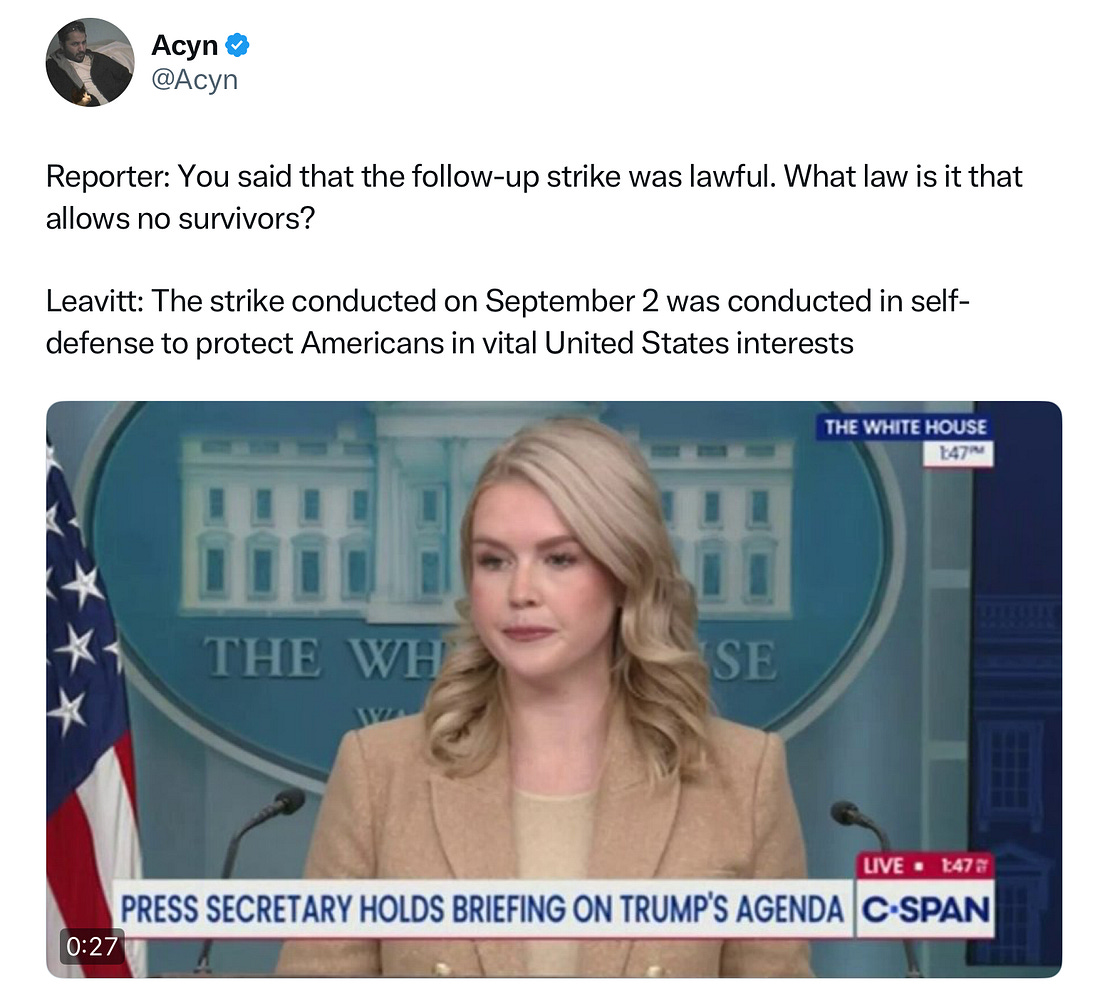 |
This stretches the notion of national “self-defense” beyond all recognition. Generally speaking, for a nation to claim it justifiably responded to a threat in self-defense under international law, there must first be an armed attack, or imminent threat of one, necessitating action, and the response must be proportional to that threat. None of these conditions is met when we’re talking about two crew members clinging to the wreck of their vessel floating in the ocean.
Zooming out, Leavitt is really making the argument that the larger campaign to stop narco-terrorists somehow justified the killings. This is the same as what Hegseth argued: They killed drug smugglers because their objective was to kill drug smugglers. That objective, we must continue to insist, is invalid and illegal on its face.
Leavitt makes a disturbing logical leap that, because drug smuggling ultimately results in the deaths of Americans, our forces were within their rights to kill any and all drug smugglers in the region. In short, the military’s actions were justifiable because they are justified.
Circular reasoning appears to be a hallmark of Leavitt. When asked to square the fact that our own laws of armed conflict say you cannot fire upon survivors from a wrecked vessel, Leavitt responded only that the strike was conducted “in accordance with the law of armed conflict.”
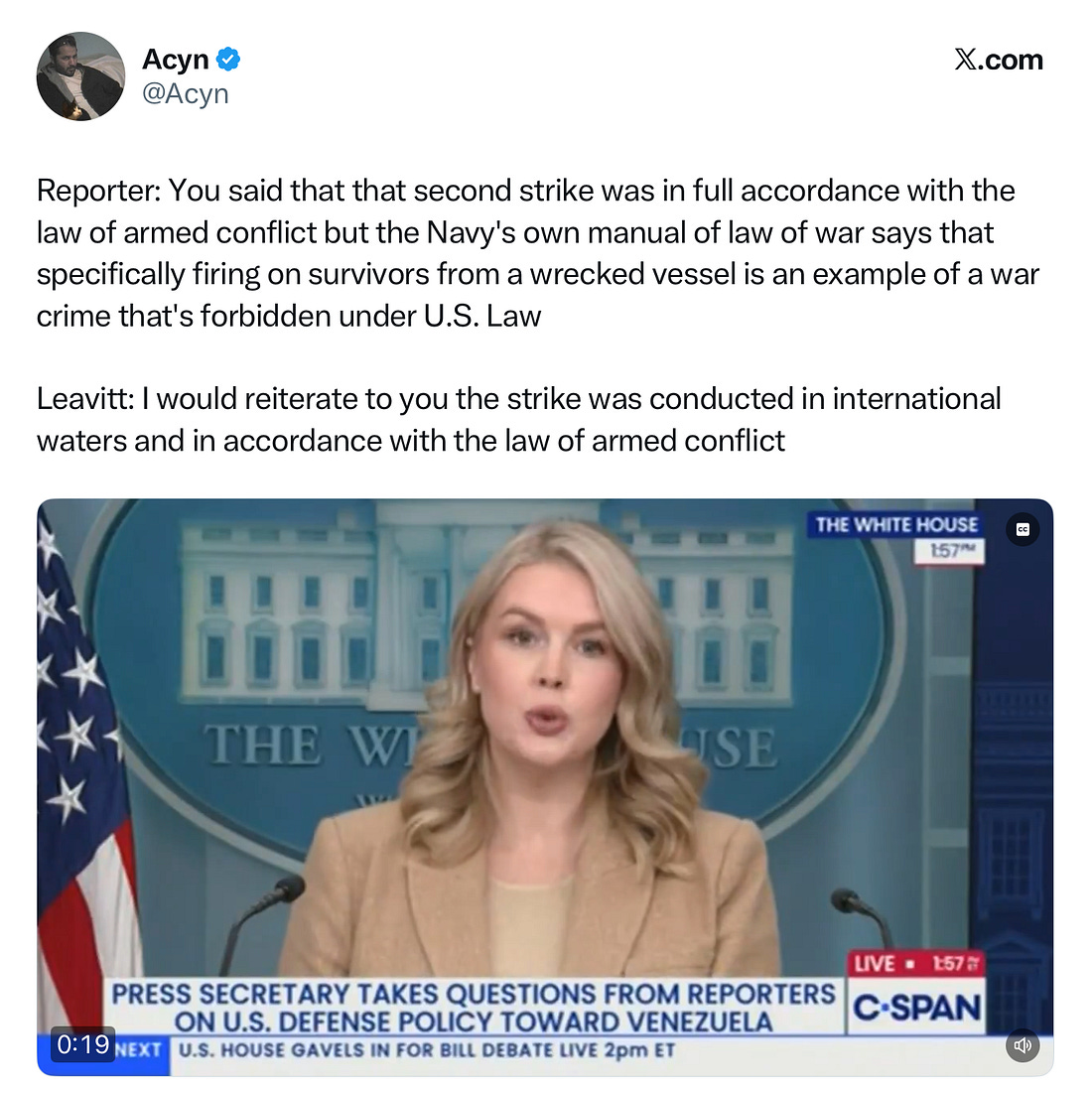 |
No further explanation or citation given. This is akin to being asked, “Why does A equal B?” and responding, “because A.”
Other examples abound
The pattern described above with respect to the illegal double-tap strike on “narco terrorists” happens in many other contexts with this White House. To review, their game is this:
1) creation of false construct “A,”
2) forcing us to confront bad behavior within “A,” until
3) we’re met repeatedly with arguments that reinforce “A.”
Take another favorite false narrative of the regime: alien crime gangs. The White House declared the Tren de Aragua gang to be an “invasion” that threatened our national security. Trump invoked the Alien Enemies Act, giving the Department of Homeland Security the green light to summarily render any suspected gang members to CECOT prison in El Salvador.
Very bad behavior followed, including the mistaken deportations of innocent men like Andry Hernández Romero, who was lumped in due to his tattoos, and Kilmar Abrego García, who was wrongfully deported due to “administrative error.” The regime’s go-to talking point in its own defense? That it was protecting the American people from dangerous gang members. When the evidence wasn’t there, no worries! Trump could simply spread misinformation about MS-13 tattoos on Abrego García’s knuckles.
The public was left arguing about whether Romero, Abrego García and others were wrongfully rendered to CECOT because they were or were not gang members, or whether there was adequate due process afforded them. This left little room to attack the underlying premise that Tren de Aragua is not a real threat to U.S. national security, justifying invocation of the Alien Enemies Act. That narrative is so bogus that even the conservative Fifth Circuit ultimately did not buy it, but the damage to our public discourse was already done.
As a second example, take the White House’s unsupported assertion that government programs, grants and funds are rife with “fraud, waste and abuse” and “DEI.” It used those broad false claims to justify very bad behavior, including granting inexperienced DOGE staffers complete access to our government systems and the ability to unilaterally cancel billions in critical funding. The public was left arguing over whether a program was wasteful or fraudulent, or whether funding had a DEI element. There was little energy to focus on the fact that the White House never had the legal right to withhold appropriated funds to begin with, no matter what excuse or justification it offered.
Same goes for Trump’s tariffs. The White House spun the false narrative that tariffs would be paid by our foreign trading partners and would restore American manufacturing. Bad behavior followed, including high tariffs to punish Canada for its alleged failure to stop fentanyl from crossing our northern border. That drug flow from Canada, of course, wasn’t really a thing, and we went round in circles on it, as well as on Trump’s false claim that tariffs wouldn’t be borne by U.S. consumers. Once again, however, we were fighting battles within a false construct: Trump never had the power in the first place to impose his tariffs, but we all acted like he did anyway.
Enter the lawyers and courts…but it’s not enough
It has taken multiple lawsuits and long court battles, but at last, many of the most egregious false constructs have begun to fall away. Most courts have found, for example, that Trump’s invocation of the Alien Enemies Act against Tren de Aragua was not justifiable. Multiple courts have enjoined the White House from withholding appropriated funds as an illegal impoundment. And recently, a majority of justices on the Supreme Court appeared skeptical of Trump’s asserted power to use “national emergencies” to justify the imposition of broad tariffs, where the law he cites doesn’t even discuss the power to tariff.
But courts and the legal system are an imperfect and painfully slow way of chipping away at the false assertions and dangerous fantasies of the White House. By the time there’s a ruling, the public unfortunately is already well indoctrinated into the Trump regime’s favored narratives.
To stop this from happening far earlier, we would normally turn to two things that are in desperately short supply these days: a press that doesn’t accept the White House narratives at face value and a Congress willing to assert its power of oversight and impeachment leading to conviction and removal.
Given that neither of these is likely to materialize any time soon, we the public need to approach our national discourse with greater awareness of the false constructs that underlie it. We must begin by rejecting Trump’s premises. Venezuelan “narco-terrorism” doesn’t pose a national security threat. Tren de Aragua isn’t invading us. The White House can’t legally withhold funding appropriated by Congress. Trump doesn’t have the power to tariff anyone in any way he wants.
Perhaps we know these things, but they need to be repeated loudly and often because the media and our elected members in Congress aren’t doing their jobs. We need to address the hard fact that the elephant actually created the room we’re standing in with it. Failure to acknowledge this will only permit more national gaslighting, as we continue to go round and round in Trump’s upside-down world.
