Tuesday, September 24, 2013

How Do Startups Disrupt Old School Industries?


Chicago Startups Learn How to Disrupt Old School Industries

BY: | September 25, 2013


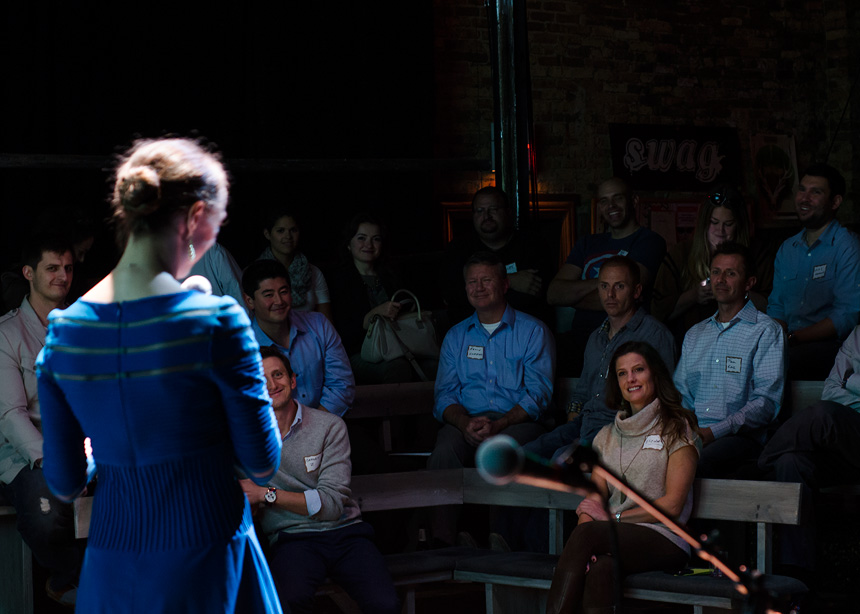
(Photo courtesy: Michael Courier/michaelcourier.com)

Disruption isn’t easy, as things that are new are not always welcome. This is the perennial problem for entrepreneurs. Startups heard from seasoned entrepreneurs in Chicago Tuesday night on how to influence real change and break into new markets.

“Disruption is a big word… we had to do a lot of things to do what we got through today,” said Mark Lawrence, CEO of SpotHero.

Speakers proved disruption is a process with persistent and persuasive means of  convincing people to accept new products into their daily lives. This often happens by meeting your customer halfway and introducing new products slowly.

“Disruption is something that defines a startup so we wanted to hear from people in different industries about what makes them successful,” said Stella Fayman, co-founder of Entrepreneurs Unpluggd, the company hosting the event. “We purposely chose people in different stages in what they’re doing.”

The speakers proved that despite their different stages in company growth, there are basic elements that facilitate disruption, and it has a lot to do with the consumer.

Many entrepreneurs are told “understanding why your consumers are doing what they’re doing,” will help you build a unique product and gain entrance into new markets,” said Kevin O’Reilly, founder of Chicago-based startup Buildings on Demand.

But they saw Tuesday that “assuming you know your market, then finding out something new can change the way you pivot” but can also entirely change your business, said Jerry Freeman, founder of Chicago-based startup, paletteapp.

Speakers proved disruption isn’t just about understanding consumers.  Often, it’s also understanding other businesses first that would lead you to your consumer.


Photo Courtesy: Michael Courier/michaelcourier.com

Mark Lawrence, disrupting parking

The parking industry was extremely slow to welcome change, Lawrence said. His app SpotHero, helps you find and reserve parking online for discounted rates through your phone. But figuring out how to make this possible took a bit of negotiation.

Making payments can be so easy nowadays. You can order food or airplane tickets through your phone, he said. But for some reason, the parking industry still needs paper slips to make transactions possible.

“When you talk to these industries, paper is king,” he said. “And this was really difficult for me because we wanted to make parking easier… and paper still plagues me.”

How did Lawrence jump the hurdle in dealing with an industry averse to mobile transactions? He gave them what they wanted – paper “SpotHero” receipts to staple to the parking slips so parking managers could continue business the way they wanted, however antiquated.

But everyone is happier for it – consumers can use their mobile devices to pay, and parking lots can keep their paper. He disrupted the industry by meeting all participants halfway.


Photo Courtesy: Michael Courier/ michaelcourier.com

Aleksandra Efimova, disrupting dance

Efimova began her company Russian Pointe, by bringing ballet shoes from Russia to America when she moved in 1993. The name of her company came to mind with no big market research and no experience, she said. She sold it by telling her clients: “Shoes from Russia, Russian ballet is good and you should buy them.”

It is now a multi-national, multi-multimillion dollar company. And Efimova said her marketing strategy had grown far more complex.

But the way she did it was not just by looking to her consumers or looking to other businesses. She first looked inside herself for a “vision of something that’s very unattainable” but motivates her in the morning, she said. It’s the vision of seeing every girl participate in the arts. And that’s how she sold the shoes: With the dream to bring culture to little girls through high quality dance apparel.

She’s formed a connection with her customers. She presents a stern value proposition to stores, and addresses the quality, safety and beauty of the shoes to professional dancers and how it will help their craft. But to parents she addresses how their kids can achieve their dreams on the dance floor and what skills their kids would need to succeed.

Like Lawrence, disrupting dance has come slow and steady with a strong company values and attention to quality. But it also came from understanding how to balance steady growth.

“You want to have time to do fun things but at the same time you want to make money. How do you find this balance?” she asked. By making “as little as possible but as much as necessary.”


Photo courtesy: Michael Courier/michaelcourier.com

Howard Tullman, disrupting disruption

Tullman is the chairman of Tribeca Flashpoint Media Arts Academy and a serial entrepreneur. He is also now the managing director of a new venture fund named G2T3V. He gave examples of companies that he’s built that are still here, still working and still creating jobs and building additional value.

“Technology once adopted is sticky, he said. “It turns out people are perfectly willing to go back” to the old way of doing things. He found, just as Lawrence showed, business sometimes has nothing to do with efficiency or rationality, “it has to do with politics,” he said.

“You discover nothing works top down, you have to sell in at the local and regional levels and work your way up.”

What is dangerous about trying to building a product to scale nationally is that it always takes a long time, he said. “A mom and pop almost anywhere can beat your head in, because they can live with the customer.”

He advised businesses to be useful in ways that defeat this advantage by providing greater economic value, better research and the ability to scale and standardize across multiple locations.

He gave eight pieces of advice to keep the ball rolling to build not just a new product, but products that will disrupt entire industries:
  • Tell a simple story: Who, what and why. Know who are you and why are you doing whatever it is you’re doing.
  • Keep raising the bar for your expectations and remember “everything can be better. Everything can be done faster.”
  • Get started and then build, don’t wait for a perfect anything.
  • Make cheap mistakes. Fail fast.
  • Don’t reinvent the wheel. Figure out your competitive advantage — what sets your business apart. But don’t try to do everything.
  • Do your customers’ homework for them. The first sale can happen easily but the second sale — when you’re not in the room and if you haven’t provided your advocate in the business with ammunition to sell the product, you’re toast.
  • Business plans are great but don’t stick to the ‘plan’ too long. Stick to your guns.
  • Make room for all kinds of people. “The biggest mistake entrepreneurs make in hiring is hiring people just like them.”
Sonali Basak

Sonali Basak

Sonali Basak fell in love with the start-up world during her short time in Chicago. She believes small businesses and start-ups are the heart of the American economy. She is a broadcast and business reporter at Medill News Service, pursuing her masters at Northwestern University. She got her Bachelor of Arts from Bucknell University in English and Econ. She loves food and sports, and when she’s not writing, she’s running. Find some of her writing here: BasakWrites and fun stuff here: Sonali Basak

STEVE CASE AT 1871


Bullish on Chicago tech? So is AOL founder Steve Case - by John Pletz

Steve Case spent the early part of his career getting people to use the Internet.


These days, the founder of America Online is preparing for what comes next. A lot of that opportunity will be in places like Chicago, not Silicon Valley, Mr. Case told a room packed with tech entrepreneurs, investors and other executives yesterday at the 1871 startup incubator in the Merchandise Mart.


“The next 25 years are going to be about the second Internet revolution — using the Internet and other technologies to disrupt industries that haven't changed much in the last 25 years,” said Mr. Case, who invests in tech companies from various funds under the Revolution banner.


Three of the biggest areas will be education, health care and transportation. That favors Chicago and the Midwest, he said in an interview, because “the insights for innovation are likely to come from people with a sense of what's happening in these industries.”


Mr. Case puts his money where his mouth is. He's an investor in Chicago-based BenchPrep, which creates test-preparation and other courses online. The startup also is backed by Lightbank, Eric Lefkofsky and Brad Keywell's venture firm.


Not surprisingly, he sees Washington, where Revolution is based, as a big winner because many of the industries about to be disrupted also are regulated by the government.


Mr. Case is best known for starting AOL and its disastrous merger with TimeWarner at the peak of the dot-com boom. But he's also been a tech advocate in Washington, where he helped push the Jobs Act, which potentially opens the doors to funding tech startups.


A new provision took effect yesterday that allows tech investors, such as angel or venture funds, to solicit investors online, loosening some decades-old restrictions. A crowdfunding provision, which many see as unlocking a big source of new capital for startups from everyday investors, still hasn't been fully implemented.

But Mr. Case is bullish on both. “It's about unlocking more capital,” he told me. “The general solicitation provision will help create other venture firms, and it will help some other venture firms scale up.

(Crowdfunding) can be a game-changer for entrepreneurs, particularly in places that don't have a lot of access to capital.”


Mr. Case's work in Washington isn't done. He's pushing hard for immigration reform, which tech companies see as crucial to retaining foreign students trained at U.S. universities. “There's general agreement on that,” he said.


But border security and citizenship for undocumented immigrants are politically divisive, which threatens to stall the overall issue.


“I'm an entrepreneur, so I'm an optimist,” he said. “If it doesn't happen by the end of the year, there's a chance we lose our moment. The next few weeks will be crucial.”


Follow John on Twitter at @JohnPletz.

CRAIN'S CHICAGO TECH 50 INCLUDES TFA CHAIRMAN HOWARD TULLMAN


Friday, September 20, 2013

Tribeca Flashpoint Academy Chairman Howard Tullman Appears on Tastytrade Talking about Start-Ups w/o Skid Marks


WATCH THE VIDEO:

“Shutter to Think: The Rock & Roll Lens of Paul Natkin” Videos Created by Tribeca Flashpoint Academy


Shutter to Think: The Rock & Roll Lens of Paul Natkin

Chicago Cultural Center  >  Exhibitions  >  Monthly Schedule  >  Shutter to Think

Produced by the Elmhurst Historical Museum

The Rolling Stones (Photo by: Paul Natkin)
Paul Natkin is widely considered to be one of Chicago’s greatest music photographers. Starting in the mid 1970s, Natkin traveled the world capturing signature moments of drama, excitement, outrageousness, and excess that propelled rock’s tumultuous history. His astute eye and knack for capturing “the decisive moment” have earned international acclaim and resulted in numerous magazine and album covers. 
Learn the stories behind many of Natkin’s photos of rock icons in their early careers including Bruce Springsteen, The Rolling Stones, Prince, Ozzy Osbourne and many more. The exhibit narrative was written by Chicago Sun-Times staff writer Dave Hoekstra.
The exhibit features dramatic large imagery and incisive interview video segments produced by the Tribeca Flashpoint Academy for Media Arts.
“Shutter to Think: The Rock & Roll Lens of Paul Natkin” was curated and designed by Lance Tawzer, Curator for the Elmhurst Historical Museum.

CHICAGO CULTURAL CENTER WELCOMES EXHIBITION OF CHICAGO’S OWN LEGENDARY ROCK MUSIC PHOTOGRAPHER
“Shutter to Think: The Rock & Roll Lens of Paul Natkin”
Opens Friday, September 20

The western’s suburbs loss is the City of Chicago’s gain as the Chicago Cultural Center’s first-floor Garland Gallery (78 E. Washington) will now be home to Shutter to Think: The Rock & Roll Lens of Paul Natkin”, an exhibition displaying the work of Chicago’s premiere music photographer. The exhibition, opening on Friday, September 20, in conjunction with the city’s first ever Chicago Music Summit, just completed a successful run at the Elmhurst Historical Museum.

The exhibition contains a veritable who’s who of rock music legends including Bruce Springsteen, Eddie Vedder and The Rolling Stones as well as superstars of other genres including Johnny Cash, Muddy Waters, Buddy Guy, and the first concert Natkin ever photographed, Bonnie Raitt.

Shutter to Think will also include several monitors embedded with the larger photographs that feature Natkin speaking about the moment of shooting that image.

Natkin’s chosen field was the family business as his father had worked for years as a well-known photographer. Though the senior Natkin left the field to raise his family, a return to photography in the world of sports inspired Paul to follow in his footsteps.

In 1975, Natkin began going to concerts and shooting the shows, eventually finding a way to make a living at it by acquiring magazine and newspaper clients, and working with record company publicity departments. During the 1980s Natkin was a frequent contributor to Creem Magazine, and his work has appeared in many other music magazines (Rolling Stone, Circus, Hit Parader) as well as many mainstream magazines including Newsweek, Time, People, Playboy, Ebony and Entertainment Weekly.

Natkin has worked as the tour photographer for both Keith Richards and Rolling Stones concert tours, spent five years as staff photographer of the Oprah Winfrey Show, and now is involved with charities that deal with social issues such as Farm Aid, Rock for Reading and the Chicago Music Commission.

However, Natkin continues to photograph musicians of all kinds whether covering acts at the Chicago Jazz Festival or the latest up and coming acts at small clubs throughout Chicago.

Shutter to Think: The Rock & Roll Lens of Paul Natkin will be on exhibition through January 4, 2014. The Garland Gallery is open every day; hours are Monday-Thursday, 9 a.m.-7 p.m. and Friday-Sunday, 10 a.m. – 6 p.m.; closed holidays. For more information, call 312.744.3316; TTY 312.744.2964 or visit chicagoculturalcenter.org

TRIBECA FLASHPOINT ACADEMY CHAIRMAN HOWARD TULLMAN - KEYNOTE SPEAKER FOR SOCIAL MEDIA WEEK


TRIBECA FLASHPOINT ACADEMY CHAIRMAN HOWARD TULLMAN IN CRAIN'S TECH 50 FOR 2013

CRAIN'S TECH 50 - Watch here: http://www.chicagobusiness.com/section/multimedia?project=Sneak%20Peek&title=Tech%2050&r=7777H2150356B9R


Watch the video here: http://www.chicagobusiness.com/section/multimedia?project=Sneak%20Peek&title=Tech%2050&r=7777H2150356B9R

Total Pageviews

GOOGLE ANALYTICS

Blog Archive