Showing posts with label jb pritzker. Show all posts

Tuesday, November 19, 2019

NU LAW SCHOOL NEWS: The 5 Traits Every Entrepreneur Must Have


News
The 5 Traits Every Entrepreneur Must Have
November 12, 2019


For an episode of Planet Lex: The Northwestern Pritzker School of Law Podcast, Howard Tullman (JD ’70), Executive Director of the Ed Kaplan Family Institute for Innovation and Tech Entrepreneurship and former CEO of 1871 Chicago, and Governor J.B. Pritzker (JD ’93), co-founder of the Pritzker Group, discussed what it takes to pursue innovation in business.
During the conversation, the guests shared insight into how a legal education contributes to an entrepreneurial mindset. “When we talk about entrepreneurs at law school, the law schools are still focused on the gladiator litigator model, which is ‘one person is going to triumph,’” Tullman said. “And frankly, the world is different today. The world is about collaboration and it’s about a different set of team-based skills.”
Still, having a legal background can help entrepreneurs be efficient and effective, Pritzker said. “A mindset of the law helps to drive the entrepreneurial spirit,” he explained. “There a lot of people who have a desire or a need to go create but may not be able to organize and head down a single road in order to get things done.”
For anyone who wants to pursue an entrepreneurial career, Tullman says there are five must-haves:
1. Passion. Being an entrepreneur is hard and lonely, Tullman says, so passion for the work is critical.
2. Dedication. “You have to do literally the hard work,” he says. You’ll be putting your sweat —and a lot of your time — into your endeavor
3. Preparation. Entrepreneurship isn’t just the excitement and glitz you see on shows like Shark Tank. Before any project takes off, you’ll need to take time to prepare.
4. Perseverance. “It’s a bumpy, long and hard road,” Tullman says. You’ll need to stick with it.
5. Desire to Make a Difference. “You have to want to do something that is more than making money,” Tullman says. “You have to want to make a contribution.”


Sunday, October 28, 2018

The State Journal-Register : Candidates for governor offer different economic visions


Candidates for governor offer different economic visions

In late 2017, Gov. Bruce Rauner’s reelection campaign debuted an adfeaturing three Republican governors from surrounding states sarcastically saying “thank you” to House Speaker Michael Madigan for “raising Illinois taxes” and “helping create new jobs” in their states.
The ad was an opening salvo in a campaign that has seen Rauner and his Democratic critics blame one another over who is more responsible for economic growth that lags behind most other states.
The state added slightly more than 50,000 jobs between September 2017 and last month, representing a year-to-year increase of just 0.8 percent, the fourth-slowest rate of job growth of any state, according to the Bureau of Labor Statistics.
Such news has become a common refrain over the past few years, and it’s the economic reality that in part motivated Rauner to run for office in the first place. And now, it’s part of the reason why billionaire J.B. Pritzker is attempting to unseat him.
When Rauner first ran, he said that as a businessman without prior government experience, he would have the independence to make politically tough, but necessary choices to get the state’s struggling economy back on track.
Literature from his campaign website that year claimed the state was in a “jobs crisis” with the highest unemployment rate in the Midwest and among the highest in the nation, calling it “unacceptable.”
Since Rauner took office, the state’s unemployment rate has dropped from 6.1 in January 2015 to 4.1 percent now. And the state added slightly more than 200,000 jobs in that time.
But Illinois’ unemployment rate stubbornly remains higher than the national rate and that of most its neighboring states. And government statistics indicate the rate of job growth has been slower during Rauner’s tenure than the final years of former Gov. Pat Quinn’s administration.
The governor’s critics say he made the state’s already dire fiscal position worse by refusing to compromise on a budget, which led to a two-year impasse that was only broken when a handful of Republican lawmakers joined Democrats to override his veto.
In that time, the state’s already-soaring pension debt climbed, its backlog of unpaid bills ballooned to more than $16 billion and the uncertainty created hampered economic growth around the state.
In this backdrop, here’s what the candidates for governor have said about dealing with the state’s economy and creating jobs:
Republican Bruce Rauner
The governor pins most of the blame for the state’s economic woes on state Democrats and, specifically, Madigan, D-Chicago, who he argues stymied his agenda, which he claims would have helped turn around Illinois’ economy.
“The Madigan Machine has stood in the way for decades, obstructing necessary regulatory and spending reforms that would grow jobs and revive the Illinois economy,” Rauner said. “Instead, Madigan forced through a 32 percent income tax hike without spending reform that does nothing but drive business and jobs away from our state. When we reduce the tax and regulatory burdens on businesses in Illinois, the economy will thrive.”
Rauner said he would seek to lower the cost of doing business in Illinois by freezing property taxes and reforming the state’s workers compensation system. He also supports the creation of “right-to-work zones,” which would allow local municipalities to decide if workers should be required to join a union.
He said such reforms are necessary for the state to compete with its neighbors, which have less generous workers’ compensation laws and, besides Missouri, are all right-to-work states.
Rauner also opposes changing the state’s “flat” income tax structure to a “graduated” scale, which would allow the state to tax wealthier people at a higher rate than middle- and lower-income folks.
Instead, Rauner has proposed rolling back the 2017 income tax increase in the form of a $1 billion tax cut. However, he has not disclosed how he would close the hole the tax cut would create in the state budget.
And while state funding for higher education was decimated during the budget impasse, Rauner was a major proponent of launching the Discovery Partners Institute/Illinois Innovation Network, a University of Illinois system-led initiative meant to drive economic growth across the state through research and innovation.
The state budget that he signed in early June included $500 million in seed money for the initiative.
“We have fantastic research universities doing world class innovation,” Rauner said. “We need to make sure that we collaborate, coordinate, communicate, partner and accelerate the economic development that can come from that kind of innovation and fundamental research.”
Most pro-business groups, including the Illinois Chamber of Commerce and the Illinois Manufacturers Association, are still backing Rauner, crediting him for holding the line during his first term on regulations and tax increases in face of a Democrat-controlled General Assembly.
“We’ve seen federally what happens when you take the shackles off job creators,” said IMA vice president Mark Denzler. “You see what the president has done in Washington with tax reform, reduced regulations, and that’s kind of created a spark across the country. Unfortunately, in Illinois, we haven’t had as much success because of the policies that have been enacted largely by the Democratic General Assembly or the reforms they’ve blocked.”
If he is reelected, however, Rauner’s allies acknowledged he would have to change his approach given the strong likelihood the legislature will remain in Democratic control.
“When he rolled out 48 items for a turnaround agenda in his very first State of the State address, that was overreach, no doubt,” said Illinois Chamber of Commerce CEO Todd Maisch. “However, Democrats have been the defender of the status quo, and I don’t care if you’re a conservative Republican or a liberal Democrat, almost no one is satisfied with the status quo.”
Democrat J.B. Pritzker
Pritzker, a venture capitalist and heir to the Hyatt Hotel fortune, has made his record as a businessman central to his campaign to unseat Rauner.
In its endorsement of Pritzker, Crain’s Chicago Business described the billionaire as “a known quantity in Chicago’s moderate business community,” and in many ways, “its unofficial mayor.”
Pritzker was instrumental in creating 1871, a Chicago-based tech incubator that has created an estimated 7,000 jobs since opening in 2012.
Former 1871 CEO Howard Tullman said the project would not have been possible without Pritzker’s leadership.
“1871 wouldn’t really exist without J.B.,” Tullman said. “Not simply because he was a part of the visualization and the conception, but because we wouldn’t have had a physical location without his willingness to underwrite the lease for the initial space.”
Pritzker said he would take a similar approach to job creation in the state by expanding the availability of microloans to increase access to capital for small businesses. Pritzker also proposes restoring and expanding Small Business Development Centers that provide mentorship, training and support to business owners.
Pritzker’s economic plan also includes a capital bill to invest in the state’s infrastructure, investing more resources into higher education and jump-starting the state’s manufacturing sector.
“Having engaged in building a fast-growing startup environment in Chicago, I know Illinoisans’ creativity and entrepreneurial drive is the best creator of new jobs for Illinois,” Pritzker said.
Pritzker, however, has caught the ire of business interests wary of his proposal to change the state’s flat income tax to a graduated rate. Such a change would require amending the state constitution. They say job creators in the state already face too high a regulatory and tax burden.
And there has been a level of uncertainty created as Pritzker has repeatedly deflected when pressed to provide proposed rates and tax brackets under a progressive system. Pritzker said such details will have to be negotiated with the General Assembly.
“Our biggest problem with J.B. isn’t that he’s not a good businessperson ... but it’s that he’s bought into this Bernie Sanders track of the far-left liberal ideology that is just completely inconsistent with a thriving, growing economy,” Maisch said.
And Pritzker’s more loyal backers dating back to the Democratic primary have been labor unions, which leads some in the business community to believe he will not make the tough, but necessary decisions when it comes to pensions, worker’s compensation and other reforms to make the state more business-friendly.
But Pritzker’s supporters say the billionaire is pragmatic and will ultimately be a governor who listens to the concerns of entrepreneurs and small business owners. Tullman, who has worked with both Pritzker and Rauner in the past, said Pritzker’s collaborative approach would be an asset in the Governor’s Mansion.
“So I’ve known both of these guys, and I would say that J.B.’s diverse experience, his ability to delegate and his ability to get along with all kinds of different people — and entrepreneurs are not easy to get along with — I think that all of those skills will be beneficial in trying to get his arms around the structure of the bureaucracy, which is the state government,” Tullman said.
And Pritzker, if elected, said he would serve as the state’s “chief marketing officer,” which he said would be a contrast from Rauner, who he believes “made our state’s problems worse by repeatedly bad-mouthing Illinois.”
Libertarian Kash Jackson
In keeping with his party’s ideology, Jackson believes a key to making the state more business-friendly is to get government out of the way.
“Illinois already has high taxes and compliance costs, but the constant increase in these taxes, fees, and regulatory requirements makes Illinois an unattractive place for businesses to want to set up shop,” Jackson said.
Jackson believes that fees associated with opening a business should be reduced to a bare minimum and that state occupational licensing should be greatly reduced, arguing that red tape and high costs hamper job growth.
The Libertarian also believes the state should lower the minimum wage, which he said will help small business owners struggling to make ends meet.
Conservative Sam McCann
McCann, who is running as a pro-union, social conservative, said he would work to restore “economic liberty” to Illinois.
He said he would work with the legislature to reduce the overall tax burden and to overhaul the state’s property tax system, but has offered very few details on how he would accomplish this.
Contact Brenden Moore: 788-1526, brenden.moore@sj-r.com, twitter.com/brendenmoore13.

Friday, November 03, 2017

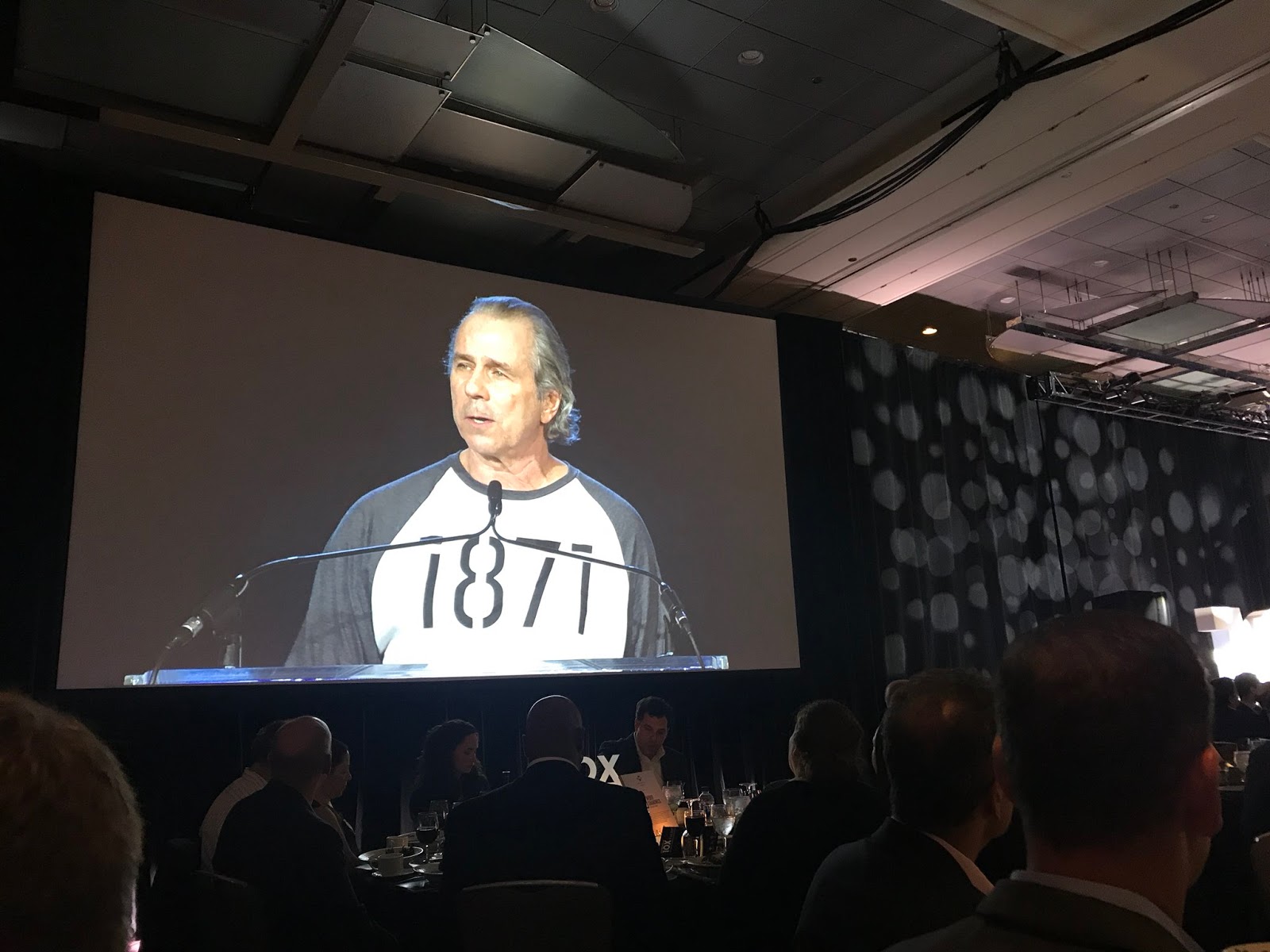
Momentum Dinner Remarks of 1871 CEO Howard Tullman


I want to start by thanking JB for his kind words and, more importantly, for his prescient vision six years ago without which 1871 would simply not exist. I asked JB to present my award, not only because of our friendship and his dedication to 1871, but also because he and I have been engaged together in this grand adventure of building a viable community of Chicago entrepreneurs and investors for almost 20 years (in good times and bad) since I first invested with him in the William Blair New World Ventures fund. Right before the beginning of what he calls the nuclear winter. But we made it through those tough times and he never lost his passion or gave up on the dream.


JB’s initial support and his enthusiastic and continuing commitment to 1871, along with the help of countless others being recognized here tonight like our Chairman, Jim O’Connor, have brought us to this time and to this special occasion – the 10th annual Momentum Awards Dinner – where we recognize our city’s best and brightest businesses. I’m pleased that Governor Pat Quinn is also with us tonight and – as we ex-lawyers love to say – “but for” his foresight and financial backing, 1871 would never have been built and we wouldn’t be here celebrating its extraordinary success. Rahm may take a lot of the credit, but Pat gave us the cash.  

And speaking of celebrating, I couldn’t be prouder of our awardees and nominees tonight; I’m honored to be in their company; and I think that this may be the strongest and most impressive group of companies that we have ever assembled. Choosing between these extraordinary enterprises – led by amazing and super-talented people - was even harder than telling Rahm that his video could only be 2 minutes long. As you know, I believe in looking for and betting on the best in people and tonight you’ll see the very best of the best.


Events as large and challenging as this don’t come together quickly or easily or by themselves and I am grateful for the hard work of our team (and also, as always, to Tuey and his team) for putting together an event and program that – as you will see – is truly remarkable and representative of everything that 1871 stands for.

I want to thank the CEC Board of Directors for honoring me with this Lifetime Achievement award recognizing almost 50 years of Chicago-based entrepreneurship although I was slightly suspicious that this was just a very polite way of their saying “enough already – go do something else – stop driving us crazy”.  Because, in all honesty, the last 4 years during which I have served as the CEO of the CEC and of 1871 have been a wild and crazy ride and one which I will never forget.

And, of course, you don’t do anything important these days by yourself and I’ve been blessed with a great management team starting with Tom Alexander and every other dedicated and hard-working member of our little group especially Lakshmi and Claudia who make everything happen on time. We’ve also had terrific partners like Phyllis Lockett, Omar Duque and Todd Connor who have each helped us broaden and strengthen the extensive educational offerings at 1871. We made the room, but they helped make the difference.


Together, we have all put Chicago on the world stage and welcomed visitors from around the globe; we have dramatically expanded the tech economy in our own city while creating more than 10,000 new jobs; we have welcomed thousands of new entrepreneurs of all ages to the expanding ecosystem, and we have worked long and hard on our diversity and inclusion efforts to make 1871 look and feel like our entire city.

To have Tim Cook, the CEO of Apple Computer (the most valuable company in the world), brag as you heard in Rahm’s video just 2 weeks ago about Apple’s partnership with 1871 and describe 1871 as the “mother of all incubators” speaks volumes about our accomplishments and reminds us as well of the achievements of our WiSTEM program which has helped make Chicago the best place in the United States for female entrepreneurs to start their businesses.

I also want to thank my wife and my daughters. I’ve said this before, but it should really be tattooed somewhere on every entrepreneur’s forehead. It’s not simply the entrepreneur who pays the price, makes the sacrifices, and supports these painful journeys. Having the love, confidence and unwavering belief of your loved ones in what you’re trying to do (when the whole rest of the world thinks you’re crazy) is the real secret super power of every entrepreneur. There’s always more work, but you’ve only got one family and ultimately, they are the best reflection of what you’ve actually accomplished. I can’t thank mine enough or love them more. 

And while 1871 has already tripled in size and continues to grow with help from folks like our good friends at BOSCH, and thanks in large part to the efforts of our partners at Gensler, Steelcase and Skender Construction who were ably directed by Barbara Pollack, I’m also very proud of the other important ways that we’re expanding our reach and impact beyond our four walls in a variety of initiatives.


              Our Eagle Entrepreneurs class for 9th graders at the Dyett High School for the Arts (now in its second year) is already showing concrete results in improved engagement and academics as well.

          Working with our latest grant from the Blackstone Charitable Foundation and WBC, we have begun implementing our 1871LIVE program to digitally deliver some of our extraordinary content and programming to entrepreneurial organizations and entities located in other underserved parts of the city. 

               And, partnering with 1871 startup, EX3 Labs, we are deploying immersive labs and AR and VR technologies to various Chicago public schools to provide students with early exposure to these critical new technologies. These are funded in part by our corporate partners and sponsors through innovative programs developed by Lakshmi who heads our business development and strategic partnering team.     

As I think about leaving the day-to-day operations of 1871, and as I consider where we stand today and what I hope the future will look like for 1871 and our city, I’m extremely proud of what we built, but I’m also a little wary. Imitation may be the sincerest form of flattery, but too much of a good thing is hard for even the most robust economy to digest.

I believe in the power of critical mass and that’s certainly what 1871 has uniquely achieved. But, going forward, we have to be careful that we don’t dilute the value of what we’ve accomplished by trying to serve too many masters. Having a We-Work in every ward is just a knee-jerk reaction to the flavor of the week. 1871 was built to last. You can try to be the best that you can be, but you can’t be all things to all people.

I’ve done many memorable things in my career, and I’m proud to say that I still have more plans and dreams than memories or regrets, but if I had to single out the most important accomplishment of my time at 1871 and the thing that I am the proudest of – it would be that I’ve been the loudest, fiercest and most aggressive advocate and champion for this precious place that I could possibly be. The personality that makes you a great entrepreneur and leader doesn’t come with a regulator or a shut-off valve. Believe it or not, it was never about ego – it was actually about feeling the pressure of an immense responsibility.

You see, when you sign up to help the next several generations of young and old entrepreneurs turn their hopes and dreams into real businesses; when you hold a part of their futures and their fates in your hands; and when your own work ethic and every-day actions speak just as loudly as any of your words, you don’t get to phone it in, you don’t get a break or a day off, you don’t get to do anything less than the very best that you can do each and every day…..because that’s what those who came before us did for us and that’s the least we owe to the ones coming up. You learn early on that the speed of the leader determines the rate of the pack.
  
We live in the greatest city, in the greatest country in the world, and the future is scary, uncertain and exciting – all at the same time. But together, we can continue to invent it, to aggressively build and change it, and to make it better – because that’s what entrepreneurs do. They make all the difference in the world.  

Thank you very much.


Saturday, May 13, 2017

1871 CEO Howard Tullman 5th Birthday Remarks


                    1871 CEO Howard Tullman 
                    5th Birthday Remarks


The best entrepreneurs are always looking ahead - not backwards. It's always about new challenges and not about old news. People ask me all the time which was my favorite business over the last 50 years and I always say that it's the one I'm doing now. No one succeeds by resting on their laurels or reflecting longingly on their past.

I've also written recently that it's for this very reason and their intense focus that entrepreneurs are lousy at saying "thank you". I certainly don't want to make that mistake tonight or waste the chance to thank each and every one of you who helped make this time and this amazing place (as well as the exciting journey to get here) possible. No one today does anything important all by themselves - although sometimes it gets plenty lonely being an entrepreneur as many of you here tonight know very well.

I wanted 1871 to be a model for how all of our member companies should operate their own businesses and - thanks to our amazing 24/7 team (especially Tom, Lakshmi and Claudia) and some very talented professionals (like Barbara Pollack and Jack Keenan) and key partners in the process (like Steelcase, Skender, and Silicon Valley Bank) as well as committed members of our amazing and dedicated Board of Directors - we've become a shining example - not simply for the city and state, but for the whole world - of what a small group of committed and passionate people can do - to enlist and earn the help and support of thousands of others - if they put their hearts and minds fully to the task. Our job was to show people a vision and a path to get there and then get out of their way.

I said in the very first visioning deck for 1871 that you can't build a dynamic and ever-changing place like this with a big book of rules and regulations. You have to bet on the best in people and build a culture of hard work based on expectations of performance and excellence. And that's what I'm proudest of today - the electricity, the energy, and the enthusiasm that abounds here - we model the behaviors we believe in - the ones it takes to be the best you can be. And that's never easy. There's no finish line. There's no end in sight. We just keep moving forward and try to get a little bit better every day.

1871 began as a dream – then an idea – then an experiment – then a business – and now it’s an institution. Institutions have distinct and different obligations than everything that came before them as they grew and matured. They need to persist – and survive – they need to perform and transform at the same time – and they need to stand over time for a single compelling and important idea. In our case, it’s community or Chicagoness.  And it's uniquely ours as you’ll hear in greater detail shortly.


But it’s also about the criticality of constant change and unstoppable growth. If you don’t continually raise your sights and reach for something better in this world, you die and an institution’s job is to long outlive its founders and its builders and to exceed even the grandest of the initial visions for it. Dream. Dream again. Dream bigger. And don’t stop dreaming ever.

I think we’re on the right road and I think that the best is still ahead of us if we all help to make it happen. It won’t be easy. Every stage of 1871’s growth has been a challenge. Skeptics, naysayers, critics and competitors. But I've always had the unstinting support of Jim O'Connor, the Chairman of the CEC, to ward off the evil spirits and help drive us always forward. 


Of course,  that’s what the entrepreneur’s job is all about. Standing up for what you believe is the best direction for the company. Making the hard calls. Stepping on plenty of toes along the way.  If it was easy or the path was smooth or the outcome was certain, anyone could do it (and believe me, we’re surrounded by people trying to do it (and do it to us) every day. 

Our job – what we come to work to do every day – is simple. We take the uncertain leaps. We lead the way. We build the future. We don’t know any other way to do this except full speed ahead – trying to do the best we can - each day, all day and every day.

And now it’s my great honor and pleasure to introduce my good friend and the man without whom there really wouldn't be an 1871.. JB Pritzker.

Total Pageviews

GOOGLE ANALYTICS

Blog Archive