Showing posts with label freshii. Show all posts

Sunday, May 08, 2016

What Do Consumers Want? Pay Your Selfie


Allison Shragal, 28, of Chicago, isn’t a model, or Internet famous — she’s an administrative assistant for a general contracting company. But almost every day companies pay her to snap photos of herself engaging in routine activities — brushing her teeth, eating breakfast, cleaning the bathroom.

If Ms. Shragal takes enough selfies with her smartphone and uploads them to a special app, she has “an extra $20 to go get my nails done,” she said.

Her seemingly mundane images, when combined with thousands of others, contain insights that companies like Crest are eager to mine. They are using a Chicago-based company called Pay Your Selfie to gather those insights and present them in reports on consumer behavior that are meant to go where focus groups and surveys cannot.

Among the tidbits that Crest, owned by Procter & Gamble, learned from its recent month long quest for selfies: There’s a huge spike in brushing from 4 to 6 p.m., probably tied to a desire for happy-hour fresh breath. That knowledge could be useful when Crest decides which times of the day to start future social media campaigns.

Users of the app receive anywhere from 20 cents to $1 for each “task” completed — in Crest’s case, a snapshot taken “while brushing your teeth with your favorite Crest product.” Users can’t double-dip; the app allows only one selfie per task.

The selfies are a good way for companies to obtain information that people can’t or don’t articulate in focus groups or other traditional research methods, said Ravi Dhar, director of the Center for Customer Insights at the Yale School of Management. For example, they could lead to an understanding of which rituals go along with certain types of consumption, he said.

Pay Your Selfie, which has been in business since last September, doesn’t require participants to have followers on a site like Instagram. In fact, users don’t have to share their images publicly at all (although they can). That makes it different from a company like Popular Pays, which offers Instagrammers the chance to post about brands like Nike in exchange for giveaways or cash.

The option of privacy suggests a greater possibility for authenticity, said Aparna Labroo, a professor of marketing at the Northwestern University Kellogg School of Management. “If the task comes up when a person is naturally engaging in a relevant activity and it’s minimally intrusive to take a selfie, they might actually capture some authentic moments.”

About 11 percent of the men in the Crest photos were shirtless, a level of comfort the brand rarely sees when it uses other tools in its research arsenal, said Kris Parlett, a senior communications manager for P.&G. Oral Care. Other research methods include recruiting volunteers to record videos of their oral care routine in their bathrooms or to brush their teeth in “insight suites,” mocked-up home bathrooms with mirrors that allow analysts to observe them.

“It’s not data you could get through Nielsen,” said Michelle Smyth, a founder of Pay Your Selfie, referring to the bare-chested photos. “It’s one-of-a-kind research.”

Companies set a target number of selfies to be collected, in the thousands or tens of thousands, and give Pay Your Selfie at least $2 per usable image, a portion of which goes to the selfie taker. A computer scans the photos to make sure that there’s a face and that the shot isn’t too dark.

App users, who must provide some basic biographical data like age and city, receive payment only for “validated” photos, and can cash out at $20. Eight Pay Your Selfie employees pore over the photos to produce reports on their findings.

The results are eye-opening, said Alex Blair, who owns four franchises of Freshii, a Toronto-based chain of healthy fast-food outlets. It has sponsored two tasks on Pay Your Selfie.

In one, the company asked participants to provide selfies with “healthy on-the-go” snacks. For some people that meant Snickers candy bars.

“We focus on organics and cool new macronutrients, and our consumers are into quinoa and kale and bean sprouts,” Mr. Blair said. “But some of these photos were so far from that wavelength, it’s really helping us kind of realign with the mass market.”

Mr. Blair said the selfies could be used to help determine whether stores should focus more on smoothies or prepackaged snacks. (The selfies leaned toward the latter.) The images also might identify neighborhoods to place new stores in, based on whether people are in their offices (suggesting a financial district opening might be a good bet) or on the couch at home in their exercise clothes.

One problem with traditional consumer research is the gap between what people say they do (or would like to think they do) and what they actually do. Selfies would seem to have the same problem, as anyone who’s ever posed for one and decided it was too embarrassing or revealing to share knows. 

But Ms. Shragal, for one, says she’s become so accustomed to the app that she doesn’t scrutinize the photos.

“In the beginning I focused on trying to do a cool picture,” said Ms. Shragal, who used to make aesthetic adjustments like wiping the toothpaste off her mouth before taking the Crest image. “But after doing it for so many months, I kind of just focus on doing the task correctly and getting it done.”

Often tasks don’t require owning or buying a company’s product. But Lakeshore Beverage, a Chicago distributor, asked users to snap a selfie with a Goose Island 312 ale, and learned which stores people visited to buy the beer.

“It was interesting to us because the user base on the app is a little more general than the beer-specific buyer that we target through our marketing,” said Matt Tanaka, who was until recently Lakeshore’s head of digital marketing. “It helps us when we’re talking to retailers where people took a lot of selfies to say these places are top of mind.” (In the case of 312, the places were Target and Walgreens.) Pay Your Selfie would not reveal how many clients it has worked with. 

The company also conducts its own research — partly as a way to attract new business. “What are you eating for breakfast?” was a recent task it asked its users to complete. For millennials, top choices were Pop-Tarts and Froot Loops, the photos showed. (Pay Your Selfie’s founders said they later had a meeting with a “major cereal brand.”) 

Even tasks not sponsored by individual companies “are a fast and powerful way to share what seems uninteresting information to consumers but critical information to marketers,” said Jean McLaren, president of Marc USA, an advertising agency whose clients include Rite Aid. She said she was considering working with Pay Your Selfie.

Ms. McLaren said she liked the idea of recreating a person’s pantry by stringing together multiple seemingly random selfies from the same users — a cheaper, faster way to get information that once could be obtained only through lengthy in-home interviews.


“It’s like automated voyeurism,” she said.

Thursday, February 11, 2016

Inside Freshii’s Tech Incubator at 1871

Inside Freshii’s Tech Incubator

Healthy chain Freshii enlists tech companies to improve everything from menu and payment to refrigeration and seating.
Chicago fast casual develops tech projects in entrepreneur incubator.
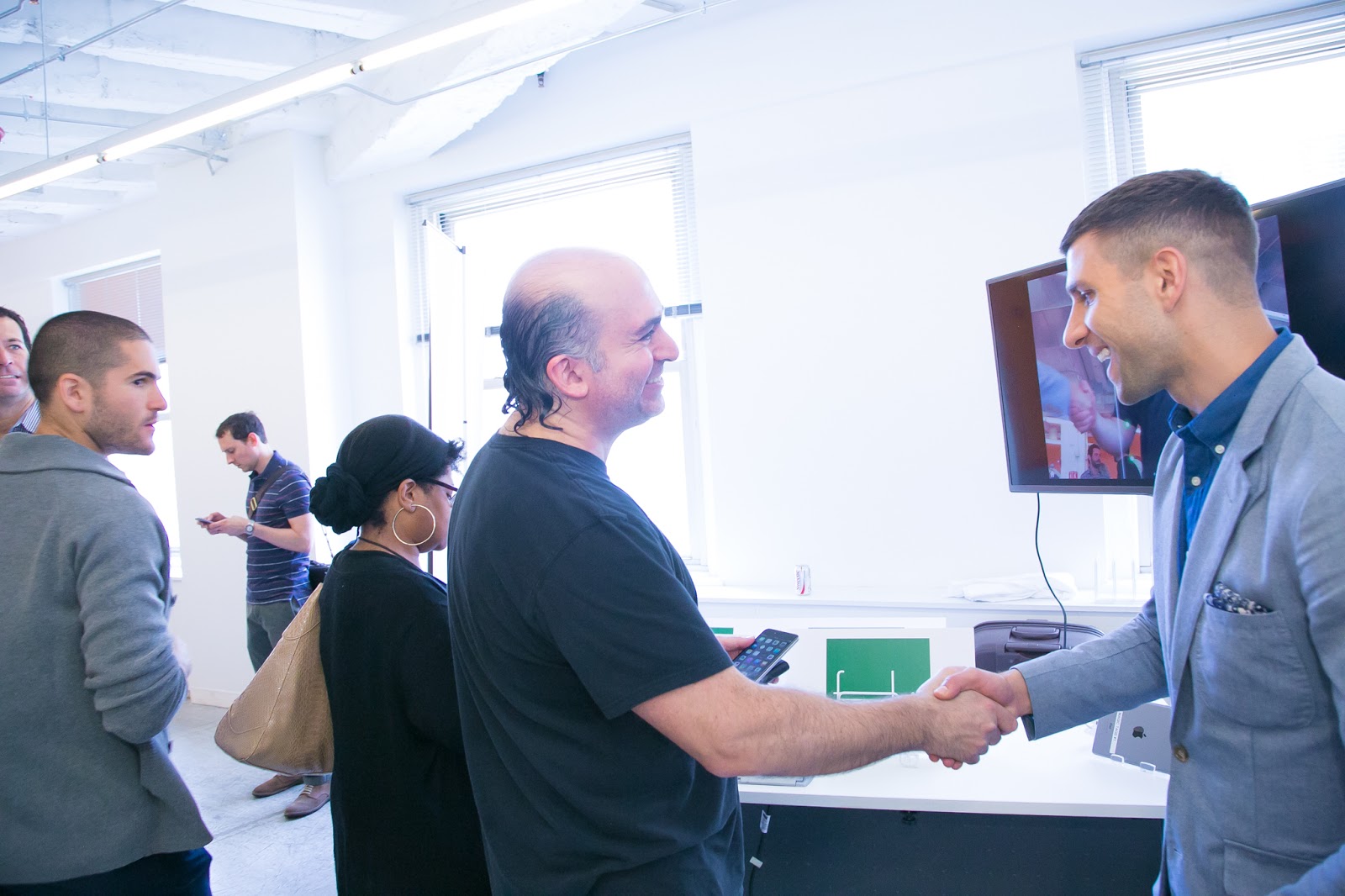
1871 CEO Howard Tullman (center) poses with Freshii’s Matthew Corrin (right) and Alex Blair at the 1871 Freshii grand opening. FRESHII

At first glance, the new Freshii store in downtown Chicago looks like any other location of the health-oriented chain. It sports vibrant digital menu boards, sculpted wood tables, and industrial-chic glass chandeliers hanging from an exposed ceiling. Huge, white letters in a friendly font proclaim, “Eat. Energize.,” which is the Toronto-based fast casual’s motto.
But signs with challenges like “How will you use tech to innovate payment?” hint that this Freshii is doing a lot more than serving wraps and bowls.
This Freshii is located in 1871, a well-known tech hub in central Chicago. Hundreds of tech companies, ranging from marketing to healthcare firms, rent sleek spaces on the 12th floor of a massive art deco building. There, they develop products and bounce ideas off each other. As of late September, 1871 is ground zero for Freshii’s unique tech collaboration initiative, Project Pioneer.
Project Pioneer is a contest that invites entrepreneurs, including those in 1871, to submit ideas for how technology can improve and streamline Freshii. Proposals must fall into one of eight categories: menu, disposal, efficiency, lighting, refrigeration, payment, team, and seating. Chosen ideas are put into practice at the 1871 location and potentially other stores.
Alex Blair, owner of the 1871 Freshii, calls his store a test kitchen. If things go well there, he says, the Project Pioneer idea could be implemented in Freshii’s 30 other Chicago stores. If things go really well, it could be applied system-wide to all Freshii stores in 15 countries. Project Pioneer entrants get credit if their ideas are implemented in stores; compensation and the price of implementation are still being worked out.
“We’re so excited to hear more from our customers and our fans, to let the Freshii fanatics lead the charge with innovating and improving our brand,” Blair says. “It keeps us having a fresh eye on our business, keeping us dynamic and on our toes.”
Pay Your Selfie is one technology product that Freshii has adopted from Project Pioneer. The app, whose developer is headquartered in 1871, pays people a small amount for sending in their selfies. Brands working with the app use the photos to learn more about their customers. The Pay Your Selfie team heard about Project Pioneer during the 1871 Freshii launch event and immediately filled out the application, says Kristen Holman, cofounder of Pay Your Selfie. They pitched Pay Your Selfie as a menu innovation and showed the Freshii team how their app could benefit the business.
“Freshii knows what happens when [customers] are in the store. What they don’t know is what their customers do when they’re outside of the store,” Holman says. Through the Pay Your Selfie partnership, Freshii can see other foods people eat when trying to be healthy on the go and ask if the menu aligns with customers’ tastes and perceptions of healthy foods. For example, if the selfies show customers drinking a lot of juice or eating mangoes regularly, Freshii can tweak its menu to feature more juices or salads with mango.
Freshii was sold on Pay Your Selfie. “They submitted it, we loved it, we accepted it, and we’re doing it,” Blair says. “We’re about to get started on an even bigger partnership with them because we’ve loved the results so far.”
At press time, the 1871 Freshii has only been open four months and Pay Your Selfie is the only Project Pioneer enterprise to have been implemented. Others are under consideration. Another of Blair’s favorite suggestions so far is a program in which digital menu boards are updated in real time. Freshii’s ingredients are so fresh that it can be challenging to keep everything in stock, so an instantly updated menu would keep customers informed.
Project Pioneer has yielded a wealth of submissions. Blair estimates that about 20 percent are from customers who have great ideas but not concrete solutions. Seventy percent are from members of 1871 who suggest ways Freshii might use their technology. The remaining 10 percent of submissions are from people with no connection to 1871.
It’s no coincidence that the majority of submissions come from 1871. Its hundreds of techies are also especially open to and familiar with the kind of collaboration that Project Pioneer encourages. Howard Tullman, CEO of 1871, credits the environment.
“[Between] the demos, the new technologies, we’ll do a thousand events this year,” he says. “I think that’s how these conversations get started. That’s really the driver.”
Freshii has a history of embracing innovation, with a noted social media presence and involvement in other tech startup initiatives such as the Fresh Startups program, which it launched with innovation firm Kinetic CafĂ© in 2013. More recently, Freshii sought out a position in 1871 because of the hub’s innovation, energy, and variety of tech fusion initiatives, Blair says.
Part of what’s made the Freshii partnership with 1871 successful is the two parties’ similar philosophies toward tech. Tullman says that, like Freshii, 1871 looks at traditional paradigms with fresh eyes.
Blair sees technology being integral to Freshii’s continued success and growth. Technology can help educate Freshii’s customers on healthy foods and how long it takes to make the meals. It can also shorten prep time and bring in more local foods. “Anything we can do to make [the process] more efficient and productive will only benefit the consumer in the end,” Blair says.
It also benefits other innovators.
“I wish that everybody would ask for ideas,” Holman says. “This is a one-of-a-kind company for saying, ‘Please come to us with your innovations, we’re really curious.’ And that is incredibly refreshing.”

Wednesday, September 23, 2015

FRESHII OPENS INNOVATION HUB AT 1871 WITH GREAT, HEALTHY FOOD TO BOOT ! !


Freshii Opens Its Ultimate Test Kitchen With Tech Contest

Fast Casual Chain Seeks Fresh Ideas For New Spot in Tech Hub

By Jessica Wohl. Published on September 23, 2015.  


Freshii, a fast-growing restaurant chain focused on fresh ingredients, is diving into the tech scene with a unique spin on a test kitchen.
.
The chain's newest location sits in 1871, a tech incubator located on the 12th floor of Chicago's massive Merchandise Mart.

Franchisee Alex Blair said the purpose of setting up shop at 1871 is to be surrounded by startups and innovators.

"If they've got something that's innovative for us, we can apply it and use it to transform our business. So it's a great tool at our fingertips to have all of these young ideas," said Mr. Blair, who has four Freshii locations including the 1871 location, which opens to the public Thursday.

Opening at 1871 gives Freshii an easy way to reach busy entrepreneurs, while also, as Mr. Blair puts it, "being able to use it as kind of a technology test hub." Still, Freshii isn't satisfied with searching only within the walls of 1871 for tech ideas. So it has launched a contest to search for innovations it can use to improve restaurant operations.

The project, which winks at coders with the name PROJECT < / PIONEER >, asks people to describe how they will use tech to innovate. There are eight categories: disposal, efficiency, lighting, menu, payment, refrigeration, seating and team.

Winning ideas will be tested at the 1871 restaurant. If successful, they could roll out across the chain, which has locations in 15 countries.

Freshii is the latest restaurant company to look outside for insights. Earlier this year, McDonald's went to SXSW seeking insights from tech entrepreneurs. The Golden Arches also opened a digital office in downtown Chicago to complement its San Francisco tech hub and attract tech talent. McDonald's Chicago office is steps away from 1871.

The Freshii restaurant at 1871 features a Metropolis coffee bar to fuel the coders, engineers and others who work at and visit the tech hub, along with Freshii fare such as salads, bowls and burritos. 

Tables from the Intelligentsia coffee shop that previously occupied the space were remade into a sign featuring Freshii mantras such as "Let's eat without regret" and "Let's embrace quinoa."


Saturday, August 22, 2015

Freshii Targets Target

At test Target cafes, hot dogs out, salads in

http://www.gannett-cdn.com/-mm-/dd8b1baf67130a1edc52e1868cb7f1ece5f42a54/r=26&c=26x26/local/-/media/USATODAY/staff/images/v2/Malcolm_Hadley.pngHadley Malcolm, USA TODAY 11:14 a.m. EDT August 21, 2015


A rendering of Freshii at Target. The fast-casual chain will open in nine Target stores this fall as part of a test Target is doing to offer healthier, fresher foods in stores.(Photo: Freshii)


For Target customers in 14 test stores, there'll be no more munching on big-box staples like hot dogs and gooey nachos while they shop this fall.

Instead,  they'll be able to choose from a wider array items, including "artisan style" pizza, fresh salads with ingredients such as kale and edamame, and pressed juices with beet and carrot.

Starting in October the company will roll out a new cafe concept  — fast-casual chain Freshii will go into nine stores, while Pizza Hut will open restaurants in three stores featuring a limited menu of "artisan" pies, such as margherita and barbecue chicken. Two Minneapolis stores will get outposts of D'Amico & Sons, a local Italian restaurant whose founders have been semifinalists for a James Beard award multiple times and whose menu includes toppings like organic goat cheese and arugula.

About 1,700 out of Target's nearly 1,800 stores have cafes. In the test markets, the cafes will be replaced with either a Freshii, a D'Amico & Sons, or Pizza Hut.

The test is the first major change to Target's food strategy since hiring new head of grocery, former Safeway executive Anne Dament, in April, but the idea has been underway since shortly after CEO Brian Cornell took the helm last August, says Tina Tyler, Target's chief stores officer. Cornell has made food a bigger priority for Target, with plans to increase its offering of natural and organic food products and local brands.

Target decided to go in a new direction with its cafes after hearing from customers who wanted higher-quality food and more of a fast-casual atmosphere, Tyler says. Currently, about 40% of Target customers visit the cafe while shopping. But the test is less about boosting that figure and more about showing customers that the brand is serious about health and wellness, Tyler says.

Right now, most stores feature a Target-branded cafe with a menu of decadent junk food including popcorn, pizza, hot dogs, nachos and Icees. The test markets will get rid of those options.

"We think this takes us a giant step in the direction of making a much better first impression," Tyler says.

Target has yet to make any significant announcements about how its grocery strategy will change in the coming months, but wellness is a core focus and one where the brand has seen significant success in the past year. Style, baby, kids and wellness — areas where Target has been investing in new products and improved store presentation — saw same-store sales grow three times as fast as the company average in the second quarter ended Aug. 1, the company reported this week. ​

Competition for customers who want fresh and local food is fierce, and mainstream retailers aren't immune to the heat food companies are feeling to use more wholesome ingredients. Even drugstores like CVS are stocking food aisles with more organic products and options that boast being gluten free or having no artificial ingredients.

Food may be a low-margin business, but it's also a traffic driver — it accounts for more than 20% of Target's business — and one that could help boost sales if customers choose to both eat and shop, says Efraim Levy, an equity analyst who follows Target for S&P Capital IQ.

"If they can enhance frequency of visits to the stores, that’s an opportunity to accelerate revenue growth," he says.


Though Brian Yarbrough, a consumer research analyst with Edward Jones, doubts the new cafes will be responsible for driving significant store traffic, they will likely appeal to Target's customer base, 
which is more affluent than a typical big-box shopper. "Their core customer ... is a little bit of a higher-end customer than Walmart," he says, "and that's what they want: organic, specialty items, more exclusives."

Total Pageviews

GOOGLE ANALYTICS

Blog Archive