

HINDSIGHT - WRITE SOMETHING WORTH READING ABOUT OR DO SOMETHING WORTH WRITING ABOUT
Showing posts with label MENARDS. Show all posts
Showing posts with label MENARDS. Show all posts
Wednesday, May 14, 2025
Tuesday, May 13, 2025
LOOP NORTH NEWS


What a retailer’s rebate reboot tells you about the pricing game
Menards just changed the rules on its longstanding rebate program – in the consumer’s favor. An act of kindness...or cleverness?
(Above) A Menards store in West Lafayette, Indiana. Photo by Huw Williams.
May 13, 2025 – For years I’ve been complaining about the sneaky merchants who have continued to discreetly place extra charges on our meals, product purchases, and various services based on a variety of rationales, including COVID charges, charges for providing employee health care benefits, credit cards surcharges, and all manner of in and out fees for airport transportation. The newest, at the coffee shop down the street, is a 50-cent upcharge per egg in any dish you order, which reflects the sharp increase in the cost of eggs.
Some of these places will remove certain charges if you ask, but, of course, the language disclosing this option is so tiny and buried at the bottom of the receipt that it’s basically invisible. Plus, you need very thick skin to stare down the various cashiers, waitstaff, and even nearby customers when you make even a modest stink over a few bucks.
Not everyone knows, apparently, that the pandemic ended long ago. And it’s especially precarious if you’re standing in a pick-up line confronting a tablet suggesting that you add 25 percent to your tab for the person handing you a bag of goodies that they didn’t prepare, select, or wrap. But such is our life and the cost of commerce these days.
A happy surprise at Menards
So, it was with considerable joy and wonder that I accidentally and quite recently stumbled upon a subtle and unadvertised change for the better at Menards, which is a home improvement retailer based in Wisconsin. To appreciate the magnitude and complexity of this change, a little history is necessary.
For many years, Menards has broadly pitched and promoted in multiple media channels that its shoppers are afforded a remarkable benefit. Everything they bought – every time they visited the store – would be subject to an 11 percent rebate. Each store receipt included a rebate receipt, and customers could fill out a form and mail the receipt to Menards.
 | Some weeks later the customer would receive a credit voucher for the dollar amount of all the rebate forms they had submitted, which they could spend in the store. Wikimedia |
To be honest, I always thought that this was slightly sleazy because the average rebate was barely more than the cost of postage and the aggravation of completing the form and mailing it. Submitting a rebate receipt for one dollar that cost 73 cents in postage plus the time and envelope wasn’t much of a deal. To make any economic sense, you would actually need to aggregate several of the rebate forms or consolidate your purchases into large quantities in fewer visits to make the process worthwhile.
The math behind the rebate strategy
Menards has never disclosed how many rebate requests are submitted or what percentage of the annual purchases were ever connected to specific rebates, but I always assumed that the store came out miles and many dollars ahead because, due to our chronic laziness, disorganization, and procrastination, millions of dollars of rebates were never claimed.
Obviously, this strategy must be very lucrative because otherwise the company could simply decide to reduce its in-store prices (as other competitors have) and drop the rebate program.
Anyone in retail knows that it’s not all that hard to lower prices; what’s hard is to be able to afford to lower those prices. Much smarter to shift the burden of performance onto the customer. Jacob Lund Photography |  |
As it happens, the whole pain and suffering of the rebate procedure wasn’t even the catchiest part of the deal. If you read each rebate receipt carefully, it said that you had a very limited time (often just a couple of weeks) to mail the rebate documents, or you were out of luck. And each receipt had a different expiration date, which made tracking them much more difficult. This short duration redemption window and the staggered expiration dates made it difficult to aggregate multiple trips to the store (which may or may not have been necessary) and easy to forget that some of your older rebate receipts were about to expire as worthless.
New rules favor the consumer
That’s why I was pleased and somewhat amazed that Menards recently changed the game in the customers’ favor by allowing a one-year period for any rebate redemption. My first thought was that this was either due to their lawyers’ advice or some litigation that attacked the rebate program as misleading or deceptive. This change is a huge boon to customers and makes it far easier and more likely that they will receive the financial benefits that were represented to them.
But, at the same time, it seems like Menards will now have some very complex challenges in trying to estimate what kinds of financial operating costs and new tax exposures the outstanding rebates and the timing of the redemptions might represent. This is why I wondered – especially given the way that the change was implemented – whether the move was voluntary, anticipatory, or required by some legal process. The company did not respond when I submitted some short questions and asked for further explanation of their rationale for the change.
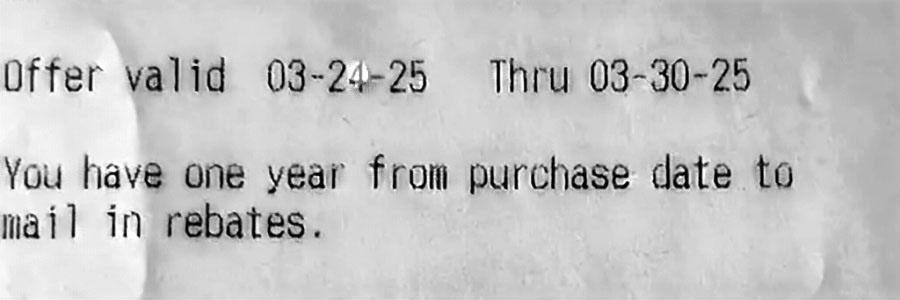 |
| (Above) Part of a Menards rebate receipt. |
Menards has been sued on various matters relating to rebates, but most of the litigation ended up in arbitration, which Menards’ customers automatically and largely unknowingly consent to by shopping there. So, we really don’t know where things stand or what drove the change.
The bottom line for now is that the change in the submission timelines for the rebates is very favorable to customers who track their purchases, retain and aggregate their rebate receipts, file the required forms and documents in a timely fashion, and wait patiently to be mailed their store credits.
The mystery is why Menards would abruptly institute such an attractive and favorable change in their program and their policies and then basically not say a word to their customers about it.
How to be smart about promotions and rebates
There are a couple of broader lessons that every business should keep in mind as you embark on any new discount promotion – especially in these crazy times when no one knows what kinds of tariffs they will be facing – and how directly those will impact your costs.
As noted above, prices are easy to lower – living with the reduced profit margin is much harder.
 | More importantly, any discount scheme trains your customers to wait and to buy based on price instead of brand, quality, or value. Monkey Business Images |
Smart consumers recognize that anything worth having is going to have a fair price. Prices may make a sale, but quality and service are what make a customer. Quality is long remembered after cost is forgotten.

NEW INC. MAGAZINE COLUMN FROM HOWARD TULLMAN
Menards
just changed the rules on its longstanding rebate program–in the consumer’s
favor. An act of kindness or cleverness?
EXPERT OPINION BY HOWARD TULLMAN, GENERAL MANAGING PARTNER, G2T3V
AND CHICAGO HIGH TECH INVESTORS @HOWARDTULLMAN1
MAY 13, 2025
For years I’ve been
complaining about the sneaky merchants who have continued to discreetly place
extra charges on our meals, product purchases and various services based on a
variety of rationales, including Covid charges, charges for providing employee
health care benefits, credit cards surcharges, and all manner of in and out
fees for airport transportation. The newest, at the coffee shop down the
street, is a 50 cent upcharge per egg in any dish you order, which reflects the
sharp increase in the cost of eggs.
Some of these places
will remove certain of the charges if you ask, but, of course, the language
disclosing this option is so tiny and buried at the bottom of the receipt that
it’s basically invisible. Plus, you need very thick skin to stare down the various
cashiers, waitstaff, and even nearby customers when you make even a modest
stink over a few bucks.
Not everyone knows,
apparently, that the pandemic ended long ago. And it’s especially precarious if
you’re standing in a pick-up line confronting a tablet suggesting that you add 25% to your tab for the
person handing you a bag of goodies that they didn’t prepare, select or
wrap. But such is our life and the cost of commerce these days.
A happy surprise at
Menards
So, it was with considerable joy and wonder that I
accidentally and quite recently stumbled upon a subtle and unadvertised change
for the better at Menards, which is a home improvement retailer based in
Wisconsin. To appreciate the magnitude and complexity of this change, a little
history is necessary.
For many years, Menards
has broadly pitched and promoted in multiple media channels that its shoppers
are afforded a remarkable benefit. Everything they bought – every time they
visited the store – would be subject to an 11 percent rebate. Each store receipt
included a rebate receipt, and customers could fill out a form and mail the
receipt to Menards; some weeks later the customer would receive a credit
voucher for the dollar amount of all the rebate forms they had submitted, which
they could spend in the store.
To be honest, I always
thought that this was slightly sleazy because the average rebate was barely
more than the cost of postage and the aggravation of completing the form and
mailing it. Submitting a rebate receipt for one dollar which cost 73 cents in postage
plus the time and envelope wasn’t much of a deal. To make any economic sense,
you would actually need to aggregate several of the rebate forms or consolidate
your purchases into large quantities in fewer visits to make the process
worthwhile.
The math behind the rebate
strategy
Menards has never
disclosed how many rebate requests are submitted or what percentage of the
annual purchases were ever connected to specific rebates, but I always assumed
that the store came out miles and many dollars ahead because, due to our
chronic laziness, disorganization, and procrastination, millions of dollars of
rebates were never claimed.
Obviously, this strategy
must be very lucrative because otherwise the company could simply decide to
reduce its in-store prices (as other competitors have) and drop the rebate
program. Anyone in retail knows that it’s not all that hard to lower prices; what’s
hard is to be able to afford to lower those prices. Much smarter to shift the
burden of performance onto the customer.
As it happens, the whole
pain and suffering of the rebate procedure wasn’t even the catchiest part of
the deal. If you read each rebate receipt carefully, it said that you had a
very limited time (often just a couple of weeks) to mail the rebate documents,
or you were out of luck. And each receipt had a different expiration date,
which made tracking them much more difficult. This short duration redemption
window and the staggered expiration dates made it difficult to aggregate
multiple trips to the store (which may or may not have been necessary) and easy
to forget that some of your older rebate receipts were about to expire as
worthless.
The new rules favor the
consumer
That’s why I was pleased
and somewhat amazed that Menards recently changed the game in the customers’
favor by allowing a one-year period for any rebate redemption. My first thought
was that this was either due to their lawyers’ advice or some litigation that
attacked the rebate program as misleading or deceptive. This change is a huge
boon to customers and makes it far easier and more likely that they will
receive the financial benefits that were represented to them.
But, at the same time,
it seems like Menards will now have some very complex challenges in trying to
estimate what kinds of financial operating costs and new tax exposures the
outstanding rebates and the timing of the redemptions might represent. This is
why I wondered – especially given the way that the change was implemented –
whether the move was voluntary, anticipatory, or required by some legal
process. The company did not respond when I submitted some short questions
and asked for further explanation of their rationale for the change.
Menards has been sued on
various matters relating to rebates, but most of the litigation ended up
in arbitration, which Menards customers automatically and largely unknowingly consent to by shopping there. So, we
really don’t know where things stand or what drove the change.
The bottom line for now
is that the change in the submission timelines for the rebates is very
favorable to customers who track their purchases, retain and aggregate their
rebate receipts, file the required forms and documents in a timely fashion, and
wait patiently to be mailed their store credits.
The mystery is why
Menards would abruptly institute such an attractive and favorable change in
their program and their policies and then basically not say a word to their
customers about it.
How to be smart about
promotions and rebates
There are a couple of
broader lessons that every business should keep in mind as you embark on any
new discount promotion – especially in these crazy times when no one knows what
kinds of tariffs they will be facing – and how directly those will impact your
costs.
As noted above, prices
are easy to lower – living with the reduced profit margin is much harder. More
importantly, any discount scheme trains your customers to wait and to buy based
on price instead of brand, quality or value.
Smart consumers
recognize that anything worth having is going to have a fair price. Prices may
make a sale, but quality and service are what make a customer. Quality is long
remembered after cost is forgotten.
Subscribe to:
Posts (Atom)