Showing posts with label BUILT IN CHICAGO. Show all posts

Monday, October 26, 2015

4 TOP REASONS WHY CHICAGO IS BECOMING THE NEW TECH HUB

4 TOP REASONS WHY CHICAGO IS BECOMING THE NEW TECH HUB

ParadigmNEXT: Top 4 Reasons Why Chicago is the New Tech Hub
The entrepreneurial spirit in Chicago has never been more alive. Not even a four game sweep, can keep some of Chicago’s brightest minds down. With the emergence of tech startups all across The Windy City, the big moguls from Silicon Valley, and New York are starting to take note.
Here at ParadigmNEXT we are constantly taking the pulse of Chicago’s tech startup community. As Chicago’s tech industries continue to evolve, it is important as a startup, to maximize on all of the great opportunities of living and working out of Chicago have to offer. Below, are some of the reasons we, here at ParadigmNEXT, have come to find Chicago as a major Tech Hub in the country.

Recent Grads Gravitate to Chicago

IMG_4707Spread across the Midwest are some of the nation’s most esteemed universities.Matt Moog, the founder of Built In Chicago, an online resource for tech startups, believes that Chicago has benefited from all the recent grads moving here. “University of Illinois, Purdue, University of Michigan, Michigan State, Wisconsin, etc. are all graduating really qualified engineering students, marketing students, entrepreneur students etc.,” said Moog.
Chicago has become a hot destination for recent grads not only for the low cost of living, but also because it has a rich industry diversity. Nick Reasner, ParadigmNEXT’s Business Developer Manager, moved here after attending Indiana University, because Chicago presented opportunities other major cities did not. “Chicago is the best of both coasts and offers tremendous opportunities for both small and large companies.”

Big City with a Small-Town Feel

Seasoned vets in the tech startup community are collaborating with eager entrepreneurs Howard Tullman 1871to help bring their vision into the forefront. A staple in the coworking space is 1871, and CEO Howard Tullman has plans to expand the community even more. Rather than only focusing on the tech and digital industries, Tullman sees the potential in all types of startups. “In the three years that we’ve been around what’s changed is that there are no businesses left that aren’t technology enabled,” said Tullman. 1871 has already introduced companies of Food, Education, Finance and Healthcare, and plan to incorporate even more areas after the expansion. 1871 along with the other Chicago office incubators have proved to be a great starting place to grow your build. But, even during off hours, there are online sites that Chicago startups can take advantage of.
Incubator PictureThrough any stage of a startup process, small businesses can find value in Built In. “Built In Chicago should be viewed as a sort of employer branding platform, a way for even the smallest young companies to get out there and get known…a combination of blog posts and profiles and job posts, they [startups] can start to become known to the tech and startup community, as a promising new company,” said Moog.

Chicago Startups are Revenue Driven

There has been a trend throughout startups in Chicago. Rather than adapting the B2C (Business to Consumer) structure, companies are more B2B (Business to Business) focused. In Chicago, for the most part, venture capitalists track results by how profitable the company is. The markets of San Francisco, and New York set to establish consumer acquisition, before worrying about making money.
“Entrepreneurs in Chicago aren’t just looking to grow users with revenue being an afterthought; most companies in Chicago are revenue first focused and as such are drawing in great VC’s and Angels that are looking into more financially viable companies,” said Anatoly Nirshberg, ParadigmNEXT’s Managing Director.
ParadigmNEXT has seen promising startups in Chicago, with this exact businessProxfinity mentality. Proxfinity is revolutionizing the way people connect at career fairs, educational conferences, social events and more. Their founders, Lisa Carrel and Christine Hutchinson have a strong background in B2B, and plan on implementing the same structure with Proxfinity.
Page Vault is also committed to building a strong revenue model. Their servicePage Vault accommodates legal professionals, by archiving web page content. Rapidly growing, Page Vault was recently proud to announce they were nominated for the 2015 Chicago Innovation Awards.

Bright Future Ahead

As a Digital Marketing agency, the team at ParadigmNEXT is excited to see the continued growth of Chicago tech. At the core, Chicago is a place for startups to flourish because of all the different factors working in unison. The young talent which fills the city, great mentor relationships and the Chicago business ethics, are only a few of the reason why Chicago is becoming a major tech hub.
“We call this [Chicago] the rise of the rest, and it means that there are many opportunities, plenty of technology, plenty of new business going on…Chicago represents the best place in the country for people to start their businesses,” said Tullman.
By: ParadigmNext https://paradigmnext.com
ParadigmNEXT, Inc. is an innovative and creative Chicago digital marketing agency providing a wide range of internet marketing services. They provide digital branding and brand management, identity, integrated marketing, social media marketing & strategy, art direction, website design & development, startup incubation, commercial video production, product development, and commercial storefront development services to a wide array of clients ranging from bootstrapped startups to successful longstanding companies. Follow them on Google+.

Friday, June 06, 2014

An open letter to women and men in tech from Maria Katris - CEO of Built In Chicago

Maria Christopoulos Katris
I THOUGHT THAT THIS WAS AN IMPORTANT POST TO SHARE.  I HAVE WORKED WITH MARIA  ON PROJECTS AND AS A MEMBER OF HER ADVISORY BOARD AND ON MORE LATE NIGHTS AND FRANTIC WEEKENDS THAN ANYONE SHOULD EVER HAVE TO. SHE IS ALWAYS THERE WHEN YOU NEED HER. THAT'S JUST THE NATURE OF THE START UP WORLD. THROUGHOUT THE YEARS, SHE HAS BEEN A COMPLETE PROFESSIONAL, A GOOD FRIEND AND A TREMENDOUS AND TALENTED LEADER. 


An open letter to women and men in tech

To all women and men in tech,
For those who know me well I am not one to come out publicly on many issues, yet given the commentary, articles and actions of both sides regarding the Techweek email sent earlier this week I honestly felt it was my obligation as a mother, entrepreneur and female CEO to respond and share my personal experience and advice with other female and male entrepreneurs. The below may not be what you expected but I do hope it resonates and helps to move everyone forward. Everyone is responsible.  
Why I am writing this? I am a mom to two (soon-to-be three) girls, a wife to a successful husband raised by a single, working mother and grandmother, sister to a female plastic surgeon and a daughter to immigrant parents who are both pharmacists and entrepreneurs. In our family, male or female, we were taught to work hard, stay humble, pay our dues and reach for the stars - regardless of sex. So yes, it does start with parenting and how you choose to raise your kids from a young age. Nothing matters more and this is why I feel strongly about the below.

What Works (to promote female entrepreneurs)
1. At Home...
  • Raising daughters to believe they can be anything they want to be and pushing them in this direction.
  • Raising sons who respect their mothers, sisters, aunts and female friends as equals.
  • Having fathers and mothers alike co-parent their kids and get as involved irregardless if one parent stays home (because let's be honest here, being a stay-at-home parent is a fulltime career). 
2. And In The Workplace...
As investors, invest in entrepreneurs regardless of sex-actually write a check!
I recently went through the fundraising process (consider this the most formal announcement but yes, we raised a seed round from some awesome investors including Joe Mansueto, Dundee VC, The Pritzker Group, David Cohen, Ellen Carnahan and Jumpstart Ventures) and look forward to growing the Built In network) and feel confident I can speak intelligently on this one as I encountered it all. 
I was fortunate to have Ellen Carnahan, a female investor, be the first "yes" to invest in our round before even seeing a full deck. Why? Because Ellen has known me personally for over three years, has watched me grow Built In and immediately saw the vision for the company. This wasn't philanthropy and this wasn't Ellen being nice. She saw the potential and could see my passion. She had a successful career in Venture Capital and now spends all of her time investing in, and mentoring, the next generation. And she was willing to write a check.
On the other end, both Joe Mansueto (Founder & CEO of Morningstar) and Mark Hasebroock (Partner, Dundee VC) said "yes" after meeting and hearing the Built In story, progress and vision because of the business, our team and the metrics - not because they knew me well personally-they judged the business on its merits. Joe has been following Built In through quarterly updates provided by Matt Moog (Built In Founder and Chairman). Once, at an event, Matt Moog shared with me that Joe stood in a boardroom of mostly male CEOs and said how every business should be built like "Built In".  Now, that works. Joe looks at metrics, is humble and hardworking. Joe did not care nor did he comment on the fact that I am the CEO - he was commenting on the success of the company. It is these discreet moments that help to define a company and propel female CEOs forward.  It is a highly respected male CEO publicly touting the success of a female-run company. Needless to say, Joe led our round and I will never be able to fully articulate the incredible amount of respect I have for him. 
As a female, surround yourself with males and females who support your career and steer away from those who don't
So it's been written about before, but as a female it is super important to surround yourself with males who view you as an equal, and women who are not threatened by your success.  Let me elaborate...
Matt Moog hired me to run something he started after knowing me for less than six months. Matt saw my passion for Built In and took a chance.  Why? I personally believe it has a lot to do with Matt's innate respect for successful females and mothers. Matt's wife, Lucy, is incredibly bright and had an amazing career in politics before choosing to stay at home and raise their three boys. Matt also has a track record of working with successful women and mothers as he had Jolie Fleming as his right hand for years at both CoolSavings and Viewpoints.  
But why I have an incredible amount of respect for Matt's support of my career is in the details: 
  • He gave me the title of CEO because he wanted everyone else to understand that I ran the company, not him.
  • When a certain reporter in town kept referring to Matt as "running Built In Chicago" Matt was the first to correct him and say, actually "Maria is the CEO."
  • When male CEOs in the community sent emails introducing Matt as the CEO of Built In Matt would quickly correct them and bring me into the conversation..it took about a year for everyone to accept this fact but had it not been for Matt, all would continue to view me as an event planner or Matt's assistant:)
  • When Matt was invited to moderate a panel of Governors and could not attend, he volunteered me into this role. 
  • When Matt could not participate in a panel event with the Mayor, he volunteered me again. 
And this is why I have a tremendous amount of respect and gratitude for Matt and why more males need to take cues from his actions.  
On the flipside, I surround myself with other successful female entrepreneurs and leaders such as Amanda Lannert and Desiree Vargas Wrigley.  Why? Because they are mothers, wives and CEOs who have built successful businesses and I admire them because we talk about our respective businesses, challenges, etc.  We don't sit around and discuss how it sucks to be a female CEO and how we got the short end of the stick.  We all had the same opportunities (albeit a lot of inappropriate comments along the way) as our male counterparts and are all facing the same challenges (with some additional challenges like being pregnant while fundraising).
So here you have concrete examples of what works.  It is not about having conversations, isolating women, establishing all-women groups, panels, forums, incubators, etc.  It's about treating women as equals and SHOWING it by investing in them, inviting them to attend events mostly male-dominated, supporting their careers, etc.

What doesn't work and the challenges we have...
1. Segregation
I've heard multiple points of views throughout the years on "women in tech" and promoting female entrepreneurs and to be honest, each time, I roll my eyes and stay far away from the conversation.  It's not because I don't think women need to be supported it's because these tactics DO NOT work.  I have once in my career sat on an all-female panel and vowed to never do it again.  Why? Because it doesn't help, it actually hurts.  Separating out women and men further perpetuates the issue.  The whole point is to treat us as equals. Have you ever seen a panel titled "men in tech". 
2. Oh, the inappropriate comments.
While running Built In and also going through the fundraising process I encountered a lot of interesting comments which included the following:
"Is this a hobby?"
"Where do you want to be in 3 years, personally?"
"This is going to be hard, you will have to travel a lot"
"I really like you, and want to be supportive...."
"Hey hottie"
"You look good"
So what do I do? I stay far away from the males who treat me as their girlfriend or daughter (you will figure this out quickly as a female) and instead stay close to those who treat me as an equal and have productive conversations with me regarding business, life, investments, etc. 
Now, do these comments offend me and/or bother me? Sure. Do they stop me from running my business, accomplishing what I want to do, etc? No. And they never will. I would rather keep my head down, build a successful company and end my career mentoring and investing in younger entrepreneurs.  I do believe these comments are a distraction and unproductive. Everyone needs to talk less and act more.  And women and men alike need to recognize that the best progress will be made by continuing to build and operate successful businesses that are inclusive and treat men and women equally.
So with that, I will get back to building Built In and helping all of you build your businesses. Let's focus on content, not parties.  Let's focus on action, not words.
Maria

Sunday, April 06, 2014

1871 CEO HOWARD TULLMAN APPEARS on WHAT WORKS CHICAGO PANEL with MAYOR EMANUEL and other mayors

What Works: Chicago

In conjunction with POLITICO Magazine's yearlong reporting project, POLITICO will host its inaugural What Works event, the first in a national series of conversations around the future of cities. Can the Rust Belt really become the Tech Belt? Can robots save a city's economy and reinvent its jobs? Why isn't my city the next Silicon Valley?
 
We’ve lined up speakers who will explore how technology and data are redefining and rebuilding cities. Headline speakers include: Chicago Mayor Rahm EmanuelGary Mayor Karen Freeman-WilsonPittsburgh Mayor William Peduto, with special guests Maria Katris, CEO of Built In, Prof. Saskia Sassen, Columbia University and Howard Tullman, CEO of 1871.
 
When: April 9; 8:30 a.m.
Where: Chase Towers; 21 S. Clark St.; Chicago, Ill.
 
Join the conversation: Tweet @POLITICOEvents using #WhatWorks and for more information about the series, visit POLITICO Magazine's What Works hub.
 
Should you have any questions about the event, please e-mail: whatworks@POLITICO.com.
 
A message from our partner:
For more information on New Skills at Work Visit: www.newskillsatwork.com.

Thursday, December 19, 2013

The Economist: Chicago's technology sector - Start-up City


Chicago's technology sector

Start-up city
Dec 19th 2013, 15:35 by N.L. | CHICAGO


LESS than two years ago a new centre for digital start-ups, called 1871, opened up shop in Chicago. At first its 50,000 square feet of jazzy furniture, polished concrete and shiny glass were largely empty of people. Today things couldn't be more different as it thrums with entrepreneurs, laptops and lattes. Whiskery coders sit hunched on beanbags, tapping on Macbooks. In one spot a geek is on a video call. In another, two men are testing a circuit board while drinking coffee.

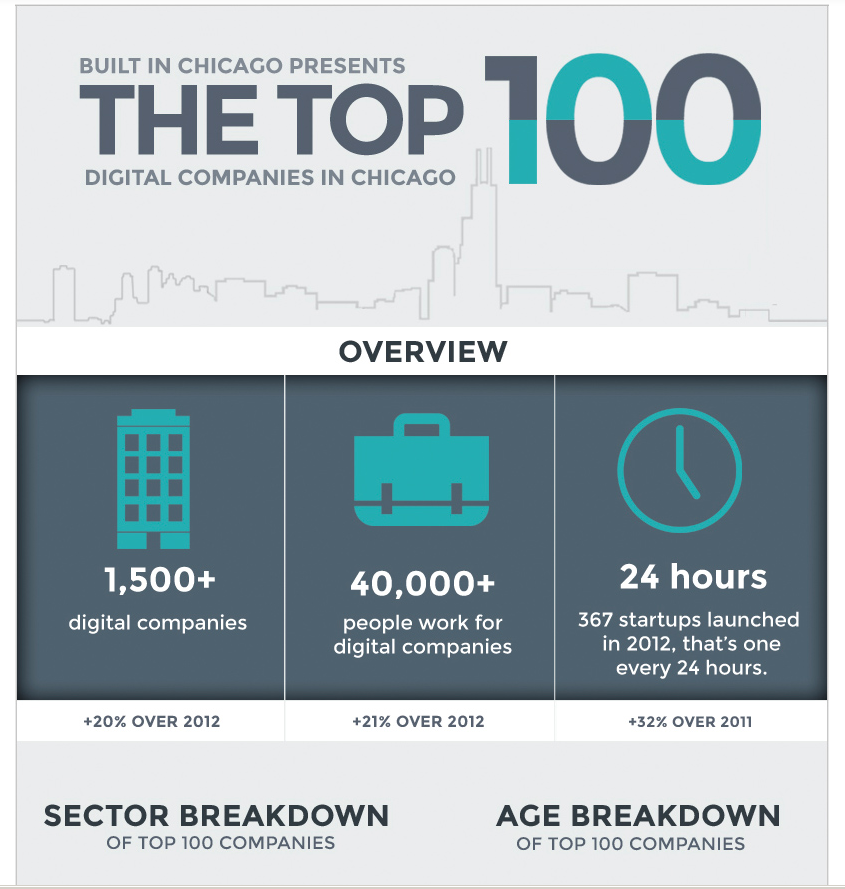
This co-working space is the most visible manifestation of a noticeable uptick in technology activity in the city. In 2012, a start-up company launched every 24 hours. The third quarter of 2013 was the digital-technology sector’s second best ever, with $265m raised. (Actual funding is probably far higher thanks to a non-disclosed investment in GrubHub, an online takeaway ordering service.) Three companies, Braintree, Train Signal, and Power2Switch, were acquired for a total of $845m according to Built in Chicago, a start-up website. Many other co-working spaces are springing up, too. The latest is called The Warehouse, and is being built by the founders of Groupon, a home-grown technology behemoth.

All this start-up activity is fascinating because venture funds used to refer to Chicago as the "flyover city". According to Patrick Spain, a local entrepreneur whose start-ups include Hoover's Inc, a research firm, among others, much has changed in recent years. He thinks 1871 has been critical as it has given the technology sector traction. The centre is a dynamic place where people with ideas can find out what is happening and get financial help and mentoring, he says: "All of a sudden you can get smarter, faster at no cost."  Many years ago, when Mr Spain was starting out, he needed to hire everyone he needed and it took millions of dollars to get to scale. "Today you can prove out a concept at under $1m and find the funding." 

A greater availability of venture capital has also probably helped the city's start-ups. As has a rich seam of local talent coming from Northwestern University, the University of Chicago, the University of Illinois and other institutions across the Midwest. (The problem has always been persuading the graduates to stay. The founders of Netscape, PayPal, Yelp and YouTube all studied at the University of Illinois but then left after graduation.) All of which means that Chicago is now ranked as one of the top ten cities in the world for starting a company, according to Startup Genome, which provides analysis on start-ups around the world.

There has also been a general change of tone. Bjoern Lasse Herman, the founder of Compass, which produces the Startup Genome report, says that in the past any Chicago start-up wanting venture capital would have been told to move to Silicon Valley. Now they are being encouraged to stay put.

Yet his report also suggests that the city has some weaknesses, most notably a conservative culture. Chuck Templeton, a local entrepreneur who founded Open Table, a restaurant-reservation site, is unfazed. Chicago, he explains, is not trying to be Silicon Valley or Boston. The city is good at being pragmatic. When Mr Templeton started Open Table he recalls that restaurants in New York and San Francisco would ask "who has this product?", while in Chicago they would ask "is this going to save and make me money?" Moreover, he says, companies in the city do not have the silly valuations sometimes seen on the west and east coasts, which means they do not feel obliged to pay more for talent than they need to. 

Being windy is good

Chicago’s reputation for being technologically conservative might be the flip side of having a large and diverse economy, with traditional industries such as manufacturing, retail, finance and agriculture. These are conservative businesses by heart, but all need to incorporate digital technologies. Jason Fried, an influential voice in the start-up scene whose company 37signals produces project-management software, says he does not think Chicago should try to be anything other than it is: "This should be the place where people build without funding, are scrappy and start up on their own." He also questions the way in which cities are ranked in terms of innovation. "In our industry we focus on a lot of the wrong things as success, such as rounds of funding raised," he says. "I see this mostly as failure. It means you need more and more money to survive, your customers are not paying, and you are not building a sustainable business." Mr Fried says he likes 1871, but reserves judgement for now on whether it is going to create many success stories.

Pragmatism and conservatism are its strengths, then, if not viewed through the myopic lens that compares every city with a strong technology sector to Silicon Valley. Indeed, another new report on the world's most competitive cities, points out that Chicago is an excellent alternative for companies currently looking for a world-class location for their software development activities. San Francisco and New York top the world's quality rankings, but are costly. 

Chicago’s technology sector also has the backing of its mayor, Rahm Emanuel. Mr Emanuel has overseen the city's first comprehensive technology plan, and he will go on the road in 2014 to recruit new technology graduates. He will also host a venture capital summit next summer right before the city's cool music festival, the Lollapalooza. Mr Emanuel says technology has been the fastest growing sector of the economy by far since he arrived in 2011, and he will double its size in the next decade. Statewide, technology jobs have been growing at 1.6%, faster than the national average of 1.1%. Even Purdue University, in Indiana, now offers a weekend MBA degree in town to turn science and technology workers into entrepreneurs. Chicago will never be Silicon Valley. That is a good thing.

Monday, November 25, 2013

Howard Tullman steps in as 1871 CEO


      Howard Tullman steps in as 1871 CEO

File 30889

Startup incubator 1871 has found new leadership in serial entrepreneur Howard Tullman, who currently serves as managing partner of G2T3V, LLC and Chicago High Tech Investment Partners. Expect the space, currently home to 240 Chicago companies, to focus deeply on digital and manufacturing and to have far greater reach.

Tullman said he’s focused on bringing new resources to the space plus a host of global partners, ranging from Indiegogo to Cisco and GE. Intent on turning the space from a room of entrepreneurs with great ideas to a factory of businesses with great products, Tullman said he will execute the following game plan:
  • Telecommunications capability: He said he wants startups  to communicate with the global community, so he’s making sure they will have the resources to do it. A potential Cisco partnership would make this possible.
  • Video capability: As chairman of Tribeca Flashpoint Media Arts Academy, Tullman has new age media in mind and wants a way for startups to market their messages to a greater audience in more visceral ways.
  • 3D printing: As startups turn from purely digital towards more tangible products, Tullman said he wants to make sure companies can build and prototype. A partnership with companies like GE would help 1871 manufacture.
  • Increased investment: Tullman said he knows that there’s space for new investment in the community and he is starting with talks with leadership at Indiegogo to help amplify not only outreach and marketing, but also investment inflow. 1871 will be the crowdfunding site’s Midwest headquarters.
All of this is in effort to make 1871 a global hub of innovation and concentrate the capabilities of the Chicagoland entrepreneurial community as it becomes increasingly infiltrated and complex, Tullman said. And while entrepreneurs can expect more resources in the space, they can also expect greater exclusivity.

“We want to be more focused,” Tullman said. “We want to be less focused on volume and more focused on companies that produce great products.”

Tullman’s entrepreneurial expertise has been developed over his 40-year career founding companies such as CCC Information and the Cobalt Group, which sold to ADP in 2010 for over $300 million. He has formed major strategic partnerships with corporations for Tribeca Flashpoint Academy and is credited with turning around culinary school Kendall College in 2003. He also owns venture fund G2T3V - whose investments he said he will be transparent about with 1871’s board to prevent any conflict of interest.

Tullman replaces 1871’s interim CEO Jim O’Connor, who will still be on the board of the Chicagoland Entrepreneurial Center – the nonprofit that oversees 1871. The incubator’s previous CEO was Kevin Willer, who founded Google’s Chicago office and now runs the venture firm, Chicago Ventures.

Tullman’s proven leadership experience has earned him the blessing of Chicago’s entrepreneurial and political leaders as he steps in the new role: “Howard Tullman is the perfect person to take 1871 to the next level,” said Mayor Rahm Emanuel in a statement.

Governor Pat Quinn said in a press release that “Howard knows what Chicago’s best and brightest need to push the innovation boundaries further than ever before.”

File 30892

Thursday, September 05, 2013

A Chat With Howard Tullman About His New VC Fund G2T3V

Amina Elahi

A Chat With Howard Tullman About His New VC Fund G2T3V

File 27992

News broke this week of a new VC fund taking root here in Chicago. The man behind the enterprise is none other than Howard Tullman, the serial entrepreneur, Inc. contributor and chairman of Tribeca Flashpoint Academy. (And these are only some of his titles.)

Storied as Tullman’s career is, his next move is certainly worth noting. Along with a gaggle of unnamed associates, he is launching G2T3V LLC, a $2 million venture fund. Investments will range from $25,000 to $50,000, although Tullman says some of his partners may go as high as $250,000, according to Crain’s.

I caught up with the notoriously busy businessman to find out more about how he prepares for this kind of work, what sort of companies interest him as potential investments and just what G2T3V means.

Why are you opening a new VC fund?
HT: It's a great time to start and fund new businesses and to support young entrepreneurs. Low costs of entry and development, early inexpensive trial opportunities, modest marketing costs, [and] quick failures or exits.

How do you prepare for this sort of enterprise?
HT: I have run a venture investment fund for more than a decade and invested personally in start-ups for 25 years.

What's behind the G2T3V name?
HT: No one knows the derivation of the name except The Shadow. [Writer’s note: Yes, I’m as intrigued and confused by this response as you are.]

What sort of companies will you be investing in?
HT: Companies in areas and industries where we have substantial expertise and operating experience to add value to our investments. Industries include media, entertainment, insurance, automotive, education, data analytics, customer satisfaction management, etc.

What do you hope to achieve through running G2T3V?
HT:  Great businesses, passionate people running them, healthy returns for our investors.

At 68, Tullman is long past the age many consider right for retirement. But with G2T3V only just starting, it’s hard to imagine this titan slowing down anytime soon. He says five years is his ideal amount of time to spend on any single venture, which makes you wonder what he’ll be doing in 2018. Knowing him, it’ll be something big.

Total Pageviews

GOOGLE ANALYTICS

Blog Archive