Sunday, November 02, 2025

Unspooling the Charred Scrolls of Vesuvius


Unspooling the Charred Scrolls of Vesuvius

How computer scientist Brent Seales triumphed on an impossible mission.

George Spencer

Oct 31, 2025

Odysseus overcame many obstacles during his 10-year voyage home. The hero of Homer’s ancient epic The Odyssey might have a modern-day counterpart — computer scientist Brent Seales MS’88, PhD’91.

A professor at the University of Kentucky–Lexington, Seales has made it his life’s work to accomplish a seemingly impossible task — to “virtually unwrap” hundreds, possibly thousands, of priceless scrolls that were buried and carbonized when Mount Vesuvius erupted in AD 79.

Sixty feet of superheated gas and rock smothered the coastal Roman resort town of Herculaneum in the Bay of Naples. Author Pliny the Younger fled the cataclysm and described it this way: “A dense black cloud was coming up behind us, spreading over the earth like a flood. Many besought the aid of the gods, but still more imagined there were no gods left, and that the universe was plunged into eternal darkness for evermore.”

Julius Caesar’s father-in-law, Lucius Calpurnius Piso Caesoninus, was likely the original owner of a three-story villa there. Statesmen like Piso often had libraries that contained as many as 40,000 scrolls.

Diggers discovered about 800 of those papyri, now known as the Herculaneum scrolls, in 1752. They look like charred, shrunken, burned pastries. At first scientists tried to unroll the brittle relics, a futile effort that caused many to crumble. “Turn’d to a sort of charcoal, so brittle, that, being touched, it falls readily into ashes,” wrote one early examiner.
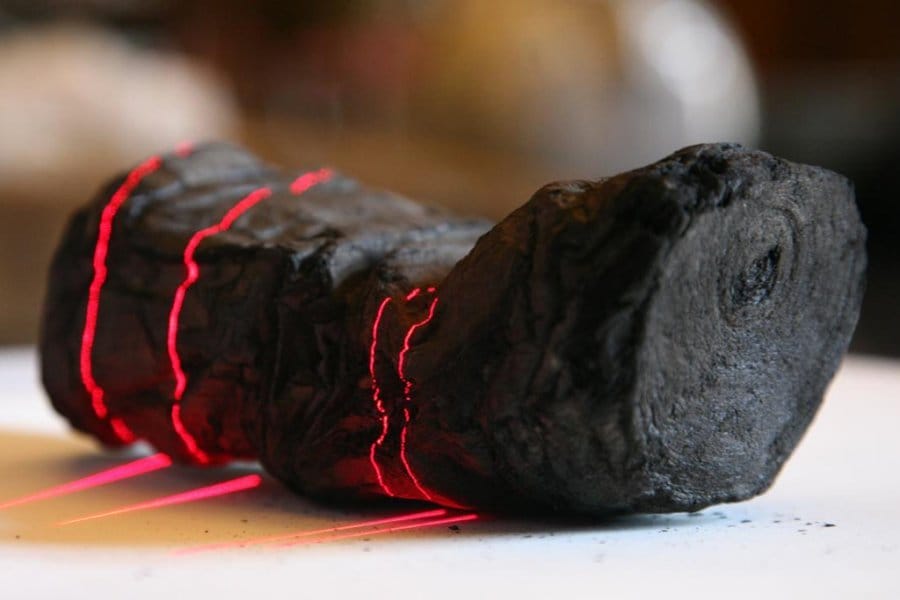
A lump of char in the vague shape of a scroll during the scanning process.


The carbonized scrolls are so brittle that unwrapping them would reduce them to ashes. EDUCELAB/UNIVERSITY OF KENTUCKY

Scholars hope Piso’s library, the only intact ancient library ever found, may contain lost treasures — plays by Aeschylus and Euripides, poems by Sappho, histories of Rome by Livy, and possibly works that document Christianity’s earliest years.

By all accounts, this find ranks with the Dead Sea Scrolls as one of the greatest discoveries in the history of archaeology. And Seales has led the way to tease out its mysteries.

Helpers on the Journey

Homer dubbed Odysseus a “man skilled in all ways of contending,” a description that fits Seales. He, too, has overcome daunting troubles. Technological riddles in the fields of AI and x-ray tomography stymied him. Museums denied him access to materials. In one case, his scholarly collaborators claimed success without mentioning him.

Through his resourcefulness, patience, and collaborative spirit, Seales won powerful allies — among them, Silicon Valley entrepreneur Nat Friedman. It was Friedman’s idea to start the crowd-sourced Vesuvius Challenge, an international competition that awards prizes to teams who succeed in reading the Herculaneum papyri. In early 2024, a winning team revealed five percent of a scroll written by Piso’s resident scholar Philodemus, a follower of philosopher Epicurus.

Seales believes that in a year or two, he and his team will overcome remaining hurdles and enable classicists to read all the scrolls. The ultimate goal? Exhume and decipher thousands of still-buried papyri.

When his odyssey began 30 years ago, no one was working on this. “No one else cared. People thought it was impossible,” he recalls. “I didn’t feel like an underdog. I just felt like a true pioneer. It was real exploration.”

The Road to Wisconsin

Seales speaks from the heart. A balding bear of a man with bushy black eyebrows, he has sparkling eyes, an infectious low-key confidence, and an easy way with words.

He grew up in the 1970s and ’80s, when personal computing was just beginning to take off. Raised in a modest household in the village of Springville in western New York, he caught tech fever at a young age. “For me, computing represented the paramount American experience where you have upward mobility. You could have pioneering exploration. You could have everything the New World is about,” he says.

A lover of math and music, he played violin at his church. The University of Louisiana–Lafayette gave him a double scholarship to study computer science and music.
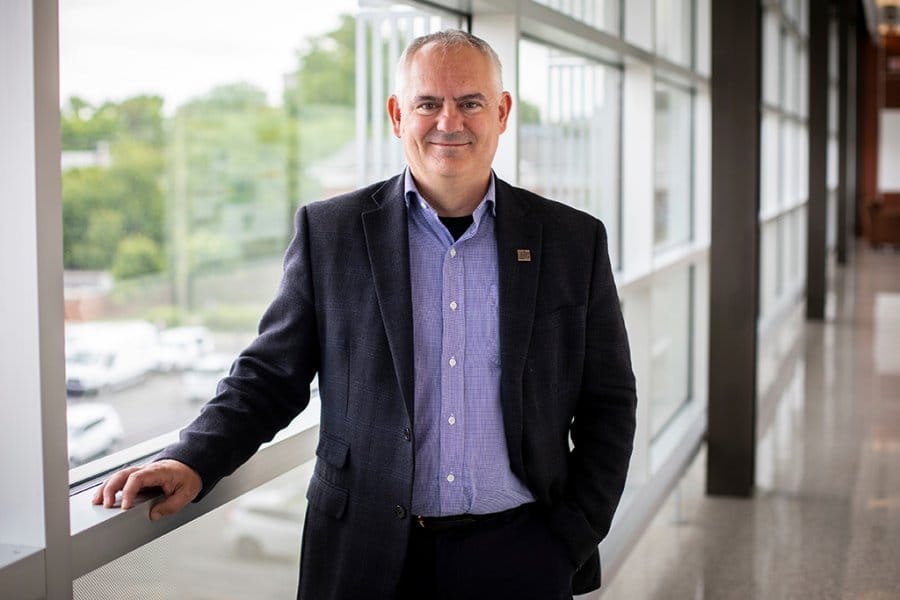
Seales poses in a suit and tie, near a window.


Seales says that scholars should soon be able to read all 800 of the Herculaneum scrolls that have been unearthed so far. But the ultimate goal is to exhume and decipher thousands more papyri from a library that ranks along with the Dead Sea Scrolls as one of the greatest finds in the history of archaeology. UK PHOTO

For graduate school, Seales says, “I shot for the moon. I couldn’t imagine anything better than to be at Wisconsin.” Strapped for money when he applied to the university, he prayed it would “just let me work and pay my own way.” Unlike other schools, the UW gave him a four-year guarantee of funding.

At UW–Madison, Charles Dyer, professor emeritus of computer sciences and biostatistics and medical informatics, was Seales’s doctoral thesis adviser. It was an ideal match. Both men were young. Dyer was only 10 years older than Seales. Both craved long-distance ordeals. Dyer ran marathons. Seales thrived in Madison’s cycling culture and pedaled in weekend races.

Even then, artificial intelligence’s potential fascinated Seales. Dyer was one of the first scientists to study computer vision, an AI-related field that gripped Seales’s imagination. Under Dyer, he wrote algorithms that transformed two-dimensional photos into 3-D images, a technique Mars Rovers would use to traverse the Red Planet without commands from Earth.

“I give Brent a huge credit for sticking with his research and making steady progress for years without a lot of big reinforcement,” says Dyer.

Perfecting X-Ray Vision

How does Seales get scrolls that look like flame-broiled croissants to surrender nearly 2,000-year-old secrets?

First, using a technology similar to that used by a computed tomography (CT) scanner, he takes a 3-D scan of a scroll. Its beam slices the scroll into about 15,000 vertical images. Each unimaginably thin slice is like a tree ring. It reveals how heat and pressure distorted the scroll’s overlapping wraps.

Then he virtually flattens the scroll. So far, this has required researchers to trace distorted rings, a process Seales hopes will soon be automated. Correct tracing of rings lets his software create an accurate 3-D image that is flattened to two-dimensions.

A charred scroll, virtually flattened, with visible characters on it.


Seales used “virtual unwrapping” to read the text from the ancient En-Gedi scroll, revealing it to be the beginning of the Book of Leviticus. It’s one of the oldest Hebrew biblical texts ever found, outside of the Dead Sea Scrolls. BRENT SEALES, UNIVERSITY OF KENTUCKY

Finally, because the Romans used an ink that scans cannot capture, Seales employs machine learning to detect nearly invisible texture differences in blackened papyrus, thus making letters visible.

His saga of discovery has been as convoluted as one of his scrolls. It began in London’s British Museum in 1995 with a digital imaging project to improve readability of the earliest copy of Beowulf. Seales used a NASA technique called MSI, multi-spectral imaging, to make letters pop out against their background. This happens because iron-based ink reflects light, especially ultraviolet light, differently than a background of parchment, vellum, or papyrus.

Based on that work, he wrote a paper about digital restoration. The result? “No one cared,” Seales says. “But I still look at it as one of those turning-point papers for me, because I articulated the principles around digital restoration that were going to be amazing. In that paper, I wrote that the pinnacle of the restoration would be complete virtual unwrapping.”

Seales had a brainstorm. He had seen enough wizened documents to know the forces of time and temperature often caused pages to grow wavy. Sometimes the distortions were so bad they hid letters.

He was working on a ninth-century vellum copy of The Consolation ofPhilosophy by Boethius. VoilĂ  — Seales performed a virtual flattening. His smoothing of the manuscript made letters reveal themselves for the first time in centuries.

The Odyssey Takes a Detour

Seales learned about the Herculaneum scrolls when classicist Richard Janko at the University of Michigan contacted him in 2004. He told Seales about their horrible condition, that others had destroyed some, and asked if he could make them readable.

“I knew instantly — instantly — that if it could be solved, it would be amazing, and the world would think it was amazing,” says Seales. With some difficulty, he got funding to proceed.

To move forward, Seales needed his own CT scanner, one that was portable. He and a partner at Iowa State University tried but failed to build one he could bring to the field to collect his own data. So Seales decided to partner with the Belgian company SkyScan to use this cutting-edge technology.

In 2005 at Oxford, he gave a talk to the Friends of Herculaneum Society. He told them that since the late 1970s, Egyptologists had put mummies in CT scanners. Since scrolls were also wrapped, surely they could be unspooled. All he and his students had to do was write software to interpret the machine’s data in combination with the imaging technology he had started to use 10 years earlier with Beowulf.

To demonstrate his proposal, he made a scroll, lettered it with iron-based ink, and scanned it. The result showed the scroll unrolling with letters visible on its surface.

Next, Seales asked the National Library in Naples, where most of the scrolls are kept, if he could perform similar magic there. “It sent me a response that didn’t say, ‘No.’ It said, ‘Hell, no.’ But it was in Italian, so it sounded better than that,” says Seales.

Undaunted, he successfully approached the Institut de France, which also held scrolls. With a National Science Foundation grant, Seales convinced SkyScan’s founder, the Russian physicist Alexander Sasov, to send his portable CT scanner to the academy in 2009, and he was able to scan two scrolls.

He was coming off a period of “unbridled enthusiasm,” but the results crushed him. The internal complexity of the scrolls “broke” his software. The layers inside the scroll were far from uniform. “They were all tangled and mashed together. My software could not follow them reliably,” he says.

There was another problem. The Romans used carbon-based ink, not ink with an iron base. The letters remained invisible. “I didn’t know what to do. It was a deeply discouraging moment,” he says.

Divine Intervention

In moments of doubt, Seales tried to take comfort from William Wordsworth’s poem SeptemberSeptember, 1819, which reads:

O ye, who patiently explore

The wreck of Herculanean lore,

What rapture! could ye seize

Some Theban fragment, or unroll

One precious, tender-hearted scroll …

“But in fact, the scrolls are not tender-hearted scrolls,” he says. “Wordsworth was wrong. They’re hard-hearted scrolls. Hard-hearted.”

For the next few years, progress was slow. Seales found inspiration — and new collaborators — in Paris in 2011 when he was invited to join forces with the Google Cultural Institute. Since renamed Google Arts and Culture, it creates services to boost digital access to the arts.

“We came along at a time when Brent was at a dead end,” says Steve Crossan, who ran the Google project. He felt sure the Kentucky professor would overcome his obstacles. “He was completely tenacious, and he never gave up. It tends to be the case that if you don’t give up, eventually you succeed.”

Both Crossan and Dyer agree that a key to Seales’s success is his collaborative spirit. “He doesn’t require that he owns the whole of the solution,” says Crossan.

“In the research area,” Dyer says, “people are often very protective of their own work. Not Brent.”

For the next few years, Seales improved the quality of his algorithms so they could conquer the complex convolutions inside scrolls. Then came what some might call divine intervention — Israeli archaeologists asked him to virtually unwrap a carbonized parchment scroll from the ancient town of Ein Gedi. It turned out to be a portion of the Book of Leviticus.

Meanwhile, Seales continued to attack the ink-readability problem. He explored using x-ray phase-contrast tomography, which can reveal minute changes in density in a material. Because of the difficulty of getting permission to use such a machine, he teamed with European scientists who could get the go-ahead.

Disappointment hit again. The scholars he trusted published a paper — without including his name — that claimed they had solved the problem of seeing non-iron-based ink. The media reported the Herculaneum scrolls could now be read. But when Seales studied his ex-colleagues’ data, he realized they were faulty. They had achieved nothing, he says.

Once again, he found himself profoundly discouraged, “because I knew those people. I had worked with them under the assumption we’d all be working together, and they cut me out so they could run forward,” he says.

A Triumphal Moment

Meanwhile, in Israel, Seales’s supercharged algorithms worked. He could virtually unwrap the scroll, and, luckily, scannable metal was in the Biblical ink. The scroll turned out to be one of the oldest copies of the Book of Leviticus and dated from the third or fourth century AD. The subject of the first chapter? Burnt offerings.

With the National Library in Naples continuing to block Seales’s access to its treasure house of scrolls, he won permission from Oxford’s Bodleian Library to scan a Herculaneum fragment known as P. Herc. 118 for signs of ink. This was not a scroll, but bits of a scroll glued to tissue paper.
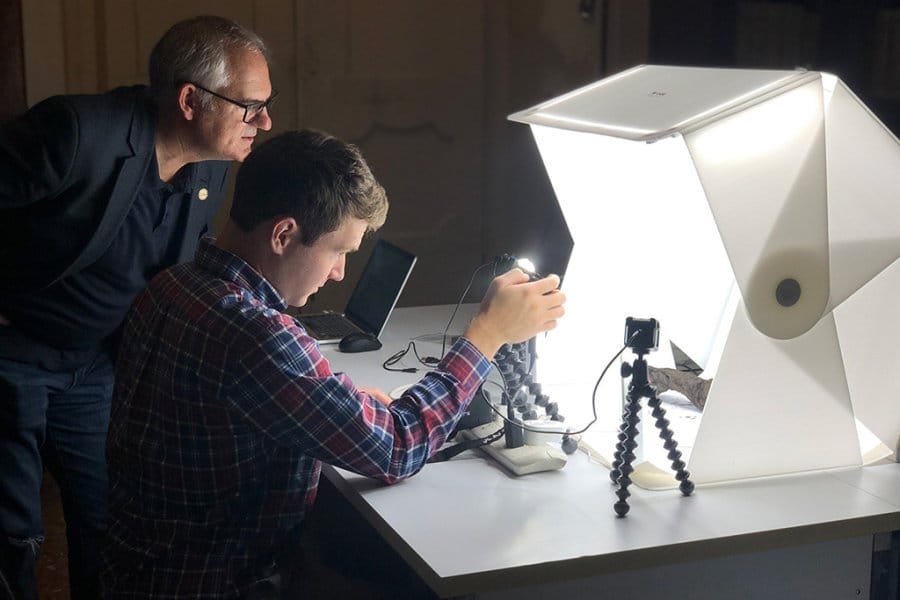
Seales and student Stephen Parsons carefully capture imagery of a Herculaneum scroll.


Seales and his former doctoral student Stephen Parsons examine a Herculaneum scroll at a science facility in England.EDUCELAB/UNIVERSITY OF KENTUCKY

The letter c could be seen with the naked eye against the papyrus background. The problem was getting the computer to recognize it. “We made the letter appear from the tomography after training the method to recognize the evidence of the ink,” he says. “Building the method to make it visible from the tomography alone was the big breakthrough, because we knew that for full scrolls, we would only have the tomography for the inner layers, not actual photographs.” This was the triumphal moment. Now Seales knew that entire scrolls could be read.

By this time, he had realized that AI and machine learning were “the rocket fuel” that would vastly speed reading of invisible ink. “In 2015 when I did experiments with AI, I realized it was going to be a game changer,” he says. “It was the key that unlocked everything.”

The man who helped turn the key was Friedman, the former CEO of GitHub, Microsoft’s open-source platform for software developers. During the COVID lockdown in 2020, Friedman had spare time. He became curious about imperial Rome. Soon he was baking Roman-era bread and learning about the Herculaneum scrolls.

“I thought Brent’s project was incredibly cool,” says Friedman. “I wanted to follow along and be a fanboy.”

In 2022 he invited Seales to his hush-hush Frontier Camp, a secretive gathering of techie wizards in the northern California woods. The goal? Win funding for Seales or at least win offers of help.

When the duo struck out, Friedman proposed the Vesuvius Challenge, with first prize going to the scholar who could read four passages of 140 characters. Within months, three college students shared the $700,000 honors. The 2024 prize dramatically ups the challenge — it goes to a competitor who can decipher 90 percent of four scrolls.

Like Seales, Friedman believes all the scrolls will be readable in short order, once the hand-tracing of wraps inside the scrolls is automated.

Hoping for “New Arrivals” in Roman Library

Seales grew up in what he calls “a very strong and devout Christian tradition.” He wants as much ancient knowledge translated as soon as possible, but his deepest hope is to find early Christian writings.

“My passion is more on religious material from the era, because the first century was the cradle of Christianity, a phenomenal point in human history.

“This villa gives absolutely no indication there would be Christian material there, but, you know, you walk into any library, and you pick a book randomly off the shelf. How do you know what you might get?” he asks.

Seales hopes Piso’s library had a new-readings section. “That’s where the Christian stuff might be, because it was the philosophy of the day,” he says. “It would blow people’s minds. It would challenge us.”

Regardless of what is found, classicist Janko, who serves as a Vesuvius Challenge judge, hopes more scrolls are dug up soon.

“Several times since the eruption in AD 79, this particular spot has been covered with molten lava,” he says. “Vesuvius is quiet for now, but experience teaches that it’s never quiet indefinitely.”

Seales believes that if the race against time to recover all the scrolls is successful, the knowledge contained in the entire collection will constitute the largest discovery from the ancient world to date. •

Originally published in On Wisconsin, the alumni magazine of the University of Wisconsin-Madison.


SPECIAL POST-HOLIDAY SALE


HEATHER COX RICHARDSON


November 1, 2025

Yesterday I wrote that President Donald J. Trump’s celebration of his new marble bathroom in the White House was so tone deaf at a time when federal employees are working without pay, furloughed workers are taking out bank loans to pay their bills, healthcare premiums are skyrocketing, and Supplemental Nutrition Assistance Program benefits are at risk, that it seemed likely to make the history books as a symbol of this administration.

But that image got overtaken just hours later by pictures from a Great Gatsby–themed party Trump threw at Mar-a-Lago last night hours before SNAP benefits ended. F. Scott Fitzgerald’s 1925 novel The Great Gatsby skewered the immoral and meaningless lives of the very wealthy during the Jazz Age who spent their time throwing extravagant parties and laying waste to the lives of the people around them.

Although two federal judges yesterday found that the administration’s refusal to use reserves Congress provided to fund SNAP in an emergency was likely illegal and one ordered the government to use that money, the administration did not immediately do as the judge ordered.

Trump posted on social media that “[o]ur Government lawyers do not think we have the legal authority to pay SNAP,” so he has “instructed our lawyers to ask the Court to clarify how we can legally fund SNAP as soon as possible.” Blaming the Democrats for the shutdown, Trump added that “even if we get immediate guidance, it will unfortunately be delayed while States get the money out.” His post provided the phone number for Senate minority leader Chuck Schumer’s office, telling people: “If you use SNAP benefits, call the Senate Democrats, and tell them to reopen the Government, NOW!”

“They were careless people,” Fitzgerald wrote, “they smashed up things and creatures and then retreated back into their money or their vast carelessness or whatever it was that kept them together, and let other people clean up the mess they had made.”

This afternoon, Ellen Nakashima and Noah Robertson of the Washington Post reported that the administration is claiming it does not have to consult Congress to continue its attacks on Venezuela. The 1973 War Powers Act says it does.

In 1973, after President Richard M. Nixon ordered secret bombings of Cambodia during the Vietnam War, Congress passed the War Powers Resolution to reassert its power over foreign wars. “It is the purpose of this joint resolution to fulfill the intent of the framers of the Constitution of the United States and insure that the collective judgment of both the Congress and the President will apply to the introduction of United States Armed Forces into hostilities, or into situations where imminent involvement in hostilities is clearly indicated by the circumstances, and to the continued use of such forces in hostilities or in such situations,” it read.

The law requires a president to notify Congress in writing within 48 hours of the start of hostilities, including the legal grounds for those hostilities, the circumstances that caused them, and an estimate of their scope and duration. The law requires the president to get the approval of Congress for any hostilities lasting more than 60 days.

On September 4, 2025, Trump notified Congress of a strike against a vessel in the Caribbean that he said “was assessed to be affiliated with a designated terrorist organization and to be engaged in illicit drug trafficking activities.” The letter added: “I am providing this report as part of my efforts to keep the Congress fully informed, consistent with the War Powers Resolution.”

Monday will mark 60 days from that announcement, but the administration does not appear to be planning to ask for Congress’s approval. It has been reluctant to share information about the strikes, first excluding senior Senate Democrats from a Senate briefing, then offering House members a briefing that did not include lawyers and failed to answer basic questions. The top two leaders of the Senate Armed Services Committee, Roger Wicker (R-MS) and Jack Reed (D-RI), have both said the administration has not produced documents, attack orders, and a list of targets required by law.

Representative Gregory W. Meeks (D-NY), the top Democrat on the House Foreign Affairs Committee, told Nakashima and Robertson: “The administration is, I believe, doing an illegal act and anything that it can to avoid Congress.”

T. Elliot Gaiser, who leads the Office of Legal Counsel under Trump, told a group of lawmakers this week that the administration is taking the position that the strikes on unnamed people in small boats do not meet the definition of hostilities because they are not putting U.S. military personnel in harm’s way. It says the strikes, which have killed more than 60 people, have been conducted primarily by drones launched off naval vessels.

Brian Finucane, who was the War Powers Resolution lawyer at the State Department under President Barack Obama and during Trump’s first term, explained: “What they’re saying is anytime the president uses drones or any standoff weapon against someone who cannot shoot back, it’s not hostilities. It’s a wild claim of executive authority.”

If the administration proceeds without acknowledging the Monday deadline for congressional approval, Finucane said, “it is usurping Congress’s authority over the use of military force.”

—

JOYCE VANCE


Good News: A Court Rejects Trump's Effort To Suppress The Vote

Joyce Vance

Nov 01, 2025

In March, Donald Trump issued an executive order titled “PRESERVING AND PROTECTING THE INTEGRITY OF AMERICAN ELECTIONS.” Predictably, it was designed to do anything but that. Its goal was to make it more difficult to register to vote.

In April, Judge Colleen Kollar-Kotelly, a senior judge in the District of Columbia, issued a preliminary injunction that temporarily prevented key parts of the executive order from going into effect while the litigation moved forward. The key problem Judge Kollar-Kotelly observed was that Trump was trying to usurp the power the Constitution affords to the states and Congress to run elections.

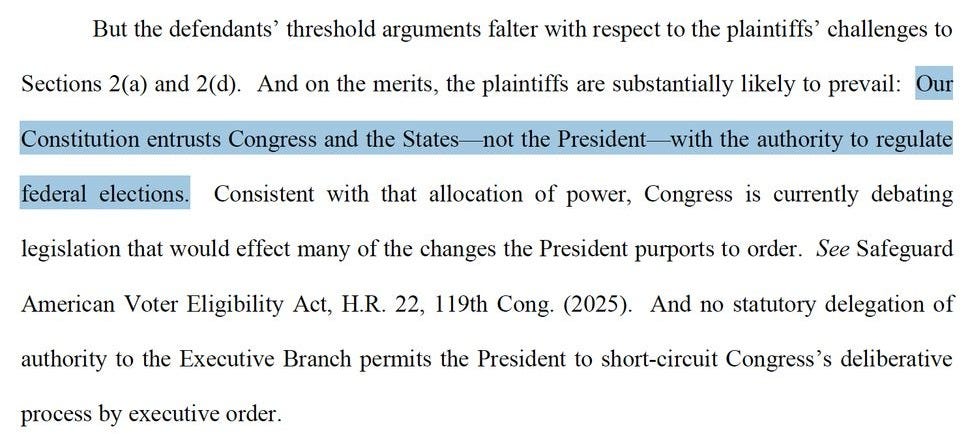
But the defendants’ threshold arguments falter with respect to the plaintiffs’ challenges to Sections 2(a) and 2(d). And on the merits, the plaintiffs are substantially likely to prevail: Our Constitution entrusts Congress and the States—not the President—with the authority to regulate federal elections. Consistent with that allocation of power, Congress is currently debating legislation that would effect many of the changes the President purports to order. See Safeguard American Voter Eligibility Act, H.R. 22, 119th Cong. (2025). And no statutory delegation of authority to the Executive Branch permits the President to short-circuit Congress’s deliberative process by executive order.


Friday, the Judge granted summary judgment in parts of the case, entering a permanent injunction that prevents the Election Assistance Commission (EAC) from implementing the worst provision of Trump’s executive order: one that purported to require proof of citizenship to register to vote.

The measure was designed to suppress voter participation in elections; a solution in search of a problem. It’s akin to the poll taxes used in the South before the Supreme Court put an end to them. Trump’s plan would require people to jump through expensive hoops to acquire proof of birth and costly forms of identification, like passports. At least 21 million Americans don’t have that kind of proof readily available. Only 51% of Americans have passports, which cost adults applying for the first time a $165.00 fee, not to mention assembling the documents you need, getting a photograph of yourself, and making it to an appointment. The problem is especially acute for young people and students who live away from home, and whose documents are with their parents, if they have them at all.

The Judge wrote, “The Constitution’s allocation of authority over federal elections between Congress and the States may not be intuitive. But it is no accident,” Judge Kollar-Kotelly wrote. “Instead, this design was the product of carefully considered compromises among our Constitution’s Framers.” Those compromisers were part of the attention to avoid rule by a king-a dictator.

Donald Trump has repeatedly tried to claim he has powers the Constitution does not give to the president. And this is especially dangerous when it comes to voting, given his track record. We the people must have the right to choose their leaders, not the other way around.

Tonight, another federal district judge stood up for the rule of law and for democracy, telling a power hungry president, “No.”

If you’re looking for something you can do to support the judiciary in this moment where district court judges are bravely standing for the rule of law even though they know that means the president could target them, let them know you support them. Send the Judge and others a postcard, like we do to encourage voters to participate in elections, and thank her for standing for the Constitution and the rule of law. It may seem like a small thing, but the judiciary deserves our support and our thanks for what they are doing. Let’s be visible and involved. Let’s make sure the courts know we are paying attention.

It’s good news when a judge blocks Donald Trump’s autocratic intentions. Here, it’s big news. While the administration will likely appeal, Judge Kollar-Kotelly has made plain that this case falls within a basic rule, that when the language of the law is clear, the courts look no further. The Constitution explicitly says states and Congress set the rules for elections, not the president. Donald Trump cannot do whatever he wants to, because Donald Trump is not a king. The rule of law still stands.

If you find value in this kind of clear, experience-driven legal analysis, I hope you’ll consider a paid subscription to Civil Discourse. Your support makes the newsletter possible.

We’re in this together,

Joyce


Saturday, November 01, 2025

JoJo


Meet Cute in Hell

They Fell in Love Over Child Separation and Never Looked Back.

There’s a metric fuckton of shit I wish I didn’t have to think about.

But my brain didn’t get the memo.

It hums, it churns, it pokes at things that should probably be left alone. Even when I tell it to shut up, it just smirks like it’s on salary and keeps going. I’ve always been that way, ever since I was a kid. I was that little goblin in class who asked too many questions and answered every answer with “But why?” Teachers hated it. It’s not curiosity; it’s compulsion. I can’t not know. So I end up thinking about things no one should have to think about.

Like, I wish I didn’t have to think about how sausage is made.

Somewhere in human history, some unhinged caveman looked at a pig and thought, “You know what this needs? Let’s grind it up and shove it back inside itself.” That was someone’s idea of progress. And some other lunatic nodded along and said, “Hell yes, Chad, that’s cuisine.” It’s a pork ouroboros, a meaty middle finger to God, and I wish I didn’t have to picture it.

And don’t even get me started on Chicken McNuggets. Whatever the fuck those things are, they’re not chicken. They’re beige, breaded cubes of existential dread, the edible equivalent of a midlife crisis. I don’t want to think about what’s in them. I really, really don’t.

Someone once told me there’s a legally acceptable amount of rat hair in a McNugget. Rat. Fucking. Hair. Somewhere in a government office, a bunch of exhausted bureaucrats sat under migraine-inducing fluorescent lights and debated how many stray rodent follicles the American public could choke down without rioting.

“Two? That’s fine. Three? Gentlemen, we’re playing God now.”

There’s a PowerPoint out there titled Acceptable Levels of Mammal. Someone has a pension because they spent their life counting rodent garnish in Happy Meals.

For me? One hair. That’s my personal apocalypse, but I digress…

Yesterday was Halloween. I meant to publish this last night, but I went to a party and got—let’s call it—enthusiastically festive. I’m writing this through a Category Five hangover, which honestly makes what’s coming even harder to stomach. If you too overindulged in Barolo, bad decisions, or the belief you could still do Thriller without pulling a hamstring, I’m sorry. Misery loves company, and my haunted-house stomach doesn’t want to suffer alone.

Like I said, there’s a metric fuckton of shit I wish I could bleach from my brain.

Microwaved fish. The stench of wet Crocs festering in July. A used Band-Aid drifting toward me in a piss-warm public pool.

But somehow, my mind bypasses all that gourmet nightmare fuel and fixates right on them.

Because really, what kind of concussed, masochistic creature looks at Stephen Miller, tilts her head, and thinks, “Yes. That one. That’s the man for me.”

Who surveys that translucent haunted-doll energy and decides to saddle up for a lifetime subscription to night terrors?

Who spreads their legs and says, “Make me Rosemary’s Baby, you alabaster crypt keeper.”

I really, really, really don’t want to have to think about that.

And yet, here we fucking are.

If you think their unholy union is revolting, just remember, they didn’t stumble into each other, they bonded over inflicting misery on kids. They got off on the child-separation policy. While toddlers screamed for their parents, this demonic little power couple were sexting each other memos dripping with cruelty. It wasn’t a meet-cute, it was a meet-cruel. Bureaucracy as foreplay, trauma as dirty talk. Their idea of romance is spreadsheets, zip ties, and a PowerPoint titled “Maximizing Childhood Suffering: Q2 Projections.”

What happens between them isn’t sex, it’s a war crime with mood lighting. When they fuck, angels file restraining orders, the Geneva Conventions start drafting new amendments, and even hell’s customer service blocks their number. You can practically hear Satan pounding on the wall, yelling, “Hey, keep it down, you freaks, some of us are trying to run a respectable underworld down here.”

And at the center of this unholy spectacle is her.

She’s always been an enigma in the same way black mold is: toxic, relentless, impossible to get rid of, and somehow multiplying every time you hit it with bleach and a string of curses. Now that she’s clawed her way onto a public platform—because apparently America hasn’t been humiliated enough—I know her far too well.

These days she’s everywhere: seeping into cable news, contaminating podcasts, and probably leaving a greasy smear on Elon Musk’s sex chair.

Katie Miller cares deeply about relevance, because relevance means oxygen. Influence means validation. A platform means someone’s still listening while she spews her special brand of bile into the public bloodstream. She doesn’t crave power to use it; she craves proximity to inhale it. She wants to feel its pulse under her fingernails, to taste it when she talks. It’s not ambition, it’s dependency. If hierarchy came in powder form, she’d cut it into lines and rail it off a government-issued desk.

She wants to be the poster child for bureaucratic cruelty: dead-eyed stare, whiny voice, and a smirk that could curdle oat milk. Every time she opens her mouth, you can hear the Constitution wince like it’s bracing for a colonoscopy. She’s smug, petty, and utterly convinced that oppression is a designer label. For Katie, being an asshole isn’t a flaw, it’s the whole fucking operating system.

When Cenk Uygur called her and her husband what they are—fucking liars—she didn’t even blink. She went full fascist cosplay. “You better check your citizenship application and hope that everything was legal and correct,” she hissed. “Because you’ll be just like Ilhan Omar.”

That wasn’t a slip. That was a threat.

Katie and Stephen aren’t human, hell, they’re not even in the same phylum. They’re what happens when spite raw-dogs a bottle of drain cleaner. Two ambulatory hate-crimes in discount skin suits, running on espresso, malice, and the last dregs of America’s collective will to live. Cruelty isn’t just their hobby; it’s their fucking cardio. Their kink is making strangers miserable. Their love language is weaponized humiliation. Watching them together is like hearing a root canal try to out-scream a fire alarm—pure, unfiltered agony for anyone within earshot.

Katie once bragged, after visiting the border, “DHS sent me to see the separations to make me more compassionate. It didn’t work.”

Yeah, no shit it didn’t. Compassion fucking flees the room when she walks in like it’s got a goddamn restraining order. Crack open her chest and you’ll find a dried-up Sharpie, a bingo card of other people’s misery, and a crusty IOU for basic human decency. Empathy wouldn’t just die near her; it’d set itself on fire and jump out the fucking window.

They’re not a couple; they’re a haunting. He’s the human equivalent of a DMV line… soul-sucking, endless, and guaranteed to ruin your week. She’s distilled malice in lipstick, the type who’d show up to your birthday party just to read your Amazon order history out loud. Together, they’re the political equivalent of Bloody Mary—say “build the wall” three times into a bathroom mirror, and these two appear behind you, clutching a Bible, a taser, and a Fox News sponsorship deal.

He’s Nazferatu, the ideological vampire draining this country of conscience one executive order and hate speech at a time. She’s the syringe, sliding the poison in with a smile. He builds the cruelty; she brands it. Together they’ve turned governance into a blood sport and empathy into contraband.

Meanwhile, the rest of us are counting quarters for groceries while Dark Hands fattens on the chaos. The prosperity-gospel Jabba the Hutt. The grifter messiah of cheap greed. The guy who preaches thrift to the poor while deep-throating the national treasury like an oyster shooter. He calls it patriotism. She calls it heritage. Everyone else calls it what it is—obscene.

Government has become Dinner Theater for Sociopaths, a Vegas residency called Cruelty! The Musical, starring Steve Bannon in a grease fire and a chorus line of demons tap-dancing on the First Amendment.

And the call? It’s not coming from outside the house—it’s coming straight from the fucking Oval Office, oozing through the vents and belting out a drunken “God Bless America” while the wallpaper curls away in horror. The air reeks of self-tanner, cheap cologne, and that sticky, sour stench of moral decay you can’t wash off, no matter how hard you scrub. Every draft carries the faint, labored wheeze of democracy on its deathbed, flatlining to the thump of Kid Rock and the wet rip of the Constitution being torn up in the next room.

The rot’s gone full nuclear. It’s oozing off the Resolute Desk in greasy orange streaks, seeping through the gold-plated vents like ghost jizz made of canned hair and bullshit. His advisors aren’t whispering, they’re tongue-fucking his earholes with ASMR nightmare porn. “Sign it, Daddy. Ruin the world for us.” Meanwhile, in the corner, democracy’s dry-heaving, popping a cyanide Tic Tac, and frantically Googling “how to fake your own death.”

And that is the horror show.

Forget your sexy nurse costume or that discount vampire cape. The real nightmare is what’s still parked behind that desk: anthropomorphic aspic in a shitty blue suit, the consistency of regret and Miracle Whip, signing executive orders with a crayon and calling it vision.

They’re not running a country; they’re running a haunted hellhouse that reeks of halitosis, hubris, and hate. Every hallway’s a jump scare, every chandelier’s fueled by taxpayer tears and the haunted howls of history teachers. We’re all trapped inside, clutching emotional-support booze while these ghoulish goons hurl horrors like T-shirts at a monster truck rally for maniacs. It’s Halloween every hellish day, and these assholes are the headliners, waving from a float made of shredded statutes and sleaze.

The scariest costume isn’t in your closet, it’s hunched in the Oval Office, grinning for cameras while monsters hiss hot garbage into his ear. A choreographed clusterfuck. The cruelty isn’t a glitch; it’s the goddamn game plan. The evil isn’t accidental; it’s the entire enterprise.

Donald Trump isn’t the architect of anything. He’s the delivery system, the DoorDash of depravity. He’s the cholesterol-clogged fever dream of late-stage capitalism: a lurching tub of expired mayonnaise crammed into a suit that reeks of casino carpet and broken promises. Picture a gelatinous homunculus, stitched together from fast food wrappers and late-night infomercial regrets, wobbling through history like the Stay Puft Marshmallow Man after a three-day bender in a gold-plated porta-john.

Every step leaves a slick of melted dignity, ketchup, and half-digested chicken nuggets as he hurls Big Mac boxes stuffed with the Bill of Rights into the crowd like confetti at the orgy of a dying empire. The air stinks of burnt ego, cold grease, and the slow death of shame. Somewhere, a bald eagle’s projectile-vomiting into the nearest flag while Lady Liberty lights a cigarette and stops pretending to care.

And waiting in the wings, grinning like stage parents at a school play from hell, are the Millers, two alabaster parasites who built the cruelty he only knows how to perform. They wrote the script; he just drooled on the cue cards. Every policy, every nightmare, every raid that drags parents out of school drop-off lines and courthouses is their love language made law.

He’s the grotesque puppet, but they’re the hands that learned how to make America flinch.

And that’s the horror story we’re living in.

Not monsters in masks.

Monsters in charge.

Total Pageviews

GOOGLE ANALYTICS

Blog Archive