Saturday, September 05, 2020

Trump hired a 'Faux-Bama' during White House run


In tell-all book, Michael Cohen says Trump hired a 'Faux-Bama' during White House run

By Erica Orden, CNN

Updated 10:02 PM ET, Sat September 5, 2020

President Donald Trump


(CNN) Before Donald Trump ever sought the Oval Office, he was preoccupied by its occupant President Barack Obama, publicly questioning his birthplace and privately describing him as "a Manchurian candidate" who obtained his Ivy League degrees only by way of affirmative action, according to a new book by Trump's former attorney, Michael Cohen.

CNN obtained a copy of the book ahead of its Tuesday publication.

Trump's disdain for Obama was so extreme that he took his fixation a step further, according to Cohen: Trump hired a "Faux-Bama" to participate in a video in which Trump "ritualistically belittled the first black president and then fired him."

Cohen's book, "Disloyal: A Memoir," doesn't name the man who was allegedly hired to play Obama or provide a specific date for the incident, but it does include a photograph of Trump sitting behind a desk, facing a Black man wearing a suit with an American flag pin affixed to the lapel. On Trump's desk are two books, one displaying Obama's name in large letters.

As an insider who spent years as Trump's personal attorney and self-proclaimed "fixer," Cohen says he is uniquely equipped to unleash on Trump, whom Cohen describes as "a cheat, a liar, a fraud, a bully, a racist, a predator, a con man" and a person interested in using the presidency exclusively for his personal financial benefit.

But according to federal prosecutors and Cohen's own guilty pleas, he, too, is a liar and a cheat. In 2018, he pleaded guilty to nine counts of federal crimes, including tax evasion, lying to Congress and campaign-finance violations he and prosecutors have said were done at Trump's direction to help him win the 2016 presidential election.

CNN has reached out to the White House for comment. In a statement to the Washington Post, White House press secretary Kayleigh McEnany said, "Michael Cohen is a disgraced felon and disbarred lawyer, who lied to Congress. He has lost all credibility, and it's unsurprising to see his latest attempt to profit off of lies."

Cohen acknowledges and apologizes for his role in Trump's rise, saying he was "more than willing to lie, cheat, and bully" to help his long-time boss win the White House. And he recounts the pressure and guilt he experienced as he spoke out against Trump, writing that he considered suicide "as a way to escape the unrelenting insanity" in the weeks prior to testifying to Congress in 2019.

But in the book, he disputes having committed certain crimes to which he has already admitted, portraying himself a victim of the "gangster tactics" of the federal prosecutors of the US Attorney's office for the Southern District of New York.

Still, Cohen's account of Trump's personal nature and presidency is damning, and during Cohen's time in prison, he writes, "I became even more convinced that Trump will never leave office peacefully."

Trump's model of a man in power, according to Cohen, is Vladimir Putin, and Trump is described as enamored of Putin's wealth and unilateral influence, and awestruck by what he sees as the Russian president's ability to control everything from the country's press to its financial institutions.

"Locking up your political enemies, criminalizing dissent, terrifying or bankrupting the free press through libel lawsuits -- Trump's all-encompassing vision wasn't evident to me before he began to run for president," Cohen writes. "I honestly believe the most extreme ideas about power and its uses only really took shape as he began to seriously contemplate the implications of taking power and how he could leverage it to the absolute maximum level possible."

But he reiterates his belief that Trump and his campaign officials were too disorganized to have coordinated with the Russians during the 2016 election. "What appeared to be collusion was really a confluence of shared interests in harming Hillary Clinton in any way possible, up to and including interfering in the American election -- a subject that caused Trump precisely zero unease," Cohen writes.

He also argues that, with Trump himself expecting to lose the presidential race, Trump's goal in cozying up to Putin was to position himself to benefit financially from a planned real-estate development in Moscow after the election.

"By ingratiating himself with Putin, and hinting at changes in American sanctions policy against the country under a Trump Presidency," Cohen writes, "the Boss was trying to nudge the Moscow Trump Tower project along." (One of the crimes to which Cohen pleaded guilty was lying to Congress about the duration of the negotiations regarding the Moscow development.)

Cohen also portrays Trump as aspiring to have ties to the Russian president. After Trump sold a Palm Beach mansion he purchased for $41 million to a Russian oligarch named Dmitry Rybolovlev for $95 million in 2008, Cohen says, Trump told Cohen he believed the real buyer was Putin.

Cohen, however, disputes the validity of a rumored videotape depicting Trump during a trip to Moscow, saying, "this claim never occurred, to the best of my knowledge and investigations."

But Cohen discloses that during the summer of 2016, he received an anonymous call from a man who said he was in possession of a tape matching its description. Cohen told the caller that he would need to see a few seconds of the tape to determine if it was real, and the caller demanded $20 million before hanging up, never to be heard from again.

Blacks & Latinos, 'They're not my people'

If Putin is held in the highest regard in Trump's mind, Cohen writes, Trump's own voters rank among those in the lowest. Speaking to Cohen after Trump gathered religious leaders at Trump Tower in the lead up to the 2012 presidential race, an encounter during which they asked to "lay hands" on him, Trump asked Cohen, according to the book: "Can you believe that bullsh*t?...Can you believe people believe that bullsh*t?"

In the wake of Trump's presidential kickoff announcement in 2015, in which he called Mexicans criminals and rapists, he dismissed concerns that he had alienated Latinos. "Plus, I will never get the Hispanic vote," Trump allegedly told Cohen. "Like the blacks, they're too stupid to vote for Trump. They're not my people." (Trump won 28% of the Latino vote in 2016.)

Trump's contempt, in Cohen's telling, extends broadly. Cohen characterizes Trump bluntly as racist, and says that while he never heard Trump use the "N-word," Trump used other offensive language.

Ranting about Obama after he won office in 2008, Trump said, "Tell me one country run by a black person that isn't a sh*thole...They are all complete f*cking toilets," according to Cohen. After Nelson Mandela died, Trump allegedly said of South Africa that "Mandela f*cked the whole country up. Now it's a sh*thole. F*ck Mandela. He was no leader."

Cohen also divulges personal details about Trump, including his hair routine, described as a "three-step" combover designed to disguise "unsightly scars on his scalp from a failed hair-implant operation in the 1980s."

Writing that he once witnessed Trump shortly after he showered, Cohen recalls that "when his hair wasn't done, his strands of dyed-golden hair reached below his shoulders along the right side of his head and on his back, like a balding Allman Brother or strung out old '60s hippie."

Many instances of Trump's alleged deceit have previously been detailed by Cohen and others in recent years: Trump's alleged inflation of his net worth to publications like Forbes and Fortune and his minimizing of the value of his properties to avoid taxes, Cohen's pressuring of the New York Military Academy to not release Trump's high school records to avoid their public disclosure, Cohen paying to rig CNBC and Drudge Report polls in Trump's favor, Trump campaign officials hiring extras for $50 apiece to attend Trump's 2015 announcement that he was running for president and the alleged fraudulent Trump University scheme, over which Trump settled a class action lawsuit for $25 million.

Harshest judgment for the media

And a healthy portion of the book is devoted to the incidents perhaps best known at this point: Trump's and Cohen's alleged efforts to silence women who claimed affairs with Trump during the 2016 election -- campaign finance violations that landed Cohen in prison and led prosecutors to say were done "in coordination with and at the direction of Individual - 1," otherwise known as Trump.

Trump has denied the affairs and any involvement with the payments.

Cohen provides detailed accounts of the negotiations that led to the payments to two women -- adult-film actress Stephanie Clifford, who goes by the name Stormy Daniels, and former Playboy model Karen McDougal -- efforts that, according to Cohen, deeply involved himself, Trump and Trump Organization Chief Financial Officer Allen Weisselberg, who ultimately cooperated with prosecutors.

Trump specifically authorized Cohen to strike the deal with Daniels, Cohen writes. "It's only $130,000," Trump said, according to Cohen. "F*ck it, Michael. Go talk to Allen and figure it all out." (Cohen, too, mocks the payment, "a sum that seemed almost laughably low.")

And he recalls Weisselberg allegedly convincing him to front the money to pay Daniels by using Cohen's home equity line of credit.

On October 27, 2016, after Cohen had wired the $130,000, he called Trump to tell him the transaction was complete, Cohen writes.

In describing the investigation and prosecution, however, Cohen portrays himself as exceedingly cooperative, a notion prosecutors have refuted. With respect to tax evasion charges, he claims he provided his accountant with all of his records, an assertion federal prosecutors have said in court filings is false.

Regarding a count of lying to a bank, Cohen calls it a "fantasy of the federal prosecutors from the Southern District of New York."

"I didn't lie for the simplest reason: the bank never asked what I wanted the money for," he writes. But the charge to which Cohen pleaded guilty, according to court documents, stemmed from him repeatedly withholding information from banks or providing them with misleading information about various lines of credit secured by his taxi medallions. (In a sentencing memo to the judge overseeing his case, prosecutors referred to the false statement to a bank charge as "far from an isolated event: It was one in a long series of self-serving lies Cohen told to numerous financial institutions.")

He writes that New York federal prosecutors "refused" his requests, made through his lawyer Guy Petrillo, to meet with him for four months in advance of his guilty plea and that they threatened to charge his wife if he didn't agree to plead guilty.

And he says it is "unimaginable" that Trump didn't have advance knowledge of the FBI raids of his properties, because Trump is "the chief law enforcement officer in the country," which he is not.

"My lawyers had continually stated that they didn't see any charges coming," Cohen writes, "but the truth in this country is that if federal prosecutors want to get you, they will."

In a section in which he describes reporting to serve his sentence, he laments being "railroaded into prison by federal prosecutors who'd since gone on to high paying white-shoe law firms, with my conviction as their signature achievement at the Southern District." A spokesman for the Manhattan US Attorney's office declined to comment.

But in a way perhaps even Trump could appreciate, Cohen reserves some of his harshest judgment for the media, which he blames for falling for Trump's attention-grabbing tactics and propelling him to office.

"Donald Trump's presidency is a product of the free press," he writes. "Not free as in freedom of expression, I mean free as unpaid for. Rallies broadcast live, tweets, press conferences, idiotic interviews, 24-7 wall-to-wall coverage, all without spending a penny. The free press gave America Trump."

"Right, left, moderate, tabloid, broadsheet, television, radio, Internet, Facebook -- that is who elected Trump and might well elect him again."

Trump's tweets are famous. But this is the Facebook presidency.


Trump's tweets are famous. But this is the Facebook presidency.

He’s trapped in a bubble defined by his own likes and clicks. And we’re all stuck in it with him.


By Jacob Silverman


Jacob Silverman is the author of "Terms of Service: Social Media and the Price of Constant Connection."

September 4, 2020 at 8:33 a.m. CDT

Interviewed by Laura Ingraham on Fox News recently, President Trump cited a false statistic that only 6 percent of covid-19 deaths were due to the disease itself. Gently pushed by Ingraham, he hedged slightly, calling it “an interesting statistic,” thus moving into the hazy well-it-could-be-true epistemological territory in which Trump and his followers thrive.


This is, by now, a familiar way of proceeding — not so much a strategy of press manipulation as Trump’s way of being in the world. When he is not outright dissembling, as he does often, the president impulsively finger-paints his own reality, assembling a worldview from bits of information drawn from disparate advisers, adoring cable news personalities, golf buddies, social media feeds and his strange brain, which, he assured us recently, definitely did not suffer “a series of mini-strokes” last year.


Sometimes, Trump’s comments are inscrutably abstract, but occasionally they can be rendered intelligible — or at least traced back to some original source. Regarding the 6 percent figure, Daniel Dale, CNN’s diligent Trump-checker, spelled out the chain of illogic: “The statistic went from a Facebook post to a QAnon person’s tweet to an article on the bonkers website Gateway Pundit citing the QAnon person’s tweet to Trump campaign advisor Jenna Ellis.” In that relay race through the Internet, we can see some of the hallmarks of Trump’s knowledge web — Facebook, QAnon, Twitter, a right-wing news outlet, a like-minded adviser who also reads fringe media and traffics in misinformation. What do they have in common? A willingness among participants to believe anything that satisfies their ideological or political priorities.


Trump is not a Facebook user, but he thinks like one, absorbing a confused mess of conspiracy theories, misinformation, random factoids, bad memes and racist rumors playing on the fears of the day. It might be more accurate to equate him to Facebook itself: His mind is ruled by black-box algorithms. But as with the social network’s news feed and recommendation systems, we can observe certain tendencies — especially toward extremism and an emphasis on the latest salacious news, its truth being secondary to its utility. Like Facebook, with its almighty metrics of likes and shares, Trump thinks only in terms of ratings. Popularity is a proxy for truth. A viral piece of misinformation isn’t a lie; it’s something “more and more people are talking about,” so the president should, too. His is, in effect, the first Facebook presidency, less a conventional authoritarian regime than an untamed information ecosystem in which the head of state drinks from the same toxic wellsprings of misinformation and extremism as the rest of us, while lacking any skepticism or self-awareness. As a result, a Facebook-originated rumor that reinforces his prejudices is far more valuable, more believable, than the informed expertise of credentialed bureaucrats or the privileged knowledge of the intelligence community.


The horror of Trump’s Facebook brain is that we all have to live with it. It creates policy, spreads deceit, defines speech standards on social media and drives the daily news cycle through its ever-multiplying absurdities. By the standards of today’s journalism, each ridiculously false statement must be taken seriously, at least outside of sycophantic Trumpist media outposts like Fox News and OAN. As a result, we have a flourishing fact-checking industry and a lengthy record of Trump’s falsehoods — and no way to curb his behavior or persuade the bulk of his supporters to adopt a healthy skepticism.


Today, it is easy to believe whatever one wants and to surround oneself with a cocoon of reinforcing opinion. Like Facebook, Trump’s brain creates alternate informational realities in which there’s room to believe anything. A perfect solipsist, Trump has faith only in himself and what he knows — or at least, what he’s heard and chosen to believe. In that way, he’s like a Facebook user trapped in a bubble defined by his own likes and clicks, along with the platform’s recommendation systems that have one main purpose: to keep him engaged.


In that same interview with Ingraham, Trump described a supposed planeload of “thugs,” clad in black and headed to a major city to cause mayhem. When pressed, the president became evasive and said more information would follow. NBC’s Ben Collins traced the obviously fake story to a June 1 Facebook post that described a flight from Seattle to Boise, Idaho, carrying “at least a dozen” men dressed in black. The post had been shared more than 3,000 times and had been picked up by militant groups. It was also, as Collins noted, in line with numerous other viral posts promising invasions of antifa sympathizers that invariably never materialized.


Subsequent reporting from the Daily Beast suggested that Trump’s anecdote might have been based on something similar that Rep. Devin Nunes (D-Calif.) had said about a flight he took to Washington. Here, as on Facebook, the branching, associative chains are at once intuitively clear and hard to follow. You liked (or “liked”) one thing, so maybe you’ll also like this thing that’s sort of similar. The connective tissue of Facebook is rumor and urban legends, like old-fashioned chain letters, or email forwards, except these find their way to the president’s addled mind and not just your grandparents’ shared inbox.  


A key problem with Trump’s Facebook brain is that when he says something absurd, his advisers and handlers endeavor to make it a reality, often by posting supportive remarks on social media or filming spot interviews designed to go viral. And so, when asked on CNN about outside agitators flying en masse, Attorney General William P. Barr said: “There were many on planes. We’ve received multiple reports.” He didn’t offer any evidence. In the same interview, Barr advanced the unsubstantiated claim that Jacob Blake was armed when he was shot in Kenosha, Wis., and said he wasn’t sure whether it was illegal to vote more than once in some states. (Trump had recently suggested that supporters try to stuff ballot boxes to test voting systems.)


Like Facebook’s beleaguered content moderators, America’s fact-checkers can track the flows of bizarre remarks from fringe Facebook accounts to Trump’s Twitter feed. They can challenge him in direct interviews, a good-faith gesture destined to fail when the president operates from a place of total conviction and muddled, self-serving reason. None of it is enough. The lies continue, rumors metastasize, truth becomes fungible.


Just as toppling the Facebook monopoly seems an unlikely prospect, there is no easy escape from Trump’s Facebook brain. Each exerts an extraordinary gravitational pull over our politics and culture. Trump has popularized a worldview in which millions of people, like him, are able to construct their own ersatz realities, absorbing only the information they want to be true. It is a catastrophic form of the filter bubble that media theorists warned against a decade ago. Except this time, people aren’t just living in their own personalized realities, being spoon-fed algorithmically tuned news and advertisements. Now we’re all caught in Trump’s filter bubble, one that he at once engenders and enjoys — a world catering to his strange peccadilloes (like the supposed problem of shower water volume or the dangers of fictitious protesters who throw canned soup).


Even if you aren’t part of the 40 percent of the country that supports Trump, we’re all trapped in the Facebook feed that streams forth whenever he speaks. What he shares, we share in turn, if only to debunk the frightening falsehoods and plead with our friends who somehow still believe.


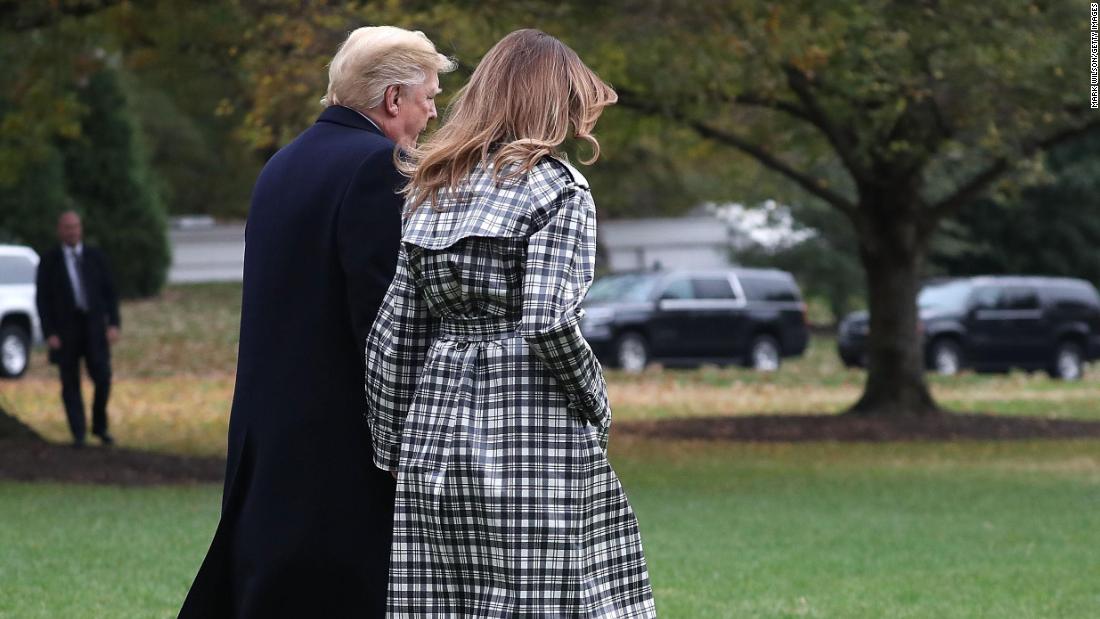
Fact-checking Trump's claims that he 'called home' to Melania during 2018 foreign trip she was on

 WATCH THE VIDEO OF HIM LYING


Fact-checking Trump's claims that he 'called home' to Melania during 2018 foreign trip she was on 

By Holmes Lybrand, Tara Subramaniam and Kevin Liptak, CNN 


HERE'S THE VIDEO:  https://www.cnn.com/2020/09/04/politics/trump-france-memorial-cemetery-visit-fact-check/index.html


Washington, DC (CNN) President Donald Trump has vehemently denied reports that he skipped a 2018 visit to a World War I memorial in France because he was concerned about his hair and considered the cemetery "filled with losers," as the Atlantic first reported. 

Trump told reporters yesterday that he "called home" to Melania Trump at the time and told her how upset he was for not being able to visit the cemetery. At the time, the White House said he was unable to attend and had to cancel the visit because of bad weather. 

Trump claims he "called home, I spoke to my wife and I said 'I hate this. I came here to go to that ceremony.' And to the one that was the following day which I did go to. I said I feel terribly. And that was the end of it." 

Facts First: Melania Trump was on the same trip with the President and was scheduled to attend the cemetery visit. She was not in the US. 

A readout from the first lady's office at the time said that "Due to inclement weather, the First Lady and President were unable to visit the Aisne-Marne American Cemetery and Memorial in Belleau, France." 

That evening, Trump and Melania went to a dinner together hosted by French President Emmanuel Macron. 

When the decision was made to cancel the visit to the Aisne-Marne cemetery, no aides cautioned Trump that it would play poorly, which he later blamed on Gen. John Kelly and one of Kelly's top aides Zach Fuentes. One person familiar with the postmortem discussions said Trump accused them of "f*cking him" by not predicting the inevitable fallout. 

Still, aides said at the time that Trump did not push to attend the ceremony after being told he could not fly there in the helicopter and that traveling by motorcade would prove difficult logistically. 

Kelly later replaced Trump on the visit to the cemetery. 

Instead of the visit, Trump spent hours on that Saturday afternoon holed up watching television inside the US ambassador's residence, people familiar with the situation said. 

CNN's Kate Bennett contributed to this article. 


The Coronavirus May Change College Admissions Forever

 The Coronavirus May Change College Admissions Forever 

A pandemic returns the focus to what matters: education. 


By Frank Bruni 

Opinion Columnist 

  • Sept. 5, 2020, 2:30 p.m. ET 

    In the context of a pandemic that has killed about 190,000 Americans and economically devastated many millions more, getting into the college of your dreams is a boutique concern. But for many teenagers who have organized their school years around that goal, it’s everything. 

    And it’s going to be different this admission season. It may well be different forevermore. 

    That was what I concluded after a recent series of conversations with Jeffrey Selingo, whose widely anticipated new book, “Who Gets In and Why: A Year Inside College Admissions,” will be published on Sept. 15. 

    Selingo was given extraordinary access to the selection process and the selectors at Emory University, Davidson College and the University of Washington. He uses it in his book to present one of the most nuanced, coolheaded examinations of the admission process that I’ve read. He explodes certain myths — for example, that SAT and ACT scores are absolutely pivotal — and confirms other suspicions, such as the ridiculous advantage conferred on middling students who play arcane sports. 

    But his knowledge and insights also put him in an excellent position to speculate on matters beyond the book’s bounds: specifically, the little, big, temporary and permanent ways in which the coronavirus pandemic, which dawned after his research was done, will change the way colleges evaluate students and vice versa. 

    “College admissions is never going to be the same,” he told me. 

    He was focusing on selective schools, which educate a small minority of Americans in college but loom monstrously large in the psyches of many high school students, who intricately game out how to breach these exclusive sanctums. Well, the rules of that game just changed. 

    Selingo predicts that many schools that allow “early decision” applications, with which a student sets his or her sights on one preferred institution and commits to attending it if accepted, will fill more of their slots that way than ever, meaning that these applications will have better odds of success than ones submitted later. Schools leaned extra hard on early decision in the shadow of the Great Recession, he said, and now face the same economic anxiety, the same motivation to figure out as soon as possible which new students will be arriving and how much financial aid they’ll need. 

    But a more broadly consequential change involves standardized tests. Because the pandemic prevented students last spring from gathering to take the SAT and ACT exams, many selective schools are not requiring them for the time being. That will force them to focus more than ever on the toughness of the high school courses that students took and the grades they got. 

    Which students will benefit from that? It’s complicated. On one hand, affluent students who are coached for these exams and usually take them repeatedly won’t get to flaunt their high scores. On the other hand, less privileged students from high schools whose academic rigor is a question mark in screeners’ minds won’t have impressive scores to prove their mettle. 

    While these exams have been blamed for perpetuating inequality, they in some cases play the opposite role. In fact, a special committee of educators in the University of California system produced an exhaustively detailed report this year that determined that the use of SAT’s in admissions had not lessened diversity and that SAT scores were useful predictors of college success. (University leaders elected to switch to test-optional admissions for a few years anyway.) 

    The SAT’s downgrade won’t be fleeting, Selingo said. “We’re going to have a whole admissions year with scores of places going test-optional,” he said. “Once their world doesn’t come crashing down and they still recruit a class, those colleges are not going to flock back to the test. I think it’s been knocked off the pedestal permanently.” 

    He makes the same guess about what he calls “application bloat,” referring to the flamboyant multiplicity of clubs, causes, hobbies and other materials that applicants assemble and showcase. The pandemic put many of those activities on hold, creating a pause in which he believes that some schools and some students will recognize the lunacy of this overkill. 

    “It’s going to be difficult for students to fill in 10 spaces for extracurricular activities, flag down teachers for recommendations or take six A.P. courses and exams,” he said. “Admissions officers are going to have to focus on what matters. That means in the future they can pare back the application and reduce our collective anxiety about what it takes to get into college.” 

    Apart from the increased early-decision emphasis, which can favor in-the-know kids from in-clover families, the changes that Selingo predicts represent a back-to-basics streamlining of the process. It may have been born of terrible circumstances, but it’s also sensible and overdue. 

    That streamlining extends to how students will choose schools during the coming admission cycle. For epidemiological and economic reasons, many of them will forgo all the campus tours and all the assessments of how comfy the dormitories seem, how tasty the food is, how high the spires rise and how lushly the trees grow. They’ll perhaps look more closely at the course catalog, the roster of professors. 

    Selingo noted that many colleges based a big part of their sales pitch on their physical setting and even on lifestyle and social perks that are less relevant than ever, given pandemic-related restrictions. “That’s forcing parents and students to ask, ‘What are we really paying for?,’” he said. 

    The answer is, or should be, an education, and students may come to realize that excellent ones can be obtained at colleges that are less expensive than others in their sights and closer to home. The lure of going far away to college may diminish. 

    What I suspect will happen, at least in the short term, is that students’ thinking about colleges will be less emotional and more practical. The pandemic has soured the romance. 

    Colleges had previously presented themselves to students as nurturing homes away from home, then had to send those students packing when the virus spread. Colleges were endless parties, then the partying stopped. They touted the intimacies of classroom instruction, then had to defend the tuition-worthy effectiveness of remote learning. How can students not feel some skepticism in the wake of all that? 

    “This morning I listened to a Planet Money podcast called ‘The Old Rules Were Dumb Anyway,’” Selingo said. “It talked about the rules that went out the window because of the pandemic and which changes might be here to stay: alcohol takeout from restaurants, telemedicine, using nursing credentials across state lines.” 

    “It got me to thinking about the old rules that were dumb in admissions,” he added. And it got him to wondering how many were gone for good. 

    Frank Bruni has been with The Times since 1995 and held a variety of jobs — including White House reporter, Rome bureau chief and chief restaurant critic — before becoming a columnist in 2011. He is the author of three best-selling books.  @FrankBruni • Facebook 


Zoom is failing teachers. Here’s how they would redesign it

Millions of students are learning through Zoom this fall. So why does it still feel like a corporate meeting app that has been MacGyvered into an education platform?


BY SUZANNE LABARRE8 MINUTE READ

This story is part of Fast Company’s Reinventing Education package. As millions of students begin school during a deadly pandemic and global recession, we’re highlighting the ongoing efforts to keep children safe in the classroom, educate them remotely, and help their parents manage a new second shift. Click here to read the whole series.


Last spring, when shelter-in-place orders went into effect, my daughter’s preschool teacher heroically tried to adapt her classroom to the virtual world. At first, she had an assistant, whose primary job was to mute and unmute kids in Zoom to imitate the experience of calling on students in class. The task is harder than it seems: You have to scan a Brady Bunch-style grid of two dozen wiggling children for raised hands, click “unmute” under one of their names, and cross your fingers that they are not muted on their end (half the time, they are).

After a few months, the assistant was furloughed, leaving my daughter’s teacher to manage the mute function on her own—while also trying to present lessons, keep track of time, and babysit a group of increasingly stir-crazy 3- to 5-year-olds. She was juggling too many competing demands. She might as well have been asked to play Rachmaninoff while riding a unicycle.

Countless teachers are facing similar problems this fall, as districts across the country usher in the school year remotely to help curb the spread of COVID-19. Conventional wisdom has it that remote learning is an inferior substitute for in-person classes, useful only in an emergency that threatens the health and safety of teachers, students, and staff. And it’s true that the circumstances around distance learning pose tremendous challenges, exacerbating inequity and placing impossible demands on working parents. But class via computers itself is not inherently flawed. It’s the remote platforms that are failing teachers and students.

Zoom, in particular, has struggled to adjust to its newfound prominence in the educational firmament. More than 100,000 U.S. school districts and roughly half the country’s higher-education institutions use the videoconferencing platform in large part because it’s easy, at least in theory: Just click a link, and start teaching. In practice, the experience is more complicated. Last month, Zoom went down for hours due to an unspecified problem, disrupting the first day of school for many children and college students. Last spring, the platform experienced several high-profile hacking incidents, which caused New York City schools and other districts to temporarily ban Zoom.

The company quickly rolled out a series of security upgrades. But it has been slower to address workaday complaints about its UX. Classes were already underway at school districts across the country on August 20 when Zoom finally released improvements critical to educators, such as a way of including ASL interpreters and more control over muting. Many other important features remain unavailable. So we asked teachers—ranging from elementary school teachers to college professors—how they would redesign Zoom to work better for themselves and their students.

A MUTE FUNCTION EVEN 6-YEAR-OLDS CAN UNDERSTAND

Muting is a key classroom tool online, allowing teachers to both minimize disruptions and encourage participation. But as I witnessed last spring, young children often don’t know how to use their microphones, and not all students have a parent sitting there to help them. It doesn’t help matters that the “mute” button is small and right next to the “start video/stop video” button—a poor design choice for little hands with limited dexterity. “It’s pretty constant for me working with 6-year-olds to have to tell them to mute or unmute themselves,” says Danielle LaBarre, a first-grade teacher at Ruby Bridges Elementary School in Alameda, California (full disclosure: She’s my sister-in-law).

In August, Zoom updated its platform to let teachers selectively unmute students. But the feature is buried in Zoom’s web portal settings. And once teachers activate it, students or their parents have to opt in through a pop-up message. This is to address potential privacy concerns (fortunately, they only have to opt in once). Of course, if they don’t, the teacher is right back where she started, wasting precious class time reminding students to unmute themselves.

Alternatively, LaBarre suggests that Zoom could create a strong visual cue that helps even the youngest learners navigate the mute function. For now, LaBarre says she’s planning to make one herself. “When I start Zooming with my new class, I’ll show a picture of what the microphone looks like when it’s on, and then I’ll have another picture of what the microphone looks like when it’s muted,” she says. “That way, I won’t have to say ‘turn your mic on.'”


BETTER BREAKOUT ROOMS

One of the biggest complaints among teachers I spoke with was the difficulty of replicating small-group learning in Zoom. You can divide students up into breakout rooms, but there’s no way for a teacher to observe every group and give feedback all at once, making it tough to know whether students are staying on track.

“I might pose a big question about the perspective of character in a story and have students draw a connection to their own lives in a pair share,” says John Cherichello, a 7th-grade English Language Arts teacher at MS 88 in Brooklyn, referring to an in-person teaching technique in which students partner up to discuss a topic one-on-one. On Zoom, he has to drop into each breakout room to pose the same question over and over again, which is a huge time suck. A better design would give Cherichello an overview of all the breakout rooms and allow him to chime in, like an omniscient narrator, at opportune moments. “An easy breakout room function would really help make the virtual classroom feel a little bit more like the real thing,” he says.

A MORE ROBUST CHAT

Zoom’s chat feature is another major pain point for many teachers. “One of the things I hate the most about Zoom is the chat,” says Brandon Ward, who teaches user experience design to continuing education learners at Southern Methodist University. “It’s really, really difficult to follow.”

Indeed, the chatbox, which appears to the side of Zoom’s main view, is frills-free to the point of wringing any nuance from conversations. You can’t have side conversations (using threads, for instance), without inundating the main chat. There are no emoji readily available. To find an emoji, you have to click “edit” in the nav bar, then “emojis & symbols,” and an emoji menu appears—a cumbersome process that defeats the purpose of using emoji as shorthand for written words.

Ward’s suggestion? Establish a stronger information hierarchy. “I would design it for moderators, so they can see a blown-out version of the chat,” he says. “Then I would create tools for distinguishing between comments, questions, and DMs, and make it more obvious when people are raising hands or clapping. Some of my meetups have close to 500 people. The chats become a constant stream. It’s overwhelming.”

A RICHER WAY OF PRESENTING LESSONS

Jamie Ewing, a science teacher for grades K through 5th at PS 277 in the Bronx, laments how Zoom “flattens” his teaching style. “When I’m in front of the classroom, I get to interact with the content,” he says. “In a Zoom meeting, you don’t have that option. Either you’re the focus or the content is the focus. When you switch over to screen share, you disappear, and you lose the ability to make eye contact [with students].”

Elise McHugh, a biology and chemistry teacher at Groton-Dunstable Regional High School in Groton, Massachusetts, echoes the sentiment. “I found myself holding up my paper copy of the periodic table, and then another paper copy of another reference sheet, and then moving the computer to face my physical white board when solving a chemistry problem” last spring, she says. “It would be easier if I could toggle between these documents quickly through Zoom, and even be able to have a cursor on them.”

Ewing has instead started testing a third-party app called Prezi Video, which enables him to overlay graphics onto Zoom lectures to liven up his lessons. In one example, images of a baseball game pop up behind him to illustrate a lesson on math angles. “Adding an extra layer makes it more inviting and more emotionally engaging,” he says.

Would he rather be able to create media-rich presentations directly in Zoom? Sure, he says, but “at this point, I’ll take what I can get.”

AN ENTIRELY NEW PRODUCT FOR EDUCATORS

McHugh was one of several teachers I spoke with who called for Zoom to spin off an app exclusively designed for educators. “I would recommend [Zoom] make a separate program, much like Google did [with Google Classroom], with features specific to the needs of teachers and students,” she says. “This is a niche market that Zoom could find a place in this coming school year.”

Zoom, for its part, says it has no plans to release such a product. “We’re focusing on our training,” says Zoom’s Global Education Lead Anne Keehn. The company recently held a virtual training summit for 40,000 educators from 150 countries and plans to continue its focus on educating teachers about the features Zoom has, not on developing new software from scratch. “We don’t see a need for a separate product,” she says.

Indeed, Zoom’s latest round of updates is geared toward teachers: Teachers can now create virtual seating charts and spotlight a group of students to approximate an in-person class presentation. There’s also a “professional music mode,” an audio feature explicitly designed to help music teachers improve the quality of their lessons. Keehn suggests more education-specific tweaks are on the way.

But these are largely iterative changes, and Zoom could be ceding its sizable competitive advantage if it doesn’t fully embrace its starring role in U.S. education—especially since aspects of distance learning will likely stick around long after COVID-19 abates.

“What it really comes down to is: Does Zoom want to continue as a meeting service that’s doing emergency remote learning?” says Shanna Katz Kattari, an assistant professor of social work and women’s studies at the University of Michigan. “[Distance learning] is going to continue for at least another year, if not longer. People are going to recognize that online learning is completely valid and effective. It would be a really wise investment to make a secondary product for classrooms.”

ABOUT THE AUTHOR

Suzanne LaBarre is the editor of Co.Design. Previously, she was the online content director of Popular Science and has written for the New York Times, the New York Observer, Newsday, I.D

 More


Total Pageviews

GOOGLE ANALYTICS

Blog Archive