
Donald Trump, Petropresident
Follow the Gulf oil money
Why did Donald Trump attack Iran? Did he believe that a quick victory would boost his poll ratings? Was he looking for a way to change the subject from the Epstein files and affordability? Was he seduced into war by the Israeli government?
The answer, surely, is all of the above. Bad decisions don’t have to have a single explanation. In fact, debacles on the scale of what we’re now experiencing usually have multiple causes.
But when I look into the larger picture of Trump administration policy — not just the attack on Iran but domestic policies, especially the administration’s seemingly irrational hatred of renewable energy and its determination to keep America burning fossil fuels no matter what — I keep coming back to the huge influence now being wielded by oil money.
I don’t mostly mean the domestic U.S. oil industry, although them too. The U.S. oil and gas sector spent large sums helping Republicans in the 2024 election, while giving very little to Democrats.
But what really stands out is the centrality of oil money from the Persian Gulf, money that has been crucial in two areas: Trump’s international economic schemes and his personal enrichment.
One recurrent theme in Trump’s economic speeches has been boasting about the size of the foreign investment pledges he has received as part of his tariff strategy. “In 12 months,” he declared in the State of the Union, “I secured commitments for more than $18 trillion pouring in from all over the globe.”
Nobody knows where that $18 trillion number, which he uses all the time, comes from. The actual announced pledges by foreign governments to invest in the U.S. add up to only about $6 trillion, and many of these pledges are vague statements of intent rather than serious commitments. Indeed, the deal with Europe may well be unraveling in part because Trump’s tariffs have been ruled illegal.
But what’s especially interesting is who has made these investment pledges, such as they are:
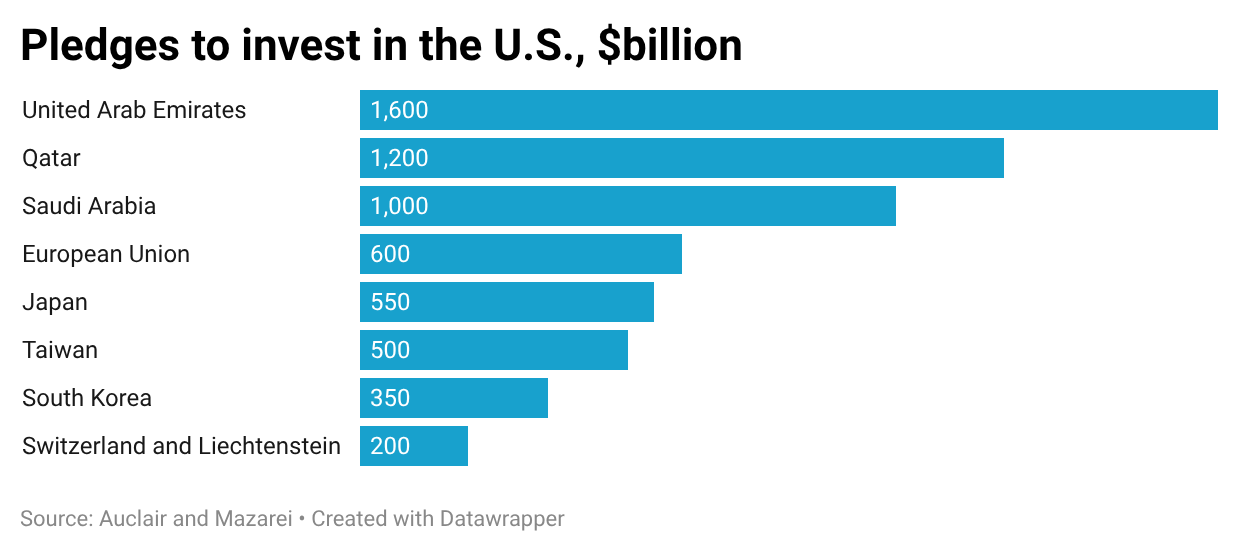
Each of the major Gulf petrostates has pledged to invest more than the whole European Union, even though they have far smaller economies. Here’s another visualization:
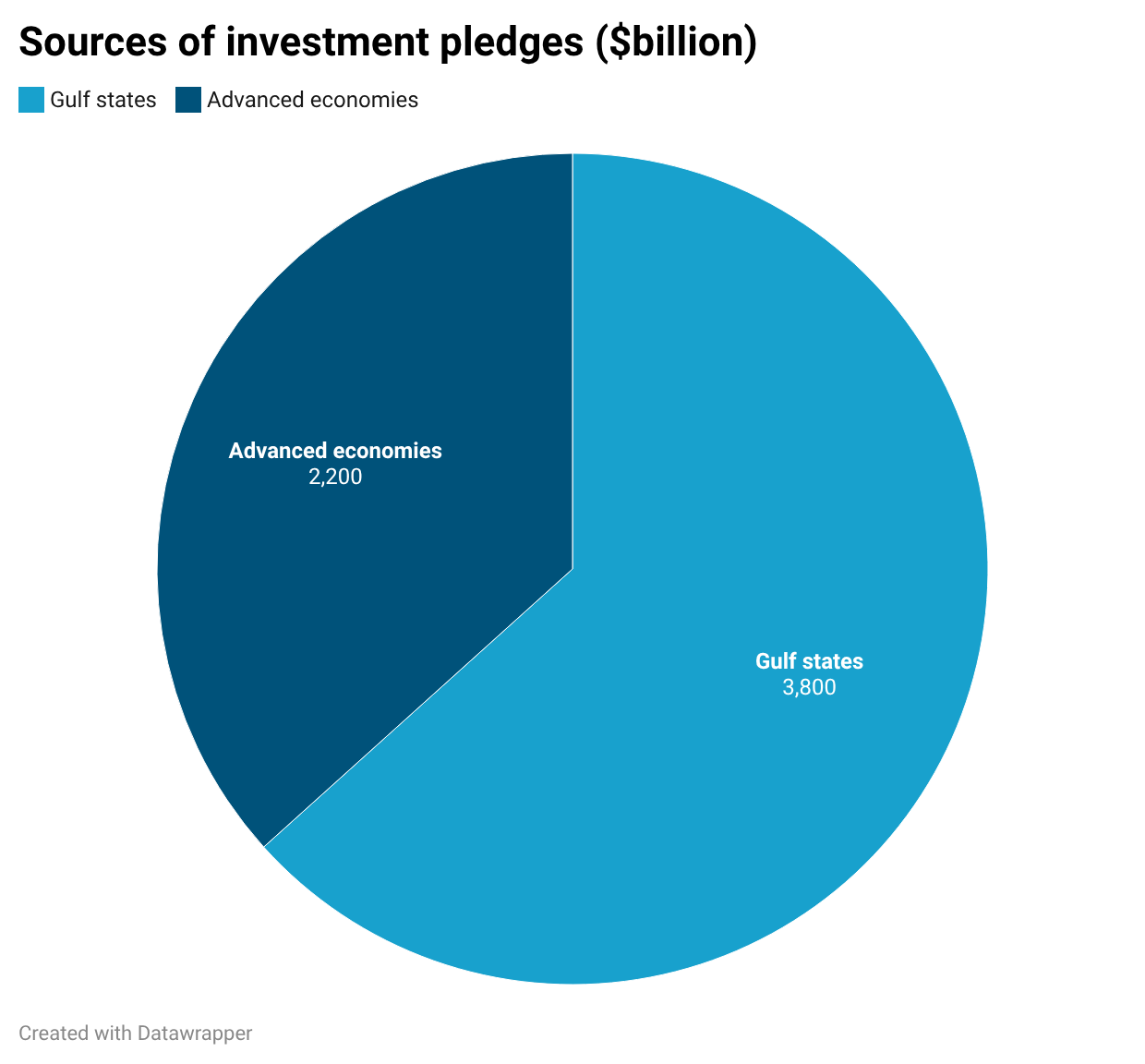
So when Trump boasts about the foreign investment he’s bringing to America, the reality is mostly that Gulf petrostates have said — with dubious credibility — that they will make big investments. That puts his boasts in a somewhat different light, doesn’t it?
And then there’s Trump’s relentless use of his office to enrich himself and his family. As the New York Times editorial board has documented, Trump has raked in at least $1.4 billion since returning to the White House. The biggest single piece of that total is Qatar’s gift to him of a $400 million jet. Most of the rest has come from sales of cryptocurrency. We don’t know who the buyers of Trump crypto are, but it seems likely that Gulf oil money has accounted for a large share. The Wall Street Journal reports that an Abu Dhabi royal secretly invested $500 million in World Liberty Financial, the center of the Trump crypto empire.
Meanwhile Jared Kushner, the First Son-in-Law, has been acting as one of the U.S. government’s chief negotiators on the Middle East while also raising large sums of money for his personal investment firm from investors in the region, especially the Saudi government’s Public Investment Fund. That fund is led by Crown Prince Mohammed bin Salman, who is widely believed to have had a critical journalist, Jamal Khashoggi, dismembered with a bone saw.
Why does Gulf oil money play an outsized role in U.S. corruption? Because petrostates, unlike advanced democracies, combine vast wealth with secrecy and a complete blurring of the lines between public office and private gain. So they’re better placed than anyone else to line U.S. officials’ pockets.
Foreign oil money, then, has been central to both the Trump administration’s economic schemes and Trump’s personal financial schemes. What has that money bought in terms of U.S. policy?
I’ve mentioned the Trump administration’s fanatical hostility to renewable energy. Like the Iran war, this hostility surely has multiple causes. Trump himself is still angry about the offshore wind farm that is visible from his Scotland golf course. Many MAGA types clearly think of wind and solar power as woke and unmanly; real men drill, baby, drill and burn, baby, burn. But suppressing alternatives to fossil fuels is also in the interests of governments and dynasties whose wealth is all about fossil fuels.
As the Guardian notes,
For decades, Saudi Arabia has fought harder than any other country to block and delay international climate action – a diplomatic “wrecking ball” saying that abandoning fossil fuels is a fantasy.
So the Trump administration’s energy policy can be seen as what Prince bin Salman would do if he were in charge. Is he?
Finally, about the war: As the bombing began, the Washington Post reported that foreign influence — and not just from Israel — played a role:
President Donald Trump launched Saturday’s wide-ranging attack on Iran after a weeks-long lobbying effort by an unusual pair of U.S. allies in the Middle East — Israel and Saudi Arabia — according to four people familiar with the matter, as Israeli and U.S. forces teamed to topple Iranian Supreme Leader Ali Khamenei after nearly four decades in power.
Saudi Crown Prince Mohammed bin Salman made multiple private phone calls to Trump over the past month advocating a U.S. attack, despite his public support for a diplomatic solution.
At this point bin Salman is surely regretting his role in promoting the war. But being corrupt and good at corrupting others is not the same thing as being smart.
Again, it’s a mistake to look for monocausal explanations of this debacle. But if you want to understand Operation Epic FUBAR, don’t forget to follow the oil money.
