

HINDSIGHT - WRITE SOMETHING WORTH READING ABOUT OR DO SOMETHING WORTH WRITING ABOUT
The Meaning of Gaza’s Tunnels
Jan. 23, 2024, 7:00 p.m. ET
Opinion Columnist
Ever
since Israel withdrew its soldiers and settlers from Gaza in 2005, critics have
accused it of blockading and immiserating the territory — turning it, as
Israel’s inveterate critics say, into an “open-air prison.”
The
charge was always preposterous. Gaza shares a border with Egypt. Gazans were
often treated in Israeli hospitals for cancer and other life-threatening
conditions. Israel provided Gaza with much of its electricity and other
critical goods even after Hamas came to power in 2007.
Now,
as Israeli troops uncover more of Gaza’s vast underground city, the falsity of
the accusation has become even more apparent.
According to a report this month in The New York Times, Israeli defense officials now
estimate that Hamas’s tunnels measure between 350 and 450 miles in a territory
that’s just 25 miles long. (By comparison, the London Underground is only 249
miles long.) Some of Gaza’s tunnels are wide enough for cars; some are more than 150 feet deep; some serve as munitions
depots; others are comfortably kitted out as command bunkers.
Israeli
officials also estimate that there are 5,700 separate entrances to the tunnels
— many of them with access from civilian houses and some directly beneath Gaza City’s main hospital,
which U.S. intelligence agencies say was also used as a Hamas command center. Within that maze, scores of Israeli hostages,
including a year-old infant, are being held without fresh air, sunlight, adequate
medicine or food, or visits from the Red Cross.
All
this should radically reconfigure the world’s understanding of what Hamas has
done in, and to, Gaza. It has turned the territory into a gigantic military
fortress purpose-built to attack
Israel, endure Israeli retaliation and
interpose civilian lives and infrastructure as part of its means of defense.
Imagine any other government doing something similar to its people — say,
putting the NORAD command center directly below Times Square — for a sense of the
outrage Hamas is perpetrating against its own people.
That’s
not the only outrage. How much did it cost to build these tunnels? How much
concrete, steel and electricity did it divert from civilian needs? How many
millions of hours of labor were given to the effort? What was the cost of
building up its stockpile of thousands of rockets, which continue to be fired at Israel? How many ordinary Gazans had to be conscripted into the
effort of miserably shoveling dirt deep underground — and how many perished in
the effort?
We
may never know for sure. But in 2014, around the time Israel first started to
get a sense of the scale of Hamas’s tunnel network, The Wall Street Journal,
citing Israeli military officials, reported that the cost of building 32 tunnels (a small fraction of what has
since been uncovered) came to around $90 million.
“Some tunnel-building materials also came from aid
earmarked for development projects by international aid agencies in Gaza or
were purchased on the open market when Israel allowed some imports into Gaza
starting in 2010,” The Journal added.
In
other words, Hamas stole from foreign donors, subtracted what probably amounted
to billions of dollars over several years from Gaza’s gross domestic product,
and diverted labor from productive to destructive ends, all to feed its war
machine. Western progressives are usually against this sort of thing, at least
when it comes to the guns-to-butter ratio in their own democracies. Why are
they virtually silent about it now?
The
tunnels also help explain the level of destruction that Israel has wreaked on
Gaza since the war began. If Hamas hides the bulk of its fighters and munitions
in the tunnels, Israel somehow has to find, search and destroy those tunnels.
If Hamas builds the entrances to those tunnels inside private homes, schools or
hospitals, those places all become military targets.
And
if there are nearly 6,000 such entrances, the destruction is all but guaranteed
to be epochal — just as it was in Mosul when the United States assisted Iraq in
destroying ISIS (which was much less deeply entrenched there than Hamas is in
Gaza) over nine months in 2016 and 2017. I don’t recall “Cease-Fire Now”
demonstrations on college campuses back then.
It’s
possible that Israel could fight with more discrimination to spare Palestinian
lives while still destroying Hamas’s ability to make war. If so, it behooves
Israel’s constant critics to explain precisely how, and to do so in a way that
doesn’t let Hamas off the hook. Otherwise, the tragic reality of this war is
that it is going to be catastrophic for Gaza — not because Israel wills it, but
because Hamas spent years of cynical efforts to make it so.
Hamas could have averted this tragedy if it had turned Gaza
into an enclave for peace rather than terror. It could have averted it if it
had not started four previous rounds of war against Israel. It could have
averted it if it had honored the cease-fire that held on Oct. 6. It could have
lessened the blow against Gazans by fighting in the open, not behind civilians.
It could have eased it by releasing all of its hostages. It could end it now by
surrendering its leaders and sending its fighters into exile.
Till then, something I wrote in October holds true
now: Hamas bears the blame for every death
in this war.

Why Older Workers Are Now the Better Choice
There's a lot to be said
for youth and inexperience, but many companies today need wiser, more
experienced workers to get them through the next business cycle. It's time to
go gray.
EXPERT OPINION BY HOWARD
TULLMAN, GENERAL MANAGING PARTNER, G2T3V AND CHICAGO HIGH TECH
INVESTORS@HOWARDTULLMAN1
As more and more
businesses begin to feel confident about the stickiness of the post-pandemic
economy, and their revenues crest or outstrip their pre-Covid levels, company
owners and managers are beginning to slowly try to hire back people they have
let go in the last three years. That's not necessarily an easy task because a
lot of their former team members have moved on, moved out, or aren't interested
in returning to their old jobs.
To allow this rebuilding
to be done at scale is also going to require a sizeable amount of attitude
adjustment on the part of all the parties. Millions of young people think the
stock market only goes up and that the world is just waiting to make them rich.
Millions of middle-aged people thought they had signed up for lifetime
employment and now are learning that they need to be lifelong learners to stay
relevant and employed. What keeps growing never grows old. And millions of
aspiring entrepreneurs think that tech is going to solve all the world's
problems if the old guys will just get out of the way. It's going to take a lot
of patience, pain, and perseverance to pull off this process of re-upping and
reloading the workforce.
Hiring the right number,
desired skillsets and demographic mix of new employees is clearly more
challenging than before because rapid advances in various AI technologies, new,
increasingly intelligent robotics, and the expanded automation of many traditional
processes have changed the game. A significant number of the old positions have
been eliminated (or compressed) and many others require new and different
skills.01:23
As a result, the job
descriptions and search parameters for qualified candidates who are already
trained and can smoothly step into the open slots have also been altered and
updated. Experience and expertise are going to be highly valued, along with the
ability to hit the ground running. The last thing that many of these companies
desire is to spend a lot of scarce dollars for on-the-job training.
Another large group of
theoretical prospects are the pools of recent college graduates -- a great
number of whom have never had a full-time job. Unfortunately, far
too many of them have unrealistic compensation goals, work-life expectations,
and other employment requirements, which make them less attractive and riskier
hires. They don't seem to have gotten the memo about what "work" actually means in
the real world. They've also never lived through a real economic downturn or
suffered through a recession and seen friends and families lose their jobs,
savings, and sometimes far more than that.
So, they're softer, less
resilient, and aggressively impatient -- but not in a good way. Since things
have largely always gone their way, they haven't really learned much about
adversity or the bitter compromises everyone eventually makes in life. You
don't really learn from good experiences and success -- you just keep doing
things the same way that you always have done.
Energy, enthusiasm, and
eagerness used to be critical considerations in
hiring new employees. These are still important attributes, but we're facing
another year or two of market uncertainty, slow and careful growth rather than
explosive leaps, and an overall interest in patience, prudence and hunkering
down to weather the next storm. Security, stability, and liquidity are going to
be top of mind for senior management, stockholders, and stakeholders and no one
wants to be seen hanging way out over their skis.
As a result, in the
smartest and most competitive companies, we're going to see another dramatic
shift in their hiring perspectives: more focus on gray hair, prior, relevant
work experience and, maybe most importantly, men and women of a certain age who
are now far more readily available in significant numbers. They're grounded,
serious and realistic and they're much more about taking orders than taking
risks, and that's a good thing. These are the mid-careerists who've seen the
hard times and remember the troughs and valleys that always offset the peaks
and moonshots that have been all the media rage for the last two decades.
The pampered and
hyper-parented Gen Zers have heard incessantly, their whole lives, about home
runs, trees that grow to the sky, and the glory days. By contrast the older
folks have seen the bumps in the road as well. People who've maybe lost a
serious job or two; who have serious financial, family, and other
obligations; and, frankly, who are likely to be excited and grateful to be
rejoining the working world at this point in their careers. What they may lack
in speed and reaction time is far less critical in the tortoise times to come
when only the craziest rabbits are running amok. The fact that they appreciate
the opportunity and what they can make out of it instead of regarding a job as
something they're willing to settle for in the moment tells a smart employer
everything you need to know.
Resilience is a powerful
muscle that grows stronger over time and through repeated exercise and testing.
Our teams need it now more than ever.


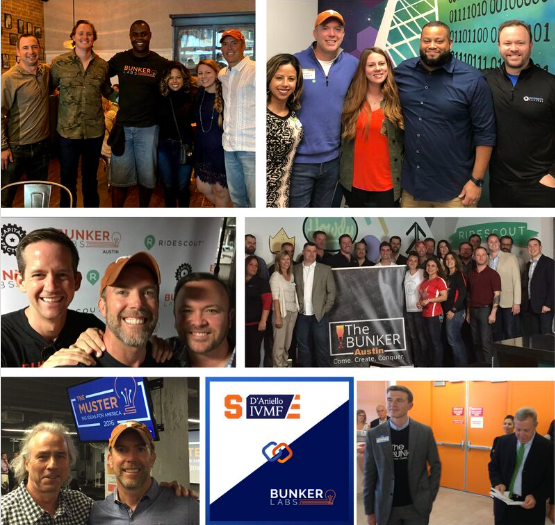

From its inception in Chicago to its expansion to Austin and then nationwide, Bunker Labs has been a beacon of growth and support for veteran entrepreneurship. I remember vividly the excitement of August 14th, 2014, when Bunker Labs launched in Chicago at 1871, thanks to Howard Tullman's support. After exiting from Cohort 1 due to our acquisition by Mercedes, the following year we proudly opened its first chapter in our RideScout offices in Austin, Texas with the generous support of many including Bob Metcalfe and Mayor Steve Adler.
Witnessing its remarkable growth over these nine years has been nothing short of inspiring. The impact Bunker Labs has made on veteran entrepreneurship and the greater good is monumental. This journey wouldn't have been possible without visionary founders like Todd Connor and Brandon Bodor, who laid the foundation, and the unwavering support of individuals like Blake Hogan, Jonathan and Sabrina Wojtewicz in launching the Austin chapter-- all who were instrumental in propelling us forward.
Seeing Kelly Perdew and Craig Cummings rise to the National Board of Directors, followed by Blake Hogan becoming the CEO, has been heartwarming at every turn. The events held at the Capital Factory in Austin, supported by Joshua Baer and the CF Dream Team, and the backing from The University of Texas at Austin, have been pivotal to their success.
As I eagerly anticipate hosting IVMF in Austin this February, I can't help but express my immense excitement for the entire team. The role models like Shaydi DeJesus, Marcus J. Carey, Anthony G., Bret Boyd, Miles Murray, Samantha Snabes and countless other Bunker company founders have been inspirational for Veterans across the country to live out their dreams.
Here's to the next chapter of innovation and impact.
hashtag#BunkerLabs hashtag#VeteranEntrepreneurship hashtag#IVMF hashtag#Innovation hashtag#Leadership hashtag#GrowthJourney"