Friday, December 17, 2021

FOX'S LIES AND LIARS KNOWINGLY COST THOUSANDS OF AMERICAN LIVES - THESE PEOPLE ARE SHAMELESS PIGS AND SCUM


Donald Trump’s Megaphone

Fox News news hosts knew that Trump’s lies were lies—and they amplified them anyhow.


Jonah Goldberg

Dec 15

Screw it.

I’ve shown a good deal of restraint since news broke that I left Fox News.

I haven’t done any TV about it, and I’ve let a lot of nonsense go by without a response.

A major reason I chose to leave with more than a year left on my contract was that I felt conflicted about speaking freely. Fox understandably doesn’t like to pay people who criticize Fox or its talent, and there is something unseemly about it.

So that was one reason why I left.

Another was that I didn’t want to be complicit in so many lies.

That’s the thing. I know that a huge share of the people you saw on TV praising Trump were being dishonest. I don’t merely suspect it, I know it, because they would say one thing to my face or in my presence and another thing when the cameras and microphones were flipped on. And even when I didn’t hear it directly, I was often one degree of separation from it. (“Guess what so-and-so said during the commercial break?”) Punditry and politics is a very small world—especially on the right—and if you add-up all the congressmen, senators, columnists, producers, editors, etc. you’ll probably end up with fewer people than the student population of a decent-sized liberal arts college.

Yes, yes, some people started to drink the Kool-Aid and actually came to believe their own lies, but that’s a subject for another time. Suffice it to say, however: Just because you’ve come to believe a lie that doesn’t make that lie true.

I never deliberately lied on Fox, but over time I felt like I was becoming complicit in a series of lies of omission. I’ll come back around to explain that in a moment. But let’s start with the news of the day.

The Meadows texts.

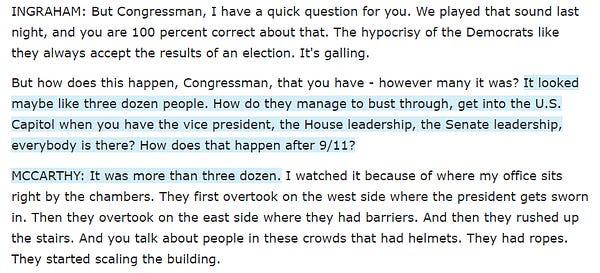
Too much and too little has been made of the Meadows texts released this week. On the one hand, we already knew that lots of Trump boosters were horrified by what they saw on January 6. Heck, I suspect that the vast majority of pro-Trump Republicans were horrified. Even Lindsey Graham, who spent much of Trump’s presidency as the Renfield to his Dracula, famously said he was done with Trump from the well of the Senate that very day. We know that Kevin McCarthy, a political homunculus who makes Lindsey Graham seem Churchillian by comparison, was outraged and expressed his outrage directly to the president during the riot—because he knew the president was responsible.

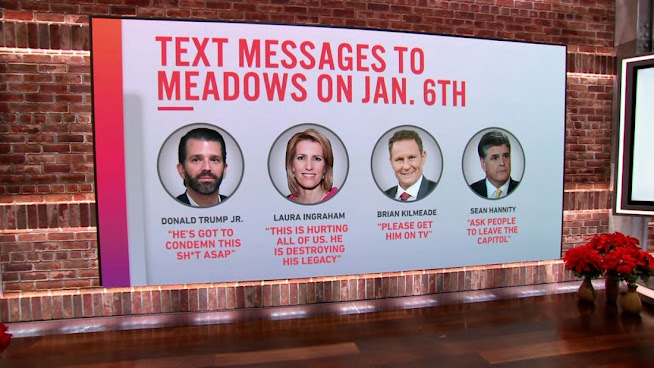
So it’s no surprise that Sean Hannity, Laura Ingraham, and Brian Kilmeade were aghast at the spectacle. (It is a bit surprising however, that Donald Trump Jr. was appalled.) The only person who we know for sure wasn’t appalled by what Trump had wrought was Trump himself.

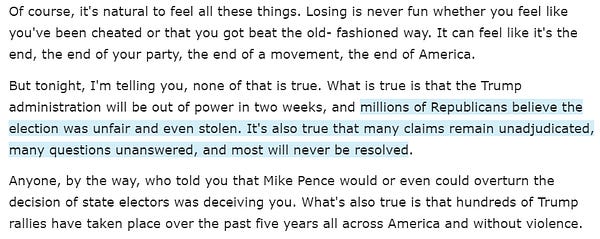
The significance of those texts isn’t that they recognized the truth of that day. What’s relevant is the contrast of that private behavior with their public behavior over the 11 months that followed.

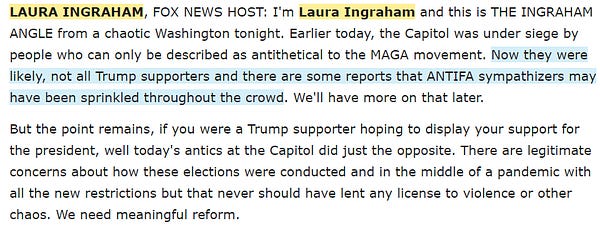
Last night, Laura Ingraham made a huge deal of the fact that she condemned the violence on her show on the evening of January 6. And she did. Although she sprinkled it with all sorts of fan service nonsense about Antifa provoking the violence and insinuations that the mob was right to be angry about the allegedly rigged election. But she did say, “Political passions boiled over today, and it will only serve to make the lives of MAGA supporters more difficult and even imperil this movement they fought so hard for.”

What she didn’t say is that the mob’s passions boiled over because of Donald Trump’s lies—and the megaphone she and her colleagues gave to those lies. From her texts it’s reasonable to assume that she believed—rightly—that this mob was Trump’s to command because the mob believed it was doing Trump’s bidding.

But that truth is what she left out that night—and, as far as I can tell, every night since. In other words, the central truth of the texts isn’t that what the mob was doing was condemnable, but that Trump was responsible for the condemnable behavior. By the time the cameras went on, Laura was still willing to condemn the president’s mob, but not the president. And if you read the transcript, much of the show was dedicated to rationalizing the mob’s behavior, with various GOP congressmen changing the subject to the supposed real outrage of the stolen election. “Laura, this is bigger than the president of the United States,” Rep. Lee Zeldin explained. “This is bigger than 2020. What we saw in this administration of the 2020 presidential election, rogue state actors, state elections officials, secretaries of state, courts, they usurp state legislative authority. They decided to administer elections however they see fit. And we need to have that conversation today.”

Yes, that was the pressing conversation we needed the day a mob chanted “Hang Mike Pence!” and bludgeoned cops with flag poles.

Laura spent the next 11 months cleaning up the president’s mess.

“No reasonable person thinks that what happened on January 6 was, as Biden said, the worst attack on the Capitol since the Civil War,” she said last July. “Come on, guys. Buffalo head guy was poised to take over the U.S. Government? Are you kidding me? We’ve had many protests, many riots in American history. We had many last year that were far worse than this.” When Capitol police testified before Congress, she dismissed it all by giving out “Best Performance” awards like they were all actors. And she said the police had “no one to blame but themselves” for letting the mob inside the perimeter.

That’s not what she was texting Mark Meadows.

For months,  many hosts and guests on Fox prime time focused on exonerating Trump, condemning liberal hypocrisy, and disseminating rumors that Antifa was really responsible.

About that: I’ve never understood the moral logic that says the riot was bad if Antifa or the deep state provoked it, but no big deal if it was just a spontaneous uprising. If Antifa or the deep state were the real culprits, that would be very bad. But they weren’t. And how was the riot just a tourist visit gone awry if they weren’t pulling the strings? Either it’s bad to bring bear spray, zip ties, and paramilitary gear to storm the Capitol, smear feces around its halls, chant “Hang Mike Pence,” and look to take hostages—or it’s not.

Similarly, if you are very angry about the BLM riots—and I am—how does that make January 6 okay (as Hannity intimated just last night)? Violent mobs are bad, period. A “law and order” conservatism that says, “As long as liberals fail to condemn thuggish violence for their side, we feel no obligation to condemn thuggish violence on our side,” cares neither about law and order nor conservatism.

Moreover, we now know that the January 6 mob was orchestrated as part of a larger effort to steal the election on behalf of Donald Trump. As Kevin Williamson brilliantly puts it, “A riot that is part of a coup d’état is not very much like a riot that is part of a coup de Target.”

I have no idea if Hannity and Ingraham knew what Trump was trying to do with John Eastman and all that. But given how chummy they are with the administration, I see no reason to give them the benefit of the doubt. And we do know that prior to January 6, they and their colleagues stoked the very passions that “boiled over.”


Whatabout whataboutism? 

Okay, about me.

During the Trump years a lot of people found safe harbor in changing the subject or playing tu quoque games. It only makes sense. If you can’t defend something indefensible, bring up something the other side did that’s not defensible either and talk about that. To any inconvenient charge or fact about Trump, his defenders would respond, “What about …?” the Democrats, Antifa, Hillary, the New York Times, Barack Obama, Hunter Biden, the designated hitter rule, whatever. 

There are three chief advantages to such rhetorical tactics. First, we live in an idiotic age where people believe that the alleged hypocrisy of a critic nullifies the merit of criticism. A parent who smokes is a hypocrite for telling his kid not to smoke—but that doesn’t mean the kid should therefore smoke.

Second, it’s what the audience wants to hear. And no “principle” explains cable news opinion shows more than “the customer is always right.” The Fox audience craved permission to be saved from its own cognitive dissonance and whataboutism as an exit ramp from having to confront the actual facts.

Finally, it lets you avoid explicitly lying. You just don’t answer the question that matters by pointing out the flaws of the other team. 

The problem, at least for me, is that if you follow this approach too long you’ll eventually become complicit in a larger deceit. And that’s where the lie by omission comes in.

For example, let’s say someone asks you, “What do you make of the credible evidence that Donald Trump is a sexual predator?” And you answer, “What about Bill Clinton!?” (Forget that this is not actually a defense of Donald Trump in the same way the smoking parent’s hypocrisy isn’t an affirmative case for smoking.)

Asking “What about Bill Clinton?” can be—and often was—an indictment of the questioner’s double standard. After all, plenty of people in the mainstream media smugly dismissed attacks on Bill Clinton’s predatory priapism as nothing more than prudish partisan nonsense. It’s a fine point to make—and I’ve made it many times. Here’s the difference, though: I believe both Bill Clinton and Donald Trump should be held to account for their behavior. But if all you’re ever allowed to say is the stuff about Bill Clinton without referencing Donald Trump, you’re left sounding like all you care about is the other side’s hypocrisy.

The whole point of these whataboutist games is to exempt yourself from consistency. If your only goal in pointing out this double standard is to let Trump off the hook for arguably worse behavior, you’re adopting the same double standard you claim to be condemning. 

This kind of thing has been the overriding ethos of Fox opinion hosts and pundits for five years (with a few honorable exceptions). It wasn’t always explicitly whataboutist. Sometimes the whataboutism was simply implied. Don’t talk about Trump’s lies, mistakes, or misdeeds, just focus on the hypocrisy or hysteria of liberals who point out Trump’s lies, mistakes, or misdeeds. Sometimes the technique becomes so ingrained there’s no double standard at all, simply a ridiculous non-sequitur. “Democrats are arguing that Trump welcomed and incited a violent incursion into the Capitol,” Laura Ingraham once fumed, “when it is they who are enticing illegals to bust through our borders, exploit our resources, and commit crimes.” Uh, what?

For most of the Trump years, when I was invited on Fox it was to talk about anything but Trump. And as a conservative, I was perfectly willing to criticize Democrats and progressives. But opportunities to criticize Trump were studiously avoided. (Though sometimes I managed.)  

With one exception, I was never told by anyone what I should or shouldn’t say. But—outside of Special Report with Bret Baier and Fox News Sunday—I was really only welcome to train my fire leftward. Eventually, I felt like a cog in the whataboutist machinery. And as a conservative who passionately believes the conspiracy-mongering, demagogic, populist, personality cult nonsense that defines so much of  prime time Trumpism is not conservatism rightly understood, or even conservative in any meaningful sense, I felt I couldn’t associate myself with it. Perhaps I waited too long, but because I consider myself a writer, not a TV personality, I consoled myself by telling the fuller truth in print.

Regardless, while I will miss many decent people who try to do what they can where they can at Fox, I am utterly content with my choice. Let me repeat my favorite line from Alexander Solzhenitsyn. “You can resolve to live your life with integrity. Let your credo be this: Let the lie come into the world, let it even triumph. But not through me.”

Thursday, December 16, 2021

These two hypocritical scumbags are the worst of the worst and killing our country.


These two hypocritical scumbags are the worst of the worst and killing our country.


Opinion: Kyrsten Sinema and Joe Manchin mull whether democracy is worth saving


By Paul Waldman

Columnist

Today at 1:00 p.m. EST

Democrats are now considering pushing negotiations over the Build Back Better package into next year and moving immediately to pass one or both of their voting rights bills, the John Lewis Voting Rights Advancement Act and the Freedom to Vote Act.


But getting either bill passed requires a carve-out of the filibuster, the procedural weapon Sens. Joe Manchin III (D-W.Va.) and Kyrsten Sinema (D-Ariz.) seem to hold in higher esteem than anything on their own policy agendas or even democracy itself.


Nevertheless, the door to reform may have cracked open a tiny bit. Sinema now says she wants the Senate to debate the filibuster — as though we haven’t been debating it for a year and there might be some arguments no one has yet considered. But at least she wants to talk about it.


More troublingly, she’s still repeating a terrible argument for the filibuster. Her spokesperson warned that whatever Democrats pass into law could be “rescinded in a few years and replaced by a nationwide voter-ID law, nationwide restrictions on vote-by-mail, or other voting restrictions currently passing in some states extended nationwide.”


In other words, if Democrats are permitted to pass legislation, that would mean someday Republicans could pass legislation if they’re in charge. Which would mean Congress should simply never do anything.


But even if your heart warms at the thought of putting Congress into an indefinite legislative coma, we face an urgent problem right now, one that can’t wait. Republicans around the country are waging war on democracy, not only passing voter suppression bills but, even more dangerously, moving to make it impossible for them to lose elections, no matter the will of the voters.


It’s a three-pronged attack: wielding suppression measures to make it harder for people likely to be Democrats to vote; drawing district lines so Republicans always control state legislatures and have a disproportionate advantage in Congress; and seizing control of voting administration to make it possible to declare Republicans the winners even when they lose.


All of which is why voting legislation is in a different class from other kinds of bills, and demands a different approach, even if you’re still devoted to maintaining the filibuster for most legislation.


To understand why, consider the 10 Republican votes you’ll need to overcome any filibuster in a 50-50 Senate.


On rare occasions — as with the recently passed infrastructure bill — 10 Republicans will see it in their own interest to allow a bill to pass, even if President Biden might get a bit of credit for it. The debt ceiling is another example: Ten Republicans didn’t want to send the U.S. economy spiraling into recession, or didn’t want to see their party blamed for it, so they agreed to a procedural do-si-do that allowed Democrats to increase the ceiling on a majority vote.


But there is no bill that secures voting rights and majority rule that 10 Republicans will accept.


You can offer all the paeans to bipartisanship that you want, but that is a simple fact. It isn’t just that nearly every Republican will vote against those two voting bills. (Sen. Lisa Murkowski of Alaska supports the John Lewis bill, but she is alone.) It’s that their party has put a commitment to minority rule, and the Trumpist belief that elections must not proceed fairly if it means a Democrat might win, at the absolute center of their identity.

They will not be moved from this position. There is no symmetry between the stances of the parties, and no compromise that can be reached. One party is trying to secure free and fair elections even if it means they’ll lose a good part of the time, and the other party is committed to nothing less than the destruction of American democracy.


Which leaves Democrats with two choices: alter the filibuster to pass legislation that pushes back on the GOP war on democracy, or sit back and watch while the pieces are systematically put in place for Republicans to steal the 2024 election, if necessary by having GOP legislatures in swing states simply declare Donald Trump the victor no matter what the voters want.


So Sinema can say she supports measures to secure democracy, but if she doesn’t favor a filibuster carve-out that allows them an up-or-down vote, then she doesn’t. You can’t say you “support” a bill when you’re actively thwarting its passage, any more than I could say “I support you getting to work on time today” if I’ve stolen your car keys and slashed your tires.


For all the work that has gone into the Build Back Better bill, many Democrats now say that voting legislation is the higher priority for the moment, and momentum is building for some kind of filibuster carve-out. In the past few days, Sens. Mark R. Warner (D-Va.), Gary Peters (D-Mich.) and John Hickenlooper (D-Colo.) have called for changing the filibuster to protect voting rights.


As for Manchin and Sinema, the most optimistic take is that they’ll be willing to sign on to some kind of filibuster workaround for these bills, but only after a protracted public process that makes clear they didn’t just suddenly change their minds.


If that’s what it takes, so be it. If they put it off much longer, there might not be a democracy left to save.


(Dobbs) Cheating in Elections for a Generation to Come


Wednesday, December 15, 2021


What the Meadows texts reveal about Trump's secret life


Lucian K. Truscott IV

Top of Form

Bottom of Form

One myth of the Trump years has been that his crimes and the crimes of his Band of Crazy Compatriots were committed in plain sight.  Trump’s rants at his rallies were remarkable, we were told again and again, because he gets up there and tells you what he’s going to do.  Some pundits thought it started during the 2016 campaign, when Trump would come right out and encourage his followers to beat up anti-Trump protesters who occasionally showed up among them.  In Iowa, he told a rally, “If you see somebody getting ready to throw a tomato, knock the crap out of them, seriously.  Just knock the hell out of…I promise you, I will pay for the legal fees.  I promise.  I promise.”

For a time, Trump’s in-your-face rabble-rousing and encouragement of violence passed for honesty.  He’ll say things other people think but won’t come out and say, went the thinking.  When two of his top campaign aides got in trouble with the FBI, Trump “sent private and public messages to Flynn encouraging him to stay strong and conveying that the President still cared about him before he began to cooperate with the government," Special Counsel Robert Mueller found in his final report.  “With respect to Manafort…the President and his personal counsel made repeated statements suggesting that a pardon was a possibility for Manafort, while also making it clear that the President did not want Manafort to 'flip' and cooperate with the government," Mueller found.

Former Michigan U.S. Attorney Barbara McQuade, a frequent legal commentator on MSNBC, wrote a major piece for the Daily Beast entitled, “Trump may be committing obstruction of justice in plain sight.” 

“Trump…seems to be attempting to obstruct the special counsel’s investigation in broad daylight. Why? It may be a deliberate strategy to maintain deniability. By using Twitter and public remarks to intimidate investigators and delegitimize law enforcement, Trump may be attempting to negate the ability of prosecutors to prove an essential element of an obstruction charge: corrupt intent. If he were intending to obstruct justice, the strategy goes, would he have done so publicly? Of course not! Therefore, he lacks the requisite intent to commit the crime.”

It happened again during the Ukraine scandal.  Trump came right out and told Ukrainian President Zelensky that all he needed was an “investigation” of Joe Biden and his son Hunter, and everything would be peachy.  He’d release the weapons promised to Ukraine’s army, and all would be well.  Efforts to impeach Trump for “high crimes and misdemeanors” related to the Ukraine scandal came to naught, at least in part because he had been seen directing the actions of his co-conspirator Giuliani “in plain sight,” so how could that have been wrong?  Nobody in his right mind commits crimes out in the open,” Trump’s defenders said.

When he lost the election of 2020, Trump made repeated statements that could be interpreted, and were interpreted, as trying to influence state recounts in Georgia, Arizona, Michigan and other states where he had lost by narrow margins, which amounts to a federal crime we’ve been told.  He invited legislators from Michigan and Pennsylvania to the White House and tried to convince them to seat Republican slates of electors in their states, and he didn’t hide it.  The story of what he was up to was told by White House reporters in real time.

And then came January 6, when as he did repeatedly at campaign rallies in 2016 and 2020, Trump got up in front of a crowd of his followers on the Ellipse and came right out and said what he wanted them to do.  They were to be “tough” and march on the Capitol and show those lily-livered members of Congress what they need to do.  In December, in the run-up to the rally when he was ginning-up support to overturn the election, he tweeted to his followers urging them to come to Washington on the 6th, “Be there.  Be wild!”  There he went again, inciting a riot in plain sight.

Aging pundits who had been around for Watergate even pointed out that everything Nixon did in secret, Trump seemed willing to do out in the open.  That was the difference between the two men, it was said.  Trump was shameless while Nixon was obsessively secretive.

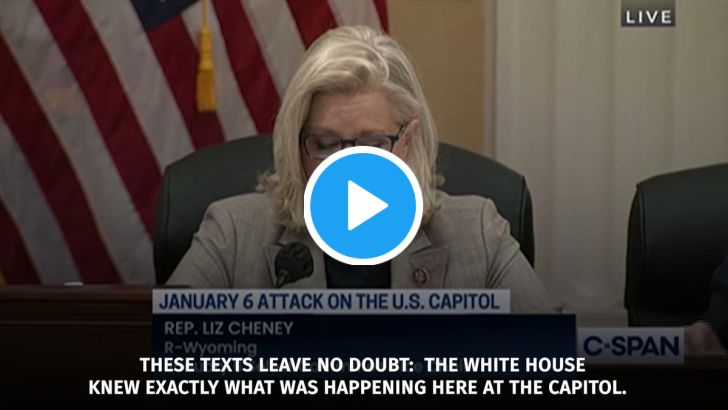
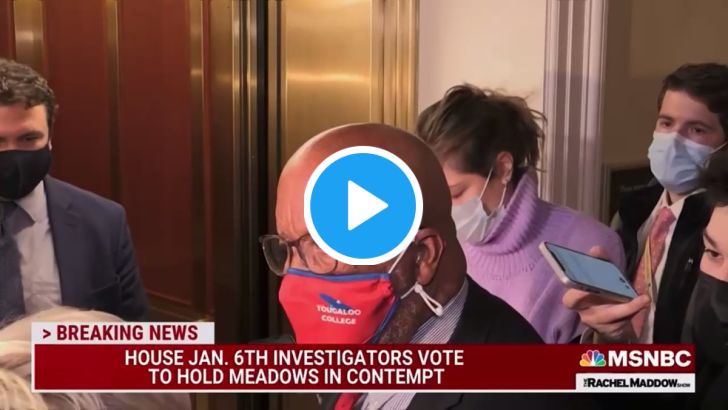
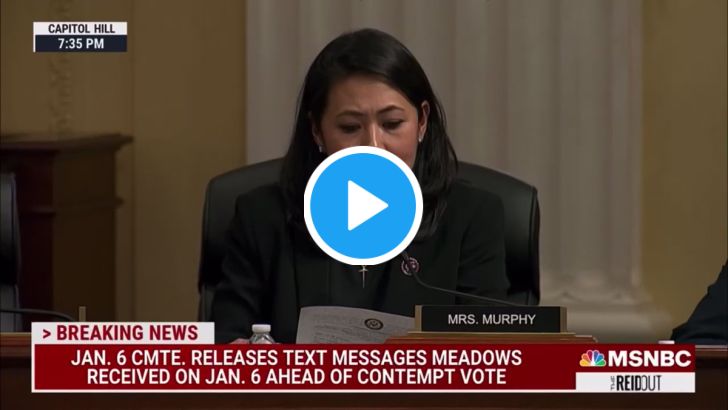
The Meadows texts show the secretive side of Trumpworld.  While Trump and his entire party were publicly playing down the insurrection as a “peaceful tourist visit,” behind the scenes Fox News anchors, members of Trump’s family, and members of Congress were trading texts proving that they knew exactly what was going on and why.  CNN helpfully summed up the texts this way: 

"He's got to condemn this shit ASAP," Don Jr. wrote. "We need an Oval office address."

"Mark, the president needs to tell people in the Capitol to go home," Ingraham wrote.  "This is hurting all of us. He is destroying his legacy."

"Can he make a statement?" asked Hannity. "Ask people to leave the Capitol."

"Please, get him on TV," begged Fox & Friends' Kilmeade. "Destroying everything you have accomplished."

Nobody – not Meadows, not Hannity, not Suckling Son No. 1 Don Jr. – none of them ever thought what they said privately would see the light of day.  Trump himself famously has never written a single email, but it’s obvious that plenty of them were written on his behalf.  Which makes you wonder, doesn’t it, what else is out there.

There have always been two Trumps, one for public consumption, and one behind the closed doors of Beverly Hills Hotel suites, Trump Tower offices, the Oval Office, and out on the golf course where I’ve always been convinced the great majority of Trump’s secret life has always been lived.  Why do you think the White House press pool was never…never…allowed to photograph him during his golf games?  Why do you think the names of his “golfing partners” were never revealed to the press?  Why do you think his White House schedule was frequently a blank slate upon which the words “Executive Time” were typed again and again and again?  We’ll never find out how many times he spoke to Vladimir Putin on the phone.  We’ll never find out what Trump did when he walked down the stairs of Jeffrey Epstein’s private plane. 

In fact, every time there’s been a crack in the door to Trump’s secret life, what peeked out has been sordid, disgusting, criminal, and usually all three at once.  

There are more text messages from Meadows to come, we’re told by the Jan. 6 committee.  Members of Congress who sent them as they cowered in their offices afraid for their lives will be named.  I can’t wait.


Tuesday, December 14, 2021

NEW INC. MAGAZINE COLUMN BY HOWARD TULLMAN


Don't Have an Enemy? Get One.

Having friends in business is very nice. But not very helpful in the long run. In the emerging post- pandemic world, you need to motivate your team around a common foe, real or imaginary.


BY HOWARD TULLMAN, GENERAL MANAGING PARTNER, G2T3V AND CHICAGO HIGH TECH INVESTORS@TULLMAN


Any successful entrepreneur of a certain age will tell you that "warm and fuzzy" fantasies and "feel good" goals don't work as effective long-term motivators for your people. Age and painful experience are important predicates for this understanding, because if you're a kid CEO who flipped your startup to Facebook, a meme "investor" who made a mint on GameStop, or if you've recently banked a bundle on Bitcoin, then the sadly practical advice which follows probably isn't for you. While you can afford to have your head stuck in the clouds or elsewhere and pontificate about peace, progress and purpose, the rest of us are concentrating on resetting and restarting our businesses and pointing our people in the right direction.

Having a professed purpose or two like ESG is clearly more desirable in your portfolio than MSG in your pot stickers. But it's even more important for the tip of the spear -- your sales team -- to have a specific point. Climate change is certainly a crucial concern and saving the seals -whales - wolves may be a great salve for the soul, but neither is concrete and immediate enough to translate into day-to-day direction.

Teams need targets. Not "nice to have" aspirations, but "need to have" objectives and the more particular and focused they can be, the more likely your business is to succeed. Good teams hit targets that others can't hit. The best teams hit what other teams can't even see, but only when they're given actionable information and ground-level guidance.

Importantly, successful salespeople require passion and commitment - the best of the bunch take things personally. We're talking emotion, energy and enthusiasm. Passion, as a practical matter, trumps purpose in the here-and-now and, interestingly enough in our post-truth world, the source, substance and sanity of the passion is almost irrelevant. You've got to believe it in order to sell it and whether it's actually true isn't that big a deal. 

As your people slowly return from a two-year COVID-19 hiatus, you're going to need to fire them up and, as often as not, you're going to be fighting a fair amount of apathy, angst and indifference. In these very confusing and conflicted times -- when half the world doesn't seem to even know which way is up -- sending your people out with warm words, a smile, and a pat on the back to fight the good fight just isn't going to get the job done. A concrete plan with some measurable and achievable goals, the promise of some financial rewards based on results, and a modest kick in the butt are much more likely to bring home the bacon than even the best of intentions and a heart of gold.

Today's highly scrutinized managers can no longer employ some of the tried-and-true motivational methods. For a variety of reasons, good and bad, managers need to be much more sensitive to the "feelings and needs" of their employees. Apparently, this is all about carrots now and not sticks - especially with a newly returning and entitled workforce that seems to think that you owe them a living and an explanation for everything.

So, if you can't prompt, push or pick on your people, and you're getting tired of putting out the politically correct pablum that passes for acceptable encouragement these days, I have an alternative approach that apparently will still pass muster, as long as your choice of target is a competitor's expected actions and not based on its country, culture, color or any other disqualifying criteria.

Any good leader knows that you need to tell your people a compelling story about an important journey and then show them a path to reach the promised land. But to jumpstart your journey, what your story really needs is a villain because, as we see every day, hate has been normalized and weaponized into a stronger driver of all manner of behaviors than love.

So, the first step is to find an available villain. And, if you don't happen to have an aggressive competitor you can transform into an evil enemy, just feel free to invent one. I don't mean to suggest that you should go around making enemies gratuitously. Unlike friends, who come and go, enemies accumulate. But invented enemies, the nastier the better, are perfectly fine. Make them greedy gargoyles who want to take the food from your team's children's mouths and put their parents out on the street. Or reveal wanton weasels who want to take your people's jobs and customers away. They could also be scoundrels and scam artists selling second-rate products and services to your friends and family. The objective is to get the whole team hyped up, focused on protecting and advancing their own futures, and going full speed ahead for the gold.

The size of your illuminated or invented opponent doesn't matter. They can be a huge corporate player or the next hot startup in your space. Whoever's most likely to be aiming to eat your lunch. It's never about the size of the dog in the fight, it's the size of the fight in the dog that makes the difference. And your guys are the fiercest fighters in the contest. As hokey as this sounds, this is what works to get everybody back on their feet and ready for battle.

Fighting a common enemy is a contagious sentiment and builds connection, cooperation, and camaraderie. You may think that the sheer joy of finally coming back together in one place will be a reward in itself and sufficient to get things back to normal but (a) it's a "new" normal for sure; (b) you're gonna have some new people in the mix who never knew the old normal; and (c) some of the new folks and some old hands as well will be working remotely forever so you're going to need to really work hard to bring them all back into the fold. The bottom line is that things aren't simply going to take care of themselves.

You need a plan that's more than putting personalized hand sanitizers on everyone's desk with a couple of Hershey's Kisses. You are going to have to expend more time, effort and resources than you expect, and the ongoing messaging will be just as critical as your other actions. Your people need to work hard, stick together, get a little bit better every day, and ask themselves regularly how badly they want to win. The simpler your message the better.

My favorite: You can make dust, or you can eat dust.


THE NOOSE IS FINALLY TIGHTENING AROUND THESE CROOKED PIGS


Total Pageviews

GOOGLE ANALYTICS

Blog Archive