Saturday, June 10, 2006

New Art from ROBERT STANDISH in Los Angeles

ROBERT STANDISH in Los Angeles http://www.robertstandish.com


Work in the Collection includes a large piece by ROBERT STANDISH.


"Untitled (Reflection)"


His new Bathing series is comprised of figurative oil on canvas paintings and photographs.

Photo-realistic and beautifully rendered, the paintings show vivid detail of meditative bathers, models Standish has photographed over the past three years. This new series developed from his earlier series, in which he photographed and painted individuals he came into contact with on the streets of Los Angeles. The subjects were comprised of street people, prostitutes and other acquaintances, reflecting moods of despondency and isolation.

Searching for a metaphorical cleansing, Standish decided to incorporate the ritual of bathing in his new series. He used some of the same models as before along with new ones, and placed them in various bathing scenes, capturing distinctive undercurrents of reflection and introspection. He explores notions of idealized femininity and the psychology of beauty.
Robert Standish has a background in psychology and is a self-taught painter and photographer.

He has developed his contemporary style of Photo-Realism during the last several years while working on this series.


ARTIST'S STATEMENT - NEW SERIES

Skin, flesh, fragile tissue... the shell of human form. Inside inhabits a soul and personality. Outside of the shell, exist many absurd influences from societies' masses, which we in our individual skins consciously and subconsciously respond to.

My work mirrors individuals’ private moments of introspection. I find myself compelled to capture the moments when a strong desire and need to feel comfortable in one's own skin are present. Similarly, I want to capture a person’s attempt at reconnecting or discovering some form of greater magic (conventionally speaking, God) and the candid instant when a person reveals how far he or she feels from that magic.

In my most recent series, I explore the pervasive influence of commercialism on individual psychology. To elicit a reaction beyond the status quo, I chose to implement advertising trends that will potentially appear in the near future. This work which features various corporate logos, was not intentionally created for a company's commercial purposes, but instead to permit mutual exploitation by allowing the display of the company’s logo on my paintings. The aim of the series is to prompt reflection and introspection by the viewer of the psychological violations and absurdness of most advertising.

Thursday, June 08, 2006

New Art from SARAH BEREZA

New Art from SARAH BEREZA


"Altarpiece"


New Art from HEATHER MARX GALLERY in San Francisco

Heather Marx Gallery in San Francisco http://www.heathermarxgallery.com


New Work by DAVID HEVEL


"PopoZao"


"Mr. Smith in Quarantine"


Work by DAVID HEVEL


"Take My Breath Away"


Artist's Information


David Hevel's over-the-top constructions employ taxidermy, props, and craft supplies to create ribald sculptures and installations that borrow their titles from celebrity tabloids. For the exhibition, Hevel will feature his own version of Bambi on ecstasy, tentatively titled It's Official…Britney's Pregnant!, featuring a 6-foot tall deer -- leaking plastic "milk" from multiple breasts -- leaping through a beautiful garden of flowers, ribbon, and rhinestones. Hevel's work is wickedly humorous, and combines elements of science fiction, horror, and an often macabre twist on Martha Stewart-style homemaking. The results are luscious and beautiful send-ups to all that glitters.

Hevel received his MFA from the California College of Art in San Francisco in 2002. His work has been exhibited at the Richmond Art Center, Richmond, CA; The Works Gallery, San Jose, CA; HereArt, New York, NY; Southern Exposure and the San Francisco Art Commission Gallery in San Francisco, CA, among other venues. Hevel was also a recipient of the Murphy/Catagan Fellowship Award from the San Francisco Arts Foundation in 2001.


Artist's Bio


DAVID HEVEL

Education:
2002 California College of Arts and Crafts, San Francisco, CA
MFA, Film/Video Performance
1998 M.Ed., Curriculum and Instruction University of Missouri, Columbia, MO
1993 Central Missouri State University, Warrensburg, MO
BFA, Commercial Illustration and Studio Painting


Selected Exhibitions:
2006 “Fantasy Island 2,” Drake Hotel, Toronto, ON
2005 “Beautiful Debris,” Heather Marx Gallery, San Francisco, CA (travelling to Cypress College Fine Arts Gallery, Cypress, CA)
“Material Matters,” The Lab, San Francisco, CA
“Nancy Boy,” Richmond Art Center, Richmond, CA
2004 “Build: An eight-hour Performance Event,” The Works Gallery, San Jose, CA
2003 “SanFranBananas,” Whitney Cultural Center, San Francisco, CA
“Queer Art,” San Francisco LGBT Center, San Francisco, CA
“Fresh: Redefining Queer Aesthetics,” San Francisco LGBT Center, San Francisco, CA
“Boutique,” Blackbird Space, San Francisco, CA
“Fictional Science,” HereArt, New York, NY
“Poplular TM,” The Works Gallery, San Jose, CA
2002 “Repurpose,” Southern Exposure Gallery, San Francisco, CA
“Punked,” Monart Gallery, Walnut Creek, CA
“Extravaganza,” Paulette Long and Shepard Pollack Gallery, San Francisco, CA
“1111,” California College of Arts and Crafts, MFA Graduate Exhibition, San Francisco, CA
“Fuel,” Paulette Long and Shepard Pollack Gallery, CCAC, San Francisco, CA
“Warrior Games,” Paulette Long and Shepard Pollack Gallery, San Francisco, CA
“Re-enactment of Voyage to the New World,” Artist Event, Oakland, CA
2001 “Voyage to the New World: 1st Fabulous Party after 9/11,” Artist Event, Oakland, CA
“Murphy-Cadogan Scholarship Award Exhibit,” San Francisco Arts Commission Gallery, San Francisco, CA
“Museum of Future Atrocities,” ATA, San Francisco, CA
“CCAC Video and Writers Showcase,” CCAC, San Francisco, CA
“BioRave: Biotech Benefit for the Coalition of Artist and Other Life Forms,” ATA, San Francisco, CA
1997 “FiberWorks,” Legacy Gallery, Columbia, MO
“Graduate Exhibit,” Bingham Gallery, Columbia, MO
“Fiber In/Forms,” Mabee Atrium Gallery, Culver-Stockton College, Canton, MO
1996 “Curator of Graduates in Fibers,”Brady Gallery, University of Missouri,
Columbia, MO
“Kimonos and More,” Legacy Gallery, Columbia, MO
1995 “Best of Show: The Mid-Missouri Computer Animation Festival,” University of Missouri, Columbia, MO
1992 “Works on Paper,” Milwaukee Art Institute, Milwaukee, WI
“Kansas City Regional Coalition of Higher Education Art Exhibition,”
Kansas City, MO


Selected Bibliography: 2006 Cash, Stephanie, “Report from San Francisco II: New and Now,” Art in America, January, p. 60, 62
2005 Berry, Colin, “ 'Material Matters' at The LAB,” Artweek, September, p. 14
Helfand, Glen, “Critic's Picks: Beautiful Debris,” artforum.com, August
Bing, Alison, “Good and Trashy,” SFGate.com Art ePick, July 28-August 3
Nataraj, Nirmala, “ 'Nancy Boy' at the Richmond Art Center,” Artweek, May,
p. 15
Taylor, Robert, “What the Peeps is going on? Examples of 'New Pop Art' are all over the Bay Area,” Contra Costa Times, February 6


New Work by FORREST WILLIAMS


"Street(3)"


Press Release:


Heather Marx Gallery is pleased to announce New York artist Forrest Williams' eagerly anticipated second solo exhibition Passage, which will feature life-size oil on canvas and small oil on panel figure paintings. Unlike his 2002 show Interiors, in which Williams' figures rarely touched or looked at each other, this new body of work explores more subtle, self-conscious attempts at connection between his subjects. "There is more of an intensification of reality, a concentrated moment of charged yet restrained feeling, within the anonymous spaces of these paintings," according to the artist.

New as well is the absence of the subdued and patterned color schemes of Williams' earlier work. An artist exchange stint in Southern California provided the initial inspiration for his solid, Mondrian-esque backgrounds of vibrant reds, greens, and blues. Later, Williams discovered that this amplified color was effective as a way to highlight -- and even dominate -- the figure, acting as a metaphor for the intensity of feeling his subjects exude. These areas of bold color also serve to create ambiguous sets seemingly outside in the street or a deserted alley, suggesting that while his subjects have begun to tackle a self-imposed isolation, they are doing so alone and somewhat hidden from view.

In a series of small Bridge diptychs, two men reach out for each other in tentative handshake poses -- their actual contact only interrupted by the tiny space between the panels themselves -- suggesting the subtle, yet profoundly awkward, separations in our relationships. In his life-size paintings, Williams further expands on this series. He has created both two panel and single canvases, such as Diver and (Green) Alley, that are a visual treat of primary color contrasted with restrained, almost reticent, male figures. Strikingly gorgeous and rich with surface texture, Williams' paintings have been described as "young men caught in the cool directional light, turbulent stillness, and psychological intrigue of a 17th-century Flemish painting," by art critic and writer Alison Bing.

Williams received his MFA from The New York Academy of Art in 1994. He was recently featured in the well-received exhibition Re-presenting Representation 6 at the Arnot Art Museum in Elmira, NY and has had solo and group shows at Elizabeth Leach Gallery in Portland, OR, Wallspace in New York City, and Gallerie de Bellefeuille in Montréal, Quebec. His work has been reproduced in Harper's Magazine and Genre, and was reviewed in Art & Antiques magazine, the Portland Mercury, and on SFGate.com.

Catalogue:


Forrest Williams: Thisclose


Come close; no, closer; closer still; now hold it right there. This is the point of departure for a Forrest Williams painting: An exquisitely untenable situation that's too close to be casual, and yet too far away to be truly intimate. Hands reach out only to hit the edge of the canvas. Heads turn to meet a glance a second too late. Figures lean toward one another, but never quite touch. You're drawn into a state of suspended animation, uncertain whether to approach or retreat, blush or blanch.

Is this a painting, or a tango? Williams draws much of his inspiration from dance, and it shows. In Diver, one man prepares to leap while the other one lights up; both actions seem contrived, choreographed, a feigned disinterest in each other's actions that's a dead giveaway of deep yearning. But these figures are not posed; they're paused, caught in a moment's hesitation that is only suggested on the face but seems to leave every muscle tense. "We tend to think of inaction as the course of least resistance, but any dancer will tell you that staying still takes as much muscle control as making a movement," explains Williams.

He's onto something here. In a society that continues to constrain intimacy -- especially between men -- every attempt to connect is a real and meaningful stretch. The sleeveless T-shirts and rumpled, unbuttoned shirts of Williams' models indicate that we've shed some formalities since the Victorian days of high collars and gloves. But still these manly encounters do not seem casual at all; they're charged with their own expectations, hopes, and fears, and everyone else's besides. The colors of Williams' paintings are bold and exuberant, but the men are not; their lips are sealed, and their brows bend under the weight of too many words left unsaid. In (Red) Alley, even a tentative handshake is prevented by a split right down the middle of the canvas. Kiss is unthinkable; where another pair of lips should be, there's a wall instead. "There may be only a quarter of an inch separating them, but there's no getting past the edge of that canvas," Williams says. There are echoes here of the political climate: Intimacy among men doesn't always come easily, but now there are structural limits imposed on those relationships as well.

Forget about safe distances and easy rapport - Williams' paintings are not about to give in to strict, distancing formalism or to loose, familiar abstraction. Street (2) is a minimalist painting that just so happens to be inhabited, the delectable green brushwork interrupted by a man leaning forward intently as though straining to hear someone just out of earshot. This scene may not be familiar, but this guy's less-than-ideal position certainly is: it's the repressed urge to join in a conversation at a busstop, that seizure of self-consciousness outside a club. He's literally out of step with the perfect geometry of his surroundings, and the taut emotions stippling his face complicate the broad brushstrokes. This is the dilemma of minimalism and modernity: A Rothko can be a lovely place to visit, but we don't live in that ideal, depopulated world. We need human contact; we keep striving for it, against all odds. There's a certain beauty that deserves to be recognized in that too.

Alison Bing, February 2005
Alison Bing is an author, art critic, and independent commentator for Artweek, San Francisco Chronicle's online edition (SFGate.com), artUS, Sculpture, CMYK, Bidoun, and other arts magazines.


New Work by DAVID LYLE


"Best in Show"


Artist's Statement:

My paintings are inspired from found photos or discarded memories. I feel that to find a lost photo and paint it, allows the photo and the memory to have a second life. Although I don't know the people in the paintings, I can relate to certain memories and times in my own life.

By using black and sepia tones, the paintings take on a nostalgic or cinematic mood and I generally try to keep a voyeuristic feel to them, as if the subject or subjects are unaware that they are being watched. I try to keep my paintings realistic yet somewhat hazy, just like memories can be.


Other Information:


Heather Marx Gallery is pleased to present David Lyle's second solo exhibition, February 17 through March 26, 2005. In Fame, Lyle has exposed -- with compassion and humor -- the seductive notion of fame, especially as it relates to middle class America. As in his previous show Sunday, Lyle acts as both curator and painter, sifting through a vast array of snapshots from the 1950s, 60s, and 70s found at thrift stores, garage sales, e-bay auctions, and flea markets. Barely altering the compositions, he bases his black-and-white oil on panel paintings on these images, mimicking their found photo authenticity and achieving a sense of nostalgia and memory. In addition, an in-gallery floor installation of found trophies and awards is also planned.

For Fame, Lyle began noticing themes in amateur family snapshots representing, for example, a blue-ribbon winner at a county fair baking contest, a bowling team posing with their winning trophy, and a small-town beauty queen winning her crown. The notion of fame is not unfamiliar; it has captured the imagination of countless people over the centuries including Leonardo da Vinci, Oscar Wilde, and Andy Warhol, to name a few. However, by focusing on imagery drawn primarily from small town America in the 1950s and 60s Lyle's humble portraits recall a nostalgic past in which the cult of fame had not reached its present cynical pitch, where celebrity can be as complex as Marlon Brando or as vacuous as Paris Hilton.

Not only are Lyle's images compelling in themselves, but in selecting themes from a dense amount of images Lyle extracts a purely American moment in our psyches. It is this blend of curator and painter that is so interesting in Lyle's work, allowing him to create a formidable sense of familiarity with his subjects. As we gaze at the proud faces clutching their trophies and ribbons, we recognize at once the fleeting nature of these awards, of fame, and most poignantly, the quest for the American dream and its imminent disappointment.

Lyle received his degree in Studio Painting from the College of Creative Studies at the University of California, Santa Barbara in 1994. His work has been featured in solo and group exhibitions at George Billis Gallery in Los Angeles; at Adobe Bookstore, George Krevsky Gallery, and 111 Minna in San Francisco; and at Greenwood/Chebithes Gallery in Laguna Beach. Lyle's work has been featured in Artweek, ARTnews, New American Paintings, and the San Francisco Bay Guardian, among other publications.


BRIGETTE BURNS


"Jack Rabbit"


Other Information:

Los Angeles artist Brigette Burns debuts a new series of compelling ink and brush drawings on painted paper (paint chips) in her second solo exhibition at Heather Marx Gallery from July 8 through August 14, 2004. Whereas Burns' earlier drawings were comprised of found imagery from commercial sources, these new drawings represent images of people, objects, and places drawn from the artist's personal history. Through this unique visual language, Burns creates intimate images that hauntingly reconstruct her recent past.

Burns no longer relies on the paint chip titles as the catalyst for her imagery. Instead, she now uses the paint chips to build a surface of abstract color on which to lay her forms, erasing all traces of text from the chips. The result is her beautifully deft drawings taking center stage. Her Romanticized titles such as The Memory Suddenly Revealed Itself, The Moment Before, and Breathing Room allude to her new exploration of a more personal state of mind. After creating several drawings on the individual painted paper, the drawings are then, according to Burns, "taken apart repeatedly without rearranging the images in a linear timeline or a narrative of an exact event." By shuffling her elements in this manner, Burns ultimately reveals the memories of a past emotional or mental state.

The artist continues to play brilliantly with the relevance of narrative and compositional structure in her work. A sequence of chips, either horizontal or vertical, will often be interrupted by blank spaces that mimic her cropped subjects. Such spaces offer holes in the narrative, whereby the viewer is challenged to visually "fill in the blanks." Just as Burns reconstructs paint chips in a myriad of constructions, so too is memory reprised, rethought, and ultimately revisited. Not only has Burns demonstrated her command of the medium of brush and ink, she has also succeeded in producing a body of work that is playful, sexy, contemplative, and very much a portrait of herself.

Burns was a recipient of a California Arts Council Grant in 2003 and has shown extensively, including a solo show at Acuna-Hansen Gallery in Los Angeles, the traveling show Representing LA at the Laguna Art Museum in Southern California, and Shores Space in Amsterdam, among others. Her work has been reviewed and featured in Contemporary, the San Francisco Chronicle, SFGate.com, the Orange County Register, the Orange County Weekly, Artweek, and New American Paintings. Her work is also featured in several private and public collections, including the JP Morgan Chase Art Collection in San Francisco and New York. Burns received her BA from New York's Hunter College in 1990.

Tuesday, June 06, 2006

New Art from JACK THE PELICAN PRESENTS in Brooklyn

http://www.jackthepelicanpresents.com


New Work:

Adela Leibowitz


"May Apple"


Artist's Statement

Adela Leibowitz shows us her world of fable like paintings of little girls lost in eerie blue landscapes. Time travel to the days when monsters walked the earth with us, legends abounded of cursed exchanges between animals and people, and deer trapped on a floating iceberg in the wide open sea are just a few of the sinister warning tales. The little girls are both the watchers and instigators in the unfolding scenes. Questions and investigations of existential angst, power dynamics and mortality are explored in Leibowitz?s finely rendered paintings where outcomes are left to be seen in a distinctly dual light.

www.adelaleibowitz.com


New Art from the May, 2005 Chicago Art in the Park and Nova Shows from Jack the Pelican Presents in Brooklyn.


Maria Capolongo


"You Want This!"


Amy Pina


"Nude Self Portrait"


John Jodzio


"La Corrida en la Ghetto"


Caleb Weintraub


"Party Favors"


Artist's Statement:
When the Bough Breaks

By Caleb Weintraub

My artwork is an accusation. The future is the accuser; we are the accused. Through paintings, drawings and work in other media, I address issues of over-stimulation and desensitization - the disintegration of moral and spiritual awareness and the absence of accountability in our culture. I conjure a world of excesses and extremes – a world not dissimilar from our own – where the inhabitants can no longer distinguish between good and evil, love and hate, hunger and greed.

Here children reign supreme; they turn against parents, assume adult roles, and function outside the normal realm of behavior and experience. The works address a culture that has lost its ability to be scandalized. Events that might otherwise seem obscene or horrifying are delivered in candy colors with vibrating patterns and spattered saccharin blood the color of pink bubble gum. By incorporating elements of exaggeration and distortion, I aim to infuse my work with satire, to unsettle viewers by encouraging them to consider the consequences of indulgence.

There is a universal distaste in the West for all things irrational. This distaste has led our nation out of the grip of archaic law and imposed religion. It has yielded some of the greatest achievements in human history including the collapse of slavery, the birth of women's rights and equal rights. Nevertheless, there have been consequences and byproducts to this state of reason that have made human spiritual experience abstract if not obsolete. And the same liberating impulse that has won us our freedom, poses a great threat to our society.

Through my work, I evoke a world in which our progressivism has resulted in an inability to judge – a world in which all limitations are seen as uncivilized -- a world where courtesy has crippled spirit and children are left without direction.

Though cynicism plays a role in my work, I am deeply optimistic and it is this optimism that drives me to color my vision with the grotesque and the farcical. By altering our reflection, I aim to expose a cultural force that is greater than the sum of its parts, to bring it into the arena of the mind and to ignite a reevaluation of humanity.

Painting as a medium is embedded with a deep and meaningful history. I rely on this history as a link to which I can attach the narratives of my work. As a child I was deeply affected by the works of Bosch, Bouts, Memling and Bruegel. These artists painted airless environments that often depicted absurd conditions and consequently seemed to allude to a reality not fixed in time but in imagination. Similarly, the movies of Jean-Pierre Jeunet inspired me with their visual and narrative complexity.

At the same time, I was influenced by the popular culture in which I grew up. The slick and off-color illustrations of Mad magazine and Garbage Pail Kids, and the artifice of WWF wrestling all had a hand in shaping my current artistic vocabulary.

By referencing the idyllic painted worlds of the old masters, and subverting that world, I hope to make the devastation of the fantasy universe that occurs in my work all the more salient, as if to say, look at how our myths have come undone.


Recent Review of Caleb Weintraub Work:

Caleb Weintraub, a recent graduate of BU and UPenn MFA as his “work is about over stimulation and desensitization” as electronic music is often employed to illustrate in films and television. His paintings are about much more than desensitization, however, they may demonstrate it more than anything else. I fear that this work will be lost in the rather vast amount of work that seeks to comment on “the disintegration of moral and spiritual awareness and the absence of accountability in our culture,” yet actually only ends up participating within the same culture.

The paintings themselves are a cartoonish hell: babies and young children with oversized eyes point hand-guns into their faces and stand pregnant with tearful looks on their round cherubic faces, a cherub army massacres a city square. They are painted in a style that emulates the old European masters such as Poussin who Weintraub seems to reference not only in style but with cherubs throwing bombs and shooting guns instead of tossing apples from an apple tree. The cartoonish quality of the works comes from its simplifications, simplifications in the same way that Poussin simplified his subjects—wrinkles, blemishes removed, the features most useful for portraying beauty left intact and often embellished. Cartoons simplify and exaggerate for purposes of humor or identification of or with. The children’s eyes enlarged as has become the common style in American cartoons (after Japanese), from Disney films to South Park.—it was indeed South Park that introduced the nation to the hilarity of cursing children paralleling Weintraub’s work with its themes of desensitization.

The choice of children to articulate his themes is a reference to the old masters with their cherubs and children signifying innocence, but in his work, their presence is purely ironic. The use of children may also be more about pedophobia as there is a long standing and extremely successful tradition of pedophobic horror films, which Weintraub may very well be aware of, unless he himself is indeed afraid of children. The painting style is indeed ironic as well, evoking a pathos that works against the subject of the work. Irony, or sarcasm, as may be the central theme here, is a prevalent phenomenon in our society today as it undoubtedly informs Weintraub’s work.

There are undoubtedly countless other ways to demonstrate over stimulation and desensitization both in an artists choice of subject matter and medium. Why work in painting? Painting as a medium holds only a fleck of the cultural relevance as it did when his heroes graced the courts of the Renaissance and Enlightenment, it is now considered to be a decadent commodity and gesture. One may argue that, without our history of painting, the imagery of our present culture (e.g. mass media) would have not be comparable to what it is today, but that still leaves his work in a relatively esoteric niche.

Painting is thought to have the ability to create the most potent images, whether ideologically or emotionally, painting enables the artist to pull the strings of the viewers’ emotions more effectively than any other visual medium, except cinema, but try to image an entire film as silky and luminously gorgeous as a Vermeer. Weintraub believes that the works of the old masters lacked truth, however. He posits that it can only be attained through the extreme; but artwork that aspires for the extreme fuels the same culture that he wishes to deconstruct.

Weintraub also works in video and may find that working with such a medium may function more effectively at achieving the specific excess and extremes his work is about. Mass media is the main proponent of “culture that has lost its ability to be scandalized” as he seems to imply in his statement. It is perhaps even the reason it apparently became that way.


Art from prior Jack the Pelican Presents shows.


The Hedonistic Imperative includes work by James Adams, Matt Borruso, Paul Jacobsen, Ted Mineo and Jerry Kearns, among others.

Press Release:

Jack the Pelican is pleased to present “The Hedonistic Imperative,” guest-curated by Graham Guerra. The show is a tribute to David Pearce’s 1996 online manifesto of the same name, which calls for the elimination of suffering in all sentient beings through genetic engineering, nanotechnology and neuroscience. “The world’s last unpleasant experience,” he writes, “will be a precisely dateable event.”“Techno-feel-goodness in futureworld is anodyne delicious,” says curator Guerra, a recent Yale MFA who solo’d at Jack the Pelican last Spring, “The clumsy boy style of last year’s fashion in painting is soft comfort food. I'm into something less regressive, more positive.” The 12 artists in this exhibition wield technologies new and old, and often in combination, with virtuoso pharmacological precision to imagine the idyllic silicon-enhanced future of our technicolor “super well” descendants. It is a paradise. Paul Jacobsen casts a glint of sunlight in the starring role of Gone to Croatan, his painting of a buxom maiden sprawled in the lush valley of futureworld. Kim Keever, in 2 photos, summons from the depths of a one-hundred-gallon tank the high baroque drama of yo-Western landscapes. Suzanne Walters paints deer-like figurines frolicking in a hazy polychrome bliss. Robert Yarber unveils an altogether new body of work of merry prancers sortie-ing through the muddy plain in celestial armillary bubbles.Desire is sated. Ted Mineo woofingly circumambulates his own initials with lovingly rendered, dough-eyed vixens. Video artist Michael Joaquin Grey re-choreographs the love motions of a very young Traci Lords and partner to the Simon & Garfunkel classic “Mrs. Robinson.” Matt Borruso’s candy colored clown is high on his own sugar.The mutant body is pleased with itself. The gimp or headless satyrs and nymphs in James Adams’ paintings seem unaware they are anything other than perfectly made. Carl D’Aliva sculpts resin “Cousin It” hair coats for his dog with a V8 engine for a head, his “manolith” and his monkey. Michael Rees rapid-prototypes headless arachnid-beasts from giant human fingers and legs. In his animations, he documents their first steps. Norm Paris overlays the anamorphic contours of specimen males Chris Dickerson, Boyer Coe and Arnold Schwarzenegger, in celebration of multi-dimensional man. And Jerry Kearns paints bodybuilder Jesus in a field of poppies.


Recent pieces purchased by HAT include the following:

Peter Caine "Officer Lard Ass"


ARTIST'S INFORMATION


Peter Caine outdoes himself with multiple figure installations of dazzling ambition, the likes of which few amusement houses have ever seen. Lights, sounds, voices and sheer quirky madness combine with homespun animatronic bravado to create a spectacle of dark Baroque magnificence.

There is his life-size ship of fools near the gallery's entrance--Dorothy and the Tin Man crossing the Delaware with George Washington, Prince Whipple and a very talkative Barbara Bush, gushing over the prodigious member of the Marquis de Sade, literally a fountain of spewing jism. A critter greeting them on the marshy shore identifies himself as a beaver and he demands to be shaved.

Just beyond, a forest of eight- and nine-foot tall nyloned and Brancusi-esque Cabana Boys wriggle to a silent, funky beat. Some are striped like Pippy Long-stocking and one, the beast of the bunch, sprouts long cascades of synthetic hair. In their shadow is an angry God, handsomely feathered with the hackles of partridges and pheasants and swelling with bursts of light, as he pronounces his indignation.

Towards the rear of the main gallery is Rudolph the Red-nosed Reindeer, pulling along a shuffling, homeless black Santa with his shopping cart of wonderland toys. They and friends are on their way to Rehab Island. Santa sings Christmas in a deep bass. Rudolph squeaks out an hilarious and irreverent six-minute testimonial.

With animatronic prowess, Caine transforms the back gallery into a gloriously beautiful undersea world, teeming with tropical fish. This coral reef is a nuclear dumping ground, littered with containers of radioactive waste from a nuclear submarine. A navy diver takes Geiger readings. He radios his commanding officer on the USS Sperry, a sub-tender out of Port Loma, California that floats in miniature on the surface above. As the channels get mixed with a civilian ordering takeout from Long John Silver's, an audio play ensues. The scene echoes an incident from Caine's own tour of duty on the ship, when he was routinely forced to participate in the dumping of nuclear waste.

Peter Caine is a self-taught artist, raised in Saint Louis. He began making collages while recovering from a crippling leg injury at the US Naval Hospital in Jacksonville Florida. His massive installation Overseer at PS 1's "Greater New York" was among the hits of the show. Reviews of his work have appeared in many publications, including Art News, The New York Times and Art Forum.


Paul Jacobsen "Gone to Croatan"


Matt Borruso "Harlequin"


James Adams "rhead"


Robert Zeller "Deep Dish"


Artist's Statement by Robert Zeller

I am presently working on a series of paintings about the sythesizing of two Western concepts. One is the icon of the nude female, a staple of almost all major periods in Western art. The other is the American landscape, but in a contemporary form - the shopping mall.

Much like the Italian piazzas and small town squares all over Europe, the suburban shopping mall is the center of American commerce. Malls have often fufilled the traditional functions of a community center. They are where we buy our clothes, food and are entertained (movies, Santa Claus, ice rinks,etc.)

Most European squares have some sort of statuary, civic or religious, as a centerpiece. I have chosen to depict the live female nude in place of that statuary since females and their bodies are the main focus of consumerism in our country.

Suburban malls require enormous amounts of space.This is an important element of the series. I want to create a sense of lonely, wasted space. The American ideal of Manifest Destiny and the slogan "Go West, young man" have given way to suburban sprawl. Ifind this a sad, yet intractible part of American life.

On a technical level, I am combining a version of 19th century figure modeling with 16th century perpective techniques.I leave a good portion of the ground exposed as well as some of the perspective grid.


Robert Zeller's website: http://www.robertzeller.com


John Jacobsmeyer "Jamie Somers"


Artist's Information:

John Jacobsmeyer imparts a pathetic, world-weary dignity to pop superheroes and freaks of the realm, like The Attack of the Fifty Foot Woman Nancy Archer. Jacobsmeyer uses masterful and studied oil technique, reminiscent at times of the Cinquecento mannerists Agnolo Bronzino, Giulio Romano and Il Parmigianino, to turn action-figure plastic and news flash and B-flim celluloid into palpable humanized flesh. But, with characteristic discombobulation, he refigures the expansive, courtly gestures of the old masters into American Sign Language, to fall on deaf eyes with pleas of help for a world gone sick.

Further twists in Jacobsmeyer’s manifestly allegorical paintings hinge on anamorphic representations of Good and Evil buried into the surround. In Steve Austen Does Not See the Enemies of Democracy, vigilant anti-communists of the 1950s hide in the stripes of the American flag. In his painting of Ham, first monkey in space (lost forever in the abyss), one can see from the chimp’s perspective the schoolboy-ish poster of Jane Goodall that decorates the capsule’s otherwise Spartan dĂ©cor.

The grand old world tradition of painting in which Jacobsmeyer works had a brief dessicated revival in the 1930s with high kitsch Social Realism. Vintage WWII (golden age) comics soon transmuted the idealized bodies of Socialist workers into pop superheroes for little boys. For the next several decades, comic books and pulp science fiction books and films continued to mine Cold War anxieties and ambivalence towards science with celebrations of radicalized supranatural anatomy—with hundreds of variants of nuclearized or alienated flesh. Jacobsmeyer restores the complex awkwardness of human depth to these conventional and one-dimensional figures of righteous justice. Presented up close and intimate, they are by turns vulnerable, self-conscious, frightened and ashamed. And, they are likeable.

Jacobsmeyer also working on book of beastly wood engravings extrapolated from James Dickey’s poem, “The Sheep Child.”

A New Hampshire native, and Yale MFA, Jacobsmeyer has lived in New York for six years. Since 1999, he has been a Graduate Instructor at New York Academy of Art. He is the winner of numerous awards, including a Pollock Krasner and a Fulbright.

John Jacobsmeyer's website:

http://WWW.JOHNJACOBSMEYER.COM


PRIOR PURCHASES FROM THIS GALLERY INCLUDE:

John Jacobsmeyer "Possible Mothers"

Monday, May 29, 2006

New Art from San Francisco - ALISON BLICKLE

New Art from San Francisco


ALISON BLICKLE


"Enjoying the Caviar of Potential Power"


"You Know I'm Yours First"


ARTIST'S STATEMENT

My latest work is about the intense intimacy we can feel with someone we are in love with, and how we sometimes place these people on pedestals, deny their flaws, and see them as perfect. Falling in love can also change the way we view ourselves, as we are suddenly seen as wonderful in the eyes of someone else. At the same time, our desire to be loved can make us attempt to present an idealized version of ourselves to others, whether it be to a lover, or to the world when you leave your house.

With these ideas in mind, my figures are shiny and beautiful, almost doll-like. My love for the people and relationships that I paint is sincere, and I want to paint them as beautifully as I experience them. The impossible loveliness of the world within the paintings adds a strange feeling of romanticism to the work. The glossy figures are alluring and glamorous, but also feel unbelievable, as they are too flawless to exist in reality. The push and pull between these two elements is a common thread throughout my work.

I keep the explicit narrative in my work to a minimum in order to focus more attention on the way in which the figures are painted. I’m concerned with color, composition, light, and space, and how I can use these elements to add content to my work.

New Art from DFN GALLERY in New York


New Art from DFN gallery in New York
www.dfngallery.com


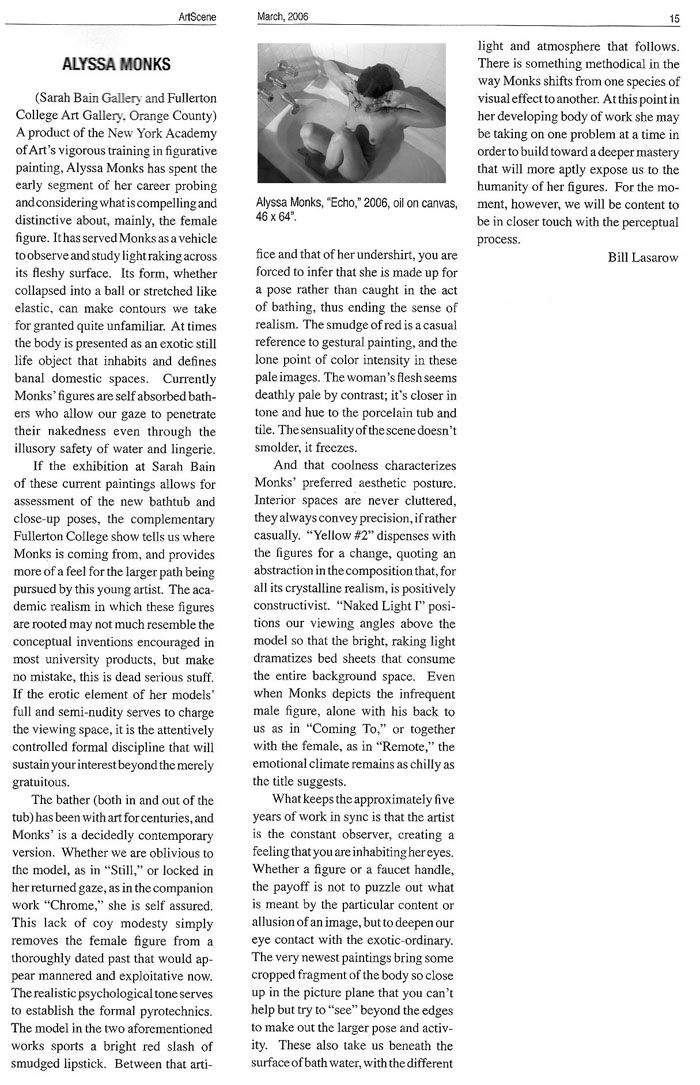
ALYSSA MONKS

"Dissolve"


REVIEW

Sunday, May 28, 2006

New Art from LYONS WIER GALLERY

New Art from Lyons Wier Gallery.

AMANDA BESL


"Meghan"


"Outlet"


ARTIST'S INFORMATION

Placed precariously between desire and detachment, Amanda Besl's paintings are provocative portraits of coquettish young girls. These alluring narratives seemingly capture a private moment of sexual awareness and self-consciousness.

This voyeuristic glimpse into the burgeoning sexual currency of female adolescence allows the viewer a participatory perspective yet somehow leaves one feeling anxious. Based on images taken from teen fashion magazines or posed snap-shots of the artist's friends, this work embraces a youthful awareness of seduction inviting the viewer into an arena of longing and drama.

Ms. Besl approaches her tiny oil paintings like a teenage crush- they are immediately wanting yet somehow awkward. Standing in front of these obsessively painted jewel-like vignettes of flirtations, one cannot help but feel an immediate connection with the sensuality of the subject, but the psychological seduction is open ended and leaves much room for discussion about the perceived power of youth. These young vixens are powerfully aware of our gaze and some models make eye contact with us while others merely allow us a fleeting view into their private world.

Amanda Besl received her MFA from the Cranbrook Academy of Art in 2001. She currently lives and paints in New York.


CHERYL KELLEY


"Speed Racer"


Artist's Information

In Kelley's particular approach to creating art from this subject,there is an element of Pop Art influence that cannot be denied. Mel Ramos, Peter Phillips and James Rosenquist are several that are alluded to, but her intent and approach to the subject sets this work apart from the traditional Pop genre. As the Pop artist was concerned with bringing mundane objects into sharp focus, making us see these familiar objects and subjects extracted from everyday life as high art; she intends to utilize this icon of 20th century speed and power, and preserve that unique moment in time through painting the feeling of motion and energy that light reflected off the curves of the cars body surfaces produces. The use of oil on canvas allows her to bring out the sensuous contour of the auto body, rather than trying to duplicate it’s actual surface texture and appearance.


Instead of a photo realistic approach, which would have a colder, more detached feeling as in the work of Ralph Goings or Richard Estes, Kelley has kept the brush strokes in a somewhat more flowing manner to elicit a feeling of motion and speed. The powerful colors of the paintings triggers an emotional response similar to that of being behind the wheel of one of these awesome vehicles. Kelley states, "The scale of the work alludes to the memory of the sound of the big 8 cylinder engine. These paintings are about first loves... a lifelong love of painting coupled with the collective memory and admiration of the American Muscle Car."


JAMES RIECK


"The Shareholders"


Artist's Information

The primary sources for James Rieck’s imagery are retail advertisements or photographs that have a consumer agenda of selling (ideas, people or things). By extreme cropping and altering the scale of the images, the artist heightens the commercial posturing of the initial subject yet negates its benign commercial aspects by re-contextualizing the composition without the lexicon of the “sale.” This process necessitates a reevaluation both aesthetically and psychologically of how commercialism invades our personal space.

The artist states, “My interest in pop culture and the ‘culture of the sale’, is both personal and social. I sometimes question (as may most of us) whether I am choosing the things I consume or if they are choosing me. I am constantly feeling overwhelmed by the mass and size of the advertisements that attract my eyes. Scale is a very important aspect to my work. It can make even the most benign image seem menacing and overpowering, at the same time feel embracing and comforting. This tension interests me for the anxiety it creates.”Throughout time, painting can be seen as a reflection of culture. Today this is perhaps better seen in magazines, TV, movies, and the Internet. By painting the images from these sources, it slows down the processing of their intended use and allows room for another look.

Mr. Rieck received his MFA from the Maryland Institute College of Art, Mount Royal School of Art in 2003 and BFA from Maryland Institute College of Art in 1987.


JARED JOSLIN


"WHISPER"


L.LOCKWOOD

"EPILOGUE"


Janet Bloch

"Conjure"


"If at First"


TULLMAN COLLECTION TULLMAN COLLECTION TULLMAN COLLECTION

Sunday, May 21, 2006

New Art from LINDA WARREN GALLERY in Chicago

Linda Warren Gallery in Chicago. http://www.lindawarrengallery.com


New Work in the Collection from this Gallery includes pieces by:


ZACH TAYLOR


"MISS MEND"


LORA FOSBERG

http://www.lorafosberg.com


"I Love Chocolate"


ARTIST STATEMENT

In an attempt to utilize metaphor, memory, iconography, and narrative, my work expresses conscious life in its most banal forms. My attempt is to transform objects and events of every day life into symbols of the universal, thus enabling me to participate within a large and complex audience.

My process is that of the historian: experiencing, assembling, and finally, recording into history, vague and seemingly impenetrable information. The intent is to utilize a vocabulary of routine images or vignettes that suggest the familiar while maintaining ambiguity.

The subjects of my work are the subtle intricacies and intimacies of life. The memories of a universal yet personal childhood, the interrelationships of emotions, and the perceptions of the mundane aspects of everyday life. The specific and the generalized, the personal and the universal, all hold equal importance in my work.

The work is attempting to bring the viewer into a place where I am able to disarm them with imagery allowing them to regress back to a particular memory; a specific moment forever embedded in the brain......whether it be truth or a complete fabrication of the subconscious, the memory has created it nonetheless.

The artwork is not to be a part nor copy of the real world, but a world in itself: independent, complete, autonomous; to understand it fully the viewer must enter that reality or world and conform to its laws.

Connection to the individual is what I seek, and what the individual viewer seeks from me. Connection to the past, to one another, to the physical world, to the spiritual. To remind the viewer of feelings, thoughts one didn't even know they had forgotten, thus enlarging emotional possibility.

Lora Fosberg 2005


New Piece from LORA FOSBERG:

“The Last True Story I’ll Ever Tell”


Yes to Everything! in which she continues her exploration of the contemporary human condition and further develops her language as a visual artist/social commentator/shrink. (Not literally… though Fosberg sometimes does draw on actual doctor’s prescription notepads to seemingly offer up remedies, though definitely no cure, to the sickness and dysfunction of our lives). Using the recognizable language of the comic world as the basis of her well-crafted work, Fosberg cleverly and unpretentiously matches form with content and gives a fresh look at familiar ground – the “stuff” of our every day lives; the trials and tribulations; the foibles and frailties of our being; the interrelationships of diverging and contradictory emotions; the universal. She reassembles her drawings and text into collages mounted on panels, or a series mounted together as an installation (that could be hung innumerable ways) that allows her work to be read like a visual journal, one in which all the pages become visible at once but are undetermined by the traditional narrarative set by the linear passage of time. Small vignettes are enough to elicit a stream of consciousness of unpredictable associations. And hence, the designation of shrink – she won’t give you the answers - she raises the issues and obliges us to figure it out for ourselves.


In the piece entitled “The Last True Story I’ll Ever Tell” (though hopefully there may still be a sequel in store) Fosberg takes off from where she left off after her recent exhibition at the Museum of Contemporary Art in Chicago’s 12 x 12 space in January 2006 where a large piece (4’ x 12”) entitled “The First True Story I’ve Ever Told” was on display. As before, the piece is comprised of phrases Fosberg has jotted down over the years in her journals, whether of simple (though profound and often very witty) observations she has made of life, conversations she has had or overheard, lyrics of songs that ring true to her, are all rewritten, collaged and rearranged randomly to create an extremely engaging composition (that nonetheless connects to the familiar and universal of the viewer).

The notion of exposure and exposing oneself runs rampart throughout Fosberg’s work. Beyond the occasional nudity, both spiritually and psychologically, layers of ideas and emotions are laid bare. To further this point, Fosberg continues to utilize a newer technique in which she pours paint over raw silk on stretchers. The silk’s translucence suggest skin to the visible skeleton of the stretcher bars and a peeling back of the onion making the “self” more revealed. The information in much of these works is pared down to a minimal, as in “The Silent Mushrooms Call Us Into the Forest” were the open space, removed from human drama, suggest the best cure of all – refuge from the deluge of all the “stuff” of our lives.

Lora Fosberg, who resides in Chicago, received her MFA from the School of the Art Institute in 1992. She has exhibited in galleries throughout the country and her work is in many private and corporate collections.


PETER DRAKE

http://www.peterdrakeartist.com


"Out of Place"


Artist's Statement:

"I believe that all pictures have various levels of meaning; there is the original intention and then everything beyond that intention. The most magical aspect of pictures is the degree to which they exceed their original intentions.

Lately I've been going through a large collection of images from the 50's, 60's, and 70's looking for pictures whose meanings have shifted with time. I am drawn to the ones where what might have been a "hidden subtext" has emerged over the years as the primary text. I find myself thinking, " this shouldn't be happening here." It's the sense that as time progressed, so did the image and that its' true meaning has only now become clear. To heighten their new meaning, I then take those images and combine them with others from the same era. As a procedure this has obvious surrealist precedents but unlike the surrealists who chose complimentary or oppositional motifs to make you aware of their disruptions, I choose from analogous or like-minded motifs so that the rents in the fabric are barely noticeable.

An image of a father and a daughter playing "horsey" can seem completely innocent to one generation and laced with malignant overtones to another. The giddy laughter of little girls from one era can seem maniacal to the next. What was a simple act of spraying pesticides on a front lawn can seem insanely threatening to a more organic world. My thinking is that if my interventions are too obvious it will be too easily categorized and the painting will loose its ability to disrupt. Ultimately I feel the strangest and strongest paintings are the ones where you know something is wrong but you just aren't sure what it is."

Artist's Website: http://peterdrakeartist.com


JENNIFER PRESANT


"Projection Memory Desire"


Artist's Statement:


Jennifer Presant draws us into dreamlike interiors which are highly evocative, richly painted and dramatically illuminated. The scale, staging of the figures and multiple layers of reality simulate the cinematic experience. Each interior space becomes a physical manifestation of the character’s psyche. Conscious and unconscious desire, memory and projection unfold pictorially. Through the merging of both real and fictitious elements, the artist also investigates the conflation between our media filled lives, and our lived reality. By depicting the subject through the female perspective, Presant represents the female nude as a figure of empowerment, not the object of the male gaze.

The artist mimics the process of reconstructing memory in the development of the composition for the painting. Objects and figures, part real, part imaginary are combined to feel fragmented and pieced together. Once a composition is finalized, at times, using digital technology, Presant meticulously paints the image in oil, adding a new level of coherence and reinterpretation achieved through the hand-made process. The treatment of light unifies the painted surface and plays an important role in the psychological content of the artist’s work. Light and shadow both reveal and conceal. The human form of both subject and viewer defines how each perceives and experiences reality.

Saturday, May 20, 2006

New Art from PLUS GALLERY in Denver

New Art from PLUS GALLERY in Denver

http://www.plusgallery.com/

JENNY MORGAN


"Fixated Flux"


ARTIST'S INFORMATION:

March 8, 2006
FOR IMMEDIATE RELEASE

Jenny Morgan has been selected for inclusion in the Outwin Boochever 2006 Portraiture Competition sponsored by Washington D.C’s Smithsonian Institution. Morgan's portrait "Falling Into," which was first presented to the public in November of 2005 as part of the artist's exhibition "Mine Not Yours," is an oil painting that was selected from a semifinalist pool of 100 artists culled from an entry base of over four thousand artists from across the United States in 2005. The Exhibition associated with the competition will be on view at Washington D.C.'s National Portrait Gallery from July 1, 2006 until February 18, 2007, and will be the lead exhibition for the grand opening of the Gallery.

The jury for the competition included Carolyn K. Carr, Deputy Director and Chief Curator, National Portrait Gallery; Trevor Fairbrother, Independent Scholar and Curator, Boston, Mass; Brandon Fortune, Associate Curator of Painting & Sculpture, National Portrait Gallery; Thelma Goodman; Deputy Director, Exhibitions and Programs, The Studio Museum in Harlem, New York, NY; Sidney Goodman, Artist, Philadelphia, Pa; Marc Pachter, Director, National Portrait Gallery and Katy Siegel, Associate Professor, Hunter College, CUNY, and Contributing Editor, Artforum

About the artist Jenny Morgan

Jenny Morgan emerged onto the Denver art scene in a manner that is both rare and respected. A 2003 graduate and Valedictorian of Denver's prestigious Rocky Mountain College of Art and Design, Morgan utilizes oil paints to create dramatic realist portraits that resonate with deep emotional impact. Minimal in style, her works are uniquely cropped to reveal parts of the body, sometimes in motion, other times static. The figures are commonly intertwined with a fabric element that creates a powerful, emotional symbol with strong historic traditions but framed with a signature style. The 24 year old artist often works in diptychs and triptychs that create a unique visual flow while also promoting a sense of separation of the body.

"Through the self-portrait, I use the body as a vehicle for self-examination, but also a way to connect the human experience of one person to a wide audience. I hope to communicate my world in a way that the viewer can react and relate." - J. Morgan

Morgan's talent as a painter was quickly recognized by + gallery owner Ivar Zeile as well as local art-legend Phil Bender, director of renowned local artist run gallery Pirate. Morgan's first exhibitions at Pirate served as a proving ground for her skills and innate ability to put together fluid and consistent bodies of work, immediately delivering a signature style through her figurative works that drew both praise and local collector interest. Following her ground-breaking exhibition "Soliloquies" at Pirate in 2004, Zeile determined that Morgan was more than ready to move into the commercial realm and become one of the galleries youngest represented artists.

In May of 2005, Morgan debuted a new body of work "First Person" at + gallery alongside two of the cities most recognized local artists, Peter Illig and John McEnroe. Success was not immediate within the new environment, but Morgan concluded the year with tremendous success. Her artwork was selected for inclusion into the prestigious national juried publication "New American Paintings," along with three other artists from the + gallery stable. The publication brought immediate attention to the young artist from a larger market, securing her first sales outside of Colorado, including a significant purchase of three canvases by the Museum of Fine Arts Key West in Florida. Morgan and the gallery were notified of her acceptance as a semifinalist in the Outwin Boochever 2006 Portraiture Competition in October of 2005, ultimately leading to her selection as a finalist this year. Morgan is currently producing a new series of paintings that will serve as her first solo-exhibition at + gallery, scheduled for September 2006.


WES MAGYAR


"Study of Lucas"

Total Pageviews

GOOGLE ANALYTICS

Blog Archive