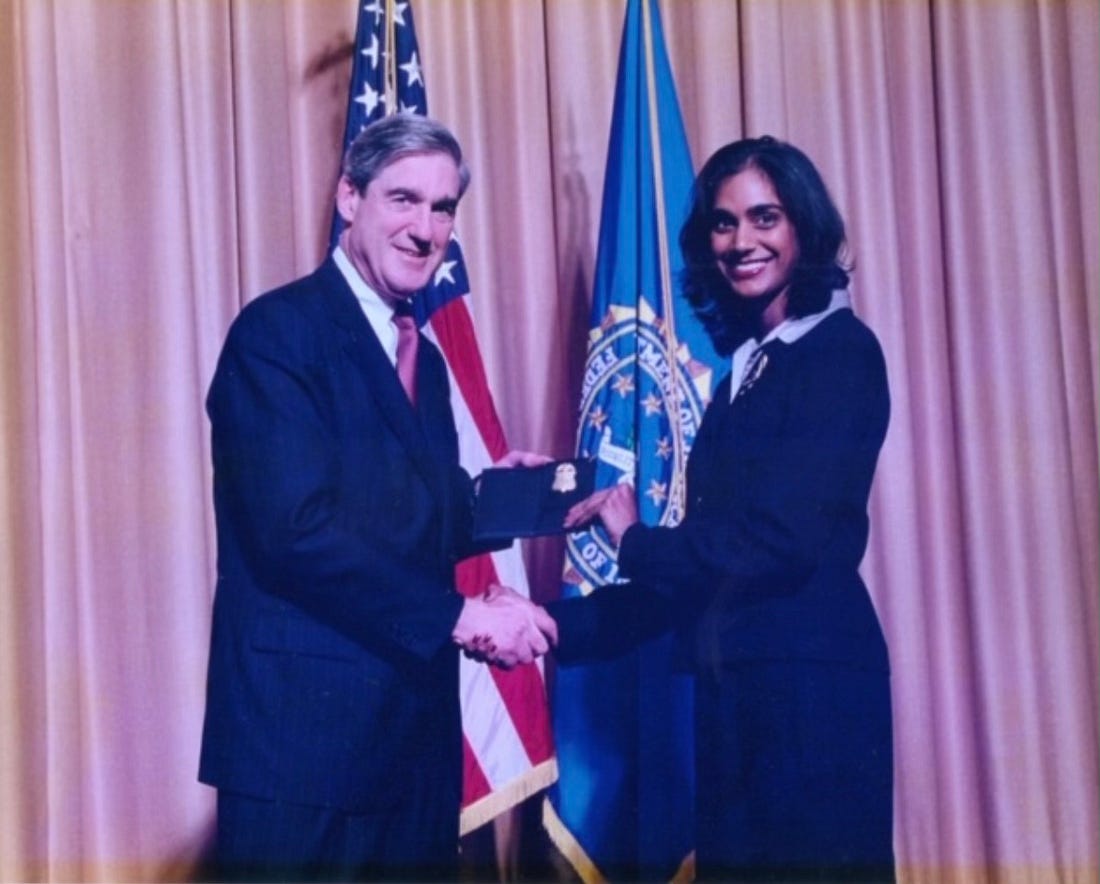
There’s a lovely chorus of great tributes to Robert S. Mueller III since his passing on Friday — this profile by journalist Garret Grad and this obituary by Tim Weiner are especially worth a read — but I wanted to add a few of my own memories and reflections to them. I didn’t know Director Mueller personally, though as you can see from the photo above he awarded me my FBI credentials when I graduated from Quantico in April of 2003. His speech wasn’t flowery or inspirational, but matter of fact: We were expected to serve the Bureau in whatever way it needed, and to follow our duty to uphold the Constitution as we did. “If you don’t like what’s being asked of you,” Mueller told us as we sat in the auditorium with our friends and family sitting behind, “there are 60,000 other people who are ready to take your place.” He was clearly not one to mince words, as others who worked closely with him have observed, as well. You can’t blame him for being direct. Mueller took over as Director of the FBI literally one week before the planes crashed into the Twin Towers on September 11, 2001. There was a lot of institutional finger-pointing in the months and years that followed over who was to blame for the intelligence failures leading to that day, and the 9/11 Commission ultimately determined that a significant part of it belonged with the Bureau. In particular, it found that the FBI’s focus on law enforcement over intelligence gathering left it ill-equipped to “connect the dots” in the way the new threat landscape of the 21st century required. Even before the Commission released its final report, there was a lot of discussion of separating the Bureau’s law enforcement and intelligence functions — basically, to break the FBI into two agencies, more in the model of the U.K., where Scotland Yard conducts criminal investigations and MI5 does domestic counterintelligence. Mueller was responsible for keeping the FBI intact. He did that in a number of ways. One of them was to modernize the FBI’s infrastructure and bring it into the digital age. I was assigned to the counterintelligence division of the New York office coming out of Quantico — itself a reorientation of priorities: my class was one of the first to have a terrorism scenario as the ongoing “case” in our training, and most people from my class ended up in counterterrorism and counterintelligence, not criminal, squads. I remember that when I got to my desk on my first day in New York, I literally did not have a computer at my desk! (Not a joke: I used to laugh when people asked me whether we had retinal scans to enter buildings and other James Bond-like technology.) But that changed very quickly: not only did Mueller get the Bureau up to speed with technological basics, but he also transitioned the Bureau to a digital case file system as well as to an integrated database that allowed more efficient sharing of data across the different agencies. The FBI’s Cyber Division was created under Mueller in 2002, and later in 2004, he stood up the Intelligence Branch, modeling the CIA’s structure by creating an entire division that analyzed the information collected by agents across the other divisions — so that it could “connect the dots.” I wrote a few months ago about how William Webster was an inflection point in the Bureau’s history following the death of J. Edgar Hoover. Mueller played a similar role as it moved into the 21st century — he transformed the Bureau from being the premier law enforcement agency in the world to also being a forward-looking intelligence gathering agency that was fully integrated into the rest of the intelligence community. One thing I didn’t appreciate at the time was that the changes Mueller instituted were not necessarily embraced by everyone, especially some senior agents who had built their careers as criminal agents and who, I think, felt that this focus and expertise was being devalued. It makes sense, since, at the time, the criminal and intelligence sides of the Bureau were very separate, as a result of the so-called “Wall” the was supposedly needed as a buffer between the two sides (and which was a major factor in the lack of intelligence sharing) — these two sides of the Bureau didn’t interact much, and I know that at least on the counterintelligence side, where I was, there was a sense that criminal agents really had no clue what we did. (I think that has changed significantly over the last twenty-five years, but in my opinion this earlier resentment may have been part of what was underlying some of the reported grumblings among some retired agents in the early days of the Mueller investigation into Russian election interference.) Because of how solid and respected he was as a director, I remember feeling so confident when Mueller was appointed as Special Counsel that he would get things back on track for the country as he did with the Bureau. Here were my comments on CNN in June 2017, soon after he was appointed: 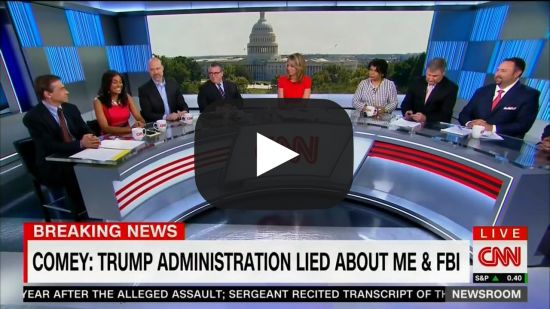 I miss that feeling that I had then — the belief in that our institutions would hold, largely because the people entrusted to run them believed in higher principles and their duty to the Constitution. That was the ethos of the FBI when I was there. I’m proud that I got to be a part of the agency under his stewardship — and I use that word, rather than “leadership,” because Mueller was one of the last few leaders in our government who really saw themselves as being a guardian for the institution’s future and its role in the country’s well being. Hopefully, one day the FBI will be lucky to be led by someone like him again. |