

[Reader advisory: This essay contains descriptions of rape, sexual abuse, and strong language, which may be triggering to some.]
Unsteady hands with their trembling fingertips take to the keyboard to write out the following essay. Where does this innocent, yet seemingly “torrid” story begin? The story isn’t really about her, although she feels central to her own narrative, to its grim, violent, sexual past, the raging attacks and transgressions that men committed against her body and mind. But she has learned with age and time that she is one of a multitude, some dead and some still living, of aged, forgotten Lolitas. She herself assumed that name in her youthful mind because of unsavory circumstances that arrived too soon, circumstances she neither wanted nor asked for. She didn’t understand at that time, but none of them was a central character, far from it, despite the book they devoured when they, too, saw themselves as the “nymphet” in their own solitary worlds, trapped, like a young butterfly in a net, by a predator they believed loved and cherished them, yet which came with all the oozing ick.
Atomized and isolated, she, like other girls, fashioned herself as special before his eyes, his eyes especially, long before her intellect and adult emotions fully developed, and failed to realize she was entrapped. She wiggled uncomfortably in a small, developing body, hoping to catch his adult male eyes’ attention, and that’s what she did—she alone caught his gaze, thinking she was the Lolita. But like the other girls, once she grew older and told her story to others, ones who cared to listen without judgment, she quickly learned he was nothing more than an old, lascivious creep. However, that awareness still didn’t stop the other male attacks and the blame and shame that came with it.
Others also listened, but with stern reproach and harsh tongues, denouncing her actions, even though she had been a mere girl. Shame covered her body, like a hairshirt, but there was nowhere for her to pay her penance, despite the support around her. Cataclysmic disruption characterized her young life; she had to change institutions, make new friends, cultivate new hobbies, all social circles became unfamiliar to her. And while she knew he was a pedophilic creep, she still, somehow, missed him. The manipulation, his insertion into her life that had yet even to form or mature, had a hold on her even in his absence. Her teenage life was crippled by him.
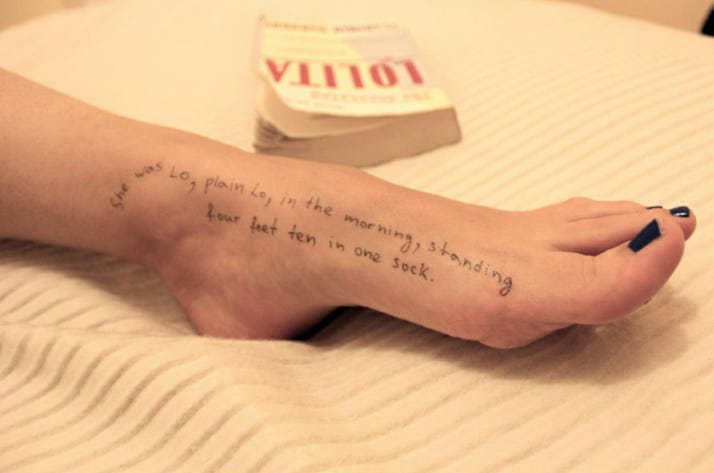
The longing, the confusion, the shame all had to do with that book and with identifying herself with Humbert’s Lolita over innocent Dolores, the girl we never learn to know, as both Humbert and Nabokov obscure her, burying her with a projection of a girl-cum-slut who didn’t exist, except in their pedophilic eyes and depraved imaginations. Yet how else are young girls to identify with the novel, especially when wrapped up in “affairs” of a similar nature, but with the girl-cum-slut? reed alyy also writes about this painfully in her piece, “Everybody Aboard the Lolita Express.”
She explains:
This runs parallel to my own experience with Lolita. Though I never identified with Jeremy Iron’s Humbert, I first stumbled across the movie as a 14-year-old girl. The age Dolores was depicted as in the 1997 film. At the time, surrounded by adult men’s attention, and experiencing normalization of pedophilia on multiple fronts, I had an internal battle. Aware of just how wrong it was, I found myself identifying as Dolores in both the film and text. No, I found myself identifying as Lolita. Imagining myself to be a nymphet, imagining myself “magnetic” to these adult men, and, just as the patriarchy desires, misapplying blame.
Here, Alyy discusses taking on the blame herself as the purported seductress, which she also did with her own predator. Yet both failed to understand the process of grooming they were undergoing. The blame remains misapplied to this day, as we continue to reckon with patriarchy and capitalism raging on, even if they are perhaps letting out death rattles; the ferocity remains, fiercer than ever, lashing out in every direction possible. After all, look at who was put in the Oval Office, a man who was called Epstein’s “best friend,” a man also at the center of that pedophilic story.
Eventually, the name of the novel, Lolita, would turn into child rapist, billionaire, black bookkeeper Jeffrey Epstein’s infamous “Lolita” Express, a symbol of both exploitative capitalism and crushing patriarchy, all wrapped into one. And everyone who stepped foot on that plane stooped to his level—every single one of them. Alyy offers incisive analysis on what it meant for these people to ride on the Lolita express, and it’s well worth reading in its entirety.
What soon followed after the “Lolita” Express was grounded, after Epstein’s arrest and prison time, along with his death, was an eventual avalanche of evidence—the Epstein files—revealing what the survivors’ voices had already told us all, hundreds, if not thousands, of so-called Lolitas subjected to the hands and sexual violence of Epstein, Ghislaine Maxwell, and a slew of influential people scattered across the globe. But do we need the files to tell us the stories we already know? Have we once again failed to listen to their voices? Why do we need to gaze at sex toys torture devices to prove the violence he committed against girls?
 |
Long before the Epstein files were released, she would have her own reckoning with her past, a maturing mind clashing with and absorbing the works of Wollstencraft, de Beauvoir, MacKinnon, Dworkin, Lorde, Federici, and more. She now knew that the survivors of Epstein’s crimes were all Dolores’s, lost in a sea of pedophilic criminality, disposable, like tissue paper, as soon as Maxwell procured the next victim to absorb, abuse, and abandon. Some were used, before being abandoned, pumped full of medication to blot out their pain, nothing but rapeable objects for the taking. Evidence of this was revealed when the House Oversight Committee Democrats released an image of a pill bottle labeled as Phenazopyridine. This medication is used to relieve pain associated with urinary tract infections, another indicator of how the girls were treated with utter dehumanizing disdain. Even when sick, Epstein and others still raped them. Imagine enduring that.
 |
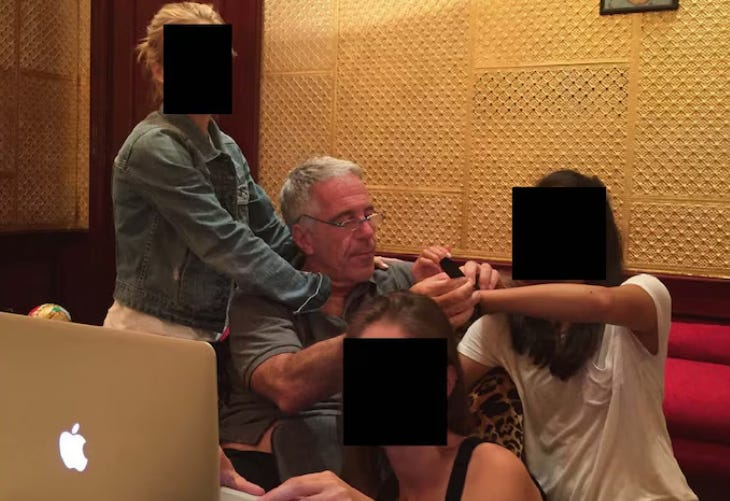
The girls, perhaps some who are sick and pumped full of Phenazopyridine, surround Epstein in many of the pictures that have been released—timidly, fearfully tending to their abuser, unable to escape his predatory grip, stuck in a miasma of relational pain with him. Hidden in his sexual dungeon of torture, disguised by its golden opulence, either on his private island or tucked away in his massive Manhattan mansion, the pedophilic capitalist is at the top of his game, subjugating those from one of the most vulnerable populations in the system: girls.
These are not lurid images. These are crime scenes of the crimes unfolding, filled with the victims themselves: the girls. We must always go back to them, especially now that they are survivors of this gigantic bastard, who, it turns out, was also a slimy, little, pedophilic man, which makes it “easy” for those who stepped on the “Lolita” Express to say, “But he seemed so nice.” Excuses, excuses, excuses either come out of their mouths or they turn defensive, as people have done in the case of renowned linguist and activist Noam Chomsky. (“How could he have known about Epstein’s crimes?” That’s one of the better ones, considering that Chomsky was a voracious reader of newspapers worldwide when he was still healthy, not to mention that he said that Epstein had a “clean slate” after serving time for raping girls. In sum, it’s clear that Chomsky didn’t give one fig about the victims.)
 |
Scanning the Epstein pictures again with him surrounded by his victims, she recalls her predator now, but this time, grown up, she’s no longer wearing her hairshirt, and she seeks no penance. He did not have as much power as Epstein did, but that did not mean that when, as people say, “the shit hit the fan,” he was not protected by institutional powers. Once that happened, even though she was still a girl, she learned how power operates within the system we have. It’s simple, really—it protects the one with the most power in the “inappropriate relationship.” She was suddenly the harlot, the seducer, the one to blame. Now she laughs out loud, thinking about how grown-ass adults framed the narrative in this way, but she also knows the millions of innocent victims, like her, who have been hurt by the way they were cast. She now feels a pang of sadness along with anger, recalling how the Epstein victims spoke up on November 18, 2025. Do people understand the level of bravery it took for those survivors to do that, the fear that they had to overcome to speak publicly about sexual violence? Congresswoman Marjorie Taylor Greene stood with them, too.
When Greene returned to her office later that day, she told the New York Times that Donald Trump called her up, angrily yelling at her on speaker phone, so there were witnesses to the words that spilled out of his tainted, orange, shriveled little mouth.
She couldn’t understand his stubbornness. He finally replied, “My friends could get hurt.”
Greene also suggested inviting the victims to the White House. He refused the idea, Greene told the Times, as “they had done nothing to merit the honor.” Greene and Trump have not spoken since that call. Survivors, according to Trump, do not merit the honor of going to the Oval Office. Consider that for a moment—or do we? It seems immediately striking to all of us. We all know that Trump was deeply entangled with Epstein; his own name drenches the files, so, naturally, he would not invite Epstein survivors to the White House. As aptly titled in a recent article that Julie k Brown wrote, “Donald Trump’s Epstein Files,” these files belong to him, too.
But it’s too late for Trump’s threats and demands that the details not be revealed. The survivors are fighting back, as they did on November 18, collectively holding onto one another. They do not need to go to the Oval Office that is currently occupied by a man accused 27 times of sexual crimes of varying degrees, who himself said that when a man is famous, like he is, one doesn’t have to ask, “You just grab ’em by the pussy.” We have also seen the video of him with his best bud, Epstein, ogling girls. We know the misogynistic jokes that they shared. And with Trump’s steep cognitive decline, his hatred and disdain towards women in general are on full display, along with a creepy and inappropriate relationship with his own daughter (Trump once said in 2006 on The View, with Ivanka sitting right next to him, that if she weren’t his daughter that “perhaps I’d be dating her,” and spoke openly about her voluptunouness on The Howard Stern Show that same year.) Recently, when Trump was giving a “speech,” he was stunned to see an apparent Ivanka look-alike, stopping in mid-sentence to compliment her.
This system, in which capitalism and patriarchy go hand-in-hand, needs to be smashed to pieces and burned to the ground simultaneously. Trump, Epstein, and other predators are all symptoms of a rotten economic system where girls, among other vulnerable groups, are central to abuse. When they are girls, they don’t understand these facts, as they are being groomed, mistreated, gravely hurt. If they become survivors, many realize these truths and go on to resist and fight back, as we are now seeing. That space for them must continue to grow. Before Tarana Burke’s #MeToo movement, these abuses, even when they happened to women, were only talked about in hushed tones, mere whispers. Not anymore. The #MeToo movement was its own avalanche of evidence against the powerful capitalistic patriarchy; the kaleidoscopic pain written across the various mediums of the internet dispelled myths that sexual abuse was limited (it’s all too common) and annihilated the notion that women, girls, and the abused are to blame. In step with these newfound voices, louder than ever, the march towards liberation must continue in full force. There will come a day when all forms of sexual violence will be fully criminalized, where the notion that a man dating grooming someone 30+ years younger than himself will be considered so taboo that it will no longer occur, that the Epsteins and the Trumps will no longer have power. She longs for that day, as she wraps up this essay, her hands no longer unsteady, her fingers no longer trembling. She can see that day coming, and she wants you to see it coming, too.
